

How to grow sweet potatoes: a commercial guide
Sweet potatoes are planted as rooted cuttings (slips), not seed, into warm soil, dug before frost, then cured for days at high temperature and humidity before storage. The numbers below describe North Carolina commercial practice, the largest US production state.
Scope: Commercial field production, US Southeast. Updated 2026-10-16.
At a glance
- Spacing
- 107–112 cm (42–44 in) rows, 23–30 cm (9–12 in) apart; about 30,890–37,070 plants per ha (12,500–15,000 plants/acre)1
- Time to harvest
- Covington about 80–115+ days; Beauregard about 90–100 days1
- Weed-free period
- At least 6 weeks after transplanting1
- Storage
- 13°C (55°F), 85–90% humidity3
- NC average yield, 2025
- 23 t/ha (205 cwt/acre) on 37,600 ha planted (93,000 planted acres)2
Choose the field
Sweet potatoes want warm, loose, well-drained soil. Wet or compacted ground and fields with a nematode or wireworm history cost marketable roots.
Pick a variety by maturity and market
| Variety | Days to harvest | Notes |
|---|---|---|
| Covington | 80–115+ | Mid-season; stores up to about 12 months |
| Beauregard | about 90–100 | Early |
| Averre | about 90–100 | Early |
Sources1
Plant slips and set the stand
Between rows: 107–112 cm (42–44 in) · Within the row: 23–30 cm (9–12 in)
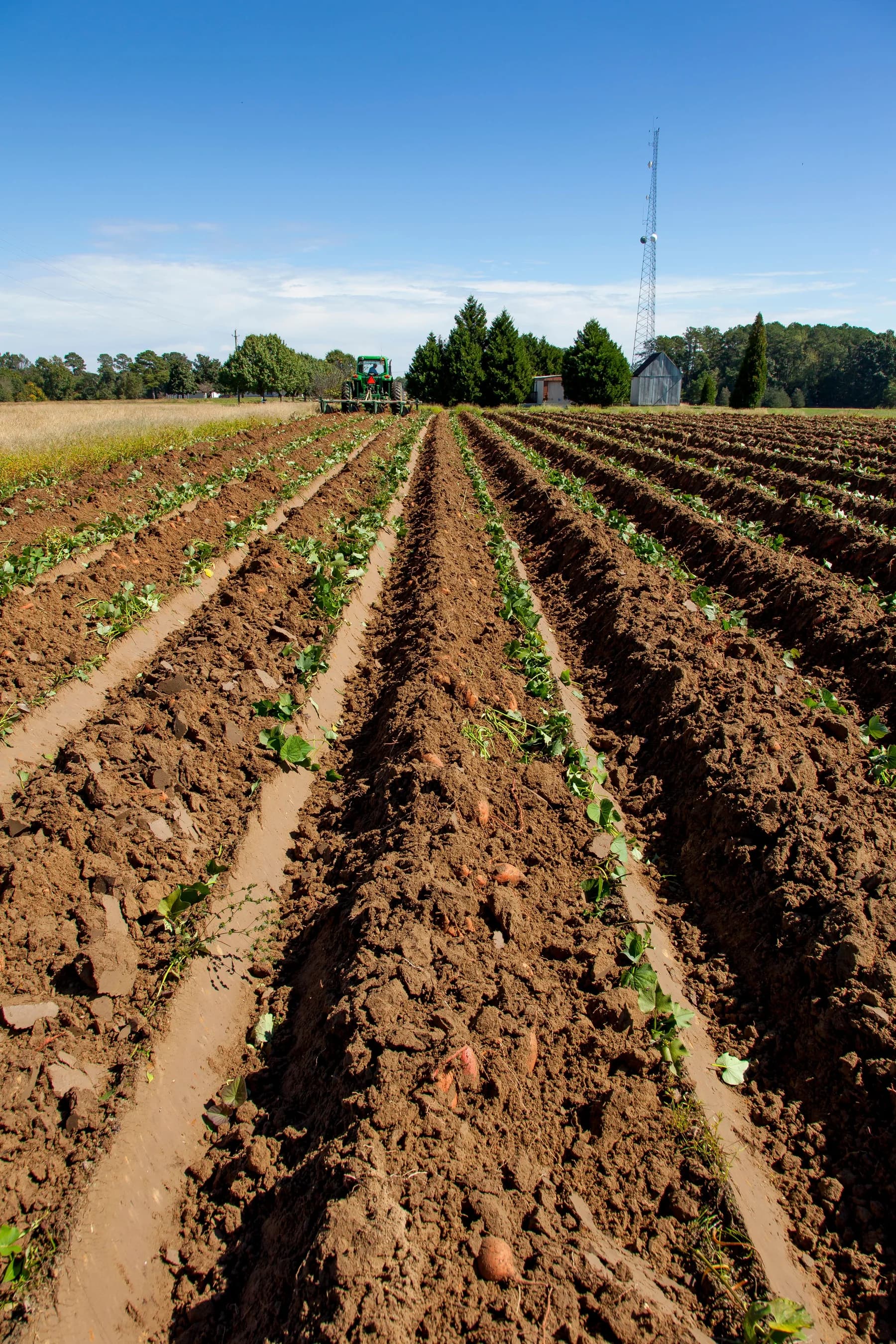
Rows 91–122 cm (36–48 in) apart (42–44 in most common) and plants 20–36 cm (8–14 in) apart, about 30,890–37,070 plants per ha (12,500–15,000 plants per acre). Schematic, not to scale.
- Slip at transplanting: 7.5–10 cm (3–4 in)
Leaves and growing tip stay above ground. Water immediately after setting.
- Dates
- Most North Carolina commercial sweet potato is planted in late May, with planting targeted to finish by the end of June; some growers plant in early July. Earlier planting gives little advantage if cold weather continues into mid-May.1
- Spacing and population
- Rows are 91–122 cm (36–48 inches) apart, most often 42 or 44. Plants go 20–36 cm (8–14 inches) apart in the row. At 107 cm (42-inch) rows that is about 30,890 plants per ha (12,500 plants per acre) at 30 cm (12 inches) and 15,000 at 25 cm (10 inches).1
- Depth
- Bury at least three nodes (about 7.5–10 cm (3–4 inches)); leaves and growing tip stay above ground. Water immediately after setting.5
Feed from a soil test, not a blanket rate
- NC State baseline
- For Covington, about 90 kg N/ha (80 lb N per acre) split in two applications, about 56 kg/ha (50 lb/acre) P and 170–225 kg of potash/ha (150–200 lb of potash per acre). Treat this as a starting point and adjust to the soil test and variety.1
- Watch nitrogen
- Too much N favours vine growth over storage-root sizing.7
Manage weeds, water and pests through canopy closure
- Weeds
- Keep the field weed-free for at least six weeks after transplanting, to about canopy closure. Palmer amaranth and yellow nutsedge are the main weeds named in NC State guidance.1
Harvest, cure and store
- 1
Plant slips
Soil at least 18°C (65°F) at 10 cm (4 in). NC main window: late May to end of June.
- 2
Grow
Keep weed-free for at least 6 weeks. Covington 80–115+ days; early types about 90–100.
- 3
Dig
Late August to October, before frost. Handle gently: skin cuts rot.
- 4
Cure
29°C (85°F) and 85–90% humidity for 3–5 days with airflow.
- 5
Store
About 13°C (55°F) and 85–90% humidity. Covington up to about 12 months.
- When to dig
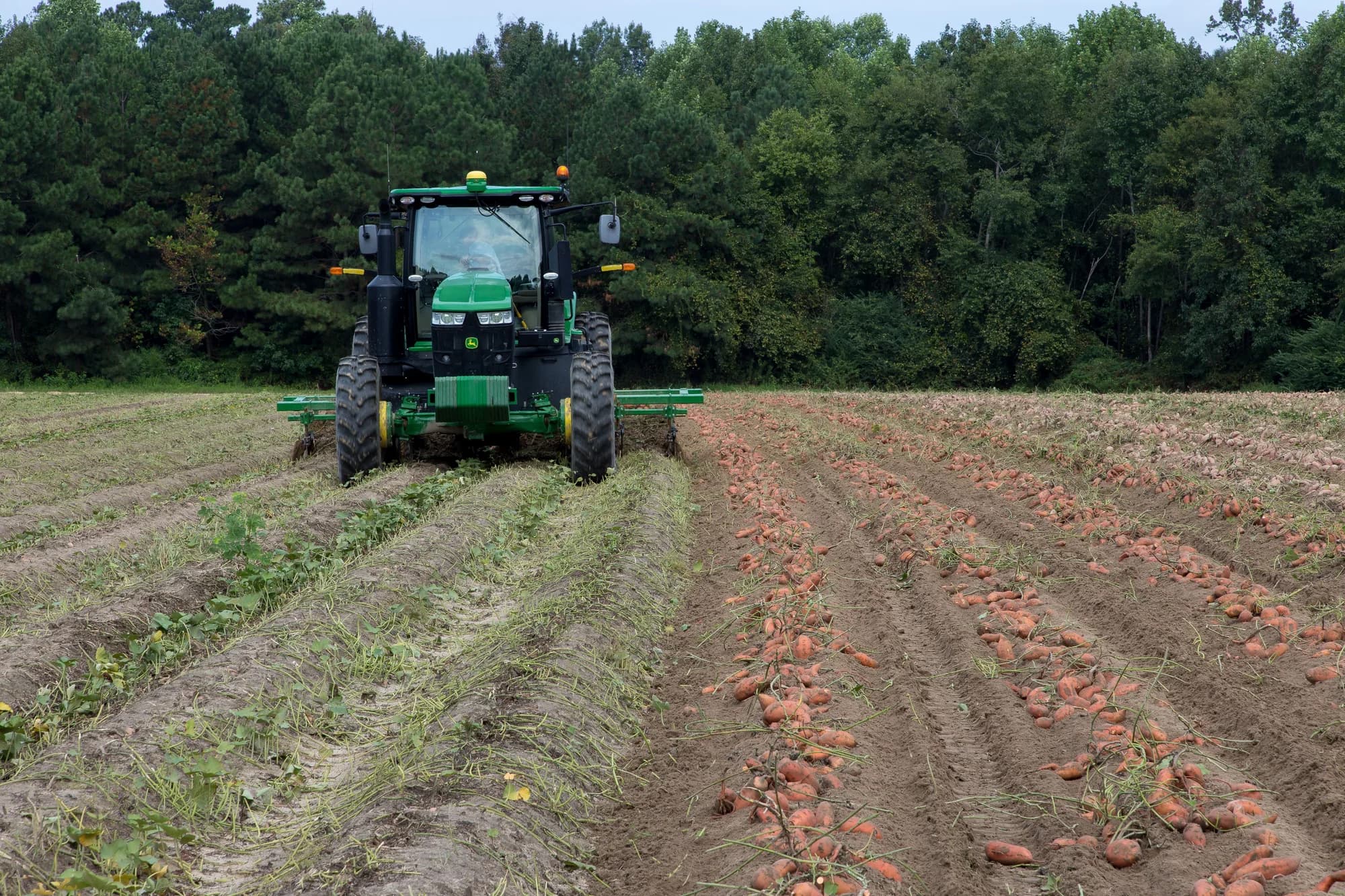
- North Carolina harvest starts as early as late August and runs through October. Dig before frost and handle roots gently; skin is thin and cuts rot in storage.1
Yield and what drives the margin
North Carolina reported an average 23 t/ha (205 cwt/acre) in 2025 across 37,200 ha harvested (92,000 harvested acres). That is a statewide average, not a target: marketable yield depends on grade, which depends on stand, weed control and handling.
- Do the arithmetic before planting
- Margin per hectare = marketable tonnes × price − (slips + land prep + labour + harvest + curing + storage + packing). Labour and cure/storage capacity are usually the constraint. Use the crop ROI estimator with your own costs.2
Frequently asked questions
- When should I plant sweet potatoes?
- After frost risk has passed and soil is at least 18°C (65°F) at 10 cm (4 inches). In North Carolina that is mainly late May through June.
- How far apart do sweet potatoes go?
- For the North Carolina commercial example, rows are 107–112 cm (42–44 inches) apart and plants 23–30 cm (9–12 inches) apart, about 30,890–37,070 plants per ha (12,500–15,000 plants per acre).
- How long do sweet potatoes take to grow?
- In NC State guidance, Covington takes about 80–115+ days and early varieties such as Beauregard about 90–100 days. Plant after soil reaches 18°C (65°F) and dig before frost.
- Do sweet potatoes need curing?
- Yes. Cure 3–5 days at 29°C (85°F) and 85–90% humidity before storing at about 13°C (55°F).
- Can I grow sweet potatoes outside the South?
- Yes where the season is long and warm enough. See the regional guides below for documented examples from the US Midwest and Europe.
Regional guides and field planning
Sources and image credits
- 1. NC State Extension — NC Organic Commodities Production Guide, ch. 8: Sweetpotatoes — Accessed 30 September 2026. NC planting dates, spacing, population, varieties, fertility baseline, weed-control period, harvest window and curing. Chapter is written for organic systems; conventional baselines are as stated there.
- 2. USDA NASS — Vegetables 2025 Summary — Published February 2026. North Carolina planted and harvested acres and average yield; statewide figures, not an individual-farm forecast.
- 3. NC State Extension — Postharvest Handling of Sweetpotatoes — Commercial technical publication. Curing and storage temperature and humidity.
- 4. Washington State University Extension — Sweetpotato Production Practices — Published January 2026. Crop-level transplant practice and the 25–30°C (77–86°F) root-development soil-temperature range.
- 5. University of Missouri Extension — On-farm Sweet Potato Slip Production — Published 2021. Soil at least 18°C (65°F) at 10 cm (4 inches) and immediate irrigation after planting.
- 6. NC State Extension — Sweetpotato Root-knot Nematode — Extension fact sheet. Field history, soil sampling, clean planting material and equipment sanitation.
- 7. NC State Extension — 2025 North Carolina Agricultural Chemicals Manual — 2025 edition. Soil-test-based pH and fertility recommendations.
Image credits
- Mechanical sweet potato harvest in North Carolina. Photo: Mark Stebnicki (NC Farm Bureau), via Pexels (Pexels License).
- Raised, crowned rows prepared for planting. Photo: Mark Stebnicki (NC Farm Bureau), via Pexels (Pexels License).
Figures are published averages or study assumptions for the places named, not guarantees for your field. Check current local recommendations and product labels before acting.