

Early planting
Late April · limitedA limited early window is described for greenhouse-grown slips. NC State notes that planting early gives little advantage if cold weather continues into mid-May.
Commercial field guide · North Carolina
Yes. North Carolina is a major commercial sweet potato state, with production concentrated in the Coastal Plain. Most commercial fields are transplanted from late May through June; the field’s soil warmth, planting stock and harvest plan determine the workable date.
Coastal Plain production focus
Growing for a home garden? See the general sweet potato guide.
Regional crop context
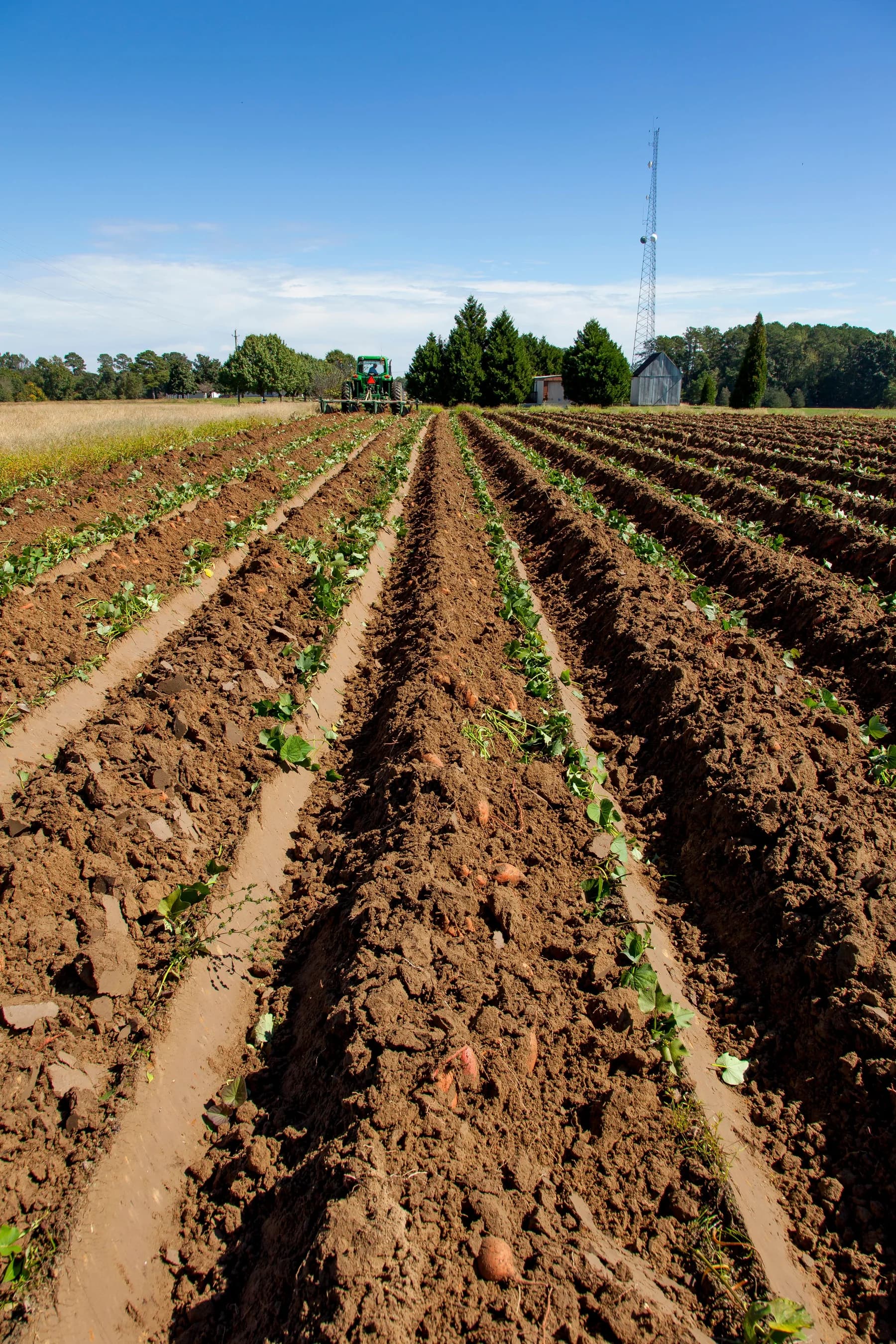
USDA NASS reported 93,000 acres planted and 92,000 acres harvested in North Carolina in 2025, with a statewide average of 205 cwt per acre. That is production context, not a field yield target.
Commercial planting base
93,000 acres planted
Average yield reported
205 cwt/acre
Harvested area
92,000 acres
Reported regional totals give production context; they are not a field-level yield estimate.
North Carolina Extension supplies the state production calendar and commercial spacing. Its detailed crop-management chapter focuses on organic production; organic weed-control examples are labeled as such below.
Step 1 of 7 · Assess
Plan around the Coastal Plain’s commercial system: slip supply, suitable beds, early weed control, field traffic, digging capacity and curing-room space must line up before transplanting.
6 topics still to verify· planning aid only, not a suitability score
Selections stay in this browser tab and are not saved or sent anywhere.
Need a field-specific review? Run a coordinate-level farm audit for localized conditions.
Root-knot nematodes, wireworms and other soilborne pests affect marketable roots. Soil sampling, clean planting material, crop rotation and equipment sanitation are the first decisions; chemical treatment depends on current field results and product labels.
Step 2 of 7 · Plan
Most commercial fields are transplanted from late May through June. The early and late bands are narrower, conditional options.
A limited early window is described for greenhouse-grown slips. NC State notes that planting early gives little advantage if cold weather continues into mid-May.
This is the main commercial period. NC State targets completion by the end of June and reports that half the crop is planted by June 10.
Some growers plant in early July when a shorter-season variety and favorable growing conditions leave time for the planned harvest.
Historical regional climate
Green tiles are months whose mean soil temperature is in the 77–86°F root-development range; all other tiles are neutral and show the value. Early, main and late badges mark the 10th, median and 90th-percentile dates for reaching 18.3°C for 4 consecutive days. Bar height shows the mean.
Early soil-warming date
April 05
10th percentile
Median soil-warming date
April 19
median year
Late soil-warming date
May 05
90th percentile
Months whose historical mean soil temperature reaches the 65°F reference: May, June, July, August, September. Months in the 77–86°F root-development range: July, August. These are monthly regional averages, not planting dates or a frost check.
Open-Meteo · era5_land · 1996-01-01 to 2025-12-31 · Reference point 35.50°N, 79.40°W. Soil-temperature values are modeled at 0–7 cm model layer; the 65°F (18.3°C) transplant reference comes from a 4-inch field measurement. Use the regional calendar above with a current field reading.
Sweet potato slips establish best after frost risk has passed and the soil is at least 65°F (18.3°C) at 4 inches. That is a field measurement; the climate strip above shows regional history.
Use the regional crop duration and expected fall cutoff to choose a variety and harvest date. Confirm market grade, digging capacity and curing space before planting.
Step 3 of 7 · Prepare
Choose a warm, loose, well-drained field with a workable root zone. Sweet potatoes are widely produced on sandy-loam soils in North Carolina; waterlogged ground and a field with a damaging pest history can reduce marketable roots.
Keep bed height and shape consistent with soil texture, water movement and the equipment used on the farm.
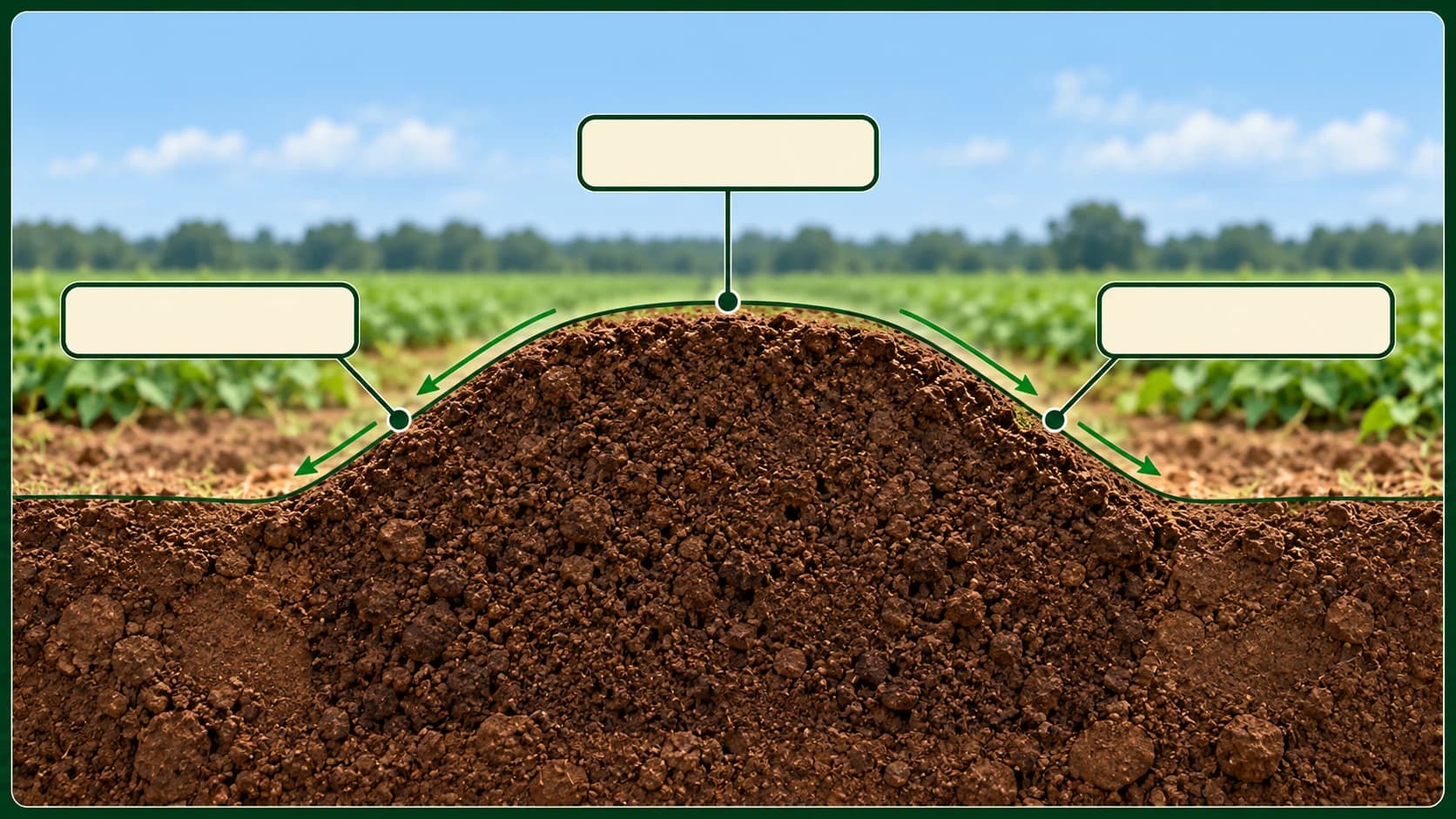
The 2025 North Carolina Extension manual lists sweet potato pH guidance and variety-dependent nutrient programs. Use the current soil-test recommendation for each field zone; excess nitrogen can favor vines over storage-root sizing.
Step 4 of 7 · Establish
Sweet potatoes are established from vegetative vine cuttings called slips. Buy clean, healthy slips in the target variety and quantity, and keep them shaded and moist until planting.
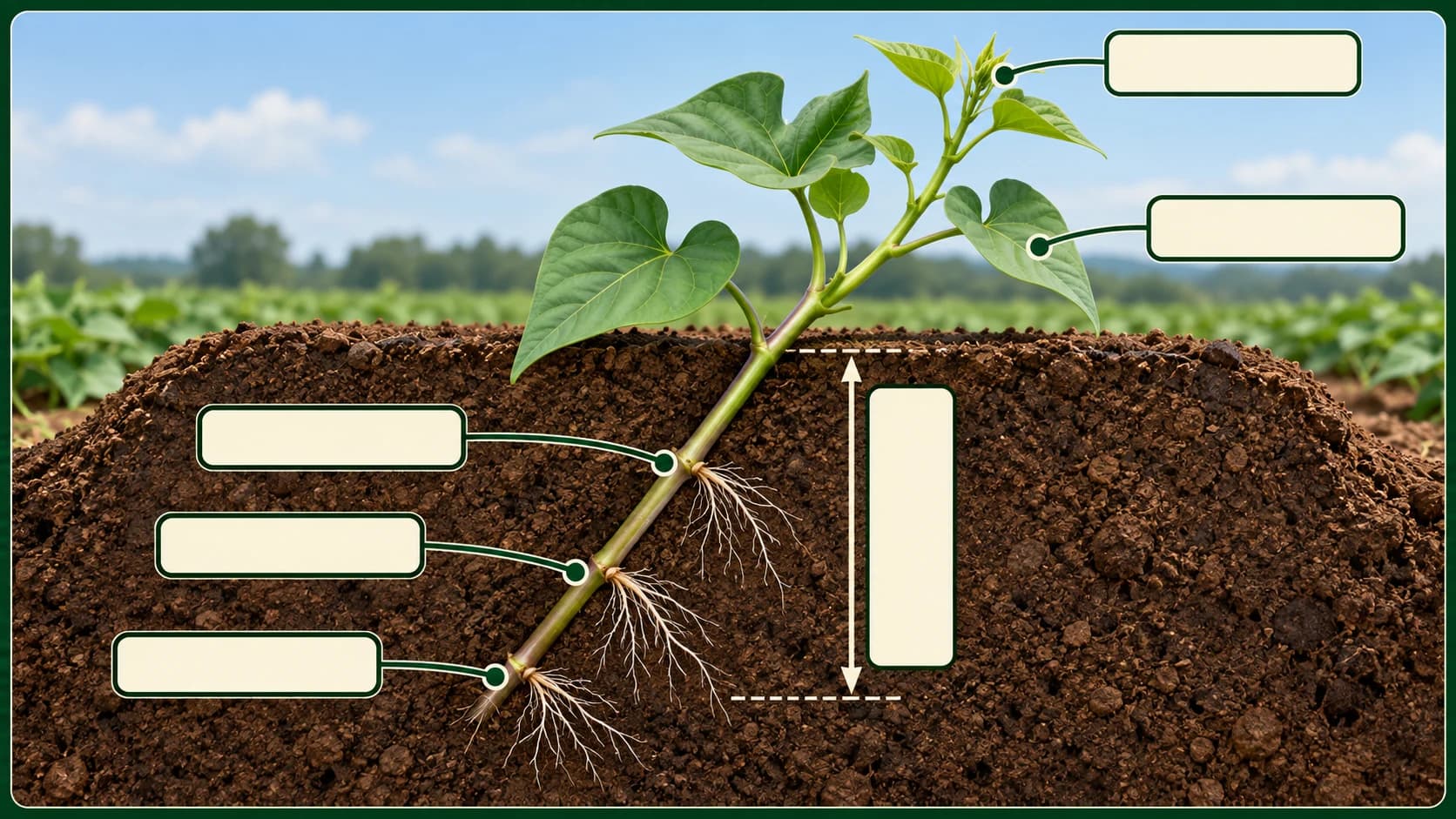
NC State reports commercial row spacings from 36–48 inches, with 42–44 inches most common. In-row spacing ranges from 8–14 inches, with 9–12 inches common. Three to four inches with at least three nodes underground is a practical transplant-depth reference.
Planting calculator
Estimated slips
12,446
at 42 × 12 in
Estimate = field area ÷ row-by-slip spacing. Keep values within the published bounds, then match the starting pattern to equipment and target root grade. Headlands and replant allowance are not included.
Step 5 of 7 · Manage
The first weeks determine how evenly slips establish and how the crop competes. NC State identifies weed competition during storage-root initiation and root sizing as a major production risk, especially in organic systems. Scout early, then choose current control methods for the farm’s production system.
Water immediately after setting and maintain enough moisture for root establishment. Track rainfall and soil moisture; avoid keeping beds saturated.
Scout early and maintain a weed-free start through canopy closure. Choose current control methods for the farm’s production system.
Wireworms, flea beetles and root-knot nematodes can downgrade roots. Keep field history and scouting records tied to each harvest lot.
Use certified or otherwise clean slips, avoid carrying soil on slips, and clean equipment after infested fields to limit movement of nematodes and soilborne disease.
Step 6 of 7 · Harvest
North Carolina harvest generally begins in late August and continues through October. Protect roots from cuts and skinning, then move them promptly into a controlled curing environment.
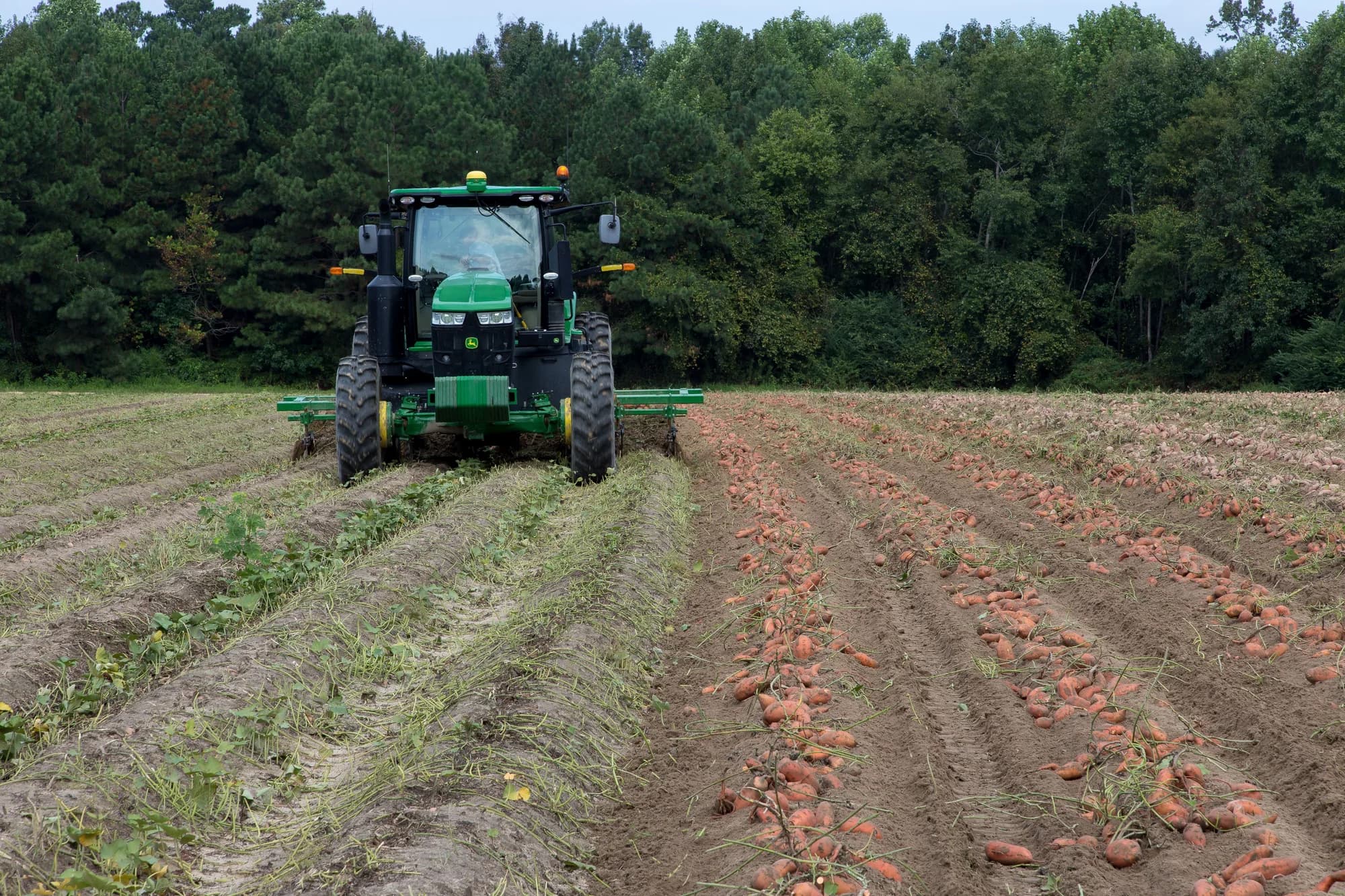
Harvest period
Plan by variety, market size, planting date, field condition and frost risk.
Cure
Hold for 3–5 days with airflow; room design and incoming root temperature affect timing.
Store
Maintain stable temperature, humidity and ventilation after curing.
Step 7 of 7 · Reference
North Carolina planting dates, commercial row spacing, population, production risks, harvest timing and curing. Weed-management examples in this chapter are for organic production.
2025 North Carolina planted and harvested area, average yield and total production; statewide statistics, not an individual-farm forecast.
Harvest handling, curing temperatures and humidity, ventilation and storage conditions.
Field history, soil sampling, clean planting material and equipment sanitation for North Carolina production.
Crop-level transplant practice and the 77–86°F (25–30°C) soil-temperature optimum for root development; Western Washington planting dates are not used.
Commercial slip handling, the at-least-65°F soil reading at 4-inch depth and immediate irrigation; Missouri calendar dates are not used.
Crop-level guidance for planting slips 3–4 nodes (about 3–4 inches) deep and using raised beds to support root development, drainage and aeration. Missouri dates are not used for this North Carolina guide.
North Carolina soil-test-based pH and fertility recommendations. The page directs fertility planning to a current soil test rather than prescribing a blanket field rate.
Photo authorship and licence information are recorded centrally. View photo credits.