

Growing blueberries in New Zealand
New Zealand’s reviewed sources support a Waikato rabbiteye orchard example under mineral-soil conditions, but they do not establish one national planting system or commercial calendar. The most useful local decisions are to confirm regional suitability, identify the production system and plan irrigation from site conditions.
By AgriAuditor. Updated .
Scope: New Zealand regional evidence, centered on a Waikato rabbiteye ‘Maru’ field study. The orchard observations apply to the named cultivar, site and study season.
At a glance
- Commercial field example
- Rabbiteye ‘Maru’ on Horotiu silt loam near Hamilton, Waikato2
- Study season
- Field irrigation study ran from November 2013 to April 20142
- Study harvest period
- Fruit ripening and harvest occurred in February–March during below-normal rainfall2
- Soil and climate screening
- MPI-commissioned modelling includes blueberry suitability criteria1
Perennial growth and climate in New Zealand
A perennial planting remains in the field for multiple years. Establishment is a long-term investment; flowering, fruit development, harvest and plant care recur as the planting matures. Follow the named cultivar and production system.
Establish a long-lived planting1,2,3
Choose cultivar and production system using local winter chill, frost exposure, drainage and water supply. Establish bushes as a multi-year fruit enterprise.
Management: Follow the Southern Hemisphere growth cycle1,2,3
Observe winter bud development, spring flowering, summer fruit fill and postharvest recovery. Cultivar and district control actual dates; do not copy Northern Hemisphere month bands.
Harvest: Waikato Maru rabbiteye field study2
The Hamilton-area 2013–14 Maru rabbiteye irrigation study harvested in February–March. This cultivar-specific Waikato observation does not represent every New Zealand district or blueberry type.
Historical monthly climate
Reference period: 1996-01-01 to 2025-12-31. ERA5-Land monthly mean soil temperature at 0–7 cm, air temperature and frost days at the regional reference point (-40.5, 175.5). Select a month to inspect its historical conditions.
Month tiles show mean air temperature.
February historical conditions
- Mean topsoil temperature
- 18.8°C
- Mean air temperature
- 17.8°C
- Mean frost days per month
- 0.0 days
Use this monthly history to assess winter exposure, seasonal heat and water planning. It does not calculate cultivar chill hours, flowering dates, frost damage during bloom or fruit maturity. Topsoil at 0–7 cm describes shallow soil context, not the full root zone. Harvest periods follow the production evidence above.
Climate source: Open-Meteo Historical Weather APIStart with a named region and production system
- 1
Place and cultivar
Rabbiteye ‘Maru’ on Horotiu silt loam near Hamilton.
- 2
Field period
An 11-year-old orchard was studied from November 2013 to April 2014.
- 3
Treatments
No irrigation, one drip line per row and two drip lines per row were compared.
- 4
Fruit period
Ripening and harvest fell in February–March during below-normal rainfall.
- Waikato orchard case
- The strongest local field-management source reviewed is a University of Waikato study of rabbiteye ‘Maru’ on mineral soil near Hamilton. It informs an orchard example, not every New Zealand region or cultivar.2
- National suitability work
- An MPI-commissioned Plant & Food Research report models land suitability for perennial crops, including blueberry soil and climate criteria. Use it for regional screening, not as a stand-alone planting recommendation.1
- Industry context
- The MBIE industry report describes New Zealand’s blueberry sector and market context. It is not a crop-management manual or a substitute for current local grower advice.3
Plan irrigation for local soil moisture
- 1
Assess the district
Check winter chill, frost exposure, soil and drainage.
- 2
Observe crop stage
Follow local flowering, fruit fill and postharvest growth.
- 3
Monitor root-zone moisture
Use field observations to adjust irrigation.
- 4
Confirm fruit maturity
Schedule cultivar-specific harvest; Waikato trial dates are not national dates.
- Study setup
- Researchers compared no irrigation, one drip line per row and two drip lines per row on 11-year-old rabbiteye ‘Maru’ bushes. The orchard was on Horotiu silt loam near Hamilton, and water was applied twice daily.2
- Dry-season observation
- Below-normal rainfall during fruit ripening and harvest in February and March created soil-moisture differences among the three treatments.2
- What it does not set
- The abstract does not give a universal irrigation volume for New Zealand. Base system design on local soil, rainfall, cultivar and farm measurements.2
Check site suitability before committing land
- Use the suitability model as a screen
- The Plant & Food Research report models perennial crop suitability using soil and climate factors. Confirm the assumptions and map scale for your property before relying on a regional suitability layer.1
- Confirm field conditions
- The Waikato study demonstrates one rabbiteye planting on Horotiu silt loam. The source does not show that all Waikato soils or other New Zealand soils support the same system.2
Keep variety dates tied to the named cultivar
Treat planting dates as a local research question
Do not combine separate sources into one season
- One Waikato study season
- The ‘Maru’ study observed fruit ripening and harvest in February and March during its 2013–14 field period, when rainfall was below normal.2
- Market and economics
- Use current buyer specifications, pack-out, labor and price records from the intended region. The 2020 MBIE report supplies sector context, not a current farm budget.3
Frequently asked questions
- Where is blueberry production documented in New Zealand?
- A University of Waikato field study documents rabbiteye ‘Maru’ near Hamilton in the Waikato region. It is one orchard example, not a national production survey.
- When are New Zealand blueberries harvested?
- Dates depend on cultivar, region and season. A Waikato ‘Maru’ study observed ripening and harvest in February–March in 2013–14. This single orchard season does not establish national harvest dates.
- What blueberry type did the Waikato study use?
- It studied rabbiteye blueberry ‘Maru’ on Horotiu silt loam near Hamilton.
- Is there a national blueberry planting date for New Zealand?
- The reviewed sources do not establish a validated national commercial planting window. Confirm timing with current local growers or research advisers.
- How much should I irrigate blueberries in New Zealand?
- The Waikato field study supports monitoring soil moisture and irrigation during dry fruiting periods, but the sources reviewed do not provide one national irrigation rate.
Regional blueberries guides
Sources and image credits
- 1. Plant & Food Research for New Zealand MPI — Modelling the effect of climate change on land suitability for growing perennial crops — Published October 2021. Regional climate and soil suitability modelling for perennial crops, including blueberries.
- 2. University of Waikato — Effect of irrigation on yield and fruit quality of rabbiteye blueberry growing on mineral soils in New Zealand — Field study November 2013–April 2014; record accessed 2 October 2026. Waikato field study of rabbiteye ‘Maru’ on Horotiu silt loam, including seasonal rainfall, irrigation and fruiting observations.
- 3. New Zealand MBIE — Opportunities in the New Zealand Blueberry Industry — Published 2020. Industry-level blueberry sector and market context; not a field-management guide.
Image credits
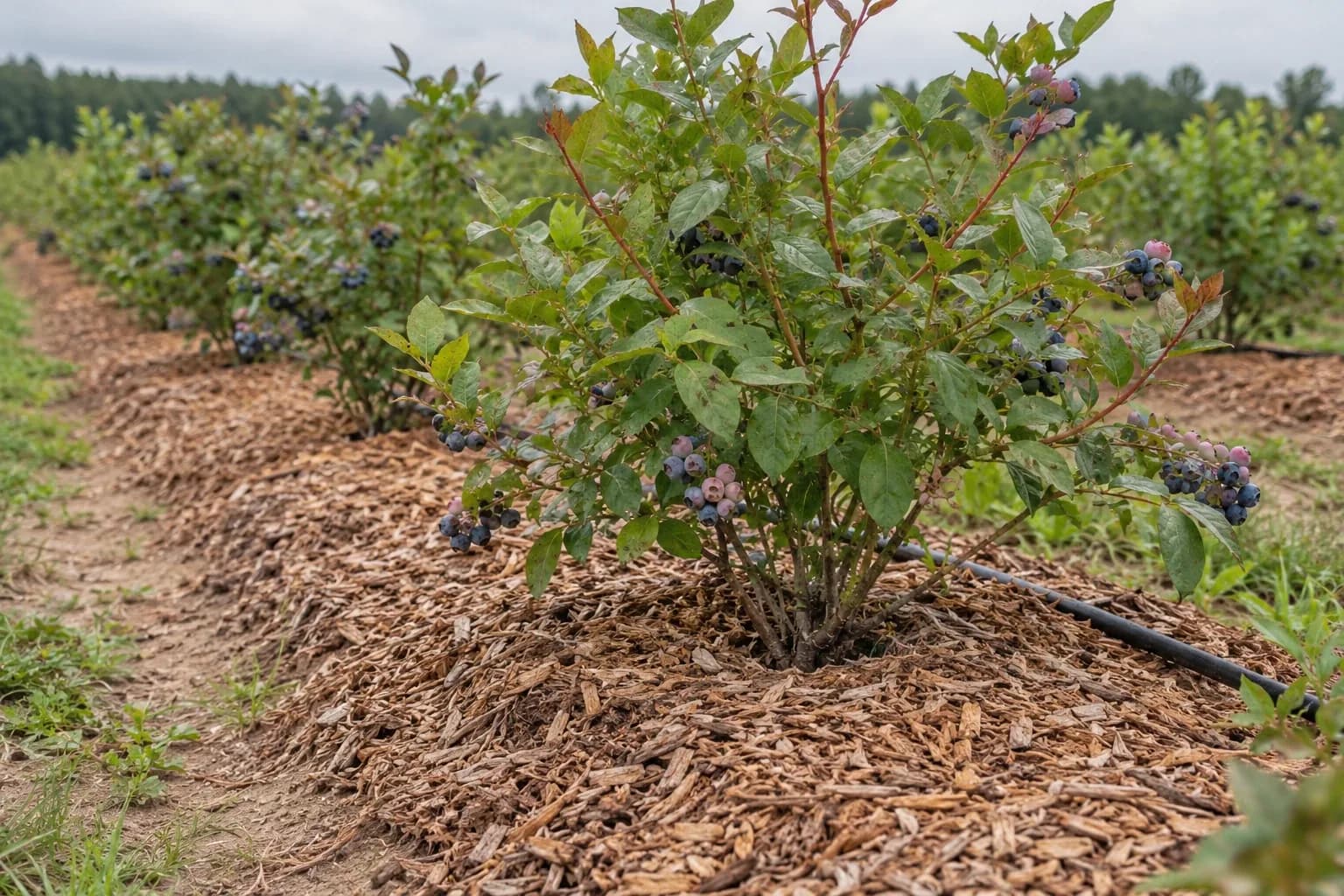
- A fruiting blueberry bush with mulch and drip irrigation.
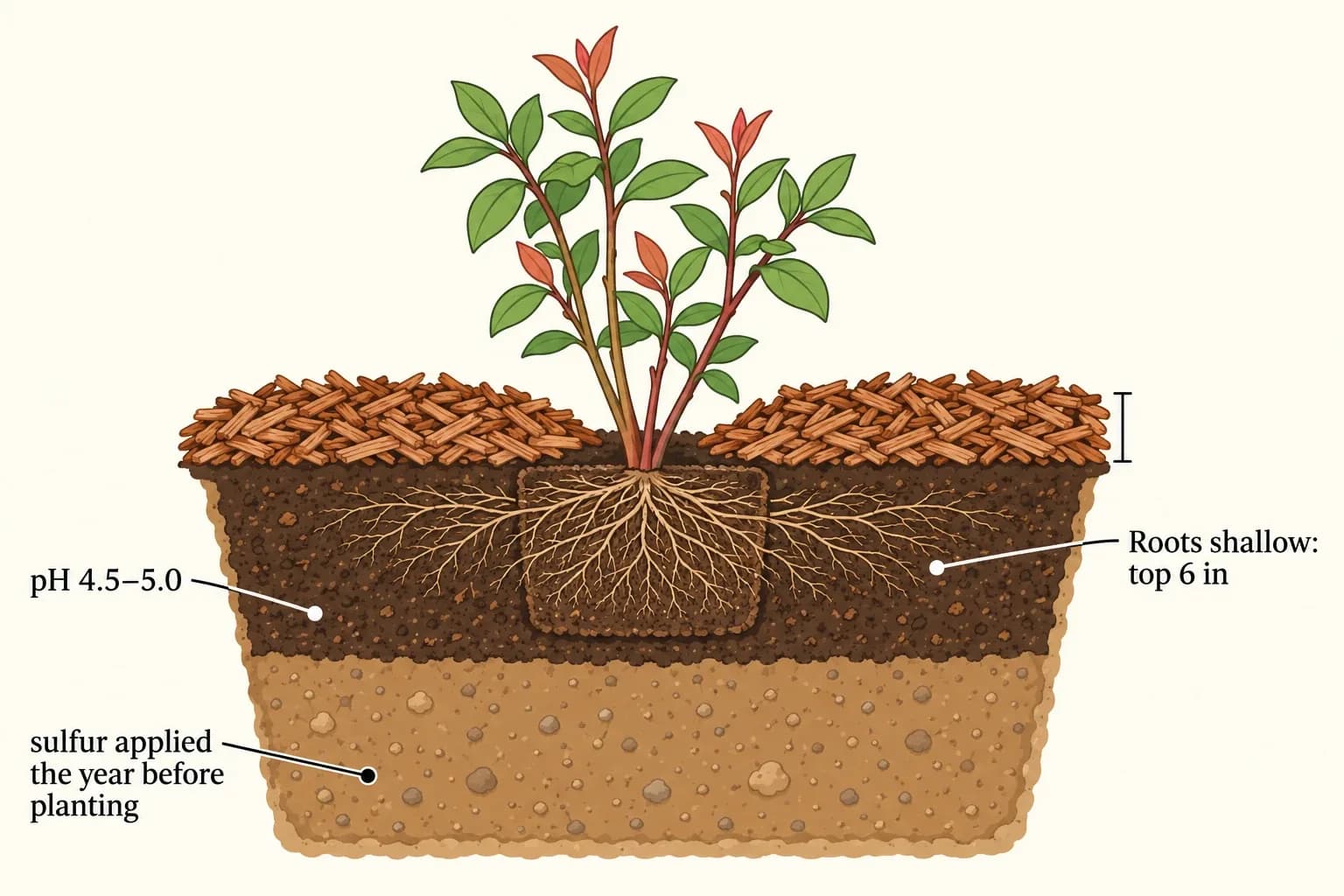
- Blueberries need an acidic, organic root zone. Schematic illustration.
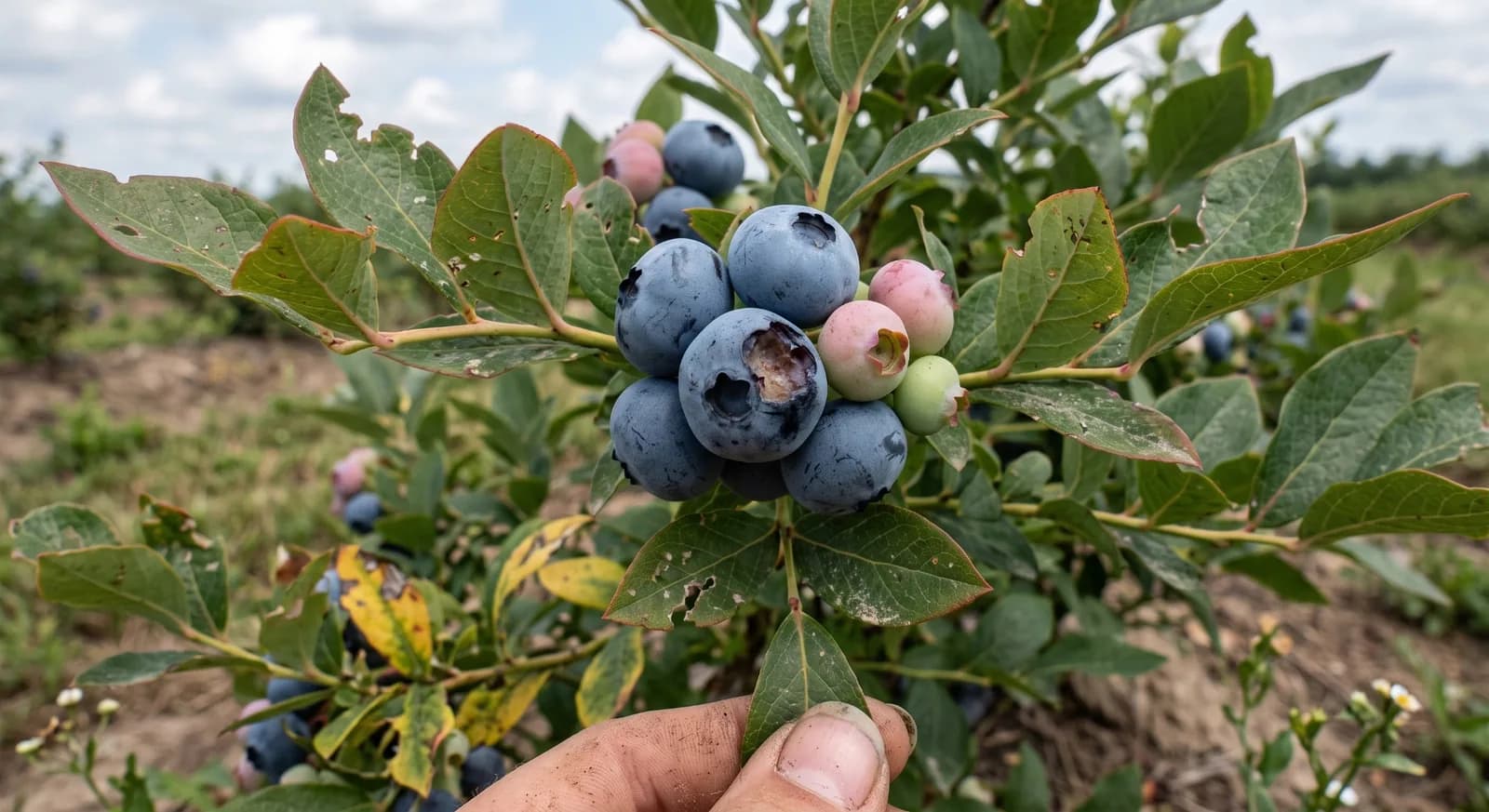
- Inspect fruit for damage as it ripens.
Figures are published averages or study assumptions for the places named, not guarantees for your field. Check current local recommendations and product labels before acting.
Some visuals in this guide are illustrations rather than photographs of a specific farm. See image credits.