

Growing blueberries in Minnesota
Minnesota’s commercial guide centers on winter-hardy half-high blueberries, careful site selection and steady moisture in acidic soil. It gives field spacing and irrigation ranges, while a 2026 southern Minnesota report offers a current but local harvest start. Choose varieties for your hardiness zone and do not assume one date or chill target fits the state.
Scope: Commercial highbush and half-high blueberry production in Minnesota, using University of Minnesota Extension guidance and a dated southern Minnesota field observation. Updated 2026-10-03.
At a glance
- Tame-blueberry activity, 2022
- 165 farms and 292 acres reported; bearing status acreage was suppressed1
- Commercial types
- Half-high cultivars are the main cold-hardy option for USDA zones 3–52
- Soil pH
- 4.5–5.5; above 5.8 can cause iron chlorosis2
- Spacing
- 1.2–1.5 m (4–5 ft) between plants; 2.4–3.0 m (8–10 ft) between rows2
- Mature-plant irrigation
- About 19–44 mm (0.75–1.75 in) per week, adjusted for weather and soil2
- Harvest length
- Half-high harvest usually takes 2–5 weeks2
- Southern Minnesota, 2026
- Extension reported harvest starting on 1 July3
Perennial growth and climate in Minnesota
A perennial planting remains in the field for multiple years. Establishment is a long-term investment; flowering, fruit development, harvest and plant care recur as the planting matures. Follow the named cultivar and production system.
Establish a long-lived planting2
Select cold-hardy cultivars and prepare an acidic, mulched root zone with irrigation. The commercial guide recommends suppressing fruit during the first two establishment years to develop the planting.
Management: Pruning, spring nutrition and fruiting2
Prune in late winter before bud swell and plan nitrogen during spring growth. The commercial guide warns that nitrogen after 1 July can increase winter injury. Follow actual crop stages and field nutrient assessment.
Harvest: Southern Minnesota early-variety start2,3
A 1 July 2026 southern Minnesota update reported early varieties entering harvest. July marks that observed start, not a statewide season end. Commercial half-high cultivars can require two-to-five weeks of repeated picking.
Historical monthly climate
Reference period: 1996-01-01 to 2025-12-31. ERA5-Land monthly mean soil temperature at 0–7 cm, air temperature and frost days at the regional reference point (46, -94.5). Select a month to inspect its historical conditions.
Month tiles show mean air temperature.
July historical conditions
- Mean topsoil temperature
- 21.9°C
- Mean air temperature
- 22.3°C
- Mean frost days per month
- 0.0 days
Use this monthly history to assess winter exposure, seasonal heat and water planning. It does not calculate cultivar chill hours, flowering dates, frost damage during bloom or fruit maturity. Topsoil at 0–7 cm describes shallow soil context, not the full root zone. Harvest periods follow the production evidence above.
Climate source: Open-Meteo Historical Weather APIChoose winter-hardy cultivars for your zone
- 1
Years 1–2
Remove flowers so plants establish rather than carrying a crop.
- 2
Around year 5
The listed cultivars average about five years before a large harvest.
- 3
Years 8–10
Plants may take this long to reach mature size.
- Typical range5 weeks, upper endUMN gives a weather-, crop- and vigor-dependent range of 2–5 weeks.
- Half-high cultivars
- Half-high blueberries cross highbush with lowbush types and combine shorter growth with winter hardiness. The Minnesota/Wisconsin guide covers zones 3, 4 and 5 and lists cultivars including Northblue, Northsky, Northcountry, St. Cloud, Polaris, Chippewa and Northland.2
- Set expectations by zone
- The guide warns that lower ends of plant size and yield ranges are more likely in harsher areas such as northern Minnesota. Use local winter survival and nearby cultivar performance when making a commercial planting choice.2
- Census context
- USDA counted 165 Minnesota farms and 292 acres of tame blueberries in 2022. Bearing and nonbearing acreage are suppressed, and the totals do not describe farm-level yields.1
Select a sunny, acidic, well-drained site
- Soil and drainage
- UMN recommends moist but well-drained acidic soil, with pH 4.5–5.5. Soil above pH 5.8 can cause iron chlorosis. Avoid standing water and low areas that collect cold air or spring frost.2
- Adjust pH before planting
- Use a soil test to determine sulfur or acid-peat needs. Elemental sulfur is slow and should be applied and incorporated the year before planting, then the pH retested after three to four months. Do not copy a rate without matching soil texture and starting pH.2
- Clear perennial weeds
- The commercial guide recommends controlling persistent weeds the year before planting because they are difficult to manage once bushes are established.2
Plant dormant stock as soon as spring fields allow
Between rows: 2.4–3.0 m (8–10 ft) · Within the row: 1.2–1.5 m (4–5 ft)
At 1.2 by 2.4 m (4 by 8 ft), the guide calculates about 3,360 plants/ha (1,360/acre).
- Planting time
- Plant dormant stock in early spring when field conditions permit. UMN prefers spring to benefit from spring rain and reduce frost-heave and winter-injury risk. Delay plants that have already leafed out until frost danger has passed.2
- Planting depth
- Loosen container roots and set each plant at the depth it grew in the container or nursery bed. Planting too deep or too shallow can damage the fine root system.2
- Row access
- Choose row spacing for the equipment you will use. Keep cultivation shallow because most roots are in the top 15 cm (6 in).2
Maintain moisture without waterlogging roots
- Lower end19 mm/weekUMN range starts at 0.75 in (19 mm) per week.
- Upper end44 mm/weekUMN range reaches 1.75 in (44 mm) per week, depending on climate.
- Irrigation
- Once mature plants are leafed out, the commercial guide gives about 0.75–1.75 inches (19–44 mm) of water per week through the growing and harvest season, adjusted for conditions. Continue moisture management in late summer while next year’s fruit buds develop.2
- Mulch
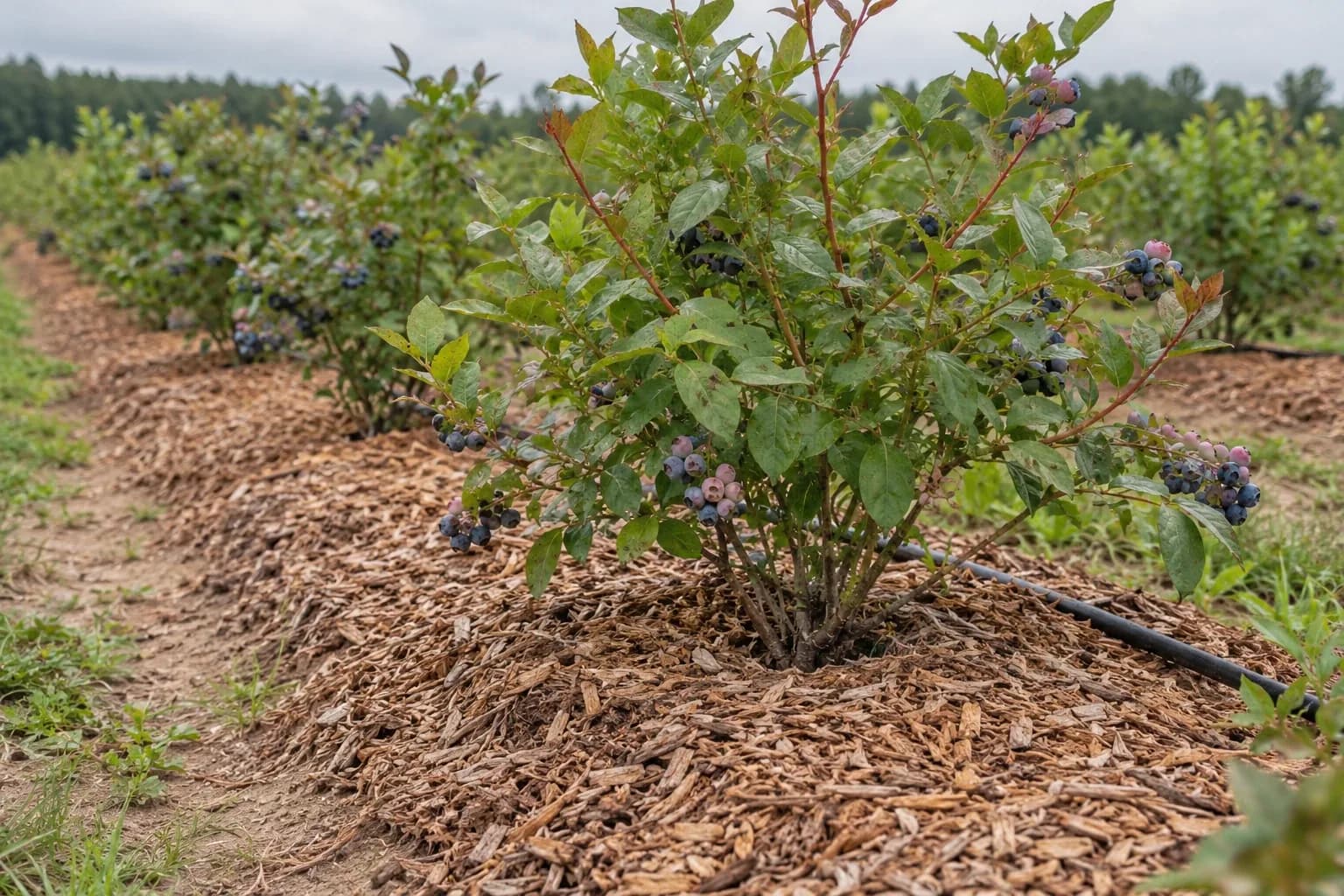
- A 5–10 cm (2–4 in) organic mulch ring retains moisture, adds organic matter and suppresses weeds. Keep mulch a few inches from the plant base; avoid deep cultivation that injures shallow roots.2
Feed from soil and plant evidence
- Nitrogen
- UMN lists 34, 45 and 56 kg N/ha (30, 40 and 50 lb/acre) for mineral soils in years one to three, then recommends basing later applications on leaf analysis and plant vigor. Rates are lower on high-organic soils.2
- Timing and source
- Use an ammonium nitrogen source such as ammonium sulfate or urea where appropriate to help maintain acidic soil. Avoid excess late-season nitrogen because it can increase winter-injury risk.2
Pick by color and use local dates
- Harvest window
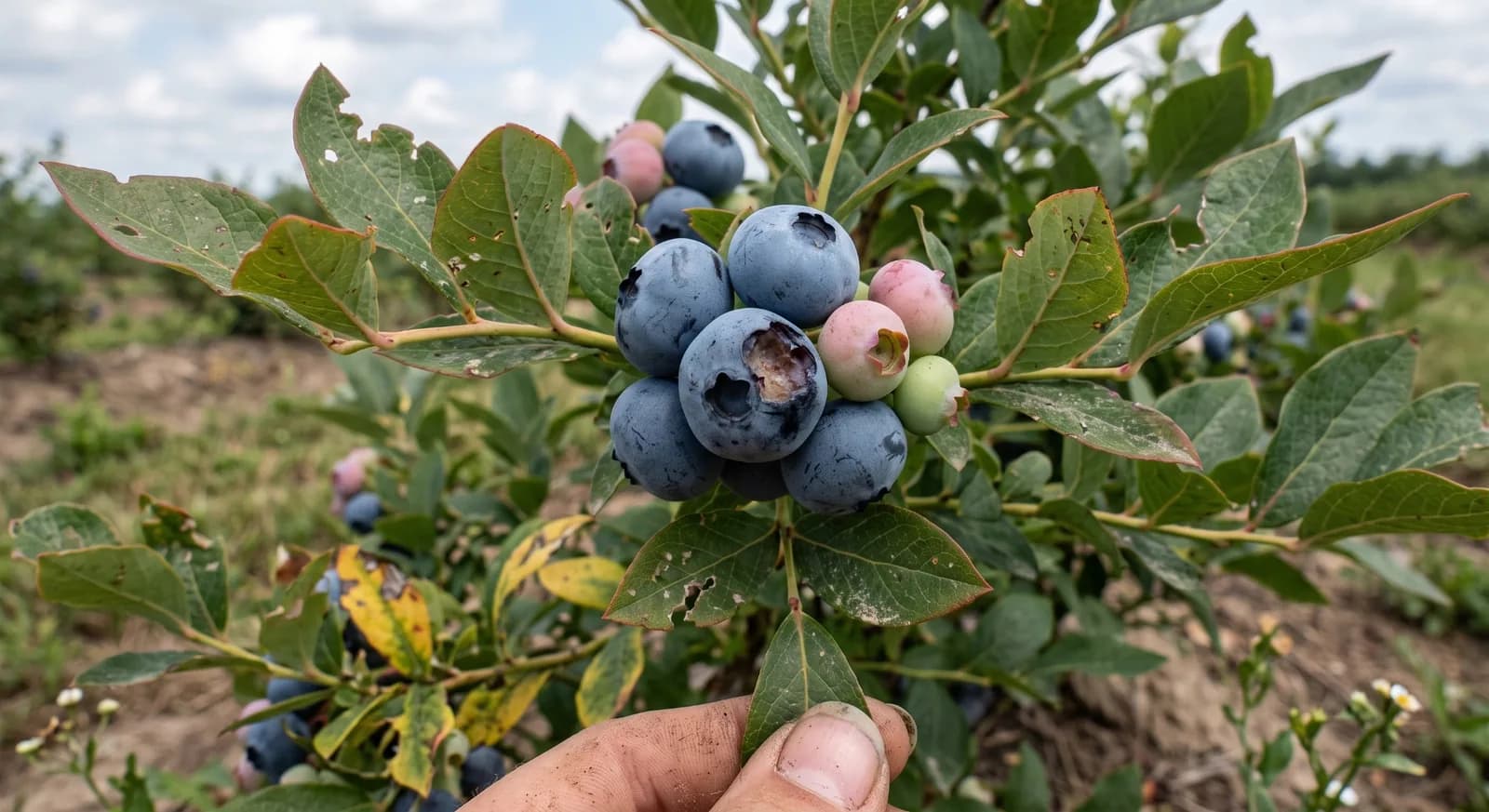
- UMN says half-high harvest commonly lasts two to five weeks, depending on weather, crop size and plant vigor. Allow berries to become fully blue before picking because they continue to sweeten after turning blue.2
- Southern Minnesota observation
- A 1 July 2026 UMN update reported harvest starting in southern Minnesota. It is a dated observation from one part of the state, not a fixed statewide calendar.3
- Pollination
- Bees pollinate blueberries. Cross-pollination between cultivars can increase berry size and advance ripening; the UMN guide identifies St. Cloud and Polaris as needing a second variety.2
Frequently asked questions
- Which blueberries grow best in Minnesota?
- The University of Minnesota commercial guide focuses on winter-hardy half-high varieties for zones 3–5, including Northblue, Northsky, Northcountry, St. Cloud, Polaris, Chippewa and Northland.
- What pH do Minnesota blueberries need?
- UMN gives an optimum soil pH of 4.5–5.5 and warns that pH above 5.8 can cause iron chlorosis.
- How do Minnesota farms establish a blueberry field?
- Choose cold-hardy cultivars, prepare acidic beds and irrigation, and set suitable nursery stock into workable soil. Protect young plants and suppress fruit during the first two establishment years.
- How much water do commercial blueberries need?
- UMN gives about 0.75–1.75 inches (19–44 mm) per week for mature plants, adjusted for climate and soil, through the growing and harvest season.
- When do blueberries ripen in Minnesota?
- Harvest timing varies. UMN reported a southern Minnesota start on July 1 in 2026; the commercial guide says half-high harvest lasts about two to five weeks.
- How long before Minnesota blueberry bushes produce?
- The UMN guide advises no crop in the first two years. Its listed cultivars average about five years before a large harvest and may take eight to ten years to reach mature size.
Regional blueberries guides
Local dates, soil-temperature history and sources for specific regions:
Sources and image credits
- 1. USDA NASS — 2022 Census of Agriculture, Minnesota, Table 38: Berries by Acres — Published 2024; 2022 data. Minnesota farm counts and tame-blueberry acreage; bearing and nonbearing acreage are suppressed.
- 2. University of Minnesota Extension — Commercial blueberry production in Minnesota and Wisconsin — Accessed 2 October 2026. Commercial varieties, hardiness, site and soil, pH, planting, spacing, irrigation, nutrition, pollination and harvest.
- 3. University of Minnesota Extension — Fruit Update, southern Minnesota blueberry harvest — Published 1 July 2026. A dated field observation that blueberry harvest had started in southern Minnesota.
Image credits
- A fruiting blueberry bush with mulch and drip irrigation.
- Blueberries need an acidic, organic root zone. Schematic illustration.
- Inspect fruit for damage as it ripens.
Figures are published averages or study assumptions for the places named, not guarantees for your field. Check current local recommendations and product labels before acting.
Some visuals in this guide are illustrations rather than photographs of a specific farm. See image credits.