

Growing blueberries in Texas
Texas blueberries mean rabbiteye varieties on acid soil in East Texas. The choices that matter are matching variety chill hours to your county, avoiding calcium-rich water, mulching deeply and feeding ammonium nitrogen in small split doses.
Scope: Rabbiteye blueberries in Texas (mainly East Texas), based on Texas A&M AgriLife Extension and USDA NASS. Metric first, with the original US units in brackets. Updated 2026-10-03.
At a glance
- Type
- Rabbiteye (Vaccinium ashei), grown commercially in East Texas1
- Soil pH
- 4.0–5.5; do not plant on alkaline soil1
- Chill hours
- Choose a variety within 150 hours of your area average; varieties run 350–700 hours1
- Spacing
- At least 1.8 m (6 ft) in rows at least 3.7 m (12 ft) apart, about 1,490 bushes/ha (605 per acre)1
- Full size
- After 7–8 years: 4.6 m (15 ft) tall and 3 m (10 ft) wide1
- Yield
- 5.6–10.1 t/ha (5,000–9,000 lb/acre); up to 6.8 kg (15 lb) per bush1
- Harvest
- May to July, picked over 4–6 weeks1
- Nearby benchmark
- Georgia, a major rabbiteye state that USDA tracks, averaged 5.7 t/ha in 20252
Perennial growth and climate in Texas
A perennial planting remains in the field for multiple years. Establishment is a long-term investment; flowering, fruit development, harvest and plant care recur as the planting matures. Follow the named cultivar and production system.
Establish a long-lived planting1
Select cultivars for local chill and frost exposure and establish acidic, well-drained beds with irrigation. Treat this as a perennial fruit planting rather than an annual crop.
Management: Bud break, fruit fill and postharvest care1
The production guide places nutrition at late winter or early bud break and again after harvest in early summer. Review soil and tissue results; maintain water during fruit development.
Harvest: Cultivar-dependent picking1
The Texas production guide gives May–July harvest, depending on cultivar. Individual varieties require repeated picks over about four-to-six weeks; confirm local fruit maturity.
Historical monthly climate
Reference period: 1996-01-01 to 2025-12-31. ERA5-Land monthly mean soil temperature at 0–7 cm, air temperature and frost days at the regional reference point (31.5, -99). Select a month to inspect its historical conditions.
Month tiles show mean air temperature.
May historical conditions
- Mean topsoil temperature
- 25.6°C
- Mean air temperature
- 24.5°C
- Mean frost days per month
- 0.0 days
Use this monthly history to assess winter exposure, seasonal heat and water planning. It does not calculate cultivar chill hours, flowering dates, frost damage during bloom or fruit maturity. Topsoil at 0–7 cm describes shallow soil context, not the full root zone. Harvest periods follow the production evidence above.
Climate source: Open-Meteo Historical Weather APIStart with acid soil and clean water
- Soil
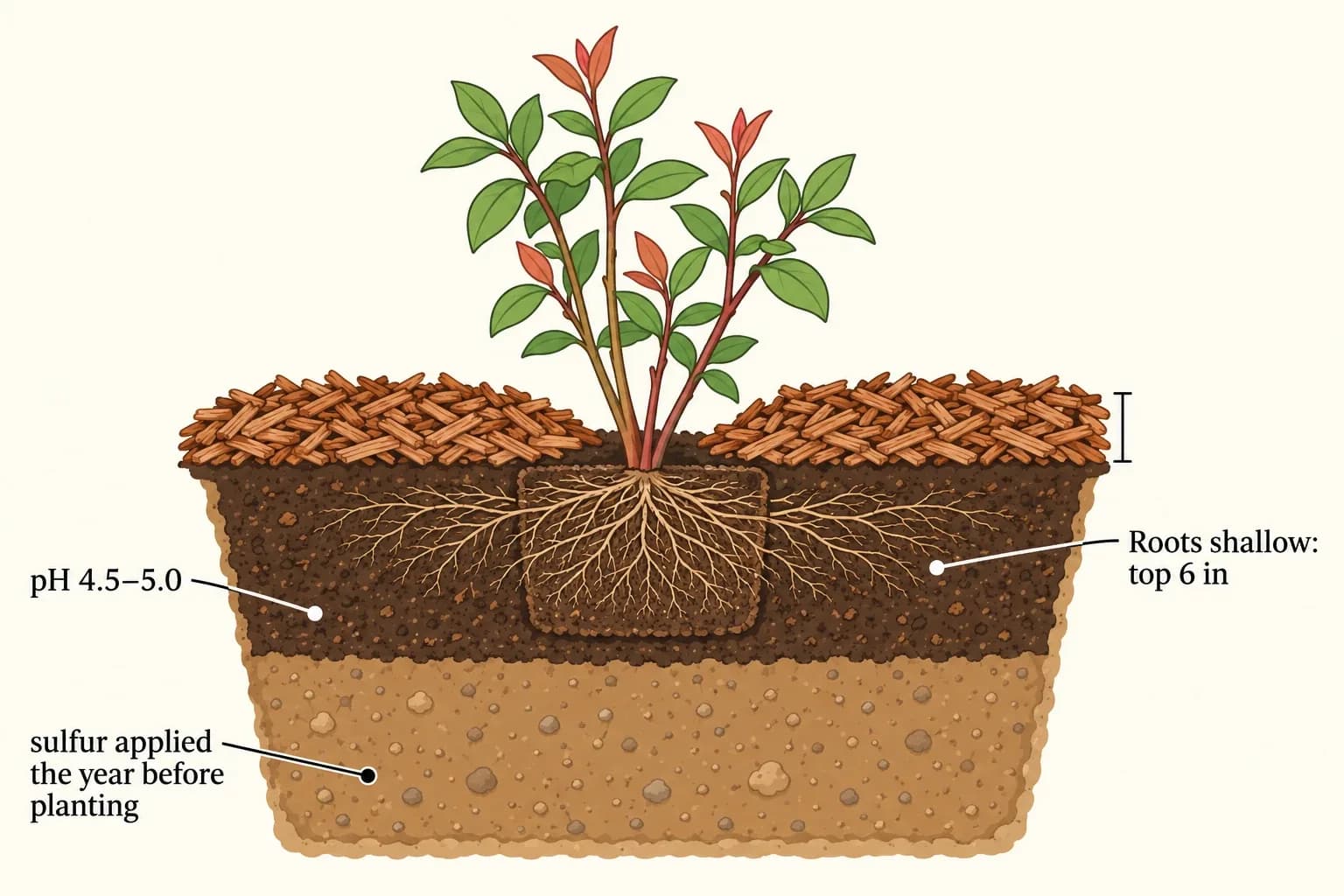
- Rabbiteyes do not tolerate alkaline soil or water and will not thrive unless soil pH is 4.0–5.5. Growers have tried lowering the pH of alkaline soils but plantings often fail; commercial growers should plant on soil with a naturally favourable pH. Roots are shallow and fibrous, so the soil must drain well; sandy soils are ideal but need drip irrigation, and heavy clay with poor drainage causes root decline.1
- Water quality
- Irrigation water must have little to no calcium bicarbonate, and there is no cost-effective way to remove calcium. Rabbiteyes are also extremely sensitive to sodium.1
- Late frost
- Late spring frosts can damage flowers. Avoid sites lower than the surroundings; sprinklers, row cover or high tunnels can protect the crop.1
Match chill hours to your county
- Prince350 hours
- Woodard350 hours
- Brightwell400 hours
- Climax450 hours
- Alapaha500 hours
- Austin500 hours
- Premier550 hours
- Vernon550 hours
- Powderblue600 hours
- Tifblue650 hours
- Ochlockonee700 hours
- Chill hours
- Varieties that need fewer chill hours bloom and set fruit early and are most likely to be hit by late spring frost. High-chill varieties may not yield well where the area does not get enough hours below 7°C (45°F). Choose a variety within 150 hours (above or below) of your area average.1
- Pollinizers
- Most rabbiteyes need a pollinizer variety planted nearby, one that blooms in the same part of the season. Tifblue is somewhat self-fruitful. Plant early, mid-season and late varieties for a longer harvest.1
Plant, feed and water by plant age
- Year 228 g/bush
- Year 357 g/bush
- Year 485 g/bush
- Year 5113 g/bush
- Year 6142 g/bush
- Year 7198 g/bush
- Year 8+227 g/bush
- Planting
- Kill grass and weeds three months before planting and cultivate; raise beds in low flat areas. Mix 9–18 litres (¼–½ bushel) of acid organic matter such as pine bark or peat into each planting spot. Set plants at nursery depth and halve the tops of bare-root plants.1
- Fertiliser
- Avoid nitrate nitrogen, which can slow growth; use urea or ammonium. Do not fertilise new plants until established, then 14–28 g (½–1 oz) of 21-0-0 in the planting summer if thriving. From year 2 apply 28 g (1 oz) per year of plant age up to 227 g (8 oz) at 8 years, near 67 kg N/ha (60 lb/acre) at 1,490 bushes/ha. Apply in late winter to early budbreak and again after harvest.1
- Mulch
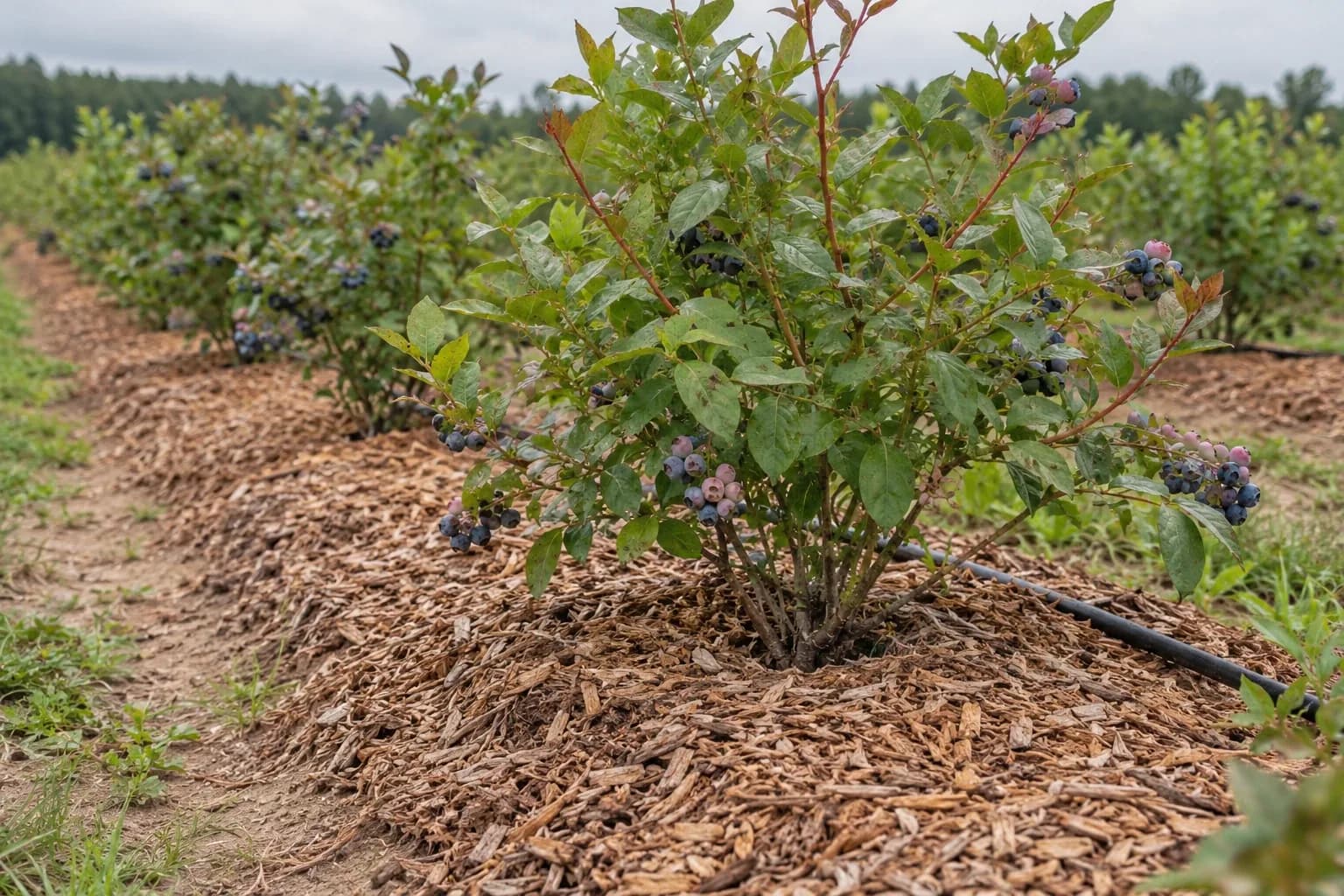
- Mulch is vital, especially in the first 2 years: 10–15 cm (4–6 in) of pine straw, pine bark, peat moss or leaves over at least 60 cm (2 ft) outward from the crown. Do not use barnyard manure, which is high in salt.1
- Irrigation
- A 1-year-old plant needs about 1.9 litres (½ gal) a day in full growth; double that in year 2 and add 3.8 litres (1 gal) each year to a maximum of 19 litres (5 gal) a day, or 132 litres (35 gal) a week. Plants carrying fruit are most sensitive to dry soil.1
Prune, protect and pick
- Pruning
- Head back lower limbs so fruit does not touch the soil and thin vigorous uprights. As plants age and form thick grey branches, thin about 20% of the branches at ground level each year.1
- Pests and diseases
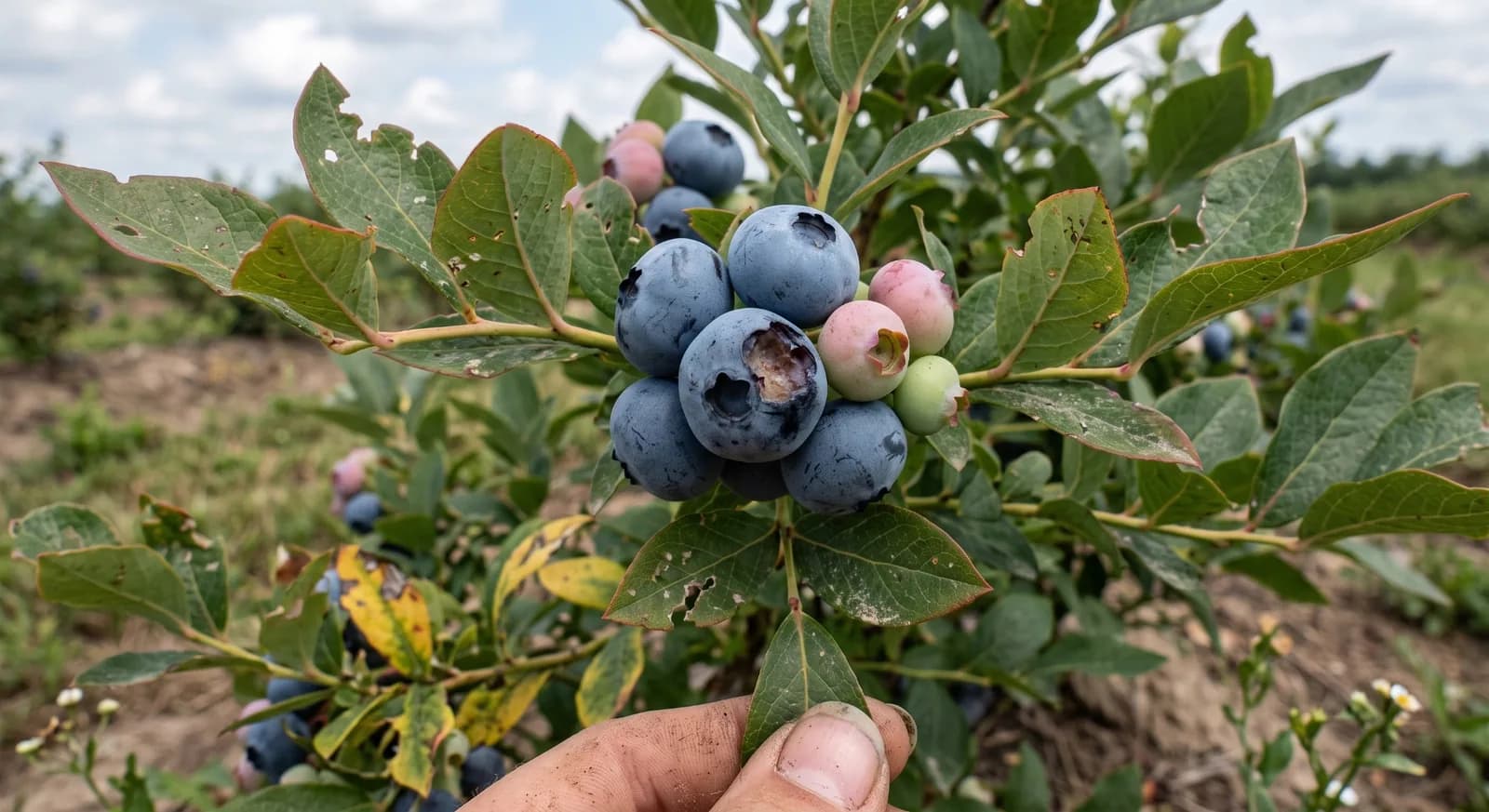
- The main fruit insect is the blueberry maggot. Mummy berry, botrytis blight and anthracnose are the key fungal diseases. Birds are a major problem and need netting and noise makers.1
- Picking
- Most Texas fruit is hand-picked for fresh sale, often pick-your-own. Rabbiteyes ripen unevenly within a cluster, so pick individual berries over 4 to 6 weeks; berries do not ripen further after harvest.1
Yield and what to expect
- Yield
- A single mature rabbiteye bush can produce 6.8 kg (15 lb) a year and well-managed commercial plantings 5.6–10.1 t/ha (5,000–9,000 lb/acre) a year. USDA does not report Texas; Georgia, a major rabbiteye state that it does track, averaged 5.7 t/ha (5,100 lb/acre) in 2025.1,2
- Time to full size
- Plants reach mature size in 7 to 8 years, so budget for several years before a full crop. Run a field audit for your coordinates and put your own costs into the crop ROI estimator.1
Frequently asked questions
- Can you grow blueberries in Texas?
- Yes. Rabbiteye blueberries are grown commercially in East Texas on acid soil with pH 4.0–5.5. Alkaline soils and water do not work.
- What is the best blueberry for Texas?
- The rabbiteye (Vaccinium ashei). Choose a variety whose chill-hour requirement is within 150 hours of your area average.
- How far apart do you plant blueberries in Texas?
- At least 1.8 metres (6 feet) apart in rows at least 3.7 metres (12 feet) apart, about 1,490 bushes per hectare.
- How much fertiliser do blueberries need?
- 28 g (1 oz) of ammonium sulfate (21-0-0) per year of plant age, up to 227 g (8 oz) at 8 years, split into late winter and after harvest.
- When do blueberries ripen in Texas?
- Harvest runs from May to July depending on variety, and individual berries are picked over 4 to 6 weeks.
- How much do blueberry bushes yield in Texas?
- Up to 6.8 kg (15 lb) per mature bush, or 5.6–10.1 t/ha (5,000–9,000 lb/acre) in well-managed plantings.
Regional blueberries guides
Local dates, soil-temperature history and sources for specific regions:
Sources and image credits
- 1. Texas A&M AgriLife Extension — Blueberries: Texas Fruit and Nut Production (E-603) — 2013, reviewed 2015. Rabbiteye varieties and chill hours, soil and water, spacing, fertiliser, mulch, irrigation, pruning, pests and harvest.
- 2. USDA NASS — Noncitrus Fruits and Nuts 2025 Summary — Published May 2026. US and state bearing acreage, yield, production, price and value for avocados, almonds, olives and other fruit and nut crops, 2023–2025.
Image credits
- A fruiting bush on deep organic mulch with drip irrigation.
- Blueberries need acid soil with high organic matter, a deep mulch layer and shallow roots kept moist. Schematic illustration.
- Birds and the blueberry maggot are the main fruit losses.
Figures are published averages or study assumptions for the places named, not guarantees for your field. Check current local recommendations and product labels before acting.
Some visuals in this guide are illustrations rather than photographs of a specific farm. See image credits.