

How to grow blueberries: a commercial guide
Blueberries need acid, high-organic-matter soil and several patient years before a full crop, wherever they are grown. The decisions that matter are fixing pH a year before planting, a nitrogen source that keeps soil acid, removing the first flowers, and mulching a shallow root system. Rates are given in metric with the original imperial figures in brackets; the underlying trials come from the eastern United States and cold-climate Midwest, so check cultivar choice and dates against your own winters.
Scope: Highbush blueberries for temperate climates with a cold winter, plus cold-hardy half-high types. Southern highbush and rabbiteye types are bred for mild winters and differ in chilling and pH. Rates are metric with the original imperial figures in brackets; the trials come from the eastern United States and the cold-climate Midwest, so check cultivars and dates against your own winters. Updated 2026-10-16.
At a glance
- Spacing
- Plants 1.2–1.5 m (4–5 ft) apart in rows 2.4–3 m (8–10 ft); Penn State 1.5 m (5 ft) in rows 2.4–3.7 m (8–12 ft)1,2
- Planting
- Dormant plants in early spring as soon as the soil is workable (about April in Pennsylvania); autumn possible1,2
- Mulch
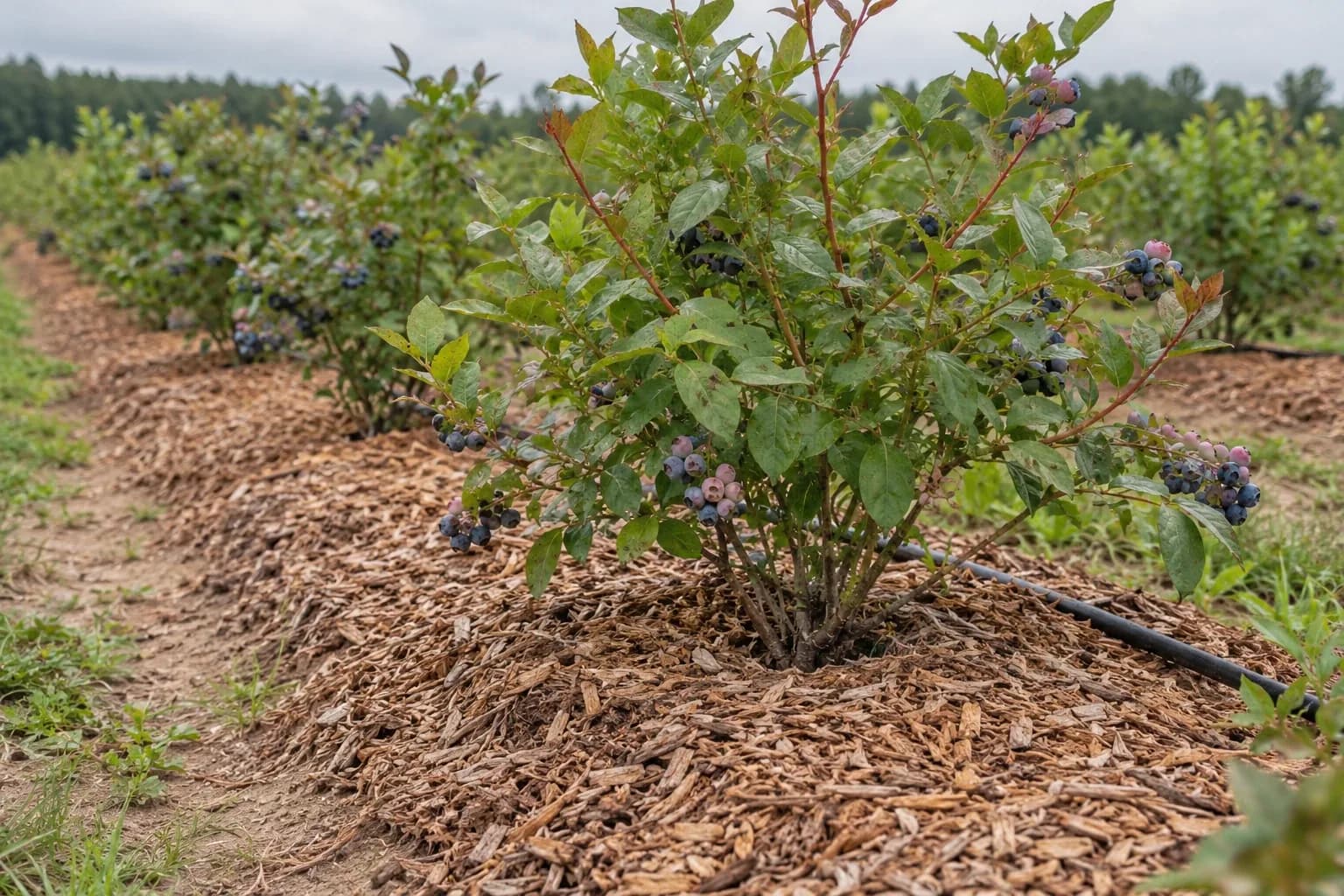
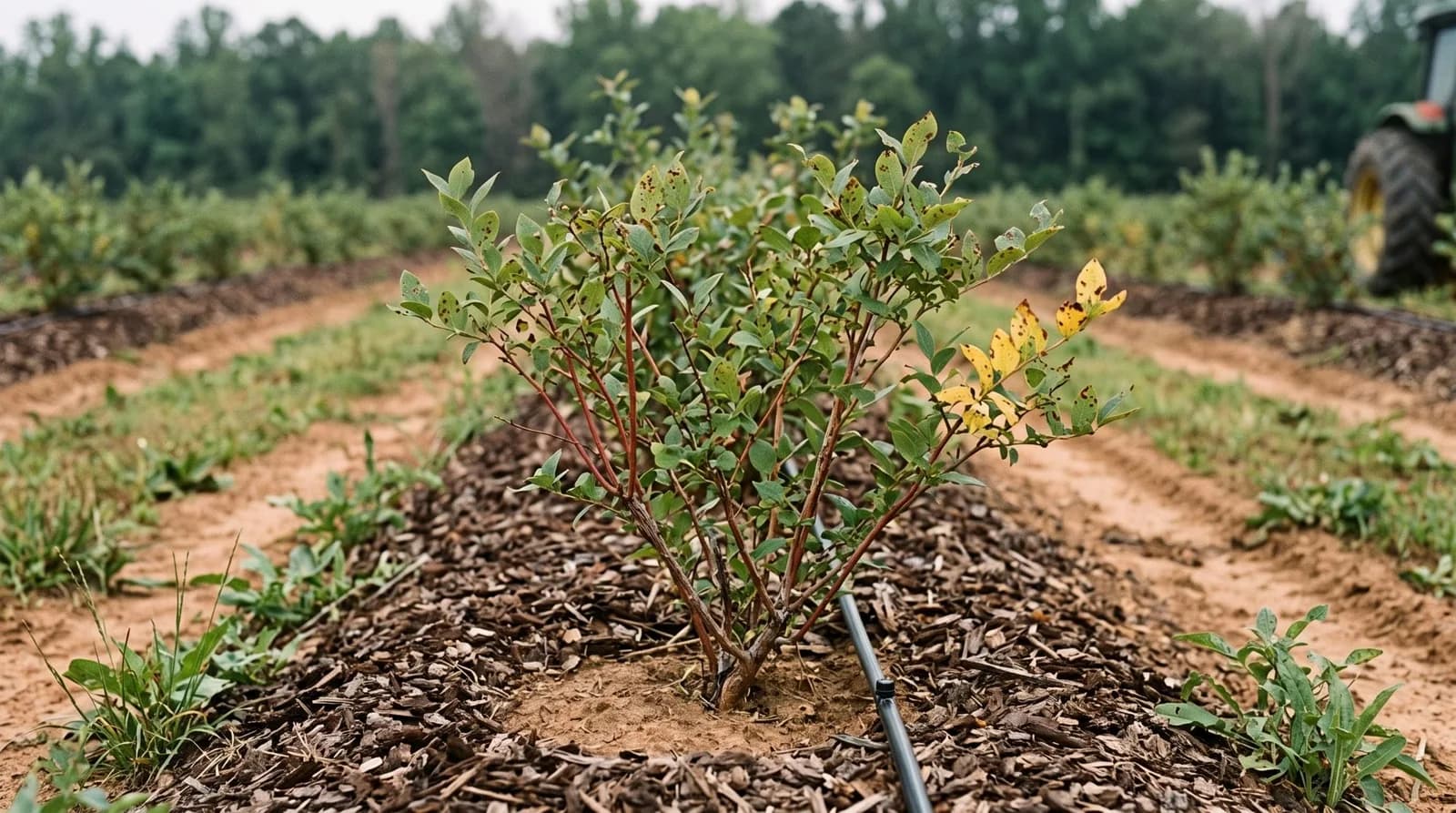
- 7.5–10 cm (3–4 in) of organic mulch, Penn State 10 cm or more at planting; keep clear of the stem1
- Nitrogen
- Cold-climate trials: 34, 45 and 56 kg N/ha (30, 40, 50 lb/acre) in years one to three; ammonium sulfate or urea2
- Flowers
- Remove all blossoms in the first year; the Minnesota guide allows no fruit for two years2
- US average yield, 2025
- 8.2 t/ha (7,340 lb/acre) across about 42,400 harvested hectares3
Match the type to your winter
- Highbush and half-high
- Highbush blueberries are the standard commercial type for cool-temperate climates. Half-high types are crosses of highbush and lowbush blueberries that stay short and are hardy enough for winter minimums of roughly −40 to −23°C (USDA zones 3–5), where taller types suffer winter injury.1,2
- Check local trial data
- Cold hardiness, chilling need, fruit size and ripening date differ widely by cultivar, so choose from variety trials near you rather than from a US catalogue. Alternating different cultivars also helps pollination.2
Fix soil pH a year ahead
| Starting pH | Sand or loamy sand | Sandy loam or loam |
|---|---|---|
| 5.0 | 190 (170) | 560 (500) |
| 5.5 | 390 (350) | 1,120 (1,000) |
| 6.0 | 590 (525) | 1,680 (1,500) |
| 6.5 | 730 (650) | 2,240 (2,000) |
| 7.0 | 900 (800) | 2,800 (2,500) |
Sources2
- From pH 5.0560 kg/ha
- From pH 5.51,120 kg/ha
- From pH 6.01,680 kg/ha
- From pH 6.52,240 kg/ha
- From pH 7.02,800 kg/ha
- Target
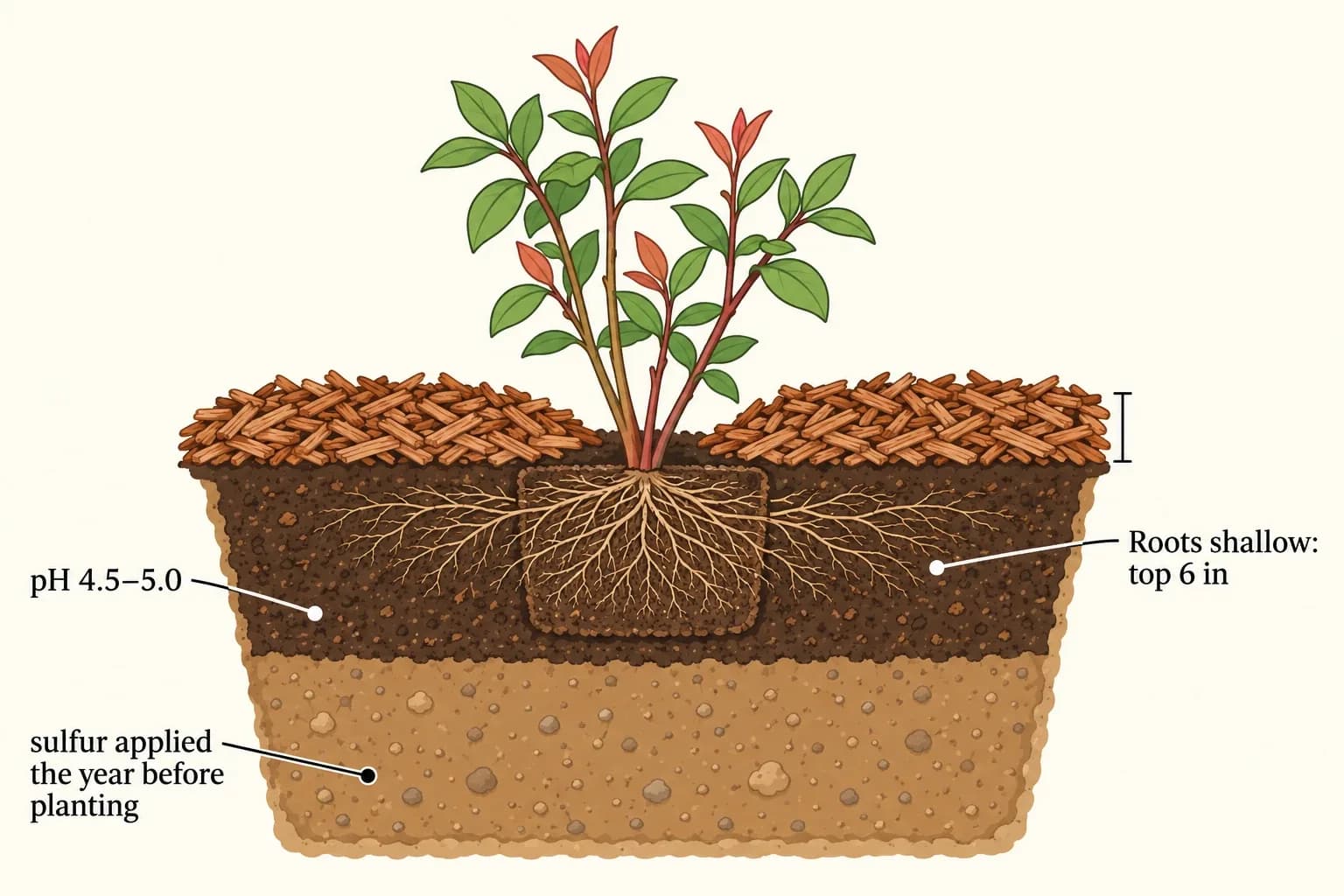
- Penn State gives pH 4.5–5.0 and Penn State advises against blueberries when native pH is above 6.2. Minnesota calls 4.5–5.5 optimum, with iron chlorosis likely above 5.8.1,2
- Sulfur timing
- Elemental sulfur reacts slowly, so apply and incorporate it to plough depth the year before planting, then retest after three to four months. Iron sulfate acts faster but costs more; avoid aluminium sulfate, which can be toxic to roots.2
Plant dormant stock in spring
Between rows: 2.4–3 m (8–10 ft) · Within the row: 1.2–1.5 m (4–5 ft)
Penn State uses 1.5 m (5 ft) in rows 2.4–3.7 m (8–12 ft), about 1,790–2,690 plants per hectare; Minnesota gets about 3,360 plants/ha at 1.2 m by 2.4 m (4 by 8 ft). Schematic, not to scale.
- Spacing
- Plants go 1.2–1.5 m (4–5 ft) apart in rows 2.4–3 m (8–10 ft) apart, set by your equipment. Minnesota counts about 3,360 plants per hectare (1,360 per acre) at 1.2 by 2.4 m; Penn State gives about 1,790–2,690 per hectare (726–1,089 per acre) at 1.5 m in rows 2.4–3.7 m.1,2
- Date
- Plant dormant stock in early spring, as soon as the field allows (about April at Penn State; the southern-hemisphere equivalent is roughly September–October). Spring beats autumn in cold climates for spring rains and less frost heave. Potted plants that have leafed out wait until frost has passed.1,2
- Planting
- Holes are about 30 cm (one foot) deep and wide. Loosen the roots of container plants, and set the plant at the depth it had in the container.2
Feed lightly with an acid-forming nitrogen
- First year34 kg N/ha
- Second year45 kg N/ha
- Third year56 kg N/ha
- Rates
- On mineral soils the Minnesota guide applies 34, 45 and 56 kg N per hectare (30, 40 and 50 lb per acre) in years one to three, 11–22 kg less on high-organic soils, then follows leaf analysis.2
- Source and timing
- Use ammonium sulfate or urea to help hold soil pH down. Excess late-season nitrogen can increase winter injury, so stop in midsummer (Minnesota avoids applications after 1 July).2
- Water
- Roots are shallow, mostly in the top 15 cm (6 inches). Do not let soil dry below 30–50 kPa (centibars) of tension between irrigations, and give a uniform supply from blossom through harvest.2
Remove flowers and prune
- Early flowers
- The Minnesota commercial guide removes flowers for the first two years so plants can establish before carrying a crop.2
- Pruning
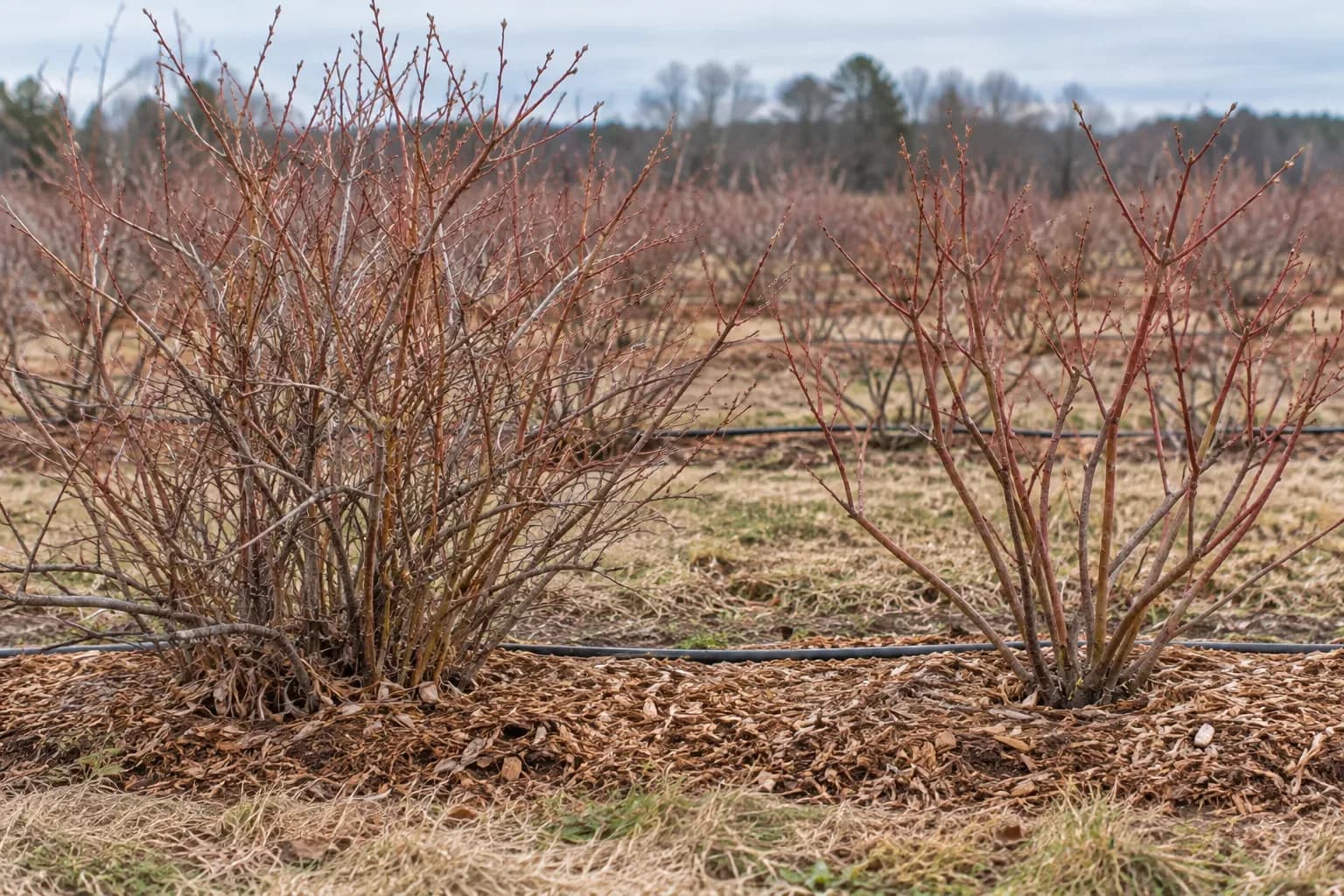
- Prune each year while dormant, late in the dormant season (March in Pennsylvania), before buds swell. Remove dead wood, weak growth and old canes; after year three keep about 6 to 7 vigorous older stems and one or two strong new shoots.1,2
- Time to crop
- Penn State expects a small crop of about 2,000 pints per acre in year three (roughly 1.5 t/ha), rising until about year five, with 6,000 pints per acre (roughly 4.5 t/ha) possible. Half-high cultivars in cold climates need about five years for a large crop and up to ten to reach mature size.1,2
Pollination, birds and fruit fly
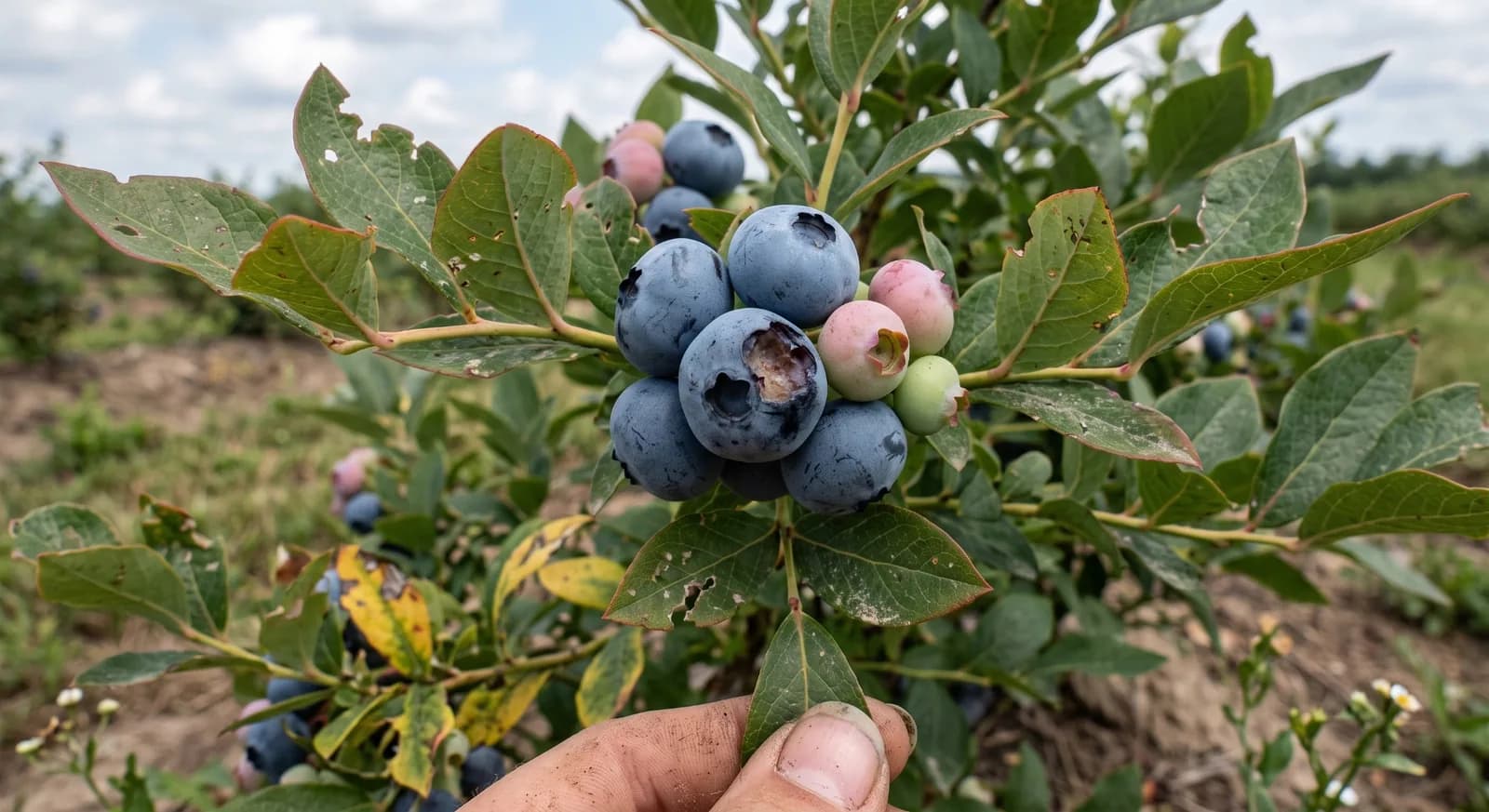
- Bees
- Bees pollinate blueberries. Many cultivars set without a second variety but mixed plantings give larger berries and earlier ripening; alternate every 4 rows or every 4–5 plants. The Minnesota guide uses about one honeybee hive per acre (roughly 2.5 per hectare) on large plantings; bumblebees are better but dearer.2
- Birds
- Netting is the only measure that gives complete protection year after year (Penn State). Distress-call and visual scare devices are only partial measures.1,2
- Spotted wing drosophila
- This fruit fly is a pest wherever it has spread. Penn State advises early-fruiting cultivars, which avoid much of the damage.1
Yield benchmark and your own margin
The only consistent national dataset used here is the United States, so treat these as a benchmark and not a forecast for your country. Cultivated blueberries were harvested from about 42,400 hectares (104,700 acres) in 2025, with about 345,000 tonnes (761 million pounds) utilised: roughly 189,000 tonnes fresh and 156,000 tonnes processed.
- Oregon14 t/ha
- Washington12.7 t/ha
- California12.2 t/ha
- North Carolina6.4 t/ha
- Georgia5.7 t/ha
- Michigan5.2 t/ha
- New Jersey5 t/ha
- Florida4.1 t/ha
- Read the chart carefully
- The Pacific states pull the US average of 8.2 t/ha up; the other five states average roughly 4–6.5 t/ha. Yield and price vary several-fold between regions, soils and markets, so the national average says little about your field.3
Frequently asked questions
- What pH do blueberries need?
- Penn State gives 4.5–5.0; Minnesota calls 4.5–5.5 optimum. Penn State advises against planting blueberries where native pH is above 6.2.
- How far apart do you plant blueberries?
- Plants 1.2–1.5 metres (4–5 feet) apart in rows 2.4–3 metres (8–10 feet) apart. Penn State uses 1.5 metres in rows 2.4–3.7 metres, about 1,790–2,690 plants per hectare.
- When do you plant blueberries?
- Dormant plants go in early spring as soon as the soil is workable, about April in Pennsylvania. Potted plants that have leafed out wait until after frost.
- How long until blueberries produce?
- A small crop arrives in year three and production rises until about year five. Cold-climate guides remove flowers for the first two years.
- How do you lower soil pH for blueberries?
- Apply and incorporate elemental sulfur the year before planting; the University of Minnesota gives about 560–2,800 kg per hectare on loam depending on starting pH. Use ammonium sulfate or urea as the nitrogen source.
- Do blueberries need a second variety?
- Many cultivars set without one, but mixed plantings give larger berries and earlier ripening. The Minnesota guide uses about one honeybee hive per acre (roughly 2.5 per hectare) on large plantings.
- What yield can I expect from blueberries?
- Penn State expects a small crop of roughly 1.5 t/ha in year three, rising to about 4.5 t/ha or more by year five. The US average in 2025 was 8.2 t/ha, with the best regions above 12 t/ha. Audit your own location before budgeting.
Regional guides and field planning
Sources and image credits
- 1. Penn State Extension — Highbush Blueberry Production — Accessed 1 October 2026. Pennsylvania pH, spacing, mulch, planting date, pruning, time to crop and pest notes.
- 2. University of Minnesota Extension — Commercial blueberry production in Minnesota and Wisconsin — Updated February 2014. Half-high blueberries in zones 3–5: sulfur rates, nitrogen by year, spacing, pollination, mulch and irrigation.
- 3. USDA NASS — Noncitrus Fruits and Nuts 2025 Summary — Published May 2026. US and state cultivated blueberry area harvested, yield, production and value, 2023–2025.
Image credits
- A fruiting highbush bush on deep organic mulch with drip irrigation.
- Planting cross-section: acid, organic soil at pH 4.5–5.0 with sulfur applied the year before, mulch on top (bracket) and a shallow root system in the top 6 inches. Schematic illustration.
- A young bush with mulch kept clear of the stem and a drip line alongside.
- Dormant pruning: the unpruned bush (left) is crowded with thin canes; the pruned bush (right) keeps strong canes and an open centre.
- Fruit damage from birds and insects such as spotted wing drosophila is a main fruit loss.
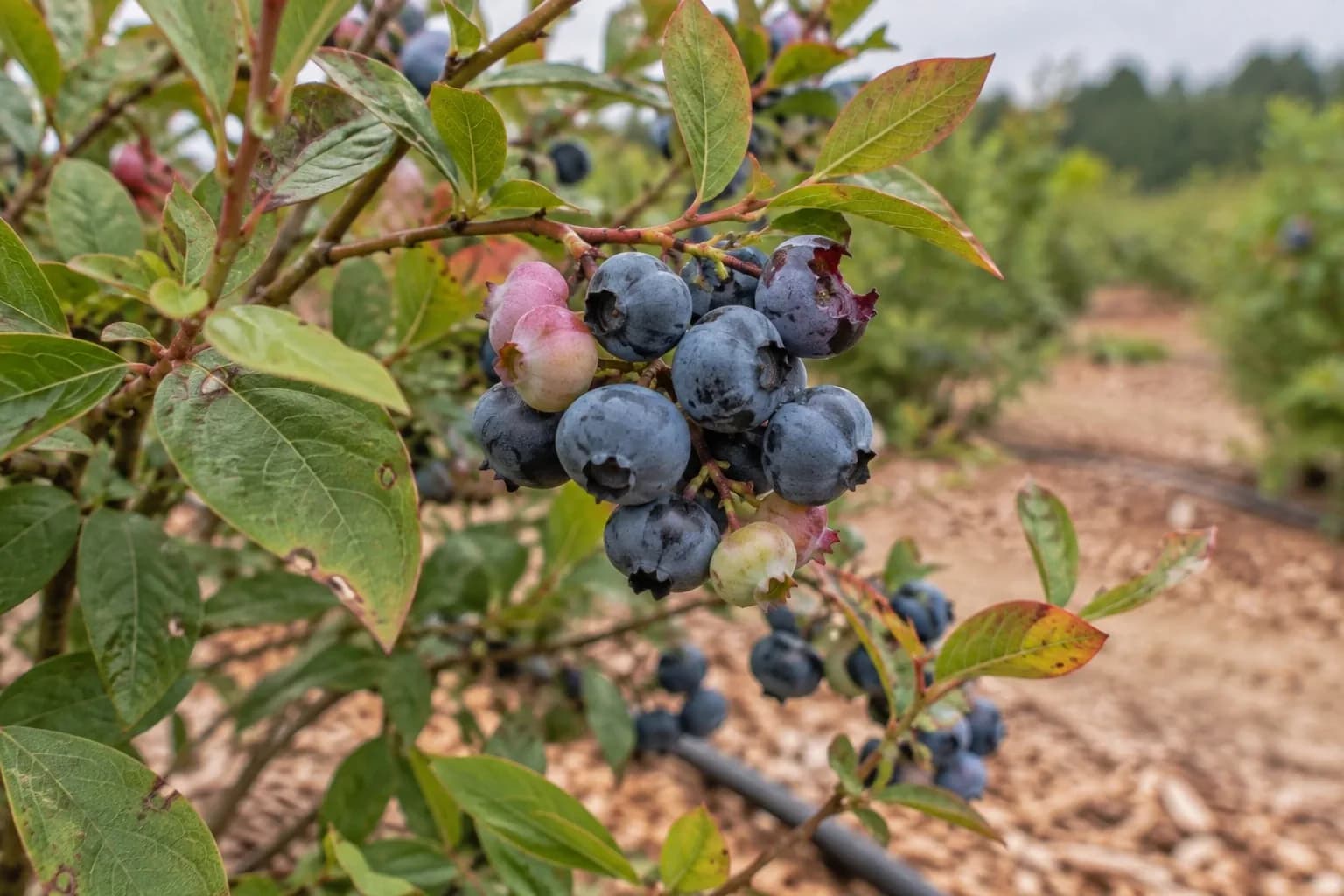
- Ripe berries have a dusty blue bloom; berries on one cluster ripen over several picks.
Figures are published averages or study assumptions for the places named, not guarantees for your field. Check current local recommendations and product labels before acting.
Some visuals in this guide are illustrations rather than photographs of a specific farm. See image credits.