

Growing blueberries in California
California grows blueberries across several climates. The strongest local production example in the reviewed sources is a 2009 southern San Joaquin Valley budget for low-chill southern highbush. Its planting dates, soil treatment and spacing describe that subregion and study, not the whole state.
Scope: Statewide crop context plus a historical southern San Joaquin Valley South production example. Confirm current cultivars and field chemistry with a local UCCE farm advisor before planting. Updated 2026-10-03.
At a glance
- California blueberry acreage, 2025
- About 3,076 ha (7,600 acres)1
- California yield, 2025
- About 12.2 t/ha (10,900 lb/acre)1
- Regional example
- Southern San Joaquin Valley South; the study uses low-chill southern highbush2
- Study soil target
- pH 5.0 ± 0.5; local soils in the study area were commonly pH 6.7–7.52
- Study field layout
- 0.9 m (3 ft) between plants and 3.4 m (11 ft) between rows2
- Study irrigation
- 2.5–3 acre-feet/acre over a season; a historical budget figure, not a current statewide schedule2
- Historical harvest examples
- Central Coast: April–July; San Joaquin Valley: May–June in an older trial4
Perennial growth and climate in California
A perennial planting remains in the field for multiple years. Establishment is a long-term investment; flowering, fruit development, harvest and plant care recur as the planting matures. Follow the named cultivar and production system.
Establish a long-lived planting2,3
Prepare and test an acidic, well-drained root zone and irrigation water before establishing low-chill southern highbush. The San Joaquin Valley budget describes a long-lived field layout; use current local cultivar trials for the farm.
Management: Follow the cultivar growth cycle2,4
Monitor bud development, bloom, fruit fill and postharvest growth. Mild coastal southern highbush systems can remain evergreen, so winter dormancy is not universal. Match pruning and nutrition to the production system.
Harvest: Historical California trials4
In the 2000 trials, Central Coast harvest ran 6 April–19 July and San Joaquin Valley harvest 6 May–13 June. These are separate historical observations, not a current statewide forecast.
Historical monthly climate
Reference period: 1996-01-01 to 2025-12-31. ERA5-Land monthly mean soil temperature at 0–7 cm, air temperature and frost days at the regional reference point (37, -120). Select a month to inspect its historical conditions.
Month tiles show mean air temperature.
April historical conditions
- Mean topsoil temperature
- 17.4°C
- Mean air temperature
- 16.7°C
- Mean frost days per month
- 0.0 days
Use this monthly history to assess winter exposure, seasonal heat and water planning. It does not calculate cultivar chill hours, flowering dates, frost damage during bloom or fruit maturity. Topsoil at 0–7 cm describes shallow soil context, not the full root zone. Harvest periods follow the production evidence above.
Climate source: Open-Meteo Historical Weather APIUse regional evidence, not one California calendar
- California12.2 t/ha
- US average8.2 t/ha
- State context
- USDA NASS reported about 3,076 ha (7,600 acres) of blueberry acreage in California in 2025. The reported yield is a state average. It does not tell you what a new field on your soil will produce.1
Test soil and irrigation water before planting
- Soil pH
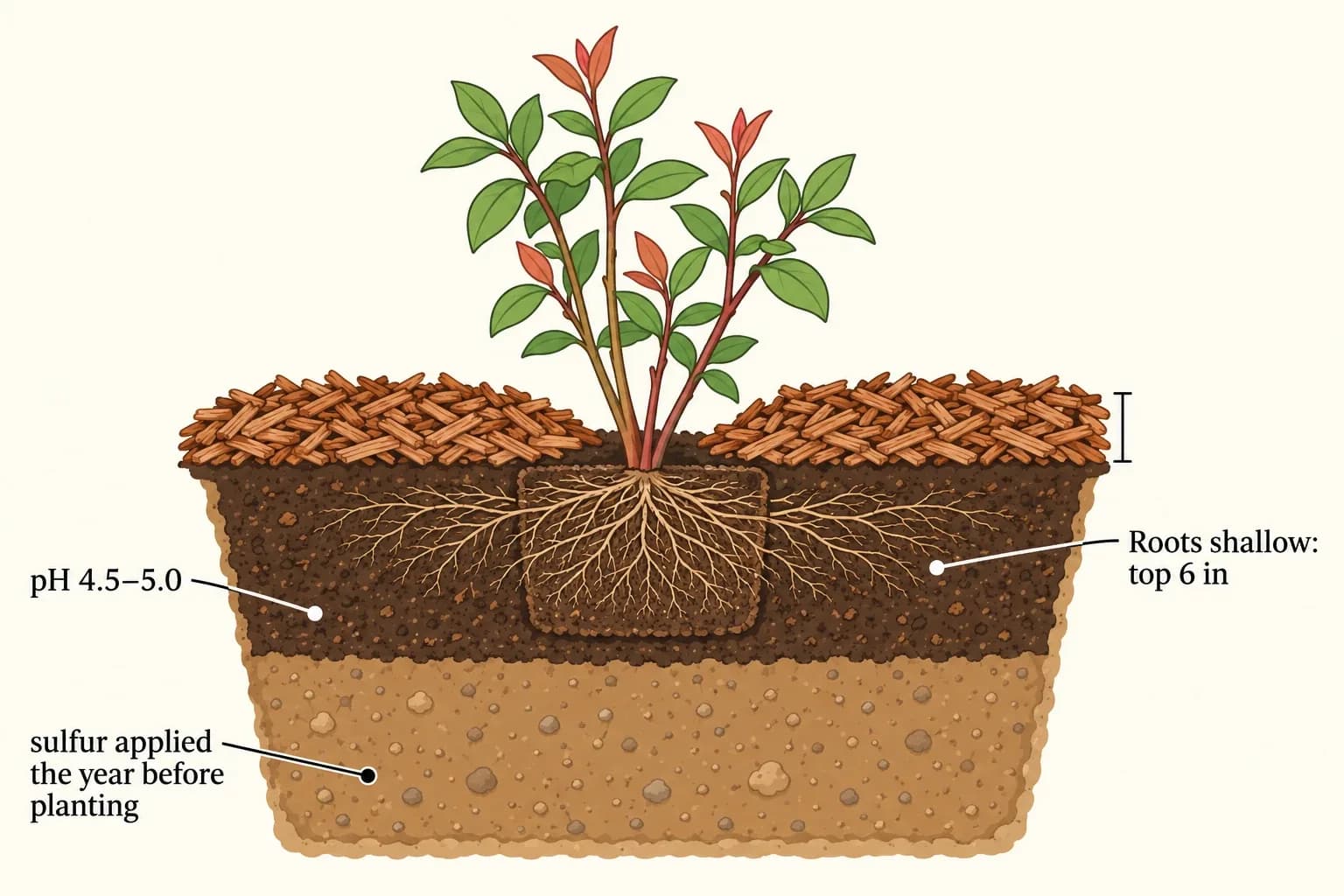
- The San Joaquin Valley South budget targets about pH 5.0, with a half-point range. It reports many local soils at pH 6.7–7.5 and says production becomes unfeasible on heavily alkaline soil.2
- Plan acidification early
- The study samples soil months before planting, adjusts and retests it, and monitors pH to avoid over-acidification. Its acid application method and rate are specific to the study operation; use a current soil and water analysis with a qualified local adviser instead of copying that rate.2
- Water chemistry
- The study also acidifies irrigation water. It reports alkaline local water, so test alkalinity and salinity as well as pH before budgeting for treatment.2
Match variety and chill to your subregion
- San Joaquin Valley South example
- The 2009 budget uses low-chill southern highbush, with Jewel or Star planted alongside Emerald as a pollinizer. These are the study’s varieties, not a current statewide recommendation.2
- Check current trials
- A 2005 UC ANR research article records early-season production in California and different trial harvest dates by area. Ask a local UCCE farm advisor which currently available cultivars fit your site’s chill accumulation and frost exposure.3
Treat the study layout as a local example
Between rows: 3.4 m (11 ft) · Within the row: 0.9 m (3 ft)
Historical commercial budget spacing; equipment and current cultivar systems may require a different layout.
- Establish a lasting root zone
- Prepare and test soil and irrigation water before setting bushes. Build the study’s raised-bed layout only where local drainage, soil chemistry and equipment justify that system.2
- Raised beds
- The study forms beds 0.9–1.2 m (36–48 in) wide and 0.3–0.46 m (12–18 in) high. It uses these beds as part of its local soil and irrigation system.2
Budget irrigation and mulch for the field
- Seasonal water
- The 2009 budget estimates 2.5–3 acre-feet/acre per growing season, about 3,100–3,700 m³/ha. Treat that as a historical regional budget input, not an irrigation prescription. Recalculate for your site, system, water quality and current weather.2
- Mulch
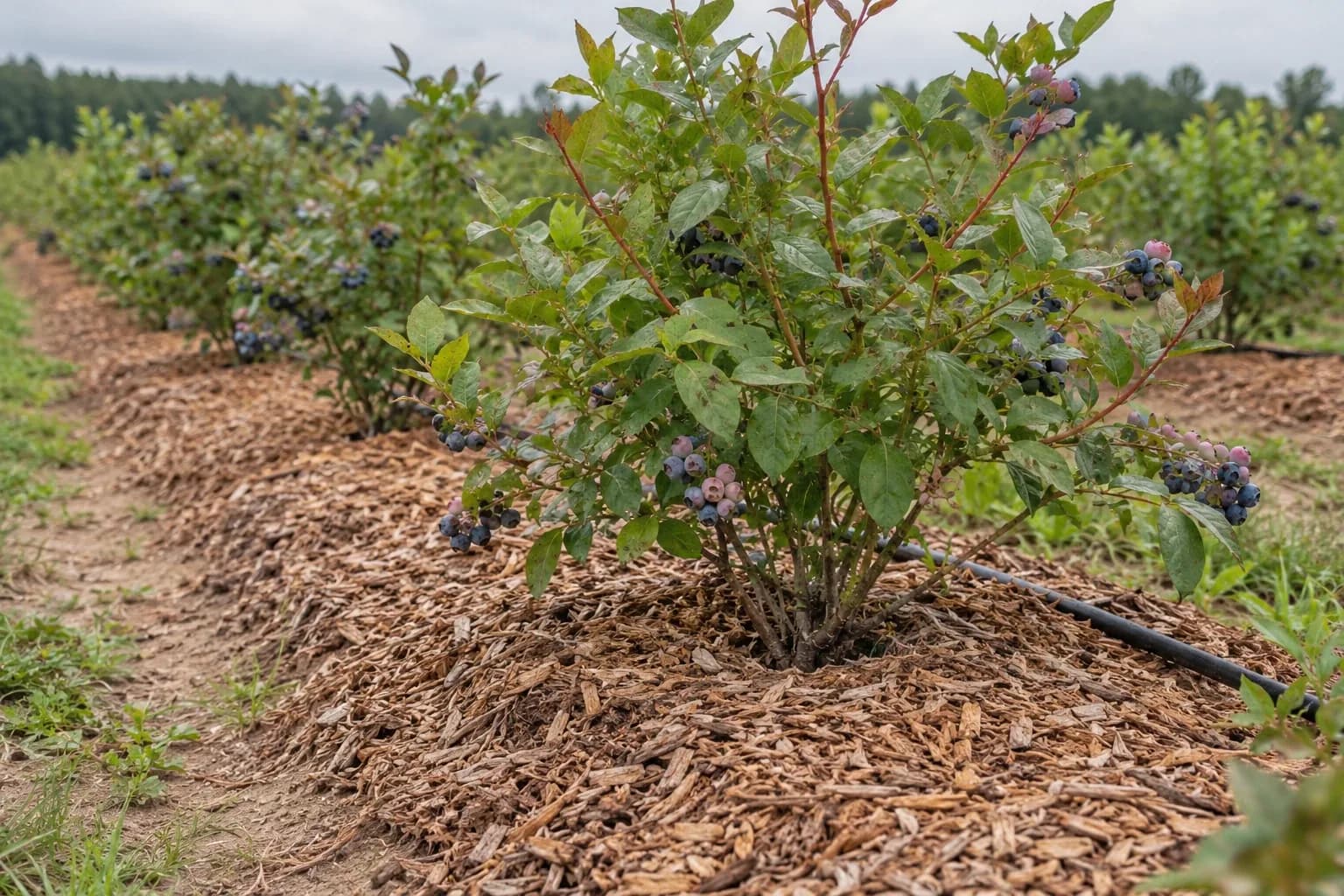
- The study uses a roughly 10 cm (4 in) wood-chip layer along the planting berm and replenishes it periodically. Material choice and availability vary by farm.2
Read harvest dates as trial history
- Historical windows
- The cited UC research records harvest from 6 April to 19 July in its Central Coast trial and 6 May to 13 June in its San Joaquin Valley trial. These older observations do not forecast current commercial dates or every California district.4
Frequently asked questions
- Where are blueberries grown in California?
- California has substantial cultivated acreage, but this guide’s detailed production example is the southern San Joaquin Valley South. Coast and other valley districts need their own cultivar and site decisions.
- What soil pH do blueberries need in the San Joaquin Valley?
- The UC ANR study targets pH 5.0 ± 0.5 and reports many local soils at pH 6.7–7.5. Get soil and irrigation water tested before planning acidification.
- How do California farms establish a blueberry field?
- Test soil and irrigation water, prepare an acidic root zone and select cultivars for local chill and frost exposure. The San Joaquin Valley budget describes a perennial raised-bed field with mulch and irrigation.
- When are blueberries harvested in California?
- An older UC trial records April–July on the Central Coast and May–June in the San Joaquin Valley. Use current local trial and farm records for planning.
- What blueberry yield can I expect in California?
- USDA reported a California average of about 12.2 t/ha in 2025. That statewide average is not a field forecast.
Regional blueberries guides
Local dates, soil-temperature history and sources for specific regions:
Sources and image credits
- 1. USDA NASS — Noncitrus Fruits and Nuts 2025 Summary — Published May 2026. US and state bearing acreage, yield, production, price and value for avocados, almonds, olives and other fruit and nut crops, 2023–2025.
- 2. UC ANR — 2009 Blueberries Costs and Returns Study: San Joaquin Valley South — Published 2009. A historical southern San Joaquin Valley South production budget covering low-chill varieties, soil acidification, planting, spacing, irrigation and mulch.
- 3. UC ANR — Blueberry research launches exciting new California specialty crop — Published 2005. Historical California blueberry research and trial harvest observations by production area.
- 4. UC ANR — Extended season fresh market blueberry production — Historical 2000 trial observations; reviewed October 2026. Central Coast and San Joaquin Valley trial harvest dates and evergreen southern highbush production context.
Image credits
- A fruiting blueberry bush with mulch and drip irrigation.
- Blueberries need an acidic, organic root zone. Schematic illustration.
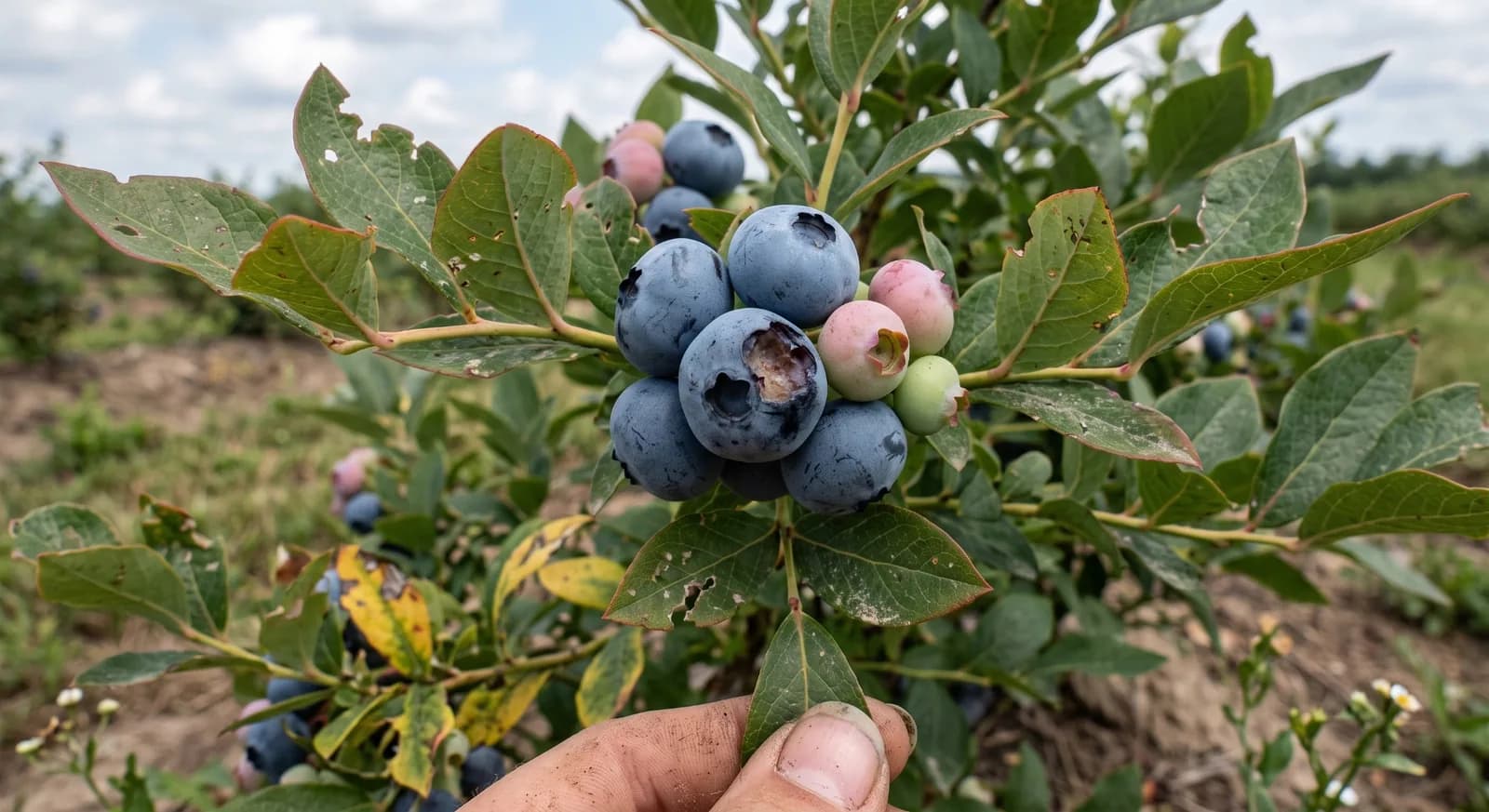
- Inspect fruit for damage as it ripens.
Figures are published averages or study assumptions for the places named, not guarantees for your field. Check current local recommendations and product labels before acting.
Some visuals in this guide are illustrations rather than photographs of a specific farm. See image credits.