

How to grow corn: a commercial guide
This guide covers grain (field) corn in the US Corn Belt, using Iowa as the reference state. Sweet corn and silage have different maturity targets and are not covered. The planting window, nitrogen rate and harvest moisture are the three decisions that move yield and cost most.
Scope: Commercial grain corn, Corn Belt (Iowa reference). Sweet corn and silage excluded. Updated 2026-10-16.

At a glance
- Seeding rate
- About 79,080–86,490 seeds per ha (32,000–35,000 seeds/acre) typical response; economic rate 2,000–4,000 lower when seed is dear1
- Depth
- About 5 cm (2 in) (4–5 cm (1.5–2 in) on fine soils)3
- Nitrogen, Iowa MRTN
- About 140 kg N/ha (124 lb N/acre) after soybean; 174 after corn (0.10 price ratio)4
- Harvest moisture
- Black layer at about 30%; combine at 15–20%5
- Iowa state yield
- 13.2 t/ha (211 bu/acre) in 2024, 210 in 2025 (NASS)6
Start from the rotation and the market
- Rotation sets the nitrogen bill
- Corn after soybean needs far less N than corn after corn (see nitrogen below). Decide rotation before you price inputs.4
- Grain outlet
- Confirm delivery window, drying and storage capacity with the buyer before choosing a hybrid and planting date. Drying cost is set largely by harvest moisture.5
Match hybrid maturity to the season
- Full-season usually wins
- When planted in April and May in northwest, north-central and central Iowa, full-season hybrids out-yielded shorter-season ones in Iowa State trials; the difference in reaching maturity was about 10 days.1
- But leave a dry-down runway
- A later hybrid reaches black layer later and dries in cooler weather. Choose the longest maturity that still finishes in time for the harvest moisture and drying capacity you have.5
Plant: date, rate and depth
| Iowa region | Window |
|---|---|
| Northeast | April 12 – May 2 |
| Northwest and central | April 15 – May 18 |
| South | April 11 – May 13 |
Sources1
- Fine-textured soils: 4–5 cm (1.5–2 in)
- Iowa reference: about 5 cm (2 in)
Dig behind the planter after the first pass and recheck when soil, residue or moisture changes.
Between rows: 76 cm (30 in) · Within the row: ≈14.5 cm (5.8 in)
Thirty-inch rows; the seed spacing is calculated for 88,960 seeds per ha (36,000 seeds per acre) (about 34,000 established plants). Schematic, not to scale.
- Soil temperature
- Plant near 10°C (50°F) at seed depth when temperatures are expected to rise; check the 3–7 day forecast and wait if equipment would smear wet soil.2
- Yield falls after mid-May
- Yield begins to decline after about May 15 and falls quickly after June 1.1
- Rate
- The seeding rate is seeds dropped, not final stand; some seeds always fail to establish. Typical response is at 79,080–86,490 seeds per ha (32,000–35,000 seeds/acre); the economic rate is 2,000–4,000 lower depending on seed cost. Iowa State guidance spans 28,000–42,000 across fields and hybrids.1,3
- Depth
- About 5 cm (2 inches); 4–5 cm (1.5–2 inches) on fine-textured soils. Dig behind the planter after the first pass and recheck when soil or residue changes.3
- Count the stand
- In 76 cm (30-inch) rows count live plants in 5.2 m (17 ft) 12.5 cm (5 in) and multiply by 1,000. Repeat in at least six areas.3
Set the nitrogen rate
| Previous crop | MRTN (lb N/acre) |
|---|---|
| Soybean | 124 |
| Corn | 174 |
Sources4
- After soybean140 kg N/ha
- After corn195 kg N/ha
- Use the calculator with your prices
- The Iowa State Corn Nitrogen Rate Calculator returns the economic rate and a profitable range for your rotation, fertilizer product and prices. The rates already include the rotation effect, so do not subtract a separate soybean credit.4
- Rates move with prices
- Another Iowa State calculation (corn at $6.50/bu, anhydrous at $1,540/t ($1,400/short ton)) gave 155 kg N/ha (137 lb N/acre) after soybean with a profitable range of 127–147 for most of Iowa. Re-run it for current prices.4
Scout establishment, then the season
- Early stand
- Cool, wet or compacted seedbeds cause delayed emergence, gaps and seedling disease. Compare plant counts with the planting record to find stand problems early.3
- Pests and weeds
- Scout by crop stage and field history and follow current local thresholds and product labels. Thresholds change and are not reproduced here.3
Harvest and dry
- 1
Black layer
Physiological maturity at about 30% grain moisture.
- 2
Field drydown
Typically 0.4–0.8 points a day; up to 2.5 cm (1.0 in) ideal weather, under 8 mm (0.3 in) poor weather.
- 3
About 2–4 weeks
To fall from about 30% to 15% in the field.
- 4
Combine
Ideal harvest moisture for field corn is 15–20%.
- Black layer
- At physiological maturity (black layer) grain is about 30% moisture. Expect 2–4 weeks to fall to 15% in the field.5
- Field drydown
- Typical in-field drying is 0.4–0.8 percentage points a day, up to about 2.5 cm (1.0 in) ideal weather and under 8 mm (0.3 in) poor weather. It slows sharply as October cools.5
- Target moisture
- Ideal harvest moisture for field corn is 15–20%. Waiting saves drying cost but risks lodging and field loss.5
Yield and economics
Iowa averaged 13.2 t/ha (211 bu/acre) in 2024 and 210 in 2025. That is a statewide average across many soils. Your break-even price is total cost per hectare divided by expected yield.
- Use current cost tables
- Iowa State publishes Estimated Costs of Crop Production in Iowa each year, for corn after soybean and corn after corn. Put your own land, drying and machinery costs into the crop ROI estimator.7
Frequently asked questions
- When should corn be planted in Iowa?
- Iowa State data put the 95–100% yield window at about April 15 – May 46 cm (18 in) central and northwest Iowa, earlier in the south and northeast. Plant when soil at seed depth is near 10°C (50°F) and warming.
- How many seeds per hectare?
- A typical response range is 79,080–86,490 seeds per ha (32,000–35,000 seeds per acre). The economic rate is 2,000–4,000 lower when seed is expensive.
- How deep should corn be planted?
- About 5 cm (2 inches), and 4–5 cm (1.5–2 inches) on fine-textured soils. Check depth behind the planter.
- How much nitrogen does corn need?
- In Iowa the economic rate is about 140 kg N/ha (124 lb N/acre) after soybean and 174 after corn at a 0.10 price ratio. Use the Iowa State calculator for current prices.
- What moisture should corn be harvested at?
- Field corn is best harvested at 15–20% moisture. It is about 30% at black layer and dries 0.4–0.8 points per day in good weather.
Regional guides and field planning
Sources and image credits
- 1. Iowa State University Extension — Updated planting date recommendations for Iowa, and corn planting research — 2010, with later planting-date summaries. Regional yield windows, yield decline after mid-May, hybrid maturity trials and seeding-rate response in Iowa.
- 2. Iowa State University Extension — Corn soil temperature and planting conditions, 2026 — 26 March 2026. Plant near 10°C (50°F) at seed depth with a warming forecast.
- 3. Iowa State University Extension — Corn Field Guide — Current online edition; accessed 26 September 2026. Iowa planting depth and population guidance; the Iowa regional guide on this site lists the supporting sources, including University of Minnesota stand-count methods.
- 4. Iowa State University — Corn Nitrogen Rate Calculator and PM 2015 (Regional Nitrogen Rate Guidelines) — Current calculator. MRTN rates by rotation and price ratio; Iowa main region.
- 5. Iowa State University Extension — How fast can corn dry down? — Accessed 30 September 2026. Drydown rates, maturity moisture and harvest moisture.
- 6. USDA NASS — Iowa State Agriculture Overview 2025 — Accessed 30 September 2026. Iowa corn for grain yield and production. State average only.
- 7. Iowa State University Extension — Estimated Costs of Crop Production in Iowa — Annual publication. Per-acre cost tables for corn after soybean and corn after corn.
Image credits
- Field corn. Photo: Lina Kivaka, via Pexels (Pexels License).
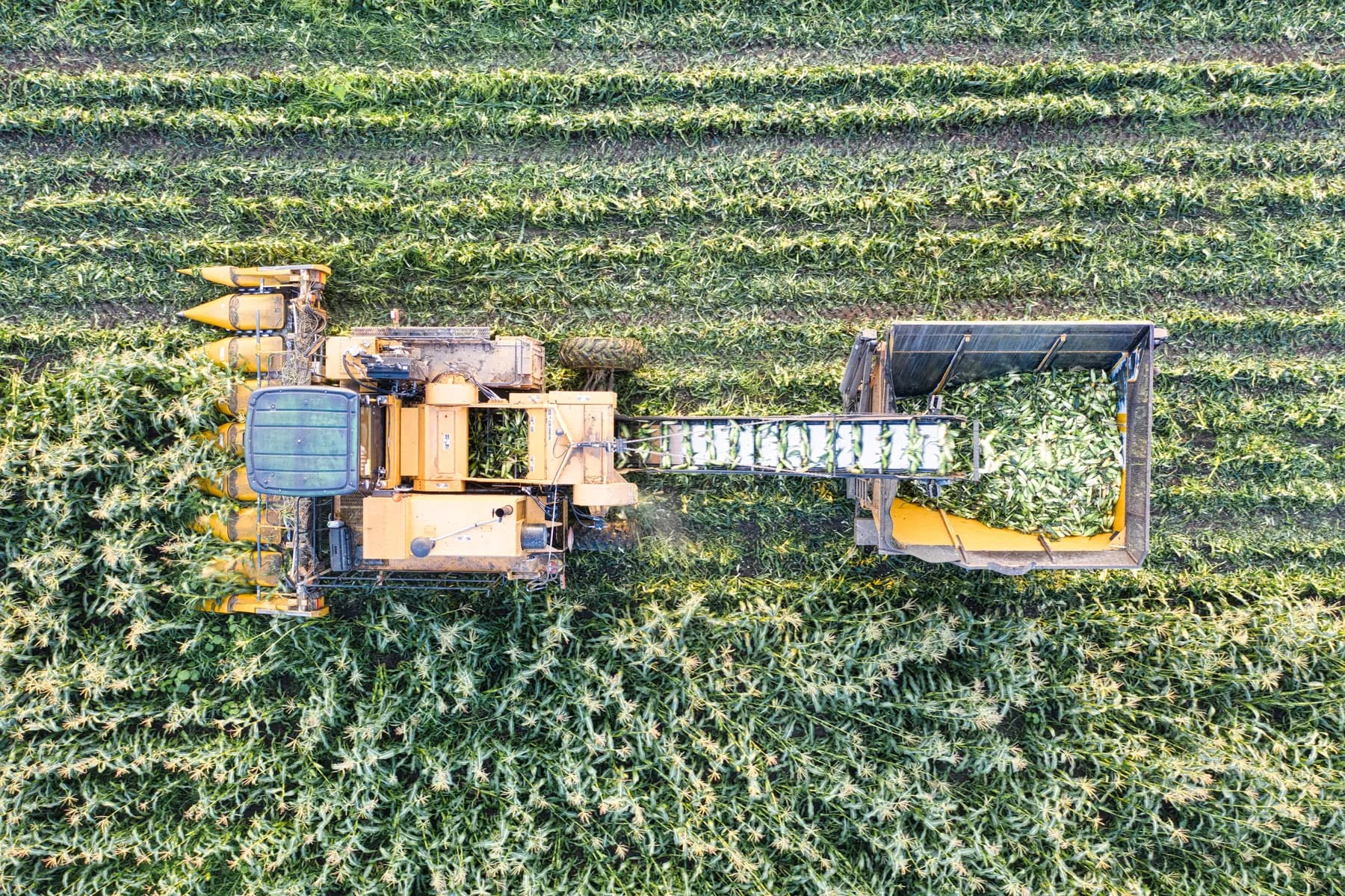
- Corn harvest from above. Photo: Tom Fisk, via Pexels (Pexels License).
Figures are published averages or study assumptions for the places named, not guarantees for your field. Check current local recommendations and product labels before acting.