

How to grow garlic: a commercial guide
Garlic is planted as cloves in the fall, overwinters, and is lifted the following summer when the lower leaves have yellowed. Planting date, clean seed and curing decide the crop. Figures are from Midwest and Northeast US university sources, and where they disagree the table or text shows both.
Scope: Commercial and small-farm garlic, northern US (fall-planted). Updated 2026-10-16.
At a glance
- Plant when
- Fall: 6–8 weeks before the ground freezes (Midwest) or 3–4 weeks before the first killing frost (Rutgers)1,3
- Spacing
- Cloves 7.5–15 cm (3–6 in) apart in rows 23–91 cm (9–36 in) apart; Oregon 19.7–30 cloves per m (6–9 cloves per row-foot) in two rows per 102 cm (40-in) bed1,3,4
- Seed needed
- About 1,570–2,240 kg of cloves/ha (1,400–2,000 lb of cloves per acre) (Oregon Cal. Early/Late)4
- Yield
- 6,730–13,450 kg/ha (6,000–12,000 lb/acre) (Rutgers); 5,000–17,000 (Oregon); California average 14,0003,4,5
- Storage
- Commercial cold store 0°C (32°F), 65–70% humidity, 6–7 months4
Choose the type and clean seed
- 1
Plant in fall
6–8 weeks before the ground freezes (Midwest).
- 2
Mulch and overwinter
5–10 cm (2–4 in) of straw over the rows.
- 3
Spring regrowth
Sidedress N every 3 weeks; remove scapes as they appear.
- 4
Lift
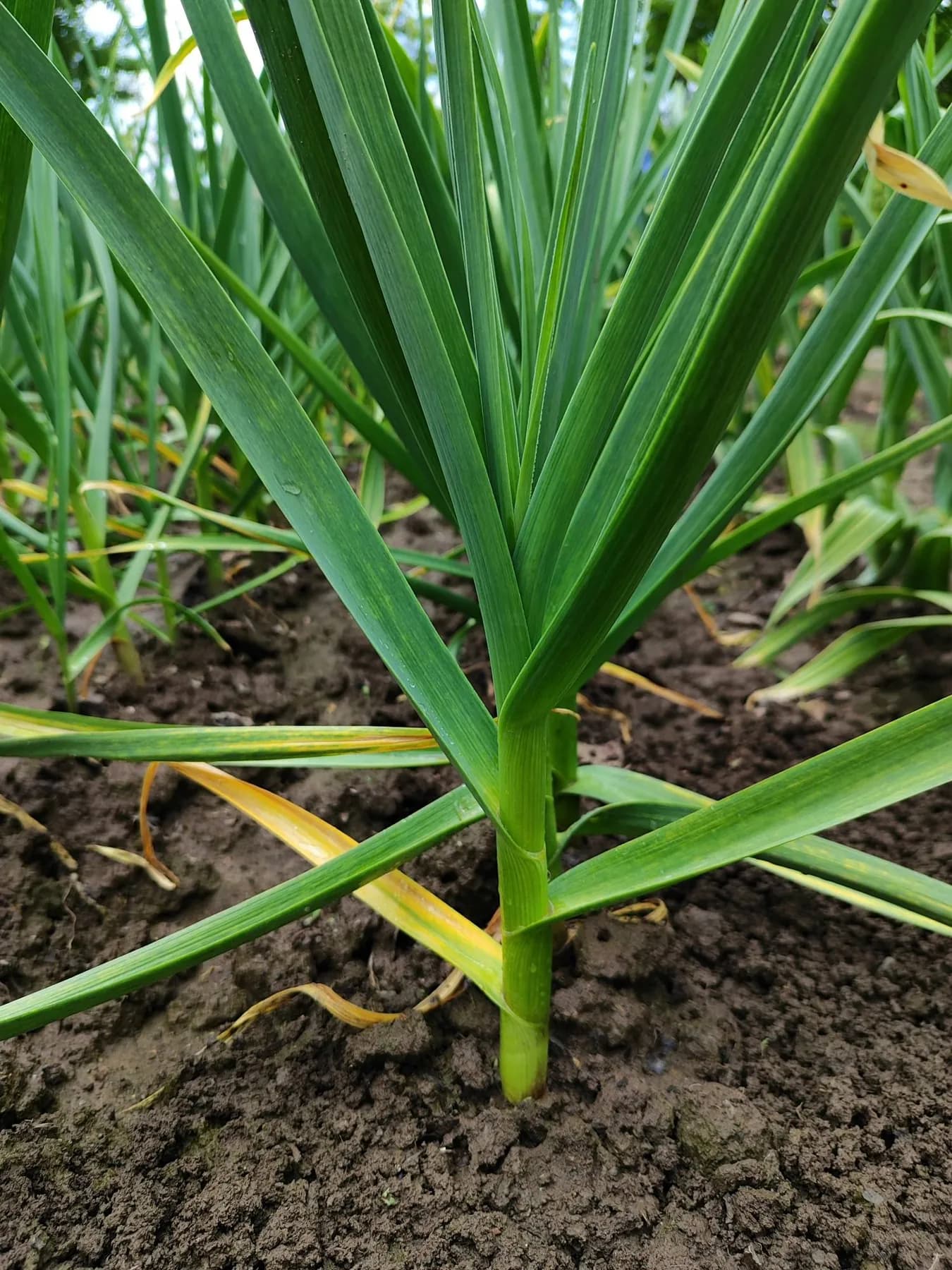
70–110 days after regrowth; 40–60% of leaves yellow.
- 5
Cure
About 3 weeks, 24–29°C (75–85°F), until outer leaves are dry.
- 6
Store
0°C (32°F) and 65–70% humidity for 6–7 months (Oregon State).
- Hardneck or softneck
- Hardneck types overwinter better in the Midwest, have stronger flavour and peel more easily, and produce scapes. Softneck types keep longer and have milder flavour and smaller cloves. Elephant garlic is grown like garlic but is milder.1
- Start from healthy seed
- White rot, botrytis leaf blight, downy mildew and Fusarium basal rot are the documented threats. Rutgers recommends clean planting stock and a robust crop rotation; discard cloves with blemishes or disease.3,2
- Seed quantity
- Oregon State gives 1,790–2,240 kg/ha (1,600–2,000 lb/acre) of California Early cloves, or 1,570–1,910 kg/ha (1,400–1,700 lb/acre) of California Late; elephant garlic needs 560–1,120 kg/ha (500–1,000 lb/acre).4
Plant in the fall
| Source | Row spacing | Clove spacing | Depth |
|---|---|---|---|
| Midwest Vegetable Guide | 30–91 cm (12–36 in) | 7.5–15 cm (3–6 in) | 7.5–10 cm (3–4 in), with 5–10 cm (2–4 in) straw mulch over winter |
| Penn State | 15–30 cm (6–12 in) | 10–15 cm (4–6 in) | 2.5–4 cm (1–1.5 in), with 5–10 cm (2–4 in) straw mulch |
| Rutgers | 23–61 cm (9–24 in) | 7.5–10 cm (3–4 in) | not stated |
| Oregon State | two rows 30 cm (12 in) apart on 102 cm (40 in) beds | 19.7–30 cloves per m (6–9 cloves per row-foot) | about 5 cm (2 in) |
- Penn State: 2.5–4 cm (1–1.5 in)
- Oregon State: about 5 cm (2 in)
- Midwest guide: 7.5–10 cm (3–4 in)
Sources differ with region and winter severity; the deepest figure is for colder Midwest winters. Check your local extension.
Between rows: 30–91 cm (12–36 in) · Within the row: 7.5–15 cm (3–6 in)
Penn State uses 15–30 cm (6–12 in) rows; Oregon plants two rows 30 cm (12 in) apart on 102 cm (40-in) beds. Schematic, not to scale.
- Date
- The Midwest guide says plant 6–8 weeks before the ground freezes so roots form but shoots do not emerge; Rutgers says no later than 3–4 weeks before the first anticipated killing frost; Oregon plants in September or early October.1,3,4
- Depth depends on winter
- Depths range from 2.5–10 cm (1–4 inches) across these sources. The deeper figure is for colder Midwest winters with mulch; check your local extension recommendation.1,2
- Orientation
- For mechanical cultivation plant the flat side of the clove perpendicular to the row; for hand cultivation in dense plantings plant it parallel.1
Fertility and water
- Nitrogen programme
- Midwest guide: about 28 kg N/ha (25 lb N/acre) before planting, then sidedress 22–45 kg/ha (20–40 lb/acre) N every 3 weeks, finishing 4–6 weeks before harvest, for a total of 80–140 kg N/ha (70–125 lb N/acre). Penn State suggests 140 kg/ha (125 lb/acre) split 75 / 25 / 25. Oregon uses 56–85 kg/ha (50–75 lb/acre) N in fall and 110–195 kg/ha (100–175 lb/acre) in spring.1,2,4
- Phosphorus and potassium
- By soil test: up to 170 kg/ha (150 lb/acre) P2O5 and up to 110 kg K2O/ha (100 lb K2O per acre) (Midwest); Penn State suggests 170 kg/ha (150 lb/acre) of each.1,2
- Irrigation
- About 2.5 cm (1 inch) of water per week in dry periods through mid-June, then stop to encourage maturation (Penn State).2
Manage scapes, rotation and disease
- Remove scapes
- Remove flower stalks as soon as they are visible for maximum bulb size. Scapes can be sold.1,2,3
- Rotation
- Rotate away from alliums for 3–4 years: 4 years for Fusarium basal rot, 3 years for botrytis neck rot.1
- Insects
- Onion maggot and onion thrips affect garlic too. Plant after the first-generation maggot flight (about 700 growing degree days, base 4°C (40°F)); the thrips threshold for several products is 1 thrips per leaf.1
Harvest, cure and store
Yield and economics
Yield varies widely by type, density and region. California, which grows nearly all US commercial garlic, averaged 15.7 t/ha (140 cwt per acre) in 2025 on 10,100 ha harvested (24,900 acres).
- Rutgers, small commercial6.7–13.5 t/ha
- Oregon State, commercial5.6–19.1 t/ha
- California average, 202515.7 t/ha
- Price and cost benchmark
- Rutgers puts retail commodity garlic at $1.50–2.50 per lb and production cost at about $1.00–1.25 per lb for small commercial growers. Garlic needs considerable labour for harvest and cleaning.3
- Run your own numbers
- Margin per hectare = saleable kg × price − (seed + labour + curing + storage). Use the crop ROI estimator with your own seed cost, which is a large share of the first year.5
Frequently asked questions
- When should I plant garlic?
- In fall: 6–8 weeks before the ground freezes in the Midwest, or 3–4 weeks before the first killing frost per Rutgers. Cloves root before winter and shoots emerge in spring.
- How do you grow garlic from a clove?
- Separate the bulb into cloves, plant each pointed end up 7.5–10 cm (3–4 inches) apart in rows, cover with soil and 5–10 cm (2–4 inches) of straw mulch, and leave through winter. Lift when the lower leaves have yellowed the next summer.
- How deep and how far apart do you plant garlic?
- Cloves 7.5–15 cm (3–6 inches) apart in rows 23–91 cm (9–36 inches) apart. Depth ranges from about 2.5–10 cm (1–4 inches) depending on region and source; deeper with mulch in cold winters.
- How long does garlic take to grow?
- Fall-planted garlic is harvested 70–110 days after it resumes growth in spring, so about 8–9 months from planting to lifting.
- Should I cut garlic scapes?
- Yes on hardneck garlic: removing the flower stalk as soon as it appears improves bulb size, and the scapes are edible.
- How long does garlic keep?
- Commercially cured garlic keeps 6–7 months at 0°C (32°F) and 65–70% humidity per Oregon State; softneck types generally store longer than hardneck.
Regional guides and field planning
Sources and image credits
- 1. Midwest Vegetable Production Guide 2026 — Onions and Related Crops: Horticulture, Diseases and Insects — 2026 edition; horticulture reviewed 2022, diseases 2023, insects 2024. Midwest commercial garlic, onion, leek and shallot: planting, spacing, fertility, harvest, diseases and thrips/maggot thresholds.
- 2. Penn State Extension — Garlic Production — Accessed 1 October 2026. Pennsylvania spacing, depth, fertility, scape removal, harvest signs, curing and storage.
- 3. Rutgers NJAES — Ultra-Niche Crops Series: Garlic for Small Commercial Growers (FS1289) — Accessed 1 October 2026. Yield range, planting date, spacing, curing, scapes, disease cautions and price/cost benchmark. Small-farm scale.
- 4. Oregon State University — Garlic (Oregon Vegetables) — Accessed 1 October 2026. Seed cloves per acre, spacing, fertility, yields and cold storage for Oregon commercial garlic.
- 5. USDA NASS — Vegetables 2025 Summary — Published February 2026. US (California) garlic acres and average yield; statewide figures, not an individual-farm forecast.
Image credits
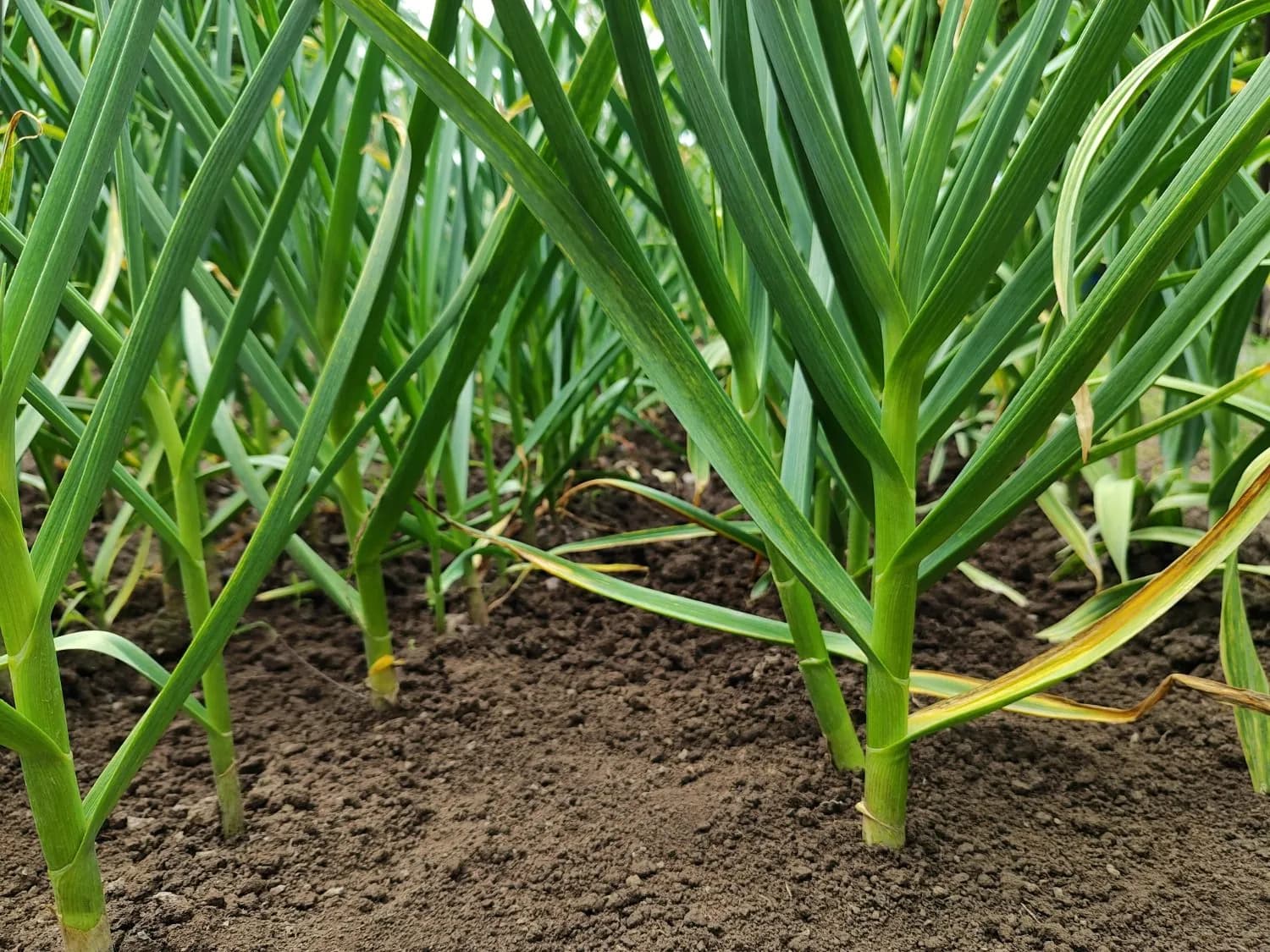
- Garlic in its spring growth stage. Photo: Anna Evans / Unsplash.
- A growing garlic plant. Lower leaves yellow as the crop approaches harvest. Photo: Anna Evans / Unsplash.
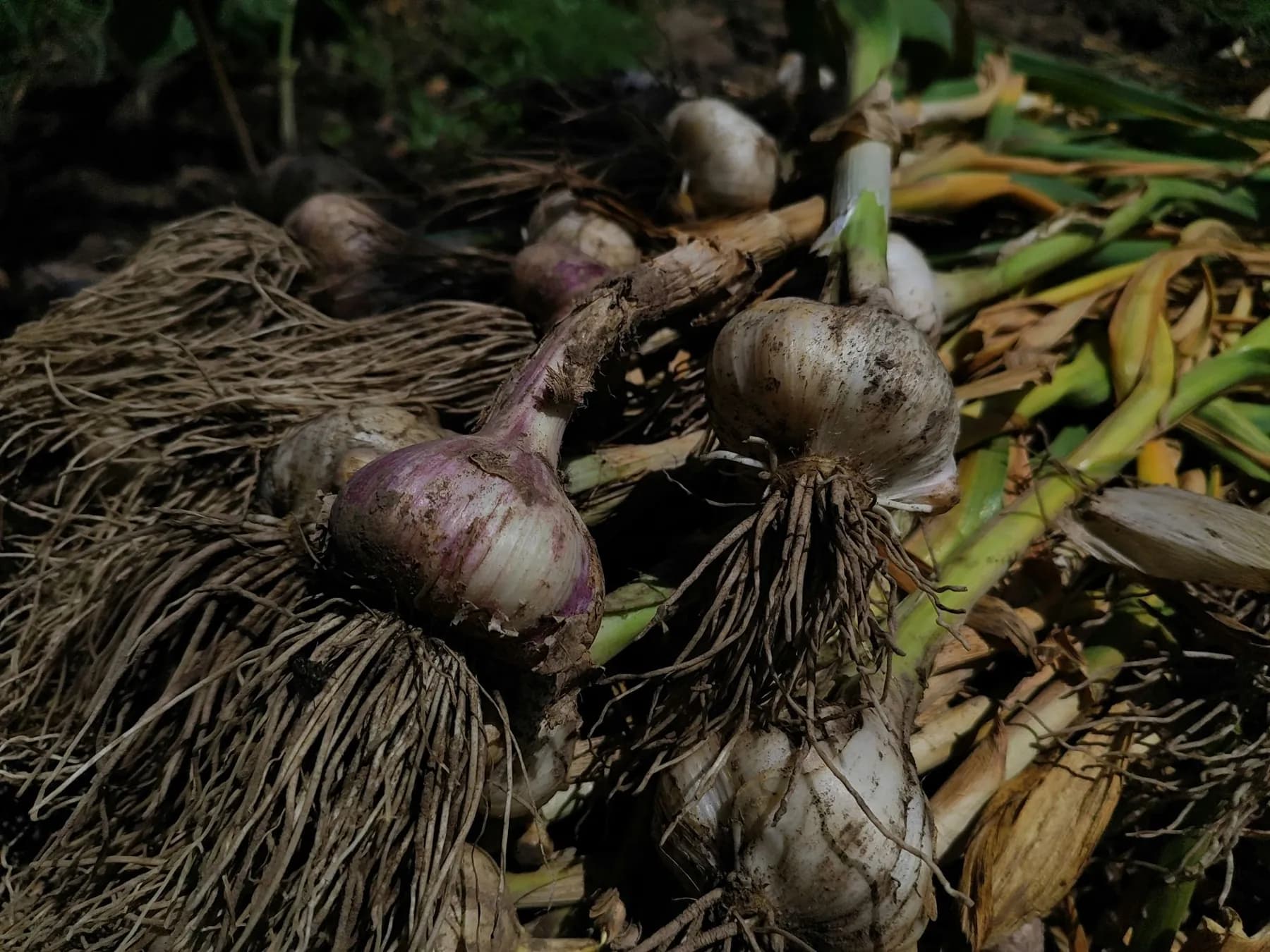
- Garlic lifted with roots and tops intact, before drying and curing. Photo: Anna Evans / Unsplash.
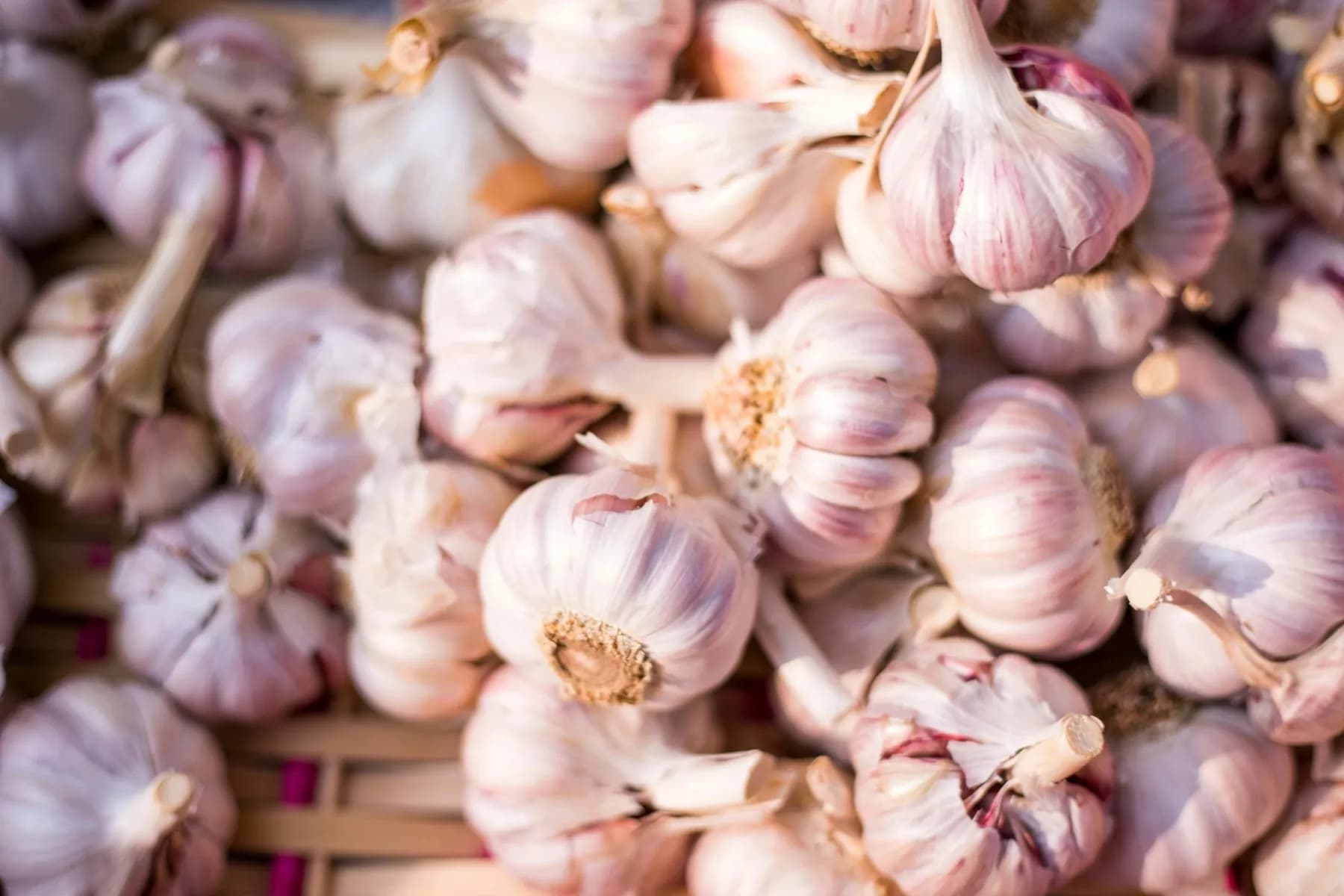
- Cured bulbs with dry wrappers and trimmed stems. Photo: Team Voyas / Unsplash.
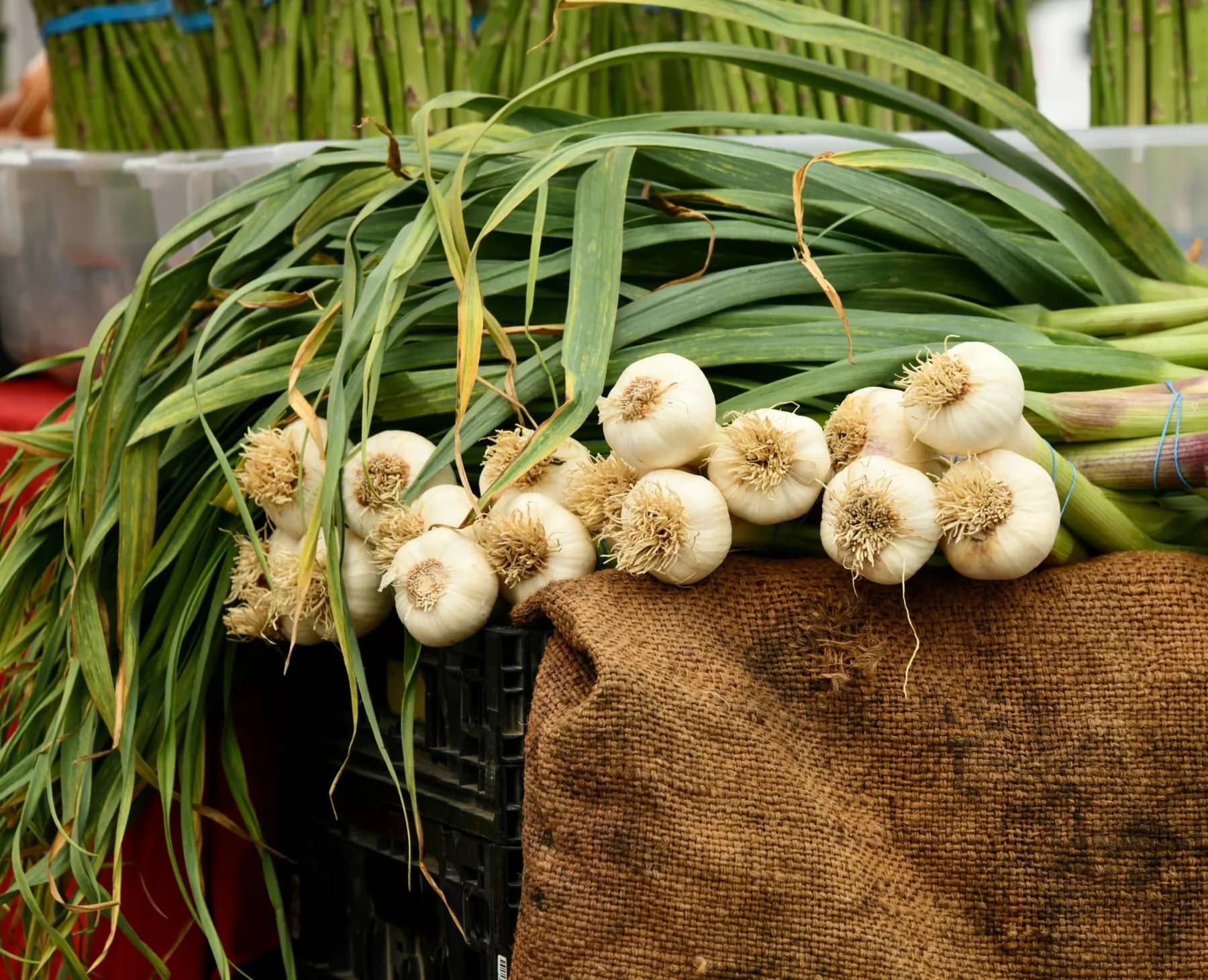
- Fresh garlic sold in bunches at a market. Photo: Shelley Pauls / Unsplash.
Figures are published averages or study assumptions for the places named, not guarantees for your field. Check current local recommendations and product labels before acting.