

Garlic farming in Iowa
Build an Iowa garlic enterprise around healthy planting stock, fall field access and enough labor and airflow for harvest and curing. Iowa State provides enterprise-planning tools, and Practical Farmers of Iowa documents a farm-level planting-stock disease investigation. The operational references below come from the 2023 upper Midwest production guide and need adjustment to your Iowa field.
Scope: Iowa field garlic for bulb and scape sales. Iowa sources cover enterprise planning, a planting-stock disease investigation and a West Branch farm trial with observed planting and harvest dates. Layout, nutrient and curing benchmarks transfer from the upper Midwest guide. Trial dates do not establish a statewide calendar. Updated 2026-10-03.
At a glance
- Production system
- Fall-established garlic, with timing adjusted to local freeze-up2
- Northern soil benchmark
- pH 6–7 and well-drained soil2
- Northern clove spacing
- 15–20 cm (6–8 in), with rows set for cultivation equipment2
- Northern winter mulch
- 7.5–10 cm (3–4 in) seed-free straw2
- Iowa enterprise tool
- ISU garlic budget in the small-scale vegetable budgets, August 20225
- Iowa disease evidence
- 2013 PFI investigation of symptomatic farm seed-stock samples6
Planting and harvest calendar for Iowa
Match clove planting and bulb harvest to the named production area and cultivar. Autumn planting precedes harvest the following year. Use the month bands to plan field work, then check bulb maturity before lifting.
Plant cloves: September–October: documented Iowa farm trial2,7
The PFI West Branch trial planted on 10 September and 20 October 2015. These are two observed farm dates, supported by the northern fall-establishment reference, not a statewide recommendation.
Harvest bulbs: July, following year: documented Iowa farm trial4,7
The PFI trial documents harvest on 3 July 2016. The farmer judged lifting about a week late and reported losses. Start maturity checks earlier and harvest by bulb condition, not this date alone.
Historical monthly climate
Reference period: 1996-01-01 to 2025-12-31. ERA5-Land monthly mean soil temperature at 0–7 cm, air temperature and frost days at the regional reference point (42, -93.5). Select a month to inspect its historical conditions.
Month tiles show mean topsoil temperature.
September historical conditions
- Mean topsoil temperature
- 20.4°C
- Mean air temperature
- 19.6°C
- Mean frost days per month
- 0.0 days
These are monthly means at one reference location. They describe seasonal field conditions, not crop maturity, actual seed-zone conditions, frost forecasts or a planting recommendation. Harvest bands follow the crop-specific production sources above.
Climate source: Open-Meteo Historical Weather APIPlan the field, seed supply and buyer together
- Choose cold-adapted material
- The upper Midwest guide describes hardneck porcelain and purple-stripe types suited to cold-climate production. Test locally sourced cultivars for survival, marketable size and storage. Minnesota variety performance is a starting point, not an Iowa cultivar ranking.1
- Budget before expanding
- Use Iowa State’s garlic enterprise tool to list planting stock, field operations, irrigation, labor and selling costs. Replace model assumptions with your quotations and records. Reserve healthy bulbs for next year’s seed before calculating saleable supply.5
Establish roots in fall and fit spacing to machinery
Between rows: 76 cm (30 in) · Within the row: 15–20 cm (6–8 in)
Transferred machinery-access example from the Minnesota guide, not an Iowa spacing trial. Set row widths for your planter, weed control and bulb grade.
- Set the date locally
- Use fall planting to allow roots before freeze-up. The northern guide’s Minnesota dates cannot supply an exact Iowa statewide date. Check local field conditions and compare establishment records across your own planting dates.2
- Placement and cover
- The northern guide commonly spaces cloves 6–8 inches apart, places the base 2–3 inches deep and uses 3–4 inches of seed-free straw. Treat these as upper Midwest benchmarks and check emergence and winter protection in the actual field.2
Manage spring nutrients and water from field measurements
- Use soil organic matter and crop credits
- The 2023 northern guide sets nitrogen from soil organic matter, with credits for preceding legumes. Use your soil test and local advice rather than transferring a flat per-acre rate to all Iowa soils.2
- Keep bulbing plants supplied
- Check soil moisture through active bulb growth. The guide avoids depletion beyond half the available water and stops irrigation about two weeks before harvest. Adjust that benchmark to local rain, soil and actual crop maturity.2
Scout seed-stock health and protect bulb development
- Local aster-yellows investigation
- A 2013 Practical Farmers of Iowa project investigated affected garlic planting stock from member farms. The diagnostic work documented aster yellows in symptomatic samples. It describes a historical selected sample, not the current disease prevalence in Iowa.6
- Keep symptoms out of saved seed
- The Iowa report links diagnosis and planting-stock decisions. Investigate distorted or poorly developed plants, keep suspect lots separate and obtain a diagnosis before retaining them for propagation.6
- Scapes and weed access
- The northern farm guide clips hardneck scapes as they begin to curl and emphasizes early weed control. Protect leaves during clipping and keep rows accessible. Confirm a scape buyer before assigning harvest labor.3
Inspect maturity and prepare curing space before lifting
- 1
Select clean planting stock
Use healthy cloves and plan a field rotation.
- 2
Fall establishment
Allow roots to develop before local freeze-up.
- 3
Inspect bulb maturity
Check bulbs and wrapper condition before lifting.
- 4
Cure and sort
Prepare ventilated curing space and separate damaged bulbs.
- Use plant and bulb checks
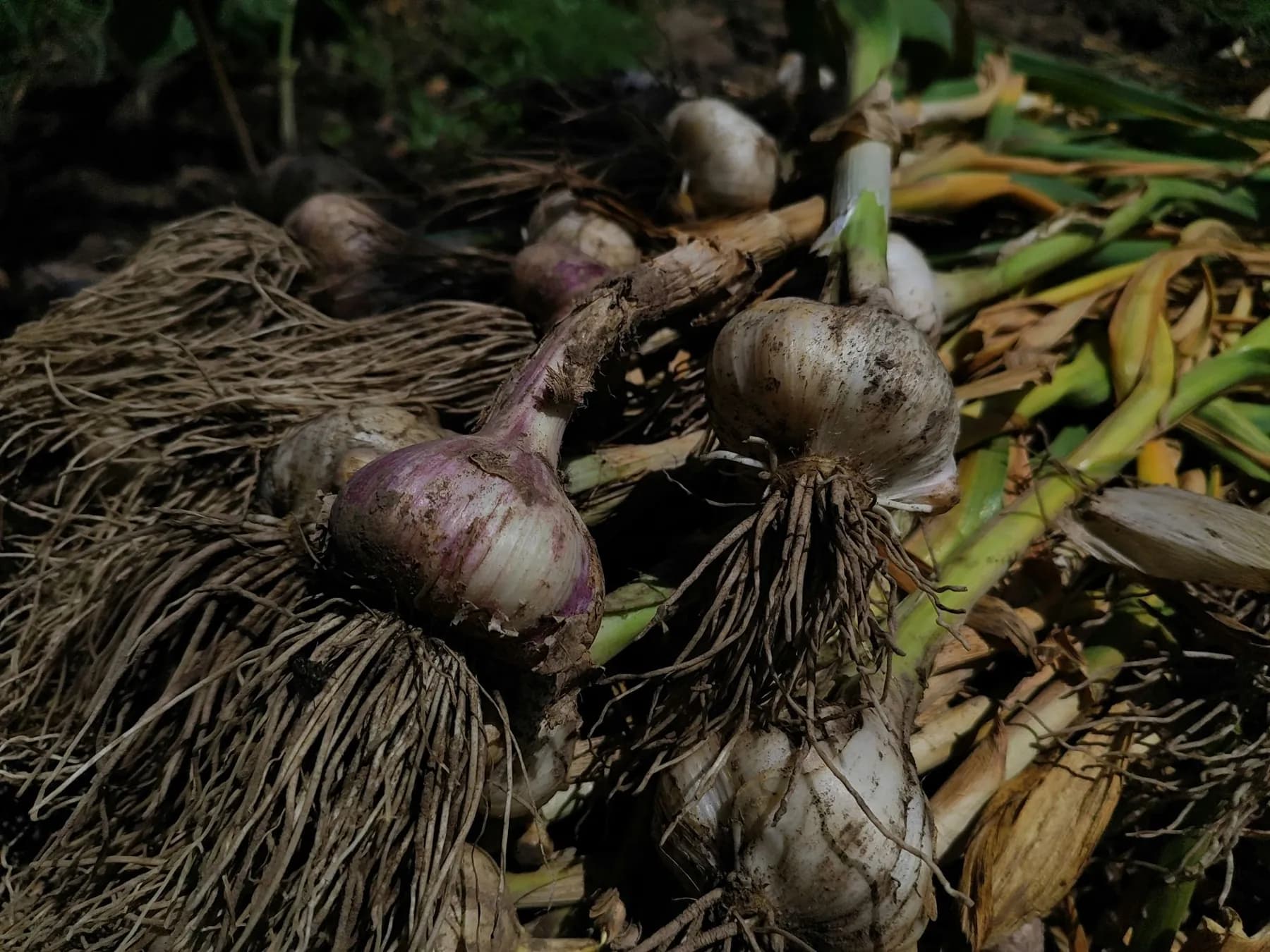
- Watch lower-leaf decline and cut representative bulbs to check whether cloves fill their skins. Minnesota’s reported summer harvest interval is not an Iowa statewide calendar. Inspect each cultivar separately and preserve intact wrappers.4
- Plan airflow for the full crop
- The northern guide describes three to four weeks of curing in indirect light with moving air around each bulb. Size the curing space for the expected harvest load and protect bulbs from damage during lifting and transfer.4
Record saleable yield, labor and storage losses
| Record | Use in the farm budget |
|---|---|
| Seed purchased and retained | Planting-stock cost and bulbs withheld from sales |
| Planting, scape and harvest labor | Hours and wage or contractor cost |
| Curing and storage | Space, airflow, energy and discarded bulbs |
| Saleable grades and buyer prices | Revenue by grade and channel |
Sources5
- Keep crop and seed lots separate
- The northern guide distinguishes cool table-stock storage from room-temperature seed storage. Grade cured bulbs and keep lot records so storage losses and seed reservations appear in the budget.4,5
- Use a farm result for expansion
- Record marketable kilograms and actual sales alongside the ISU expense categories. A climate screen or reference budget cannot establish a farm’s profit or replace a buyer agreement.5
Frequently asked questions
- When should Iowa farms plant garlic?
- A West Branch farm trial planted on 10 September and 20 October 2015. Use these fall observations for planning, then allow roots before local freeze-up. They do not establish a single statewide date.
- What spacing should an Iowa garlic farm use?
- The upper Midwest guide commonly uses 6–8 inches between cloves, with row widths chosen for machinery. Its 30-inch single-row example is a transferred benchmark, not an Iowa trial result.
- What did Iowa’s garlic disease investigation show?
- The 2013 PFI investigation documented aster yellows in selected symptomatic farm samples. It does not measure current statewide prevalence.
- How should an Iowa farm budget garlic?
- Use the ISU garlic enterprise tool and replace assumptions with farm seed costs, labor, saleable yield, curing losses and buyer prices.
- When is garlic ready to lift?
- Inspect declining lower leaves and sample bulbs with cloves filling their skins. Assess cultivars individually, then cure with airflow before grading and storage.
Regional garlic guides
Local dates, soil-temperature history and sources for specific regions:
Sources and image credits
- 1. University of Minnesota / MISA — Garlic varieties and production systems — 2023. Cold-climate farm garlic types, cultivar selection and upper Midwest niche markets.
- 2. University of Minnesota / MISA — Soils, planting, mulching and irrigation — 2023. Minnesota planting windows and upper Midwest farm benchmarks for soil, nutrients, machinery spacing, mulch and irrigation.
- 3. University of Minnesota / MISA — Scapes, weeds, pests and diseases — 2023. Farm scape management, weed competition, seed-stock disease and pest identification.
- 4. University of Minnesota / MISA — Harvesting, curing and storing garlic — 2023. Minnesota harvest observations, maturity checks, curing airflow, and separate storage conditions for market and planting stock.
- 5. Iowa State University Extension — Small-scale vegetable production enterprise budgets — August 2022. Iowa enterprise-planning tools including garlic. Model budgets need farm-specific prices, costs and yield assumptions.
- 6. Practical Farmers of Iowa — Garlic planting stock investigation — August 2013. On-farm investigation of symptomatic garlic seed stock and aster yellows. Selected historical samples, not statewide prevalence.
- 7. Practical Farmers of Iowa — Oat cover crop versus straw mulch in garlic production — November 2016. West Branch farm trial: September and October 2015 planting, July 2016 harvest and historical weather comparison. One farm and season, not a statewide calendar.
Image credits
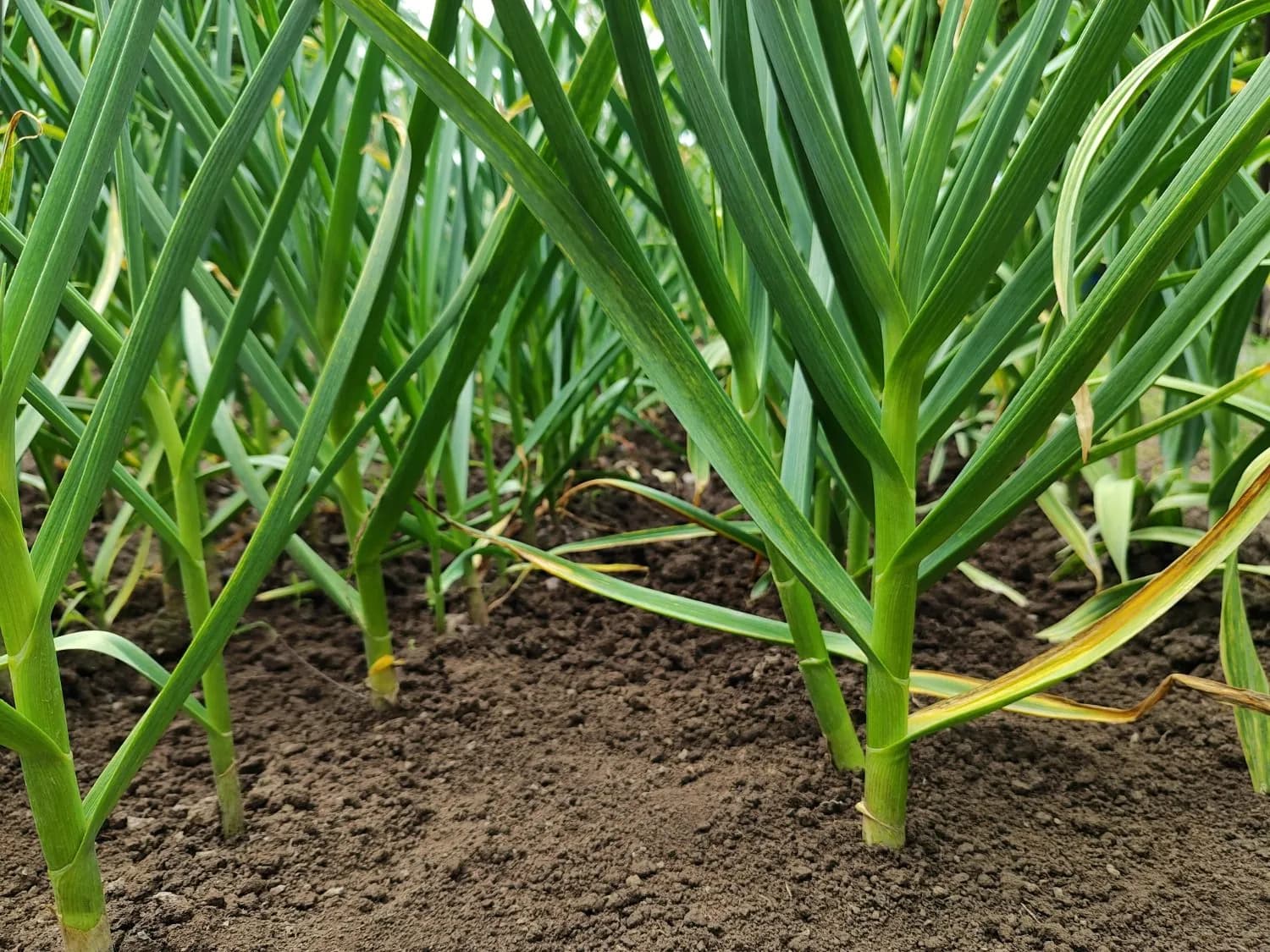
- Garlic field rows during vegetative growth. Photo: Anna Evans / Unsplash.
- Lifted bulbs before curing. Photo: Anna Evans / Unsplash.
Figures are published averages or study assumptions for the places named, not guarantees for your field. Check current local recommendations and product labels before acting.