

Garlic farming in California
Plan California garlic around the intended buyer, clean planting stock and a reliable irrigation supply. UC field research documents fall planting of California Early and California Late, while its agricultural pest guidelines emphasize weed control before planting and keeping white rot out of clean fields. Use local crop development and soil moisture to schedule water and harvest.
Scope: Commercial field garlic, with recent Fresno County trial evidence and historical Salinas and San Joaquin Valley research. Trial dates and rates describe their sites and seasons. Confirm cultivar, planting depth and harvest specifications with the buyer and local farm advisor. Updated 2026-10-03.
At a glance
- Recent field example
- California Late planted 20 November 2023 at the UC West Side center in Fresno County1
- Historical planting window
- October–December in ten Salinas and San Joaquin Valley fertilizer experiments, 1979–19852
- Commercial bed layout
- 2–4 planting lines on approximately 102 cm (40 in) beds3
- Irrigation research
- 2005–06 Five Points study reported 425 mm (16–17 in) crop water requirement4
- Field exclusion risk
- White rot can persist in soil for more than 20 years5
- Long-term bulb storage
- −1 to 0°C (30–32°F), 60–70% relative humidity and airflow6
Planting and harvest calendar for California
Match clove planting and bulb harvest to the named production area and cultivar. Autumn planting precedes harvest the following year. Use the month bands to plan field work, then check bulb maturity before lifting.
Plant cloves: October–December1,2
Observed planting months in the 1979–1985 UC Salinas and San Joaquin Valley trials. The recent Fresno California Late trial planted on 20 November 2023. Set the farm date for cultivar, district and field conditions.
Harvest bulbs: June–September, following year2
Historical UC trial harvest months across different varieties and valley sites. These are observed production windows; inspect bulb maturity for your cultivar before lifting.
Historical monthly climate
Reference period: 1996-01-01 to 2025-12-31. ERA5-Land monthly mean soil temperature at 0–7 cm, air temperature and frost days at the regional reference point (37, -120). Select a month to inspect its historical conditions.
Month tiles show mean topsoil temperature.
October historical conditions
- Mean topsoil temperature
- 21.1°C
- Mean air temperature
- 19.6°C
- Mean frost days per month
- 0.0 days
These are monthly means at one reference location. They describe seasonal field conditions, not crop maturity, actual seed-zone conditions, frost forecasts or a planting recommendation. Harvest bands follow the crop-specific production sources above.
Climate source: Open-Meteo Historical Weather APISet the market, variety and field layout
- 1
Before planting
Check field history, obtain clean cloves and control weeds before crop establishment.
- 2
Fall establishment
Confirm cultivar and date locally. The Fresno trial planted California Late on 20 November.
- 3
Growing crop
Measure soil moisture, scout foliage and maintain accessible row middles.
- 4
Mature bulbs
Inspect maturity and lift with minimal bulb injury.
- 5
Cure and grade
Dry necks and outer skins with warm, dry moving air before storage.
- Cultivar and calendar
- California Early and California Late appear in UC commercial field research. Older experiments planted in October–December. The recent California Late rust trial planted on 20 November 2023. These observations support fall establishment, with final timing set for the actual cultivar and production area.1,2
- Bed configuration
- UC IPM describes two to four garlic planting lines on 40-inch beds. Lay out beds for planting, irrigation and cultivation equipment. The 2024 Fresno trial used surface drip in the middle of beds after sprinkler establishment. Neither source supplies one universal within-row clove gap or planting depth.1,3
- Clean stock
- Use cloves from known sources without a white-rot history. Keep cull bulbs, soil and crop debris from infested fields away from clean land.5
Schedule irrigation from measured demand
- Match irrigation to the field
- The Five Points study compared furrow, surface drip and subsurface drip against measured crop evapotranspiration. Its seasonal water requirement was about 425 mm. This is a study benchmark, not a fixed irrigation allocation: account for rain, stored soil water and system performance at your site.4
- Avoid deficit during bulb development
- In that 2005–06 experiment, marketable yield at 50% and 75% of crop evapotranspiration was below the 100% treatment. The 125% treatment did not improve yield significantly. Use soil-moisture observations and local weather data to prevent both stress and unnecessary application.4
Use soil and tissue tests to set fertility
- Historical nitrogen evidence
- UC experiments from 1979–1985 found most nitrogen responses leveled off at 100–200 lb N/acre, approximately 112–224 kg N/ha. Some virus-free California Early plantings responded to higher rates. Treat this as historical response evidence and set current inputs from soil, tissue and crop observations.2
- Do not assume every nutrient is limiting
- Those trials found no significant yield response to phosphorus or zinc despite low tests in several fields. The authors recommend interpreting soil tests alongside leaf analysis. Their results do not establish that phosphorus or zinc is unnecessary on every farm.2
Reduce weed pressure before the crop closes access
- Prepare the field
- Garlic leaves provide little competition against weeds. Choose fields with low perennial-weed pressure, control weeds before they set seed and use a stale seedbed where it fits the rotation. Dense planting limits the areas available for later cultivation.3
- Scout and cultivate early
- Record weed species and remove small seedlings while row middles remain accessible. Keep cultivation shallow enough to avoid crop disturbance. Plan labor for weeds within planting lines, where machinery access is limited.3
Keep white rot out and monitor rust
- White rot changes the field decision
- UC IPM reports survival for more than two decades. Clean equipment between fields and avoid planting Alliums after Alliums. Rotation helps limit buildup but does not clear an infested field. Investigate unexplained yellowing, basal white growth and small black resting bodies before moving stock.5
- Rust needs timely scouting
- The 2024 Fresno experiment recorded unusually favorable leaf wetness and temperatures for rust. Treatments reduced disease under those trial conditions. Use current UC IPM guidance, a confirmed diagnosis and the current crop label when deciding treatment, rather than copying a trial spray schedule.1
Protect bulb quality through harvest and curing
- 1
Inspect maturity
Check dry tops, mature bulbs and firm cloves.
- 2
Lift with care
Minimize handling injury and separate damaged bulbs.
- 3
Cure thoroughly
Dry necks and outer sheaths with low humidity and good airflow.
- 4
Plan storage
Set temperature, humidity and airflow for the intended sales period.
- Harvest by maturity and buyer requirements
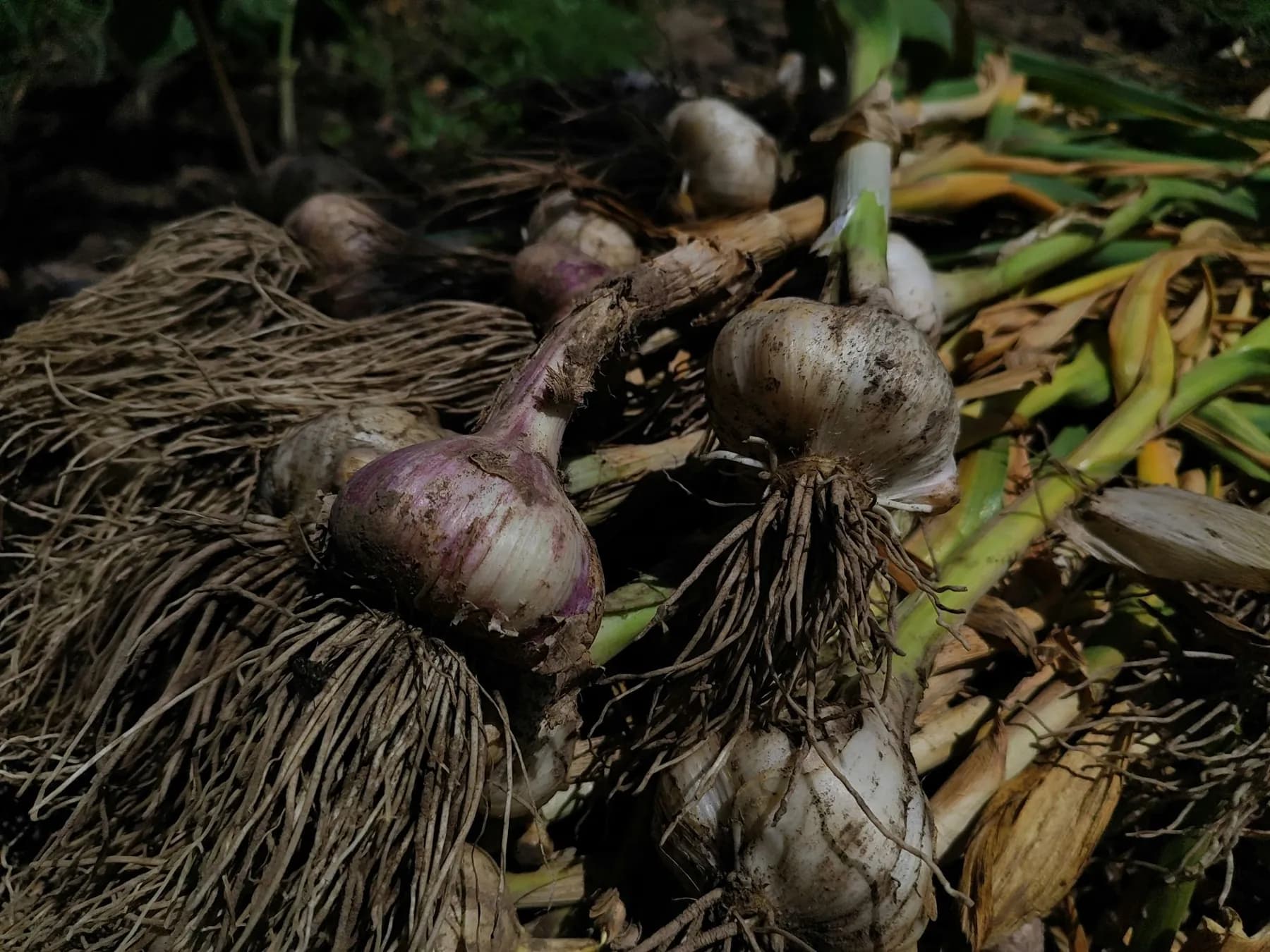
- UC Davis describes mature bulbs, dry tops and firm cloves as quality indicators. Inspect representative plants before lifting and minimize handling injury. California field research spans different summer harvest dates, so a single statewide harvest day would be misleading.2,6
- Cure before storage
- Dry the bulb neck and outer leaf sheaths using warmth, low humidity and good airflow. California conditions can allow field curing. Assess weather and protect quality when conditions are unsuitable. Sort injured or decaying bulbs out of storage lots.6
- Choose storage for the sales period
- For long storage UC Davis gives −1 to 0°C with 60–70% relative humidity and airflow. Intermediate temperatures favor sprouting, while excess humidity favors mold and rooting. Separate storage garlic from planting stock and set conditions for each purpose.6
Frequently asked questions
- When should a California farm plant garlic?
- UC commercial research documents fall establishment. Historical trials planted in October–December, and a recent Fresno trial planted California Late on 20 November. Confirm timing for your cultivar, field and buyer.
- What field layout is used for California garlic?
- UC IPM describes two to four planting lines on approximately 102 cm (40 in) beds. Equipment, irrigation and weed control determine the final configuration.
- How much irrigation does California garlic need?
- A 2005–06 Five Points study reported about 425 mm crop water requirement. Calculate farm applications from crop demand, rain, stored soil water and irrigation efficiency.
- Will crop rotation remove garlic white rot?
- No. UC IPM reports survival for more than 20 years. Clean stock, field selection and equipment sanitation are central controls.
- How should harvested garlic be stored?
- Cure bulbs first. UC Davis gives −1 to 0°C and 60–70% relative humidity with airflow for long-term bulb storage. Conditions for seed stock need separate planning.
Regional garlic guides
Local dates, soil-temperature history and sources for specific regions:
Sources and image credits
- 1. UC ANR — Garlic rust control in Central California, 2024 — 2024 field trial, published 2025. Fresno County California Late trial, planting date, bed and irrigation setup, and rust observations.
- 2. UC Cooperative Extension — Diagnosing nutrient needs of garlic — March–April 1988; field experiments 1979–1985. Historical Salinas and San Joaquin Valley cultivar, calendar and fertilizer-response research.
- 3. UC IPM — Integrated weed management for onion and garlic — Text updated October 2018; checked 2 October 2026. Commercial garlic bed configuration, preplant weed reduction and in-crop cultivation.
- 4. USDA-ARS — Water requirement of irrigated garlic — 2005–06 Five Points experiment; checked 2 October 2026. Measured crop water requirement and yield response to irrigation treatments at the UC West Side center.
- 5. UC IPM — White rot of onion and garlic — Updated February 2019; checked 2 October 2026. California disease signs, persistence, clean stock and field sanitation.
- 6. UC Davis Postharvest Research and Extension Center — Garlic — Fact sheet updated August 2000; checked 2 October 2026. Bulb maturity, curing, handling and commercial storage conditions.
Image credits
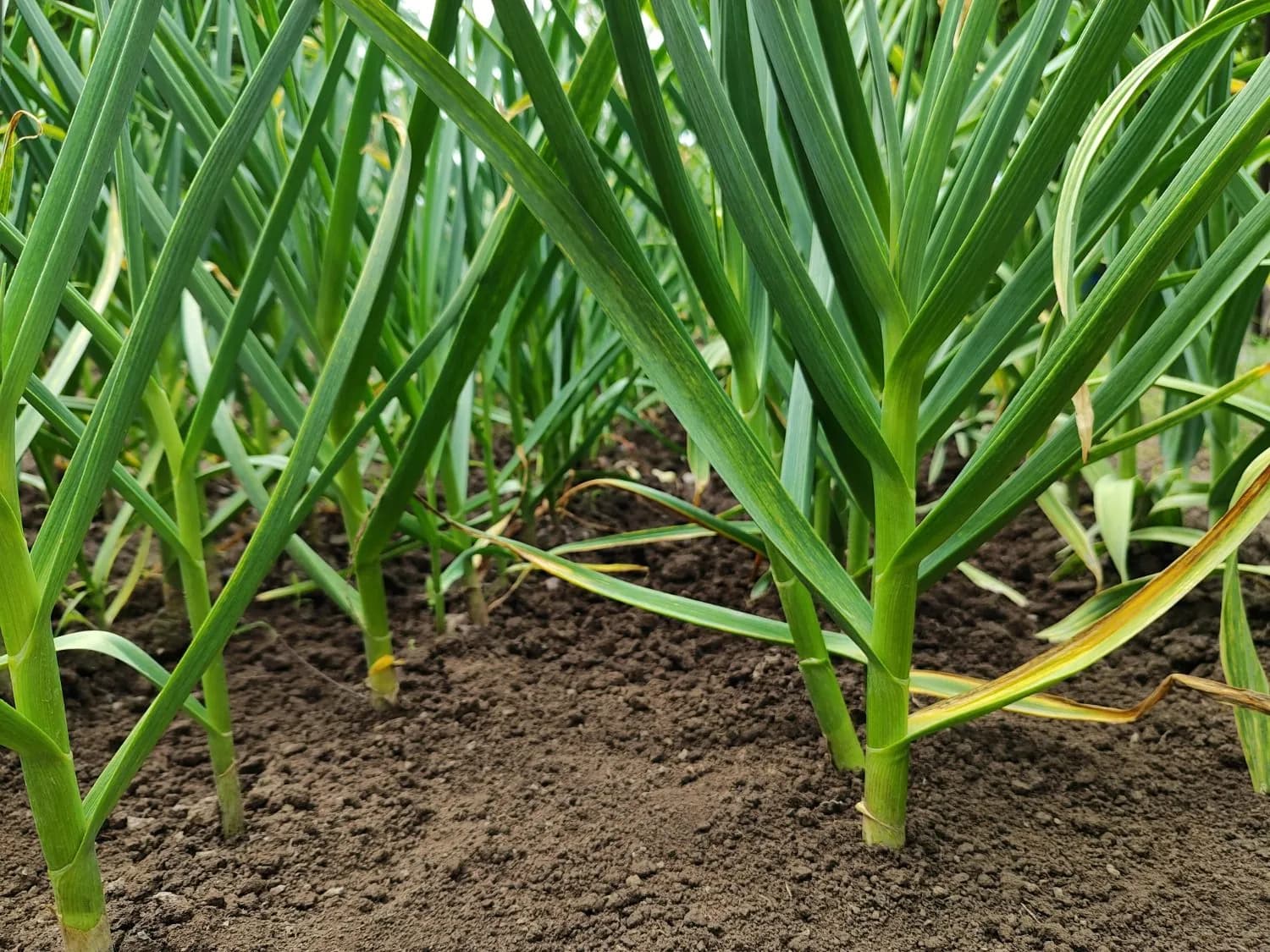
- Garlic field rows during vegetative growth. Photo: Anna Evans / Unsplash.
- Lifted bulbs before curing. Photo: Anna Evans / Unsplash.
Figures are published averages or study assumptions for the places named, not guarantees for your field. Check current local recommendations and product labels before acting.