

Growing avocados in Texas
Avocados are a frost-sensitive tropical tree, and cold is what limits them in Texas. Commercial plantings are confined to the Lower Rio Grande Valley, and even there the variety decides whether a freeze kills the crop. Hass, the supermarket standard, does not have enough cold hardiness for Texas.
Scope: Avocados in Texas, based on Texas A&M AgriLife Extension guidance. Texas avocado production is too small to appear in USDA statistics. Metric first, with the original US units in brackets. Updated 2026-10-03.
At a glance
- Commercial area
- Lower Rio Grande Valley only; too small to be reported by USDA1
- Hardiest type
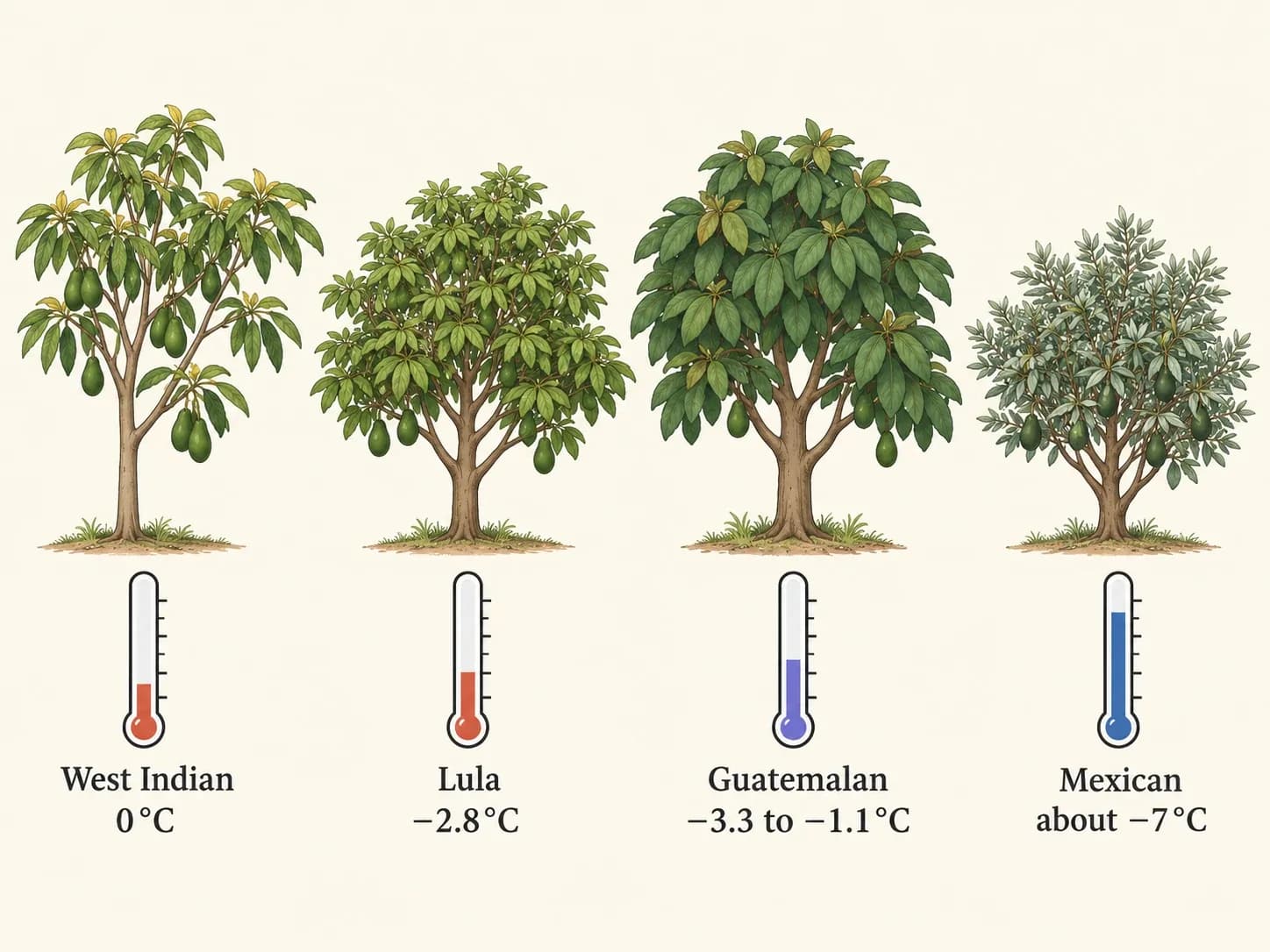
- Mexican race: some varieties tolerate about −7°C (19–20°F) as mature trees1
- Hass
- Too little cold tolerance for a dependable Texas commercial orchard1
- Valley variety
- Lula (Guatemalan × West Indian hybrid): severe damage below −2.8°C (27°F), but usually regrows from below ground1
- Spacing
- 6–9 m (20–30 ft) between trees1
- First fruit
- 2–3 years after planting for a grafted, protected tree1
- Harvest
- Mexican types mature in summer; Lula and most hybrids mature in September–October; Lula can remain on the tree into January1
- For comparison
- California has 19,950 ha (49,300 acres) of bearing avocados; Florida 1,540 ha (3,800 acres)2
Perennial growth and climate in Texas
A perennial planting remains in the field for multiple years. Establishment is a long-term investment; flowering, fruit development, harvest and plant care recur as the planting matures. Follow the named cultivar and production system.
Establish a long-lived planting1
Evaluate frost exposure, drainage, irrigation and cultivar suitability before establishing trees. The Lower Rio Grande Valley is the commercial suitability reference; protected trees elsewhere do not demonstrate a viable commercial orchard.
Management: Bearing-tree nutrition review1
The production publication describes February, May and August nutrient divisions for bearing trees. Review crop load, soil and tissue evidence before deciding applications; monitor frost and water through the year.
Harvest: Cultivar maturity and holding1
Lula and most hybrids mature in September–October; Lula can remain on the tree into January. The highlighted months combine maturity and holding, not identical picking dates. Mexican-race varieties generally mature in summer, without a verified month range in this source.
Historical monthly climate
Reference period: 1996-01-01 to 2025-12-31. ERA5-Land monthly mean soil temperature at 0–7 cm, air temperature and frost days at the regional reference point (31.5, -99). Select a month to inspect its historical conditions.
Month tiles show mean air temperature.
February historical conditions
- Mean topsoil temperature
- 12.2°C
- Mean air temperature
- 12.3°C
- Mean frost days per month
- 4.4 days
Use this monthly history to assess winter exposure, seasonal heat and water planning. It does not calculate cultivar chill hours, flowering dates, frost damage during bloom or fruit maturity. Topsoil at 0–7 cm describes shallow soil context, not the full root zone. Harvest periods follow the production evidence above.
Climate source: Open-Meteo Historical Weather APICold decides everything
| Type | What it tolerates |
|---|---|
| West Indian | Almost no subfreezing temperature; damage at or below 0°C (32°F) |
| Guatemalan | About −3.3 to −1.1°C (26–30°F) |
| Lula (Guatemalan × West Indian) | Severe damage below −2.8°C (27°F); usually regrows from below ground |
| Mexican | Some varieties about −7.2 to −6.7°C (19–20°F) as mature trees |
Sources1
- Where it can be grown
- The only Texas counties suitable for commercial avocados are in the Lower Rio Grande Valley, where avocados are a very small share of farm acreage. Growers south and southwest of San Antonio have tried varieties said to survive winters, but with no formal long-term research those plantings should be considered very risky unless protected from freezes.1
- Freeze injury
- A freeze can damage part of the above-ground tissue, kill all of it, or kill the whole tree. The outcome depends on the variety and on the depth and duration of the freeze. Trees sometimes escape a harsh winter or two and look promising, only to be badly damaged by the next.1
- Salinity and soil
- Soils should be coarse and well drained; avocados do not tolerate flooding. Salinity injures them, so test soil and irrigation water before planting. Mexican varieties are the least salt-tolerant; West Indian rootstock tolerates salinity better.1
Choose a variety for the cold, not the fruit
- 1
Mexican types
Generally mature in summer; exact months depend on cultivar.
- 2
Lula and most hybrids
Mature in September–October.
- 3
Lula holding
Fruit can remain on the tree into January; holding is different from maturity.
- Best bets
- Seedling varieties of the Mexican type tolerate freezes best. Those grown in Texas include Brogdon, Holland, Wilma and Winter Mexican. Winter Mexican has excellent cold and good heat tolerance and has been popular in the Valley for many years. Lula is the commercial variety of the Lower Rio Grande Valley; its fruit nears 0.45 kg (1 lb), has a thick green skin and resists disease well.1
- Why not Hass
- Hass is the main commercial variety in California but has too little cold hardiness for Texas. No formal variety trials in Texas have tested which varieties are best for production, fruit quality or freeze tolerance.1
- Pollination
- Avocado flowers are type A or type B, and orchards elsewhere interplant both. In South Texas the flower phases overlap enough that pollination and fruit set are rarely a problem.1
Plant deep and plan freeze protection
- 1
Plant deep
Set the graft at or below the soil line so soil can be mounded.
- 2
Mound in winter
Mound soil around the trunk to insulate the graft.
- 3
Before a freeze
Add more soil and water thoroughly 2–3 days ahead.
- 4
During a freeze
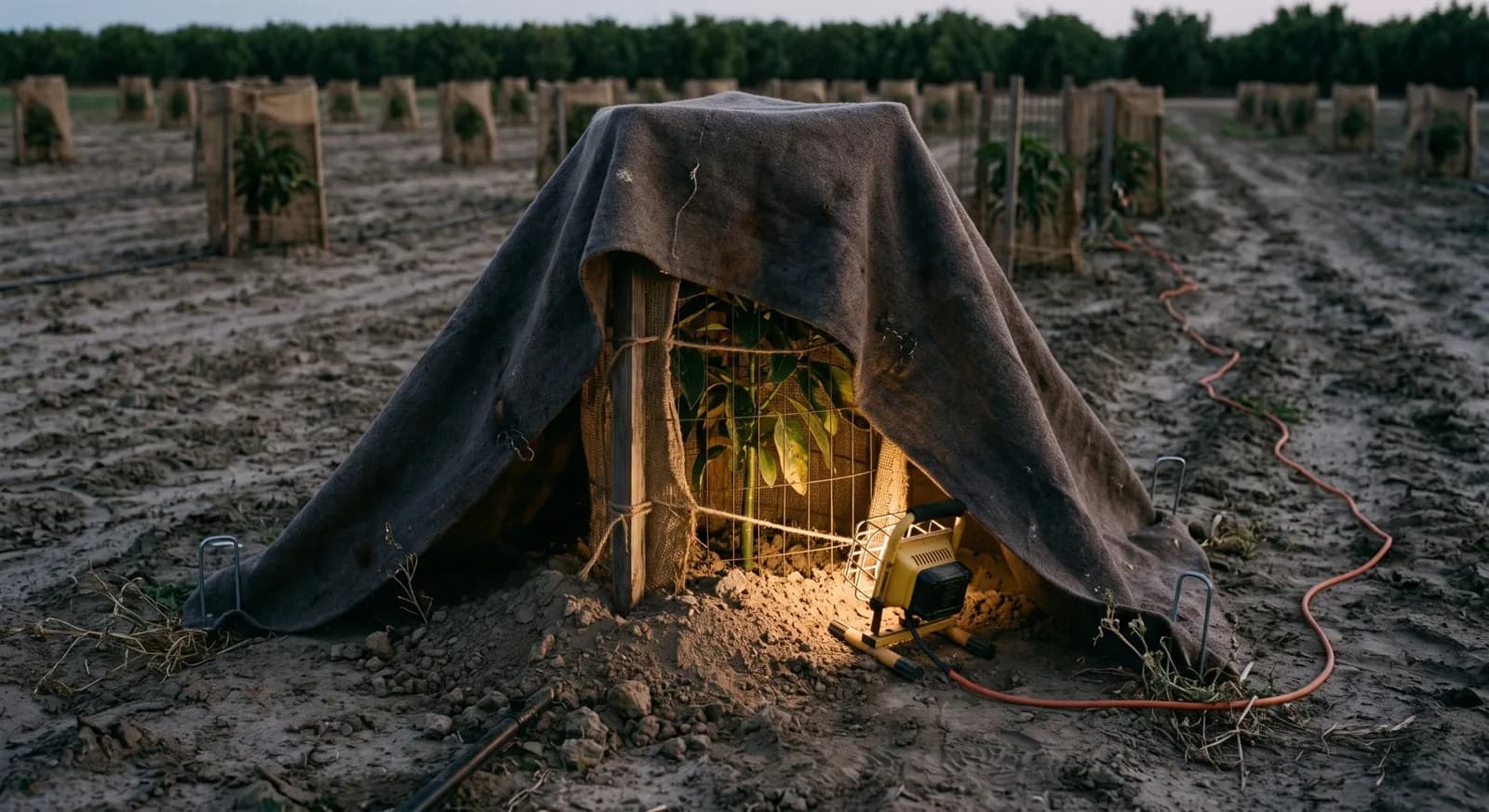
Drape, do not wrap; anchor the corners and add a heat source under the cover.
- 5
After
If killed to the ground, cut at ground level and let sprouts regrow from the graft.
- Spacing and support
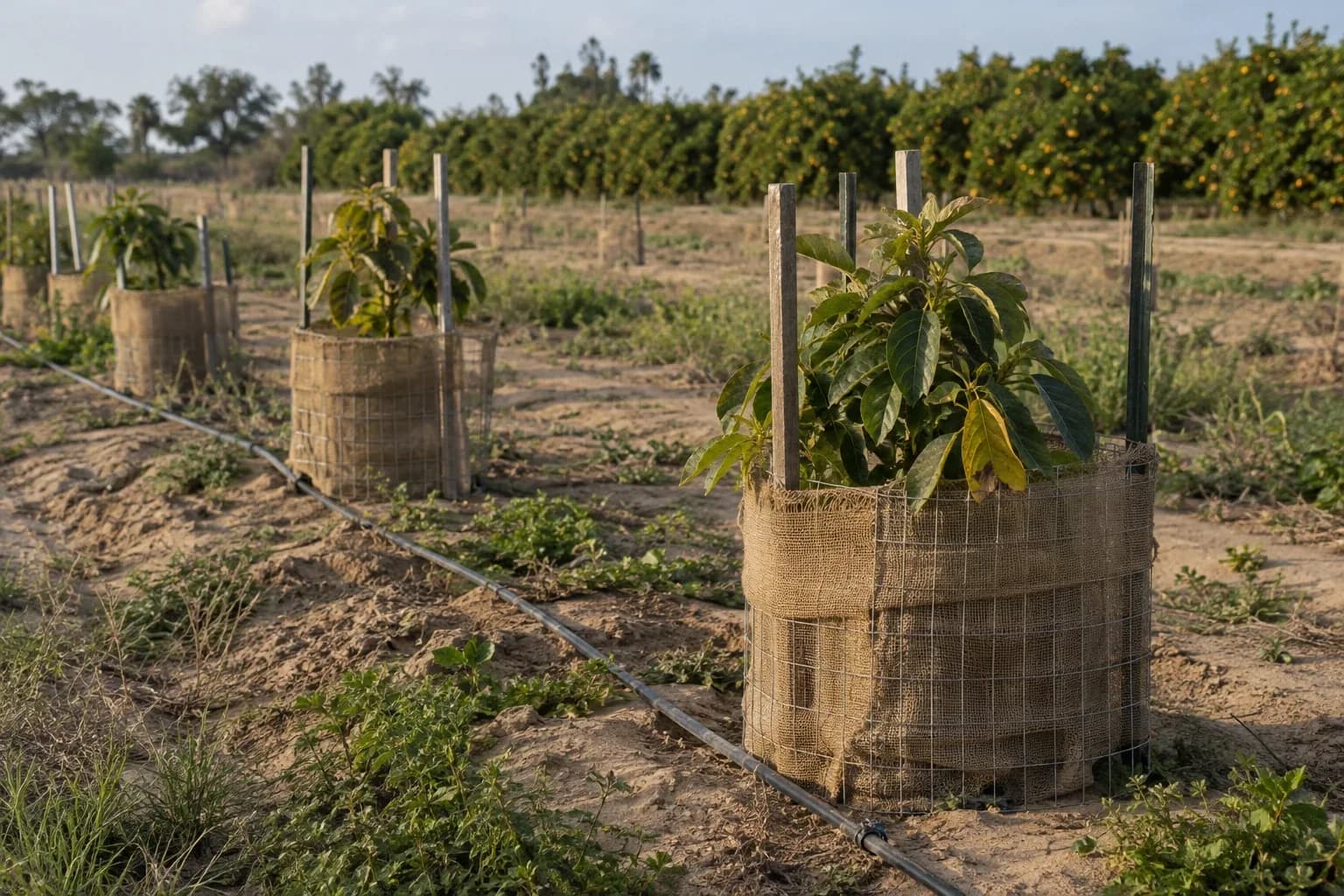
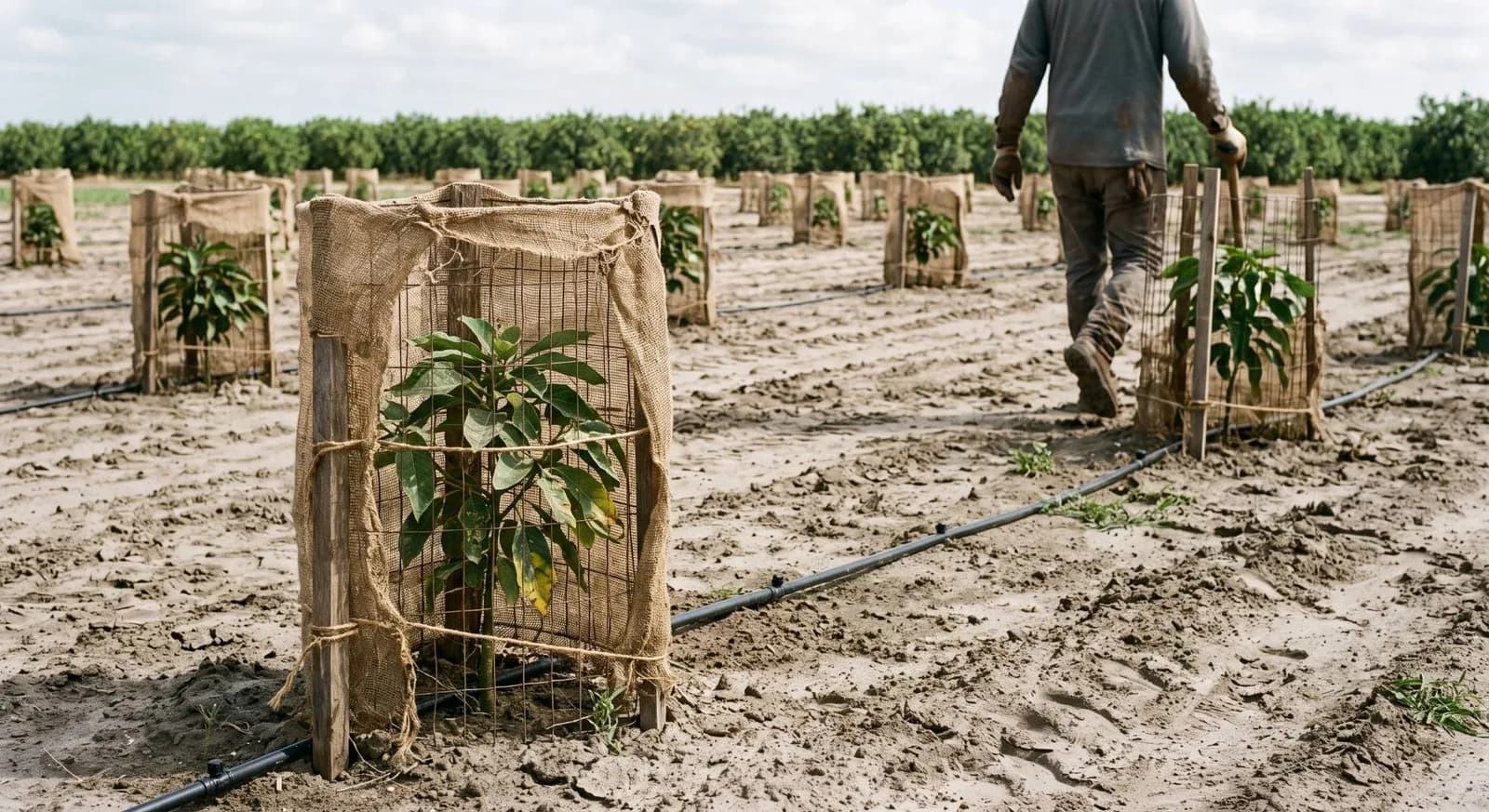
- Space trees 6–9 m (20–30 ft) apart. Newly planted trees are usually staked and shaded for the first months of hot weather; Rio Grande Valley growers often place burlap-covered cages about 30 cm (1 ft) higher than the trees to protect them from sun and wind.1
- Beyond the Valley
- North of the Lower Rio Grande Valley, growers wanting a commercial crop should consider permanent enclosures such as high-tunnel greenhouses, which store solar heat and can use ice from sprinklers and light sources to protect trees from occasional freezing nights.1
- Buy grafted trees
- Use grafted nursery trees of a known cultivar and suitable rootstock. Avocados do not come true from seed, and ungrafted seedlings can take 10 to 15 years to bear.1
Feed lightly and every year
- Year 10.45 kg/tree
- Years 2–30.9 kg/tree
- Year 41.4 kg/tree
- Schedule
- Year 1: split 0.45 kg (1 lb) into three to six equal doses every second or third month from February to early August. Years 2 and 3: 0.9 kg (2 lb). Year 4: 1.4 kg (3 lb). After that apply 0.23 kg (½ lb) per 2.5 cm (1 in) of trunk diameter each year, split into February, May and August.1
- Soil tests
- Test before planting and every second or third year to find phosphorus, potassium or other shortages. Nitrogen is needed every year regardless of soil test.1
- Common problems
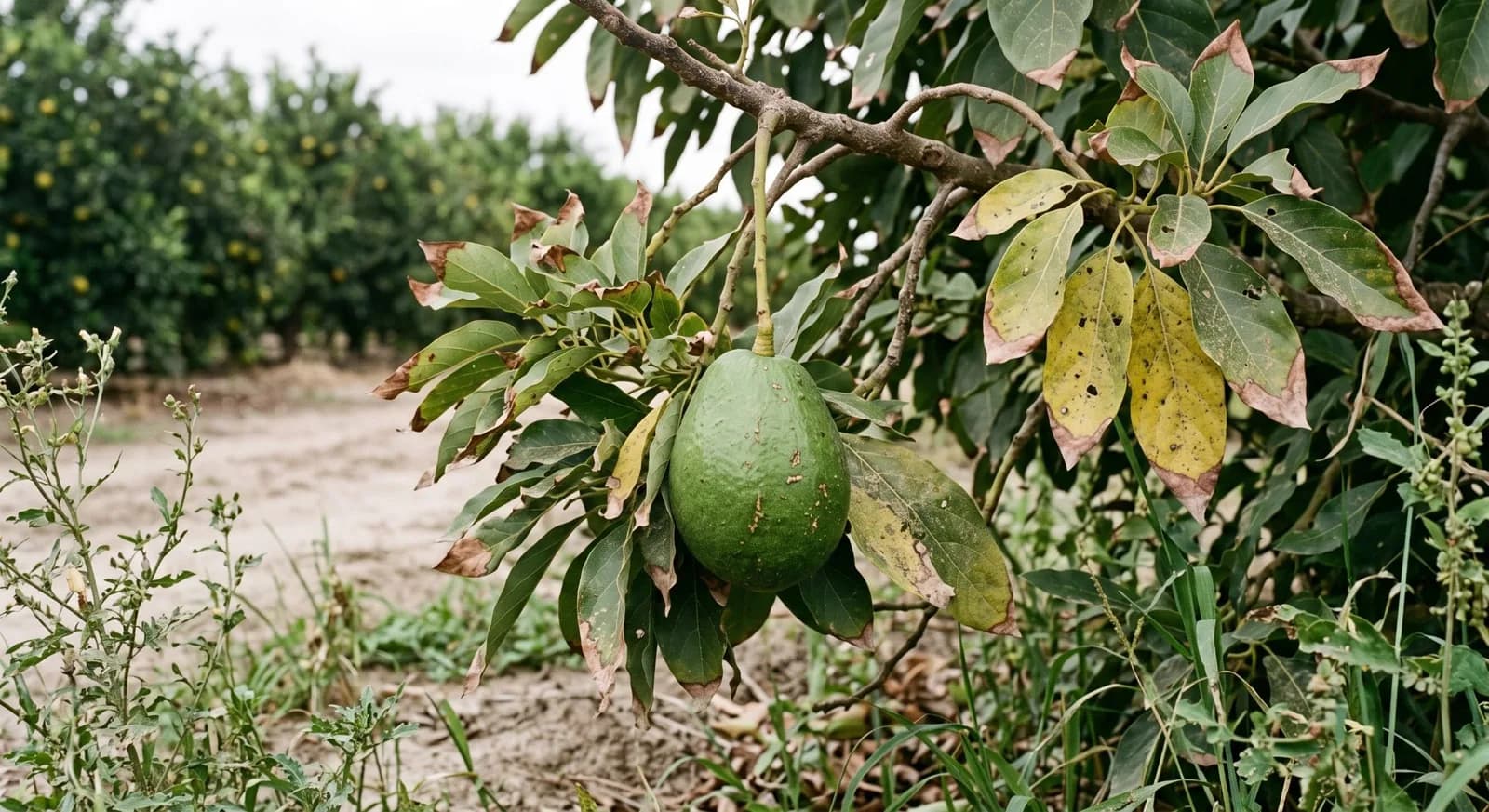
- The commonest disorder is leaf-tip burn from water stress and salinity in hot dry weather, worst on Mexican seedlings. Anthracnose is the most serious disease, mainly on fruit nearing maturity; it is severe on thin-skinned varieties and rarely serious on thick-skinned Lula.1
Harvest and expectations
- Picking
- Avocados do not ripen on the tree. Use representative fruit samples to check postharvest softening and confirm cultivar maturity before scheduling commercial picks. Oil content rises with time on the tree for many varieties; coordinate maturity and handling requirements with the buyer.1
- Yield
- Mature trees can produce 2, 3 or more bushels, depending on variety. Texas production is not reported by USDA, so there is no state yield benchmark; California averaged 7.8 t/ha in 2025 on frost-free sites.1,2
- Test your site
- Run a field audit for your coordinates to see how often it falls below the thresholds above before planting any avocado tree.1
Frequently asked questions
- Can you grow avocados in Texas?
- The reviewed commercial suitability reference is the Lower Rio Grande Valley. Elsewhere, occasional tree survival does not establish commercial orchard viability; freeze exposure remains a major risk.
- What avocado variety is best for Texas?
- Mexican-type seedling varieties tolerate freezes best (Brogdon, Holland, Wilma, Winter Mexican). Lula is the commercial variety in the Rio Grande Valley. Hass has too little cold tolerance.
- How cold can avocado trees get in Texas?
- Some Mexican varieties tolerate about −7°C (19–20°F) as mature trees, Guatemalan types −3 to −1°C (26–30°F), and West Indian types almost no subfreezing temperature.
- How far apart do you plant avocado trees?
- Space trees 6–9 metres (20–30 feet) apart and from other large trees.
- How long until a Texas avocado tree fruits?
- A grafted, well-grown, winter-protected tree can fruit 2–3 years after planting. Ungrafted seedlings may take 10–15 years.
- Does Texas appear in USDA avocado statistics?
- No. Texas production is too small to be reported, unlike California, Florida and Hawaii.
Regional avocado guides
Local dates, soil-temperature history and sources for specific regions:
Sources and image credits
- 1. Texas A&M AgriLife Extension — Avocados: Texas Fruit and Nut Production (EHT-018) — 2013, reviewed 2015. Texas avocado climate, cold hardiness by type, varieties, spacing, freeze protection, feeding, pests and harvest.
- 2. USDA NASS — Noncitrus Fruits and Nuts 2025 Summary — Published May 2026. US and state bearing acreage, yield, production, price and value for avocados, almonds, olives and other fruit and nut crops, 2023–2025.
Image credits
- Young Rio Grande Valley-style plantings: staked trees in burlap-covered cages that shade and shelter them in their first months.
- Approximate cold tolerance by avocado type (Texas A&M AgriLife). Thermometer levels are indicative. Schematic illustration.
- Cages protect young trees from sun and wind; drip tubing runs along the row.
- Freeze protection: drape, do not wrap, anchor the corners, mound soil at the trunk and add a heat source under the cover.
- Leaf-tip burn from water stress or salinity is the commonest avocado disorder in Texas.
Figures are published averages or study assumptions for the places named, not guarantees for your field. Check current local recommendations and product labels before acting.
Some visuals in this guide are illustrations rather than photographs of a specific farm. See image credits.