

How to grow avocados commercially
Avocados are perennial evergreen trees with narrow climate and root-zone requirements. Commercial planning starts with cold exposure, drainage, water quality, cultivar and market access. California and Texas sources show how management changes by climate; neither regional schedule or trial rate is universal.
Scope: Commercial orchard planning synthesized from California and Texas extension studies, with India-related production references retained in the regional pages. Crop survival does not guarantee flowering, fruit set or a commercial crop. Updated 2026-10-16.
At a glance
- Crop life cycle
- Perennial evergreen orchard; establishment, canopy growth and bearing span multiple years1
- California spacing example
- A UC high-density trial used 3 × 3 m (10 × 10 ft); this is not a universal orchard layout1
- Water planning
- Set irrigation from local weather, soil, tree age and water quality; do not transfer one trial’s annual use1,4,3
- Harvest plan
- Choose maturity standards, picking labour, packing and buyer before fruit is ready1
Perennial avocado growth calendar
A perennial planting remains in the field for multiple years. Establishment is a long-term investment; flowering, fruit development, harvest and plant care recur as the planting matures. Follow the named cultivar and production system.
Establish a long-lived planting1,2,3
Avocado orchards are perennial. Time establishment for locally suitable nursery stock, workable soil, irrigation readiness and the site’s frost exposure. California and Texas sources use different establishment practices; choose the one that fits the field.
Management: Protect bloom, fruit set and young trees2,3
Track field temperatures and crop stage. Frost protection is especially important for young trees; cultivar and avocado race affect injury risk.
Screen climate, drainage and water quality
- Check cold exposure by cultivar type
- Avocado cold tolerance varies with cultivar and genetic background. UC and Texas A&M describe different approximate injury limits and regional protection methods. Compare the selected planting material with local minimum temperatures and freeze duration; one statewide minimum cannot settle a site decision.2,3
Choose cultivars and design the orchard system
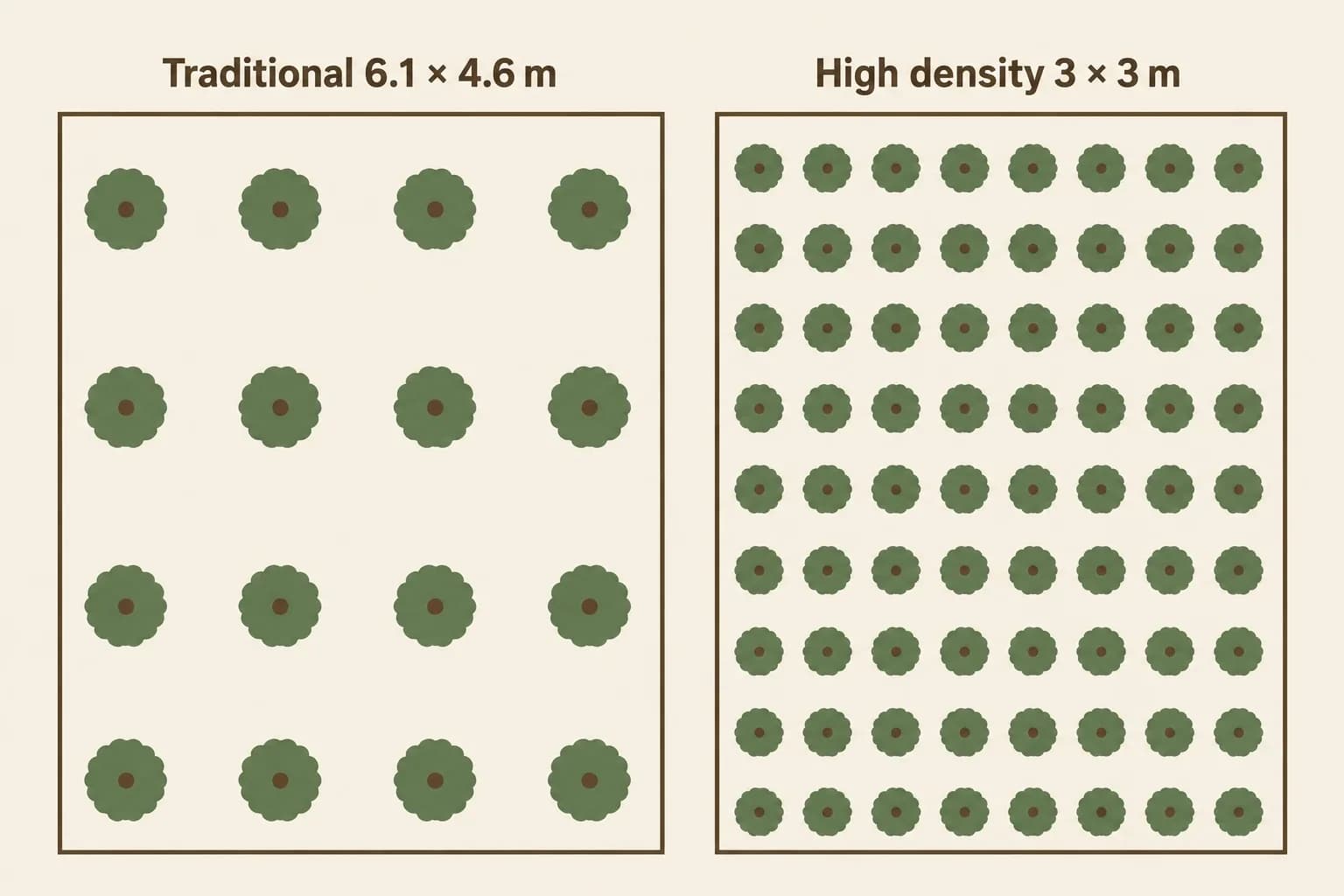
Between rows: 3 m (10 ft) · Within the row: 3 m (10 ft)
This was one UC high-density Hass trial. Traditional and high-density systems need different pruning, access and costs; match the design to rootstock, site, water and harvest plan. Schematic, not to scale.
- 1
Test the site
Review frost, drainage, soil and irrigation water.
- 2
Choose cultivar and rootstock
Match fruit market, cold exposure, disease risk and local adaptation.
- 3
Plan pollination
Check flowering behaviour and compatible pollinizers where needed.
- 4
Fit orchard operations
Plan tree density, pruning, frost protection and harvest access together.
- Choose for market and site fit
- Confirm cultivar, rootstock, fruit quality target, local adaptation and nursery traceability. A Texas cultivar list, a California Hass trial and Indian grafting guidance describe distinct production contexts.1,3
- Plan spacing around mature tree size
- The UC California trial used 3 × 3 m (10 × 10 ft) high-density planting, compared with a wider traditional layout. Dense plantings change pruning, equipment access and cost; use a local orchard design rather than treating the trial as a standard.1
Manage irrigation, nutrition and canopy by block
Harvest by maturity and protect packout
Frequently asked questions
- When should avocado trees be planted?
- Choose timing from local frost risk, nursery stock, soil conditions and irrigation readiness. California and Texas sources give different regional practices, so this guide does not prescribe a global month.
- How cold can avocado trees tolerate?
- Tolerance varies by cultivar and avocado type, and injury also depends on exposure duration and tree age. Use local extension thresholds for the chosen planting material and plan protection before a freeze.
- How far apart should avocado trees be planted?
- It depends on rootstock, cultivar, terrain, water and orchard system. A California high-density trial used 3 × 3 m (10 × 10 ft), while traditional layouts are wider.
- How much water do avocados need?
- Set irrigation from local weather, soil moisture, tree age, crop load and water quality. Regional study totals are examples, not a universal rate.
Regional guides and field planning
Sources and image credits
- 1. UC Cooperative Extension and UC Davis — Avocado Establishment and Production Costs and Returns, High Density Planting, San Diego County, 2020 — 2020. Valley Center field trial 2011–2018: spacing, rootstock, pruning, irrigation, yields by year, costs and returns.
- 2. UC ANR Topics in Subtropics — Frost in some part of Southern CA — Accessed 1 October 2026. Critical frost temperatures by avocado type and protection practices.
- 3. Texas A&M AgriLife Extension — Avocados: Texas Fruit and Nut Production (EHT-018) — 2013, reviewed 2015. Texas avocado climate, cold hardiness by type, varieties, spacing, freeze protection, feeding, pests and harvest.
- 4. UC ANR — UCCE advisor provides first-of-its-kind avocado irrigation data — Accessed 1 October 2026. Data-based avocado crop water use and the advice to trim older estimates.
- 5. USDA NASS — Noncitrus Fruits and Nuts 2025 Summary — Published May 2026. US and state bearing acreage, yield, production, price and value for avocados, almonds, olives and other fruit and nut crops, 2023–2025.
Image credits
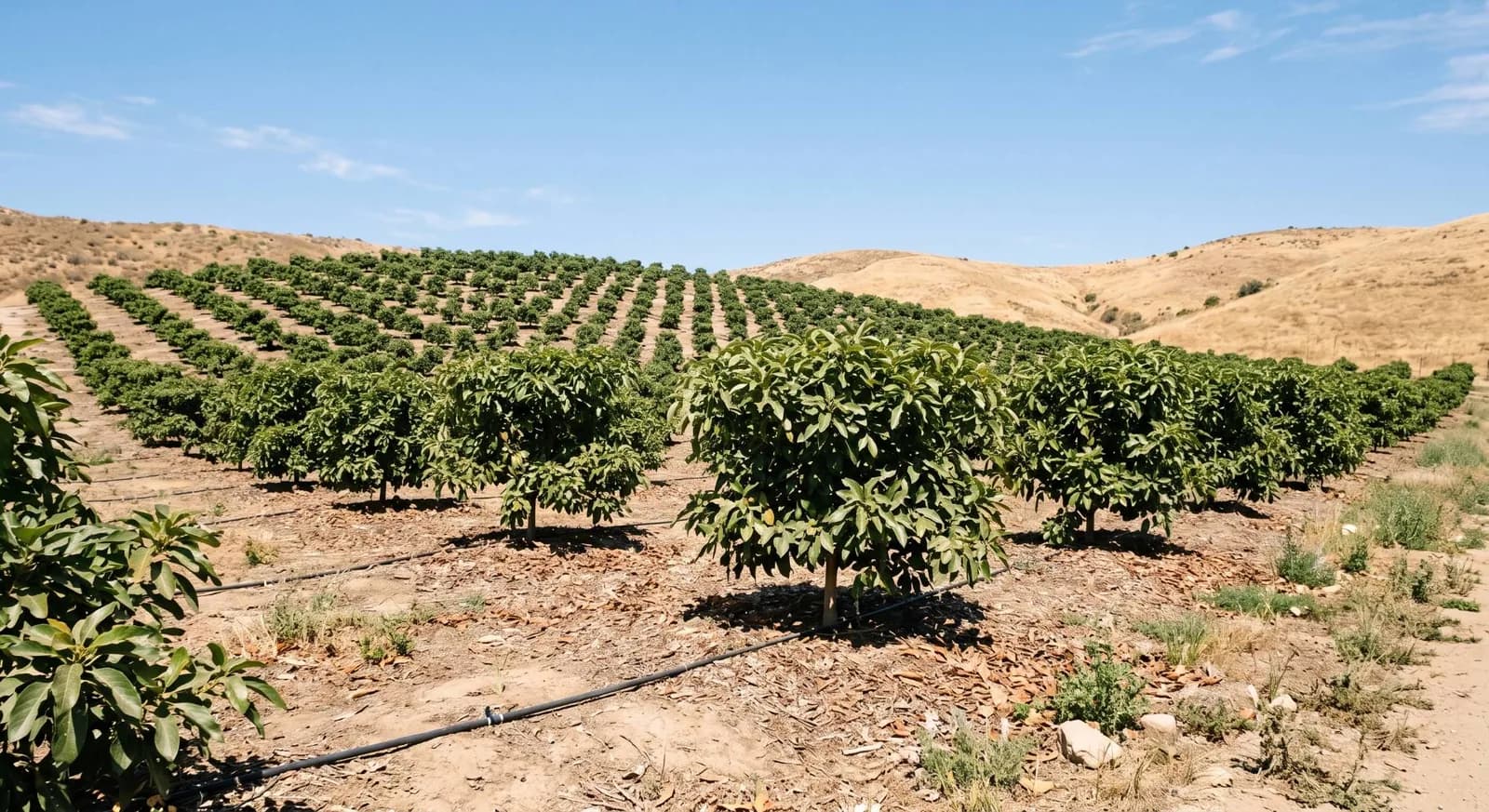
- High-density Hass avocados on a southern California hillside with drip irrigation and mulch.
- Traditional spacing (left) against high density (right): high density holds about three times as many trees per hectare. Schematic, not to scale.
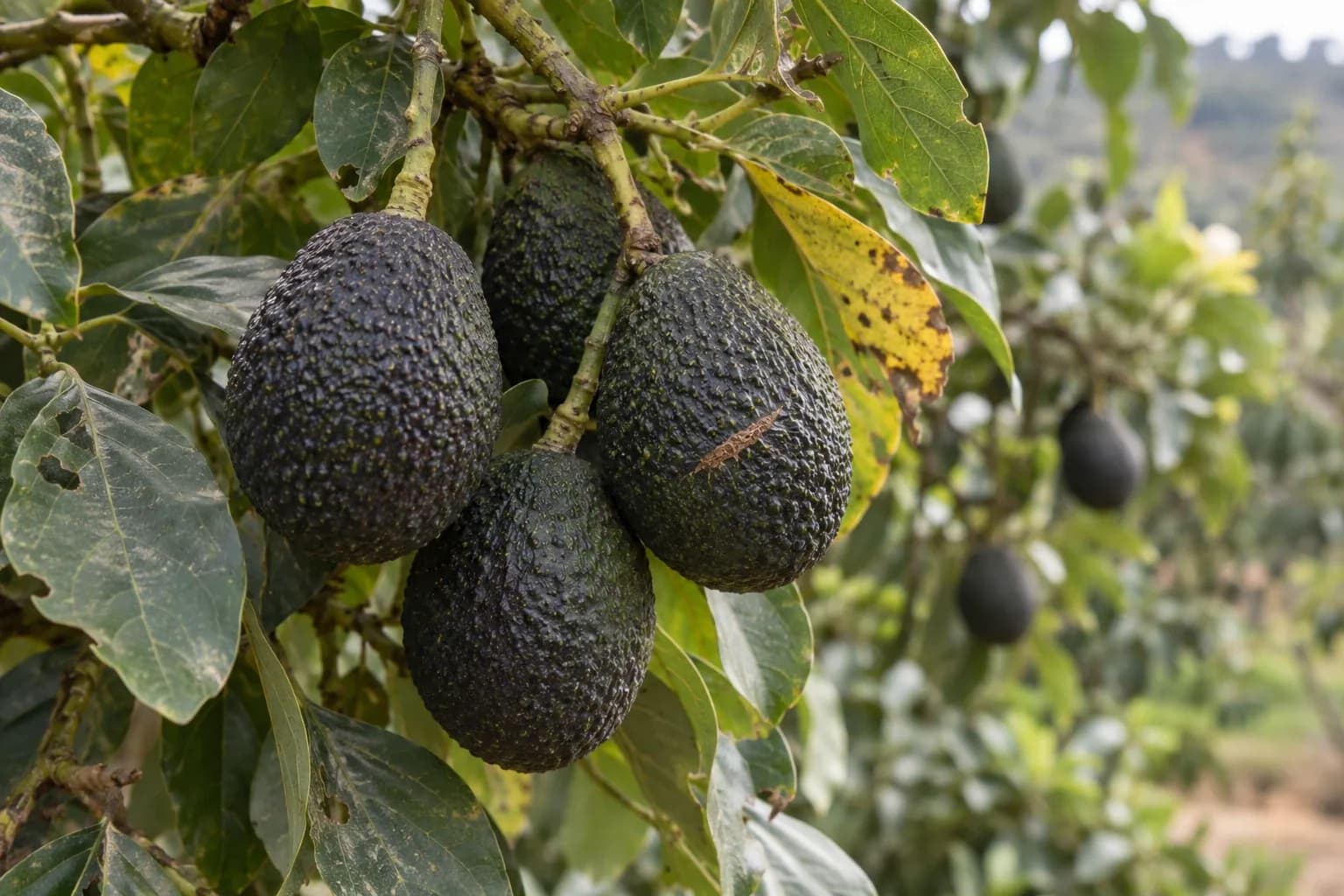
- Hass fruit on the tree. Yield swings between years because of alternate bearing.
Figures are published averages or study assumptions for the places named, not guarantees for your field. Check current local recommendations and product labels before acting.
Some visuals in this guide are illustrations rather than photographs of a specific farm. See image credits.