

Growing avocados in California
California grows almost all US avocados, on frost-free, well-drained slopes in the south. The decisions that matter are tree spacing, a root-rot-tolerant rootstock, a water budget that is lower than older advice and a frost plan for Hass. Yield also swings sharply from year to year.
Scope: Hass avocados in southern California (San Diego, Riverside and neighbouring counties). Figures are metric, with the original US units in brackets. Updated 2026-10-03.
At a glance
- Bearing area, 2025
- 19,950 ha (49,300 acres) in California4
- Tree spacing
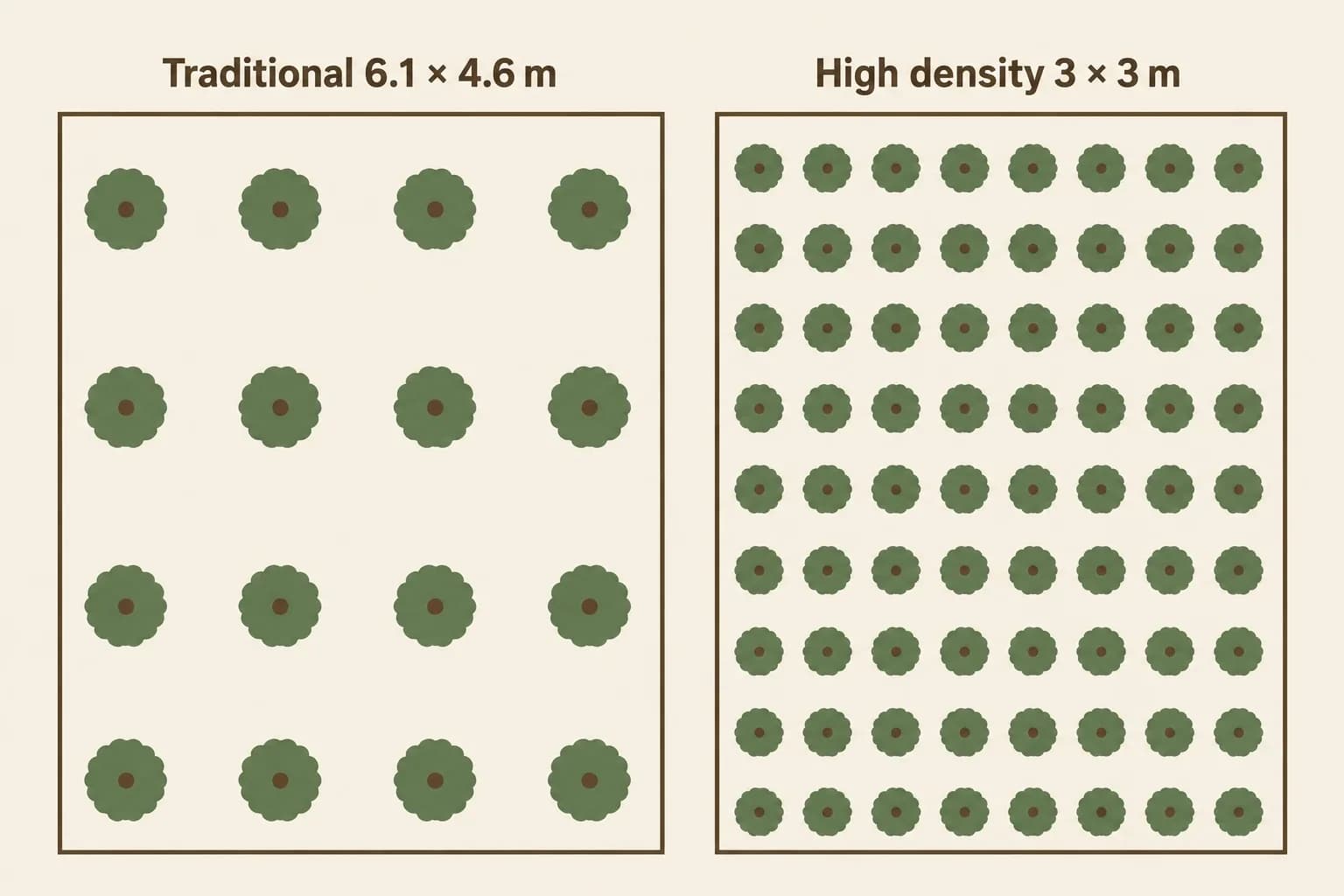
- High density 3 × 3 m (10 × 10 ft), about 1,060 trees/ha; traditional 6.1 × 4.6 m (20 × 15 ft), about 360 trees/ha1
- Pollinizer and rootstock
- One Zutano pollinizer for every 8 Hass; Dusa clonal rootstock for root-rot tolerance1
- First crop
- Fruit from year 3 in the high-density trial1
- Frost limit
- Hass is damaged below about −1.7°C (29°F); Mexican-race types to −3.9°C (25°F)2
- Water
- About 8,800–11,600 m³/ha (2.9–3.8 acre-ft) a year in the trial; UC advises trimming older figures by about 10%1,3
- Harvest
- January to August in San Diego and Riverside counties1
- California yield, 2025
- 7.8 t/ha (3.47 tons/acre); 5.6 t/ha in 2023 and 8.6 t/ha in 20244
Perennial growth and climate in California
A perennial planting remains in the field for multiple years. Establishment is a long-term investment; flowering, fruit development, harvest and plant care recur as the planting matures. Follow the named cultivar and production system.
Establish a long-lived planting1
Establish a long-lived Hass orchard with suitable rootstock, drainage, spacing and irrigation capacity. The San Diego high-density study begins bearing in year three; orchard age and site conditions determine development.
Management: Irrigation monitoring: southern California study1
The cooperating grower irrigated March–November. Adjust amount and frequency to weather, rainfall, stored soil water and orchard condition; this is a study practice, not a fixed irrigation prescription.
Harvest: San Diego and Riverside Hass1
The commercial study gives January–August harvest in San Diego and Riverside, varying with weather and production. Confirm fruit maturity and buyer requirements for the orchard.
Historical monthly climate
Reference period: 1996-01-01 to 2025-12-31. ERA5-Land monthly mean soil temperature at 0–7 cm, air temperature and frost days at the regional reference point (37, -120). Select a month to inspect its historical conditions.
Month tiles show mean air temperature.
March historical conditions
- Mean topsoil temperature
- 13.4°C
- Mean air temperature
- 13.4°C
- Mean frost days per month
- 0.1 days
Use this monthly history to assess winter exposure, seasonal heat and water planning. It does not calculate cultivar chill hours, flowering dates, frost damage during bloom or fruit maturity. Topsoil at 0–7 cm describes shallow soil context, not the full root zone. Harvest periods follow the production evidence above.
Climate source: Open-Meteo Historical Weather APIChoose a frost-free, well-drained site
| Type | Critical temperature |
|---|---|
| Mexican race (most resistant) | −3.9°C (25°F) |
| Hybrids such as Fuerte | −2.2°C (28°F) |
| Guatemalan, tender (Hass) | −1.7°C (29°F) |
| Guatemalan, very tender | −1.1°C (30°F) |
Sources2
- Where the crop is
- California had 19,950 ha (49,300 acres) of bearing avocados in 2025 and produced about 155,000 t (171,000 tons) of the US crop. Production is concentrated in southern California, where San Diego County was once the leader but has lost acreage to urban growth and high water costs.1,4
- Slope and soil
- The UC trial orchard was on a hillside with a gentle slope, clay loam soil and no history of avocado root rot. Avoid sites with root rot history and poor drainage.1
- Frost risk
- Hass is classed as a tender Guatemalan type, damaged at about −1.7°C (29°F). Fuerte-type hybrids tolerate about −2.2°C (28°F) and Mexican-race trees about −3.9°C (25°F), roughly as well as orange trees.2
Plant at high density on a root-rot-tolerant rootstock
Between rows: 3 m (10 ft) · Within the row: 3 m (10 ft)
About 1,060 trees/ha (430 per acre), almost three times the traditional 6.1 × 4.6 m (20 × 15 ft) spacing of about 360 trees/ha (145 per acre). Schematic, not to scale.
- Traditional 6.1 × 4.6 m (20 × 15 ft)360 trees/ha
- High density 3 × 3 m (10 × 10 ft)1,060 trees/ha
- Pollination
- The trial planted 1 Zutano pollinizer tree for every 8 Hass trees, all grafted onto clonal Dusa rootstock, which is currently the most root-rot-tolerant rootstock. Trees cost $32 each in the cost study.1
- Root rot management
- About 3.2 kg (7 lb) of gypsum per planting hole and mulch (about 76 m³/ha, or 40 cubic yards per acre, in the first years) help suppress root rot, and potassium phosphite is applied for treatment.1
- Pruning
- The trial pruned right after harvest in March and kept trees to about 2.4 m (8 ft), at about 80% of the 3 m spacing. Two pruning styles gave no significant yield difference.1
Budget water carefully
- 201410.1 1,000 m³/ha
- 20158.8 1,000 m³/ha
- 201711.6 1,000 m³/ha
- Schedule
- The grower irrigated from March through November: once a week in spring and autumn and twice a week in summer. Trees are sensitive to both water stress and salinity.1
- Use less than the old figure
- Older guidance of about 3 acre-feet a year (about 9,100 m³/ha) is probably on the high side. New UC irrigation data suggests growers were overwatering at some times of year and should trim about 10%.3
- Cost
- District water was $1,900 per acre-foot (about $1.54 per m³) and was 44% of production costs, so a larger crop from high density spreads the water bill over more fruit.1
Expect alternate bearing
- Year 3 (2015)14.8 t/ha
- Year 4 (2016)28.1 t/ha
- Year 5 (2017)6.2 t/haOff-year after a hot June
- Year 6 (2018)23.5 t/ha
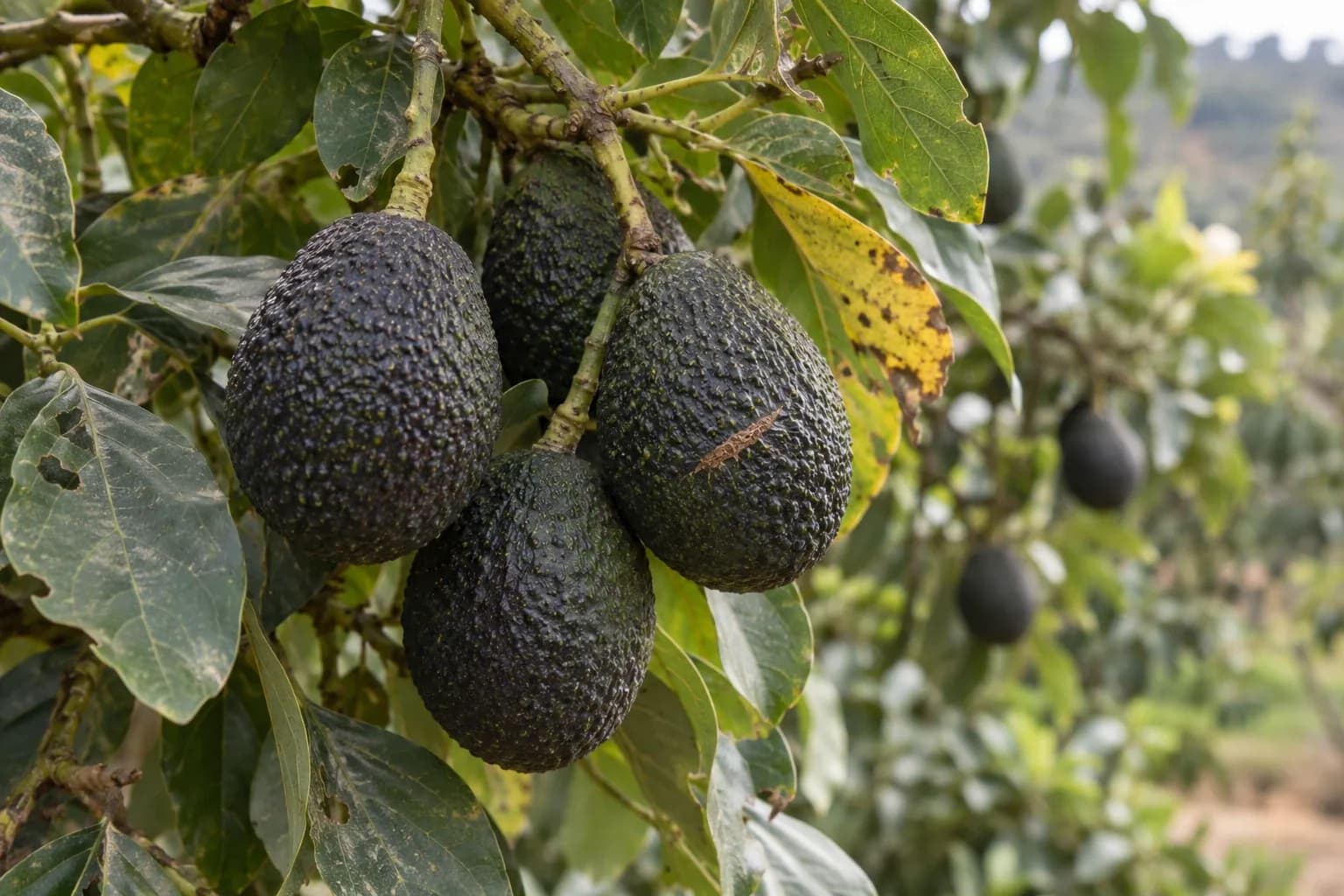
- Big swings
- The trial yielded 14.8, 28.1, 6.2 and 23.5 t/ha (13,246, 25,100, 5,541 and 20,992 lb/acre) in years 3–6. 2017 was an off-year after high temperatures in June 2016 and typical alternate bearing.1
- Statewide too
- California averaged 5.6 t/ha in 2023, 8.6 t/ha in 2024 and 7.8 t/ha in 2025 (2.48, 3.82 and 3.47 tons/acre), so budget on a multi-year average, not the best year.4
- Season and picking cost
- Growers in San Diego and Riverside counties typically harvest from January to August. Picking was costed at $0.09 per pound ($0.20 per kg) plus hauling and industry assessments.1
Costs and returns
- 20235.6 t/ha
- 20248.6 t/ha
- 20257.8 t/ha
- Establishment and production
- The UC study put cumulative establishment cost for years 1–6 at $43,500/ha ($17,597/acre) and annual production cost at $40,100/ha ($16,233/acre).1
- Break-even
- At the trial yield of 18.2 t/ha (16,220 lb/acre) the break-even price for total production cost was about $2.20 per kg ($1.00 per lb). The study assumed prices of $2.91–3.06 per kg ($1.32–1.39 per lb).1
- Test your own site
- Run a field audit for your coordinates and put your own water cost and price into the crop ROI estimator before planting.1
Frequently asked questions
- Can you grow avocados in California?
- Yes. California had about 19,950 hectares (49,300 acres) of bearing avocados in 2025, mostly Hass in the south, on frost-free well-drained sites.
- How many avocado trees per acre?
- A UC trial planted 430 trees per acre (about 1,060 per hectare) at 10 × 10 ft, almost three times the traditional 145 per acre at 20 × 15 ft.
- How much water do avocado trees need in California?
- About 8,800–11,600 m³/ha (2.9–3.8 acre-feet) a year in a UC trial, with newer UC data suggesting growers trim older figures of about 3 acre-feet by roughly 10%.
- What temperature damages Hass avocados?
- Hass is damaged below about −1.7°C (29°F). Fuerte-type hybrids tolerate about −2.2°C (28°F) and Mexican-race trees about −3.9°C (25°F).
- How long until avocado trees fruit?
- The high-density UC trial began bearing in its third year, and yields swung between 6 and 28 t/ha in years 3–6 because of alternate bearing.
- How much does it cost to establish an avocado orchard in California?
- The 2020 UC cost study estimated about $43,500 per hectare ($17,597 per acre) cumulative over the first six years for a high-density Hass planting, in San Diego County.
Regional avocado guides
Local dates, soil-temperature history and sources for specific regions:
Sources and image credits
- 1. UC Cooperative Extension and UC Davis — Avocado Establishment and Production Costs and Returns, High Density Planting, San Diego County, 2020 — 2020. Valley Center field trial 2011–2018: spacing, rootstock, pruning, irrigation, yields by year, costs and returns.
- 2. UC ANR Topics in Subtropics — Frost in some part of Southern CA — Accessed 1 October 2026. Critical frost temperatures by avocado type and protection practices.
- 3. UC ANR — UCCE advisor provides first-of-its-kind avocado irrigation data — Accessed 1 October 2026. Data-based avocado crop water use and the advice to trim older estimates.
- 4. USDA NASS — Noncitrus Fruits and Nuts 2025 Summary — Published May 2026. US and state bearing acreage, yield, production, price and value for avocados, almonds, olives and other fruit and nut crops, 2023–2025.
Image credits
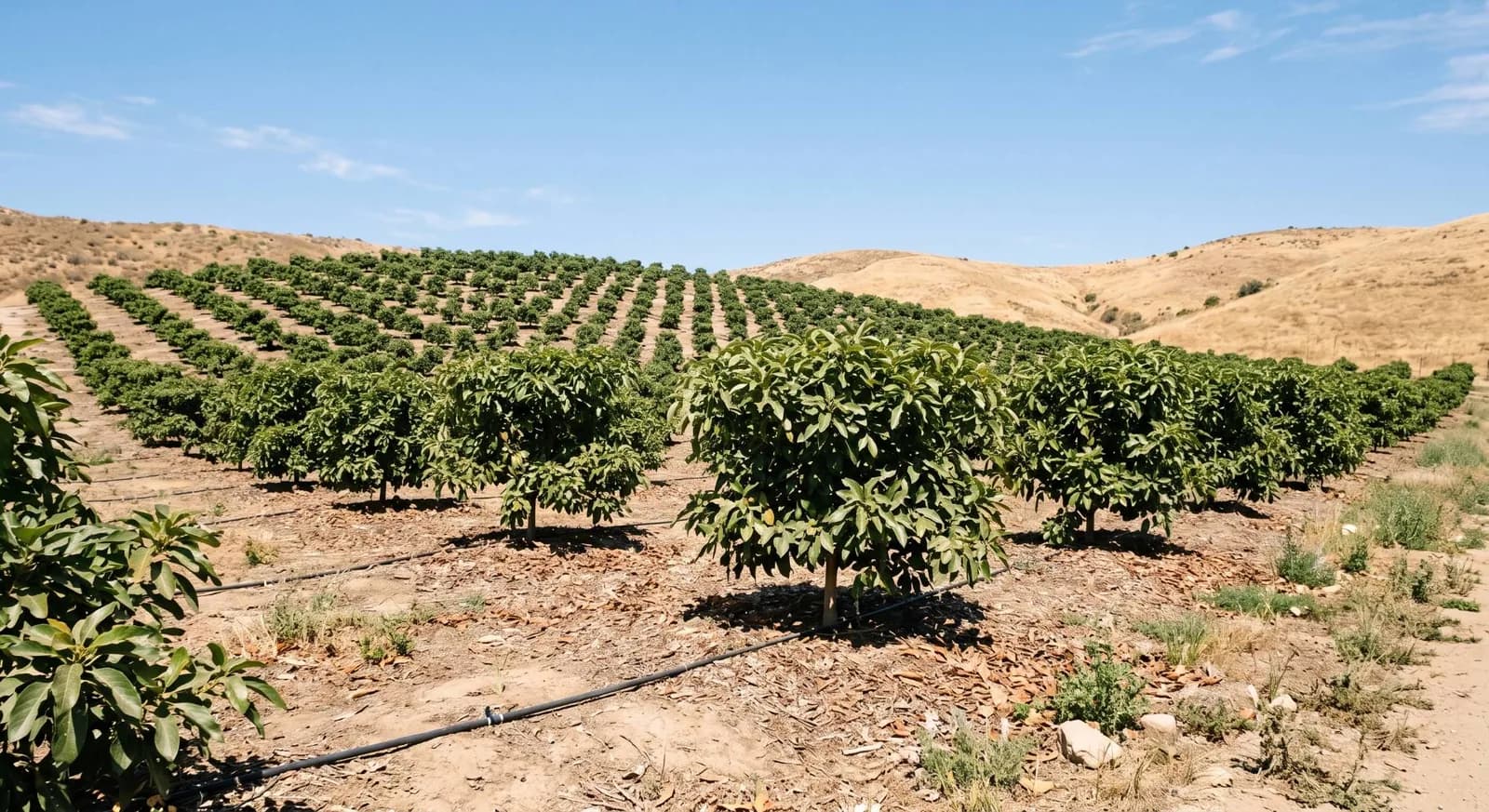
- High-density Hass avocados on a southern California hillside with drip irrigation and mulch.
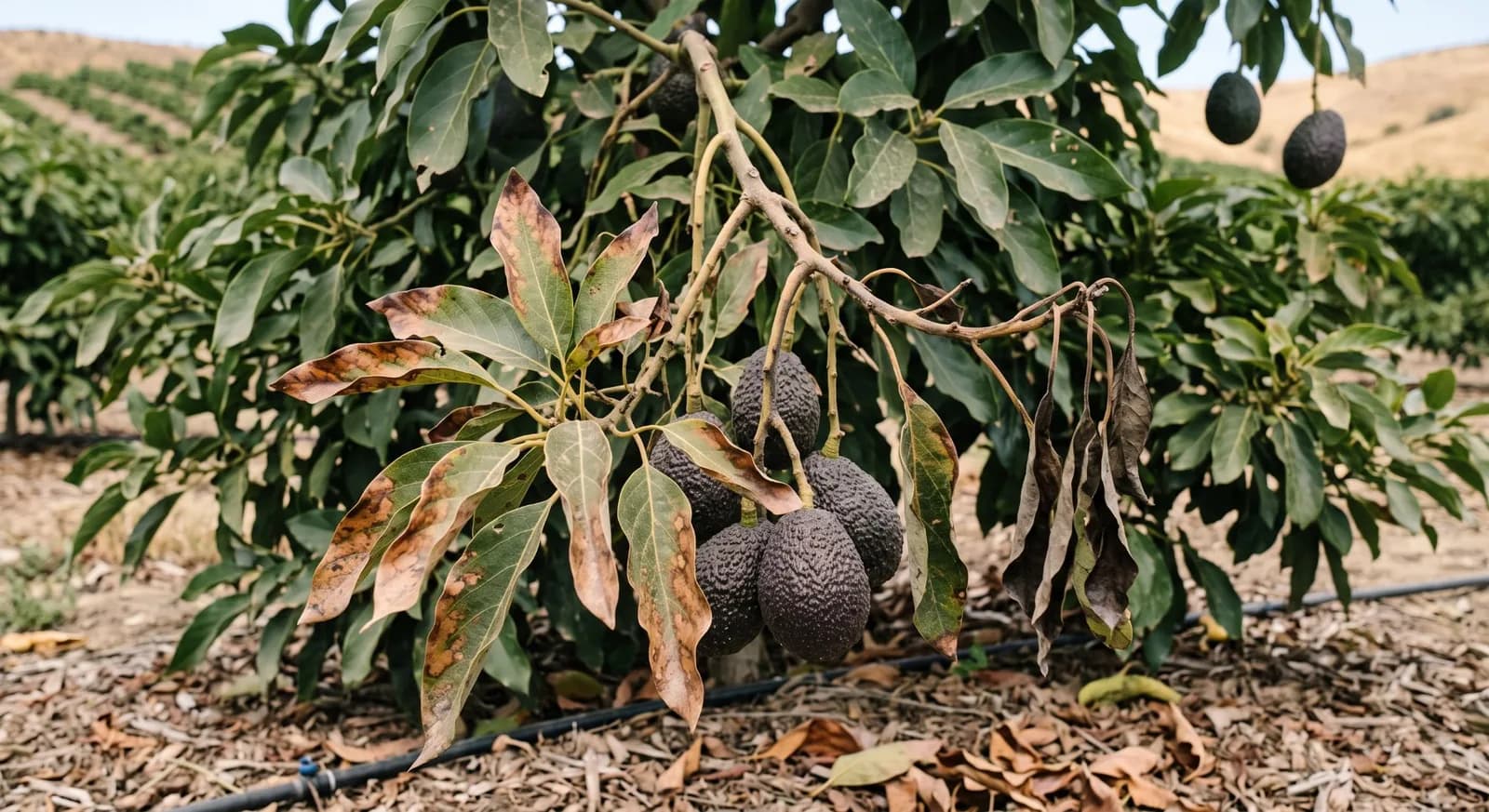
- Leaf browning and dieback can follow frost, water stress or salty irrigation water.
- Traditional spacing (left) against high density (right): high density holds about three times as many trees per hectare. Schematic, not to scale.
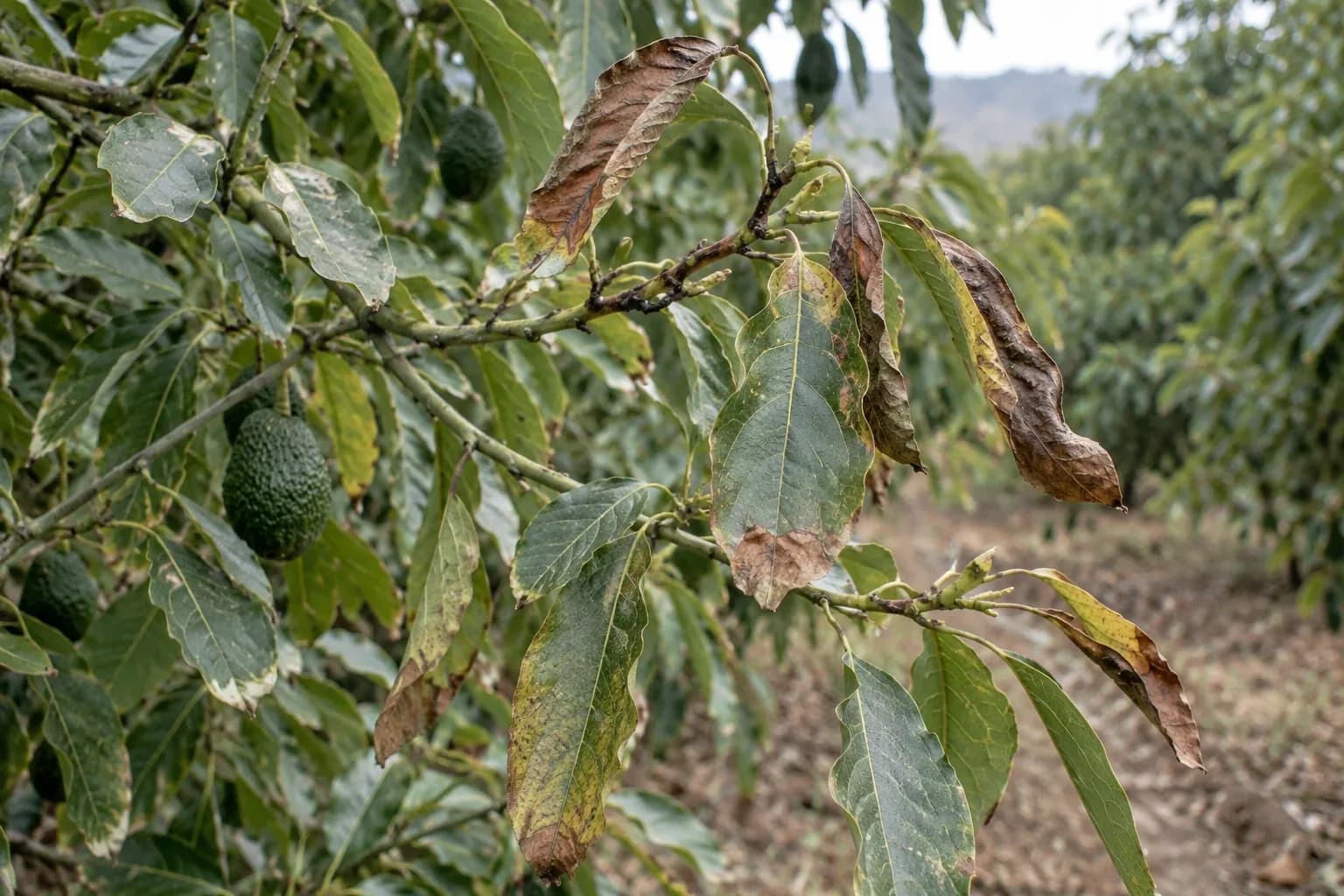
- Leaf-tip burn and browned margins are typical signs of water stress or salty irrigation water.
- Hass fruit on the tree. Yield swings between years because of alternate bearing.
Figures are published averages or study assumptions for the places named, not guarantees for your field. Check current local recommendations and product labels before acting.
Some visuals in this guide are illustrations rather than photographs of a specific farm. See image credits.