

Growing avocados in India
India does not have one avocado calendar or orchard prescription. Kerala Agricultural University documents commercial cultivation in parts of southern India and gives an 8–10 m starting spacing; ICAR-IIHR has released Indian selections and continues regional production work. Match cultivar, flower type, drainage and water supply to the proposed district before establishing a perennial block.
Scope: Indian commercial avocado production, with Kerala Agricultural University cultivation guidance and ICAR-IIHR variety evidence. These sources describe southern production contexts, not every Indian climate zone. Updated 2026-10-07.
At a glance
- Documented commercial context
- Parts of Kerala, Tamil Nadu, Maharashtra and Karnataka1
- Standard spacing reference
- 8–10 m between trees; allow more room for spreading cultivars1
- Planting stock
- Grafted plants are preferred for commercial blocks1
- Bearing onset
- KAU reports grafts may flower from year 3–4; seedlings later1
- Indian cultivars
- Arka Supreme (A-type) and Arka Coorg Ravi (B-type)2
- Main site risks
- Water stagnation, dry-season moisture stress and pollination mismatch1
Perennial growth and climate in India
A perennial planting remains in the field for multiple years. Establishment is a long-term investment; flowering, fruit development, harvest and plant care recur as the planting matures. Follow the named cultivar and production system.
Establish a long-lived planting1,2
Use true-to-type grafted material from a reliable nursery, plan compatible flowering types and confirm drainage and dry-season water before committing land. The sources do not support one India-wide establishment month.
Management: Nutrition checks in the documented KAU schedule1
The KAU source splits fertilizer applications between April–May and September–October. Treat this as its southern Indian reference; adjust rates to tree age, soil tests, rainfall and local extension advice.
Management: Follow flowering and fruit development by cultivar1
KAU describes flowering from December and fruit set around April–May in its cultivation account. Record actual bloom and set locally; this is not a national harvest forecast.
Historical monthly climate
Reference period: 1996-01-01 to 2025-12-31. ERA5-Land monthly mean soil temperature at 0–7 cm, air temperature and frost days at the regional reference point (22, 79). Select a month to inspect its historical conditions.
Month tiles show mean air temperature.
April historical conditions
- Mean topsoil temperature
- 32.1°C
- Mean air temperature
- 29.9°C
- Mean frost days per month
- 0.0 days
Use this monthly history to assess winter exposure, seasonal heat and water planning. It does not calculate cultivar chill hours, flowering dates, frost damage during bloom or fruit maturity. Topsoil at 0–7 cm describes shallow soil context, not the full root zone. The monthly history does not establish a local flowering, maturity or harvest period.
Climate source: Open-Meteo Historical Weather APIConfirm the district, drainage and water supply first
- 1
Map the production area
Use district-level climate and existing horticultural advice; the national label covers very different environments.
- 2
Protect the root zone
Choose freely drained soil and a field that can shed excess monsoon water.
- 3
Budget dry-season water
KAU describes avocado as rainfed in some settings but notes better yield with irrigation and mulch to reduce summer stress.
- 4
Check market access
Confirm a buyer, grading expectations, packing and transport before scaling a new block.
- Do not use a single India-wide recommendation
- Commercial cultivation is documented in parts of four southern states, but a local valley, plateau or coastal site can have different rainfall, drainage, heat and disease pressure. Ask the district horticulture office or nearby research station for local cultivar performance.1,3
- Drainage matters in wet periods
- Avocado roots are sensitive to water stagnation. Provide surface drainage and avoid planting in low spots that hold water after heavy rain.1
Select grafted cultivars and plan pollination
- 1
Choose a main market cultivar
Match fruit type, buyer demand and local trial evidence.
- 2
Identify its flowering type
Avocado flowers open in female and male phases at different times; cultivars differ.
- 3
Add a compatible pollen source
Use a locally suitable complementary type where flowering overlap supports pollination.
- 4
Record fruit set
Compare bloom overlap, pollination and fruit retention by cultivar.
- Use local grafted planting material
- KAU recommends grafts for commercial orchards, with earlier bearing than seedlings. Verify cultivar identity and plant health at purchase.1
- Use released Indian selections as candidates, not universal answers
- ICAR lists Arka Supreme as A-type and Arka Coorg Ravi as B-type, with large fruit and yield potential reported by the institute. Confirm their adaptation and commercial performance in your district before planting acreage.2
Lay out the orchard and establish trees
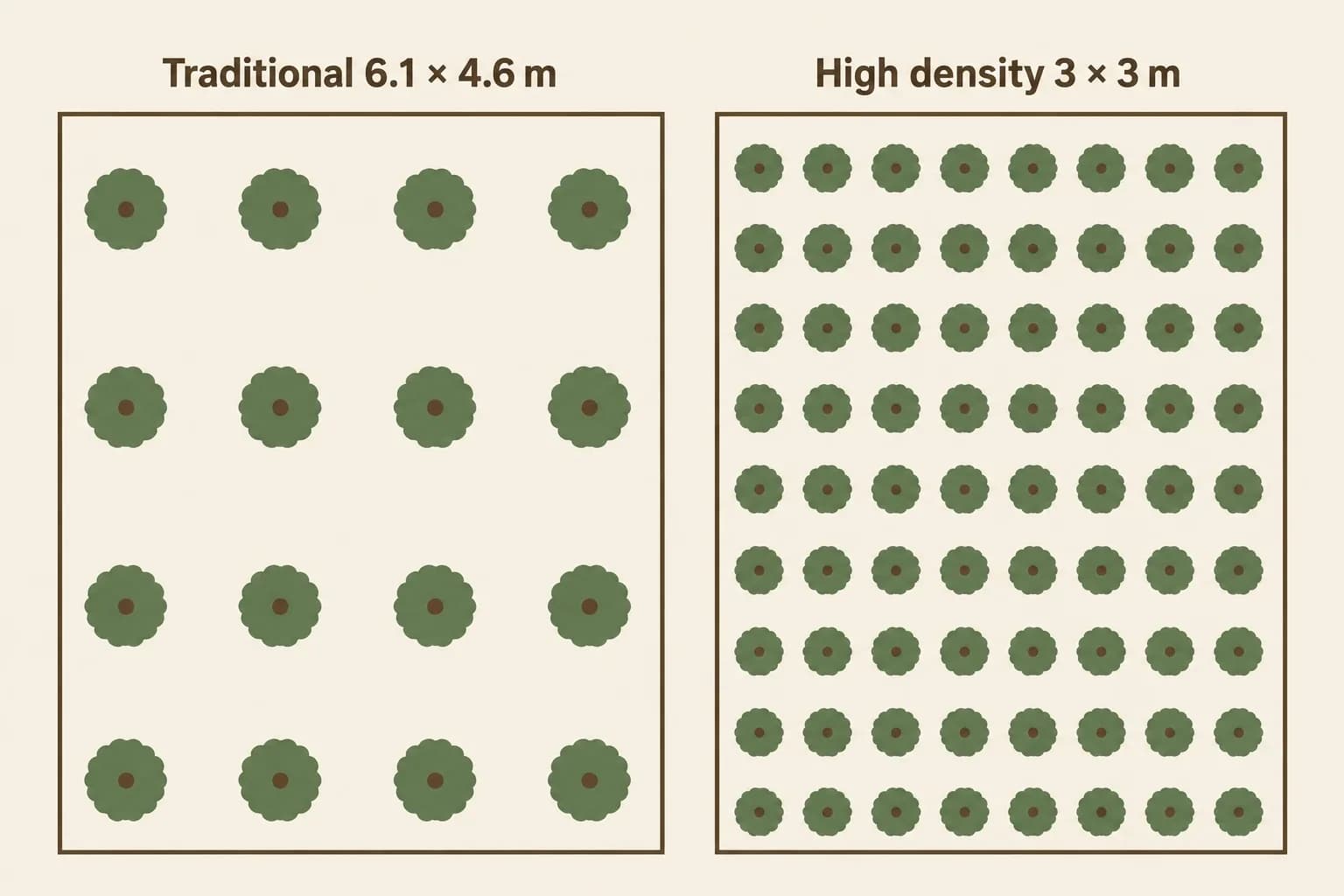
Between rows: 8–10 m between rows · Within the row: 8–10 m between trees
Use wider spacing for spreading cultivars such as Fuerte. Confirm final density against canopy vigour, slope, equipment access and orchard design. Schematic, not to scale.
- Prepare the planting site
- The KAU reference describes 90 × 90 cm planting pits with topsoil and farmyard manure. Keep the graft union above the soil line and avoid burying the stem.1
- Keep young trees evenly supplied
- Use drip irrigation where available, mulch to conserve moisture and drain excess water after heavy rain. Irrigation amount should follow soil, weather and tree size rather than a national fixed rate.1
Manage nutrition, canopy and orchard health
- Base fertilizer on tree age and soil
- KAU provides an age-based nutrient schedule and calls for split applications. Use it as a regional reference only; confirm local soil-test recommendations before setting commercial rates.1
- Avoid saturation and moisture swings
- Avocado responds to irrigation but is sensitive to standing water. Keep drainage working and maintain root-zone moisture through dry periods.1
Frequently asked questions
- Where is avocado grown commercially in India?
- Kerala Agricultural University documents commercial cultivation in parts of Kerala, Tamil Nadu, Maharashtra and Karnataka. Conditions and cultivars vary by district.
- How far apart should avocado trees be planted in India?
- The KAU reference gives 8–10 m, with more room for spreading cultivars. Confirm spacing against local tree vigour and equipment access.
- Should I plant avocado seedlings or grafted trees?
- For commercial production, KAU recommends grafted plants, which may bear earlier than seedlings. Buy verified, healthy planting material.
- Which avocado varieties are available from ICAR?
- ICAR lists Arka Supreme, an A-type selection, and Arka Coorg Ravi, a B-type selection. Check local adaptation and flowering overlap before using them in a commercial block.
- When should avocado trees be established in India?
- The reviewed sources do not support one national planting month. Set establishment timing with local nursery and district advice, considering rainfall, drainage and irrigation access.
Regional avocado guides
Local dates, soil-temperature history and sources for specific regions:
Sources and image credits
- 1. Kerala Agricultural University — Avocado cultivation — Extension publication; accessed 7 October 2026. Commercial production locations, spacing, grafting, pollination, pit preparation, irrigation, drainage and age-based nutrient guidance; apply to relevant southern Indian conditions.
- 2. Indian Council of Agricultural Research — Landmark varieties: Avocado — Accessed 7 October 2026. ICAR variety traits and flower types for Arka Supreme and Arka Coorg Ravi.
- 3. ICAR-IIHR — Scientific cultivation of avocado training in Karnataka — 18 September 2025. Evidence of current avocado production training and farmer interest in the Kodagu region; the event report is not a production-rate recommendation.
Image credits
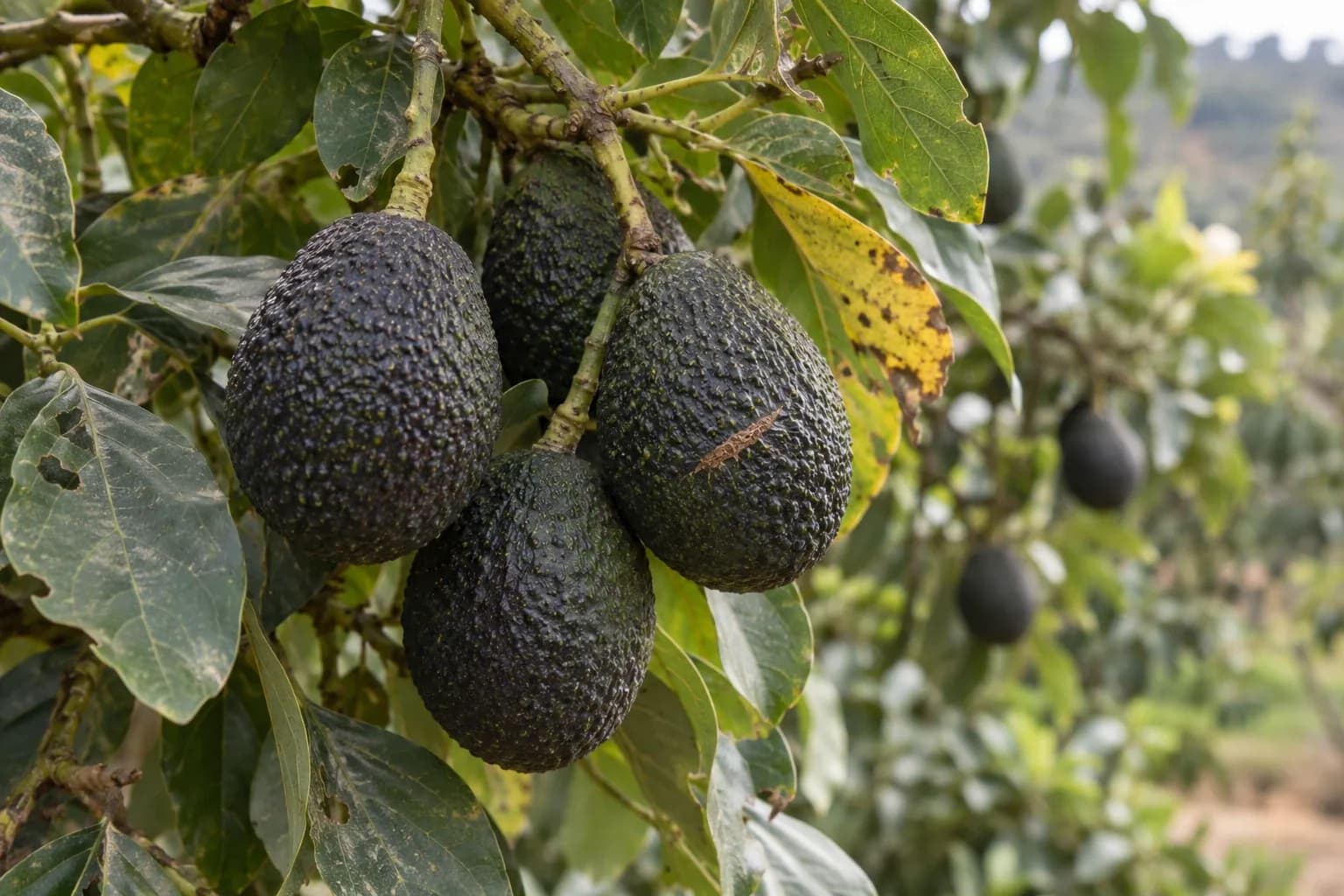
- Illustration of avocado fruit; cultivar and harvest timing vary by region.
- Illustration of published cold-tolerance thresholds; duration, tree age and acclimation affect injury.
- Illustration of orchard layouts from a California reference; it is not a local spacing recommendation.
Figures are published averages or study assumptions for the places named, not guarantees for your field. Check current local recommendations and product labels before acting.
Some visuals in this guide are illustrations rather than photographs of a specific farm. See image credits.