

Commercial rice farming
Rice production does not follow one global calendar or one water system. Choose the variety, establishment method, field layout and harvest plan for the local rice ecology, water supply and buyer. This guide brings together regional evidence from California, Texas, India and China while keeping each region’s operating figures in context.
Scope: Commercial grain rice across irrigated lowland and direct-seeded systems. Dates, spacing, water depth, nutrient rates and harvest targets below are source- and region-specific examples, not universal prescriptions. Updated 2026-10-16.
At a glance
Choose the market and establishment system
Plan around the grain class, buyer specification, local crop season, available water, field shape and equipment. Rice regions use different combinations of direct seeding, transplanting and flood management.
| System | Field example | Planning constraint |
|---|---|---|
| Direct seeding | Seed is drilled or broadcast into the field; Texas uses dry-seeded and water-seeded options | Match the seedbed, weed control, water and equipment plan to the local system |
| Transplanting | India ICAR example raises seedlings in a nursery before field transplanting | Nursery size, seedling age and spacing follow the state and variety recommendation |
| Water seeding | Sacramento Valley fields are flooded before pre-soaked seed is broadcast | Requires level fields, controlled water and the services used by that production district |
| Ratoon crop | Texas fields may regrow after the main harvest | A conditional second crop that depends on stand, heat, water and pest pressure |
- 1
Confirm the market
Choose grain class, variety, buyer grade and delivery plan.
- 2
Choose the field system
Compare direct seeding, transplanting or water seeding for local conditions.
- 3
Prepare land and water
Level or grade fields and confirm drainage, water access and equipment.
- 4
Establish and scout
Check stand uniformity and control weeds early in the crop.
- 5
Harvest to specification
Coordinate crop maturity, combine, drying and storage capacity.
Prepare a uniform field and sound seed lot
- Level fields for the chosen water system
- IRRI describes better water coverage, crop establishment and weed suppression as benefits of land leveling. The exact grade, levee layout and tillage depend on whether the field is puddled, flooded or direct-seeded.2,5,6
- Test seed before planting
- Use a traceable seed lot and check germination and vigor. IRRI describes a simple two-sample germination check; follow the local seed certification and phytosanitary rules for the crop and destination market.3
Establish the crop and control weeds early
- Choose direct seeding or transplanting deliberately
- Direct seeding avoids a nursery and transplant operation but changes weed competition and water management. Transplanting adds nursery planning and labor. The India ICAR advisory, for example, describes 20–25-day seedlings for one kharif system; that age is not a universal rice standard.1,7
Manage water, nutrients and crop health by stage
- 1
Establish first
Do not start the drying cycle until the crop is established and the field system is suitable.
- 2
Monitor below the surface
Use a field water tube to track the water table rather than judging only the soil surface.
- 3
Reflood at the guide threshold
The IRRI reference irrigates when the water level reaches about 15 cm below the soil surface, then refloods to about 5 cm.
- 4
Protect flowering
Keep the field flooded from one week before to one week after flowering in the safe-AWD reference.
- Do not assume continuous flooding is universal
- IRRI describes safe alternate wetting and drying for suitable irrigated lowland fields. It is not a fit for every soil, water source, crop stage or rice system. Follow local guidance, maintain water through flowering as specified, and do not use the example as a general irrigation schedule.4
Harvest, dry and store grain to the buyer’s standard
- 1
Sample the field
Check grain maturity and moisture across representative areas.
- 2
Harvest to the buyer grade
Match combine setup and timing to the lot and crop condition.
- 3
Dry with a measured endpoint
Use the market and storage target; avoid relying on a calendar date.
- 4
Store and identify the lot
Keep clean, dry grain protected from moisture and mix-ups.
- Harvest by maturity and grain condition
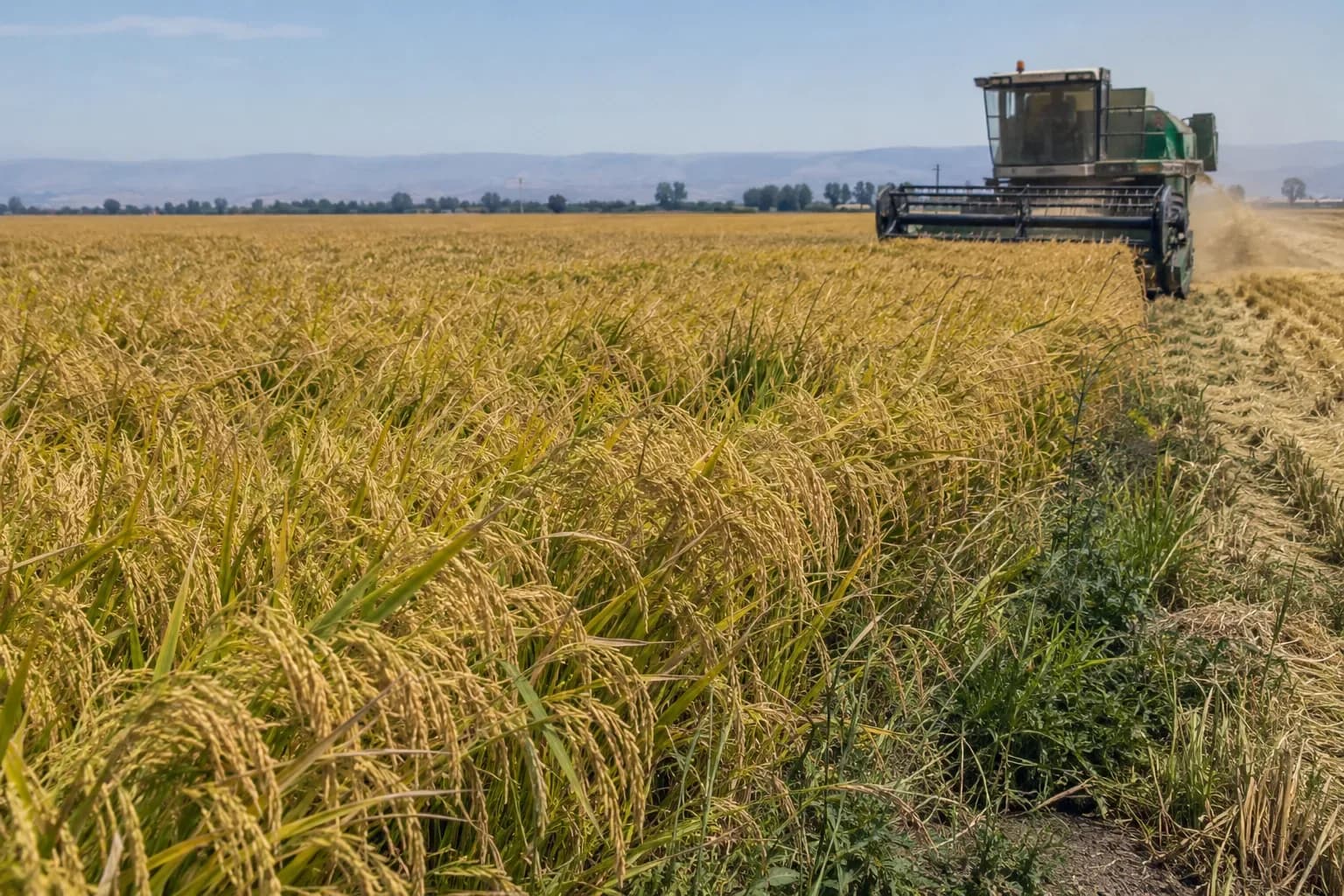
- Use panicle maturity and grain-moisture sampling alongside the buyer’s quality standard and combine capacity. One ICAR advisory example uses about 80–85% golden grains and harvest near 20% grain moisture; the California study also models combining near 20%. These are examples, not a global harvest rule.6,7
Frequently asked questions
- Does rice have to grow in standing water?
- No. Rice can be direct-seeded or transplanted, and irrigated lowland systems range from continuous flooding to suitable alternate wetting and drying. Choose a method for the local soil, water source and weed plan.
- When should farmers plant rice?
- There is no single global month. Planting depends on rice season, latitude, variety, water availability and establishment method. Use the regional crop calendar and the linked local guides.
- Is rice direct-seeded or transplanted?
- Both methods are used. Direct seeding establishes seed in the field; transplanting raises seedlings in a nursery first. Water-seeded production is another local system.
- How much water does rice need?
- Water needs vary with climate, soil, land preparation, crop duration and irrigation method. Use measured field water and the local water-management recommendation instead of a single global total.
- What spacing should rice use?
- Spacing depends on variety and establishment method. The India transplanting example and China field study use different layouts; neither applies to California water seeding or every direct-seeded field.
- When is rice ready to harvest?
- Check panicle and grain maturity, sample grain moisture, and follow the miller or buyer specification. About 20% moisture appears in the cited California and India examples, not as a universal target.
Regional guides and field planning
Sources and image credits
- 1. International Rice Research Institute — Rice Knowledge Bank: Growth and production management — Accessed 7 October 2026. Direct seeding and transplanting, early weed competition, water and soil-fertility management.
- 2. International Rice Research Institute — Land leveling — Accessed 7 October 2026. Benefits and systems for leveling rice fields; field and water-system requirements vary.
- 3. International Rice Research Institute — Using good, clean and healthy seed — Accessed 7 October 2026. Seed-lot quality, germination checks and seed handling.
- 4. International Rice Research Institute — Saving water with alternate wetting and drying — Accessed 7 October 2026. Safe-AWD field water-tube method and the limits around establishment and flowering.
- 5. Texas A&M AgriLife Research — Texas Rice Production Guidelines — 2023. Texas field preparation, direct and water seeding, crop-stage nutrients, irrigation, harvest and ratoon management.
- 6. UC Cooperative Extension and UC Davis — Sample Costs to Produce Rice, Sacramento Valley — 2021. California water-seeded system, field operations, harvest moisture and historical cost assumptions.
- 7. Indian Council of Agricultural Research — Kharif Agro-Advisories for Farmers 2025 — 2025. One regional advisory example for nursery, transplanting, crop-stage water and harvest; recommendations vary by state and system.
- 8. USDA Economic Research Service — Rice sector at a glance — Accessed 7 October 2026. US rice systems and the regional context of a partial ratoon crop.
- 9. USDA Foreign Agricultural Service — Grain and Feed Annual: China — 19 March 2026. China rice area, production and seasonal market context.
- 10. Comparative analysis of rice yield and economic performance across planting patterns in double-cropping rice systems — 2025. A 2021–2022 China field study with system-specific sowing dates, transplant spacing and nitrogen rates.
Image credits
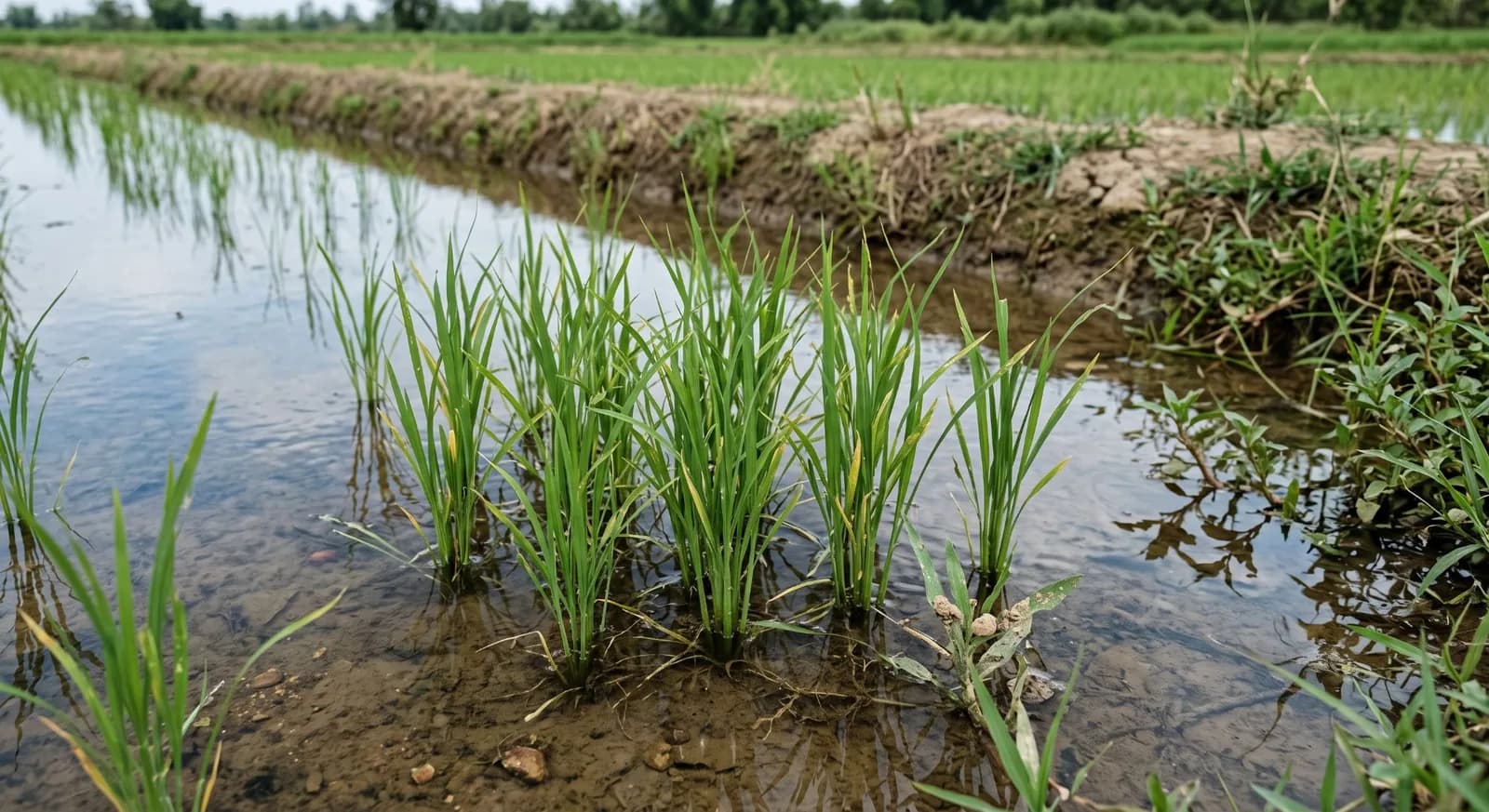
- Flooded-field establishment is one rice production system. Illustration.
- Rice harvest and field handling. Illustration.
Figures are published averages or study assumptions for the places named, not guarantees for your field. Check current local recommendations and product labels before acting.
Some visuals in this guide are illustrations rather than photographs of a specific farm. See image credits.