

Growing rice in India
India grows rice in three overlapping crop seasons, not one national planting window. USDA FAS reports that kharif contributes about 82% of production, rabi about 11% and summer about 7%. The field example below follows ICAR’s kharif transplanting advice; rice systems, dates, varieties and water access still need to be matched to the state and district.
Scope: A national seasonal overview paired with an ICAR kharif transplanting example. The field spacing and dates are not a blanket prescription for every rice region or for rabi and summer systems. Updated 2026-10-07.
At a glance
- Production seasons
- Kharif ~82%; rabi ~11%; summer ~7% of production1
- Kharif nursery example
- Mid-May to mid-June2
- Transplanting example
- 20–25-day seedlings; mid-June to early July2
- Hills and spacing
- 2–3 seedlings per hill; 20 × 15 cm for HYVs or 20 × 20 cm for hybrids2
- Water depth in ICAR example
- 2–5 cm through tillering; around 5 cm at panicle initiation and flowering2
- Harvest and storage moisture
- Harvest near 20%; dry paddy to 13–14%2
Planting and harvest calendar for India
Use the source-backed production windows to coordinate establishment, crop care and harvest. Production districts and cultivars can have different cycles; the historical climate adds context for the field plan.
Planting: Three seasons; dates vary by region and system1,2
USDA FAS reports kharif sowing from May to August, rabi from November to February and summer from March to May. For one ICAR kharif example, sow the nursery in mid-May to mid-June and transplant 20–25-day seedlings from mid-June to early July. These national and advisory ranges describe different scales; use the state crop calendar.
Harvest: Harvest follows the crop season and maturity1,2
USDA FAS describes kharif harvest from September to January and rabi harvest from March to May. Harvest when about 80–85% of grains on the panicle are golden; the ICAR advisory gives about 20% grain moisture, followed by drying to 13–14%. Summer harvest timing varies by local system and is not set here.
Historical monthly climate
Reference period: 1996-01-01 to 2025-12-31. ERA5-Land monthly mean soil temperature at 0–7 cm, air temperature and frost days at the regional reference point (22, 79). Select a month to inspect its historical conditions.
Month tiles show mean topsoil temperature.
March historical conditions
- Mean topsoil temperature
- 27.5°C
- Mean air temperature
- 25.7°C
- Mean frost days per month
- 0.0 days
These are monthly means at one reference location. They describe seasonal field conditions, not crop maturity, actual seed-zone conditions, frost forecasts or a planting recommendation. Harvest bands follow the crop-specific production sources above.
Climate source: Open-Meteo Historical Weather APIChoose the rice season for the district and water source
- Kharif82 %
- Rabi11 %
- Summer7 %
- Kharif is the largest crop, not the only crop
- USDA FAS reports three rice seasons: kharif is generally planted May–August, rabi November–February and summer March–May. Production share and calendar vary with state, rainfall, irrigation and local varieties, so select the season from the district’s extension calendar rather than the national month range alone.1
Raise a uniform nursery for transplanted kharif rice
- 1
Sow nursery
Mid-May to mid-June in the cited advisory; use a healthy seed lot.
- 2
Prepare main field
Finish puddling and drainage preparation for the target transplant date.
- 3
Transplant
Move 20–25-day seedlings in mid-June to early July in the advisory example.
- 4
Manage water
Keep shallow water according to the crop stage; avoid waterlogging in the nursery.
- 5
Harvest and dry
Harvest at panicle maturity and dry grain to a safe storage moisture.
- Use a regional calendar
- The dates above are an ICAR kharif reference, not a whole-country transplanting rule. Highland, lowland, eastern and western production areas have separate crop calendars and suitable varieties.1,2
- Keep nursery and field capacity in step
- The ICAR advisory estimates about 800–1,000 m² of nursery for one hectare of main field and gives a seed requirement of 30–40 kg/ha for the specified system. Confirm the rate and nursery design with the state variety recommendation.2
Set the stand to variety and field conditions
Between rows: 20 cm between rows · Within the row: 15–20 cm between hills
The advisory gives 20 × 15 cm for high-yielding varieties and 20 × 20 cm for hybrids, with 2–3 seedlings per hill. This is a reference layout; use the locally recommended variety and machinery system.
- Avoid old or over-aged seedlings
- The ICAR example uses 20–25-day-old seedlings. Timely transplanting is tied to the nursery date and seasonal conditions; older seedlings may not perform the same way across varieties and locations.2
- Use the appropriate spacing class
- The ICAR advisory distinguishes HYV and hybrid layouts. Do not carry this spacing to direct-seeded rice or to a different cultivar without checking the state recommendation.2
Manage water and nutrients by crop stage
- Keep water shallow and timely
- For the cited transplant system, ICAR recommends 2–3 cm of standing water for the first few days, then 2–5 cm during tillering and about 5 cm at panicle initiation and flowering. Drain excess water from nursery and fields during intense rain; local irrigation systems may use alternate wetting and drying.2
- Split nitrogen to match crop demand
- The ICAR advisory describes dividing the remaining nitrogen into three or four applications from early growth through panicle initiation. Set the rate from the state recommendation, soil test, variety and yield target; do not treat the timing example as a national dose.2
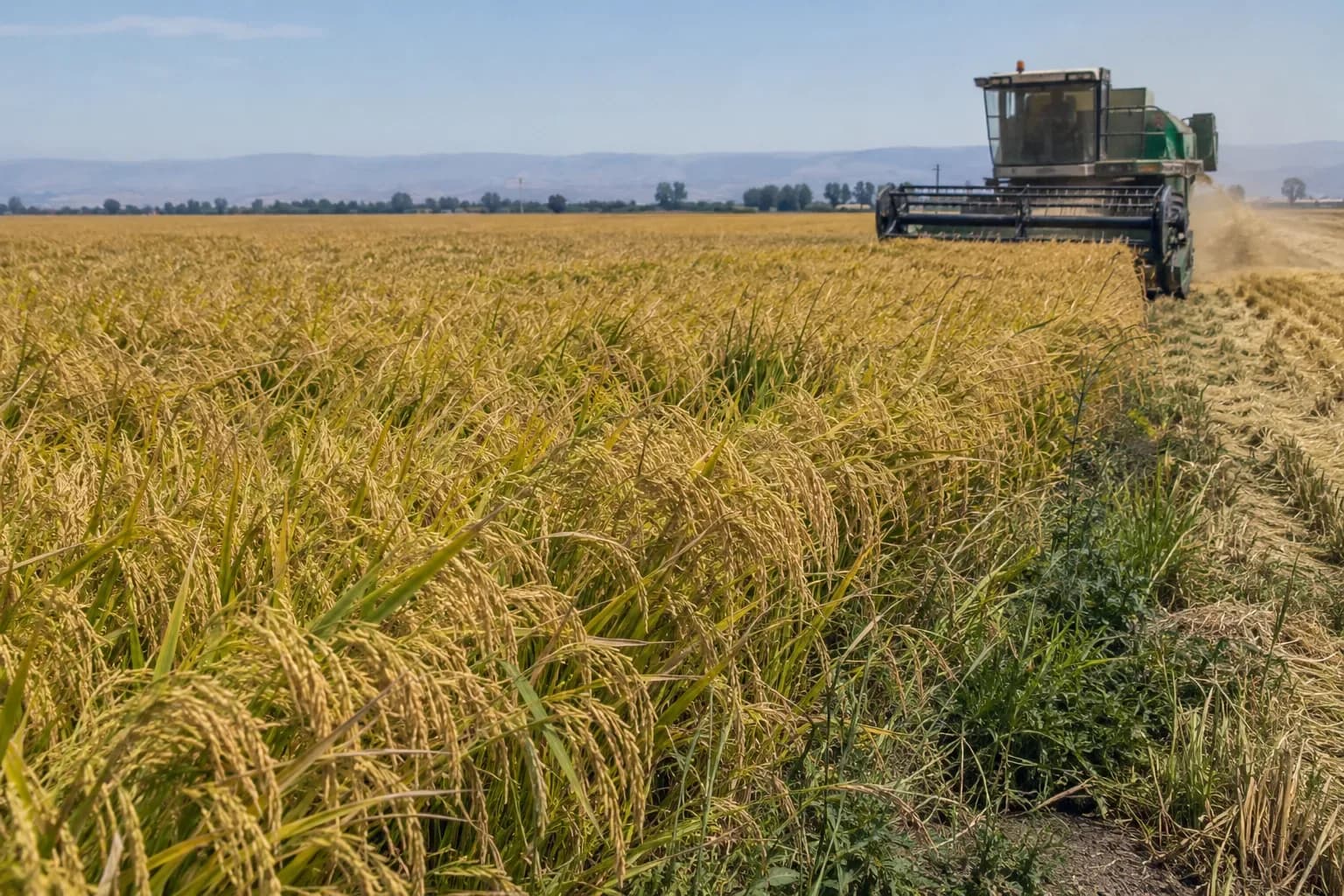
Harvest mature panicles and dry paddy promptly
- 1
Assess maturity
Around 80–85% of grains on each panicle have turned golden.
- 2
Harvest
The ICAR advisory gives approximately 20% grain moisture.
- 3
Dry
Bring paddy to about 13–14% moisture for storage.
- 4
Store clean grain
Use clean, dry storage and prevent moisture re-entry.
Frequently asked questions
- When is rice planted in India?
- India has three rice seasons. USDA FAS reports kharif planting from May to August, rabi from November to February and summer from March to May; state calendars vary.
- When should kharif rice seedlings be transplanted?
- The ICAR 2025 advisory example uses 20–25-day seedlings and mid-June to early July transplanting. Use your state’s crop calendar.
- How far apart is transplanted rice in India?
- The ICAR example gives 20 × 15 cm for high-yielding varieties and 20 × 20 cm for hybrids, with 2–3 seedlings per hill.
- How much water should transplanted rice have?
- The cited ICAR schedule starts shallow, then gives 2–5 cm during tillering and about 5 cm at panicle initiation and flowering. Local systems may use different irrigation methods.
- When is Indian rice harvested?
- Kharif harvest is generally September–January and rabi harvest March–May in USDA FAS descriptions. Judge maturity locally; the ICAR guide uses 80–85% golden grains.
Regional rice guides
Local dates, soil-temperature history and sources for specific regions:
Sources and image credits
- 1. USDA Foreign Agricultural Service — Grain and Feed Annual: India — June 2025. National rice seasons, approximate planting periods and share of production by kharif, rabi and summer crop.
- 2. Indian Council of Agricultural Research — Kharif Agro-Advisories for Farmers 2025 — 2025. Kharif rice nursery, transplanting age and timing, spacing, water management, crop care and harvest moisture examples; recommendations vary by regional advisory.
- 3. ICAR — Technology: modified SRI method for enhancing water productivity in rice — Accessed 7 October 2026. A specific modified SRI method and water-productivity comparison; not a universal transplanting or irrigation requirement.
- 4. ICAR — Kharif rice seedling production initiative in Nadia, West Bengal — Accessed 7 October 2026. District-level example of community nurseries and seedling supply in Nadia; not a national production benchmark.
Image credits
- Rice establishment varies by production system. Illustration.
- Harvest grain at the moisture and maturity suited to the buyer and dryer. Illustration.
Figures are published averages or study assumptions for the places named, not guarantees for your field. Check current local recommendations and product labels before acting.
Some visuals in this guide are illustrations rather than photographs of a specific farm. See image credits.