

Growing rice in California
California rice is almost all medium-grain, water-seeded into flooded fields in the Sacramento Valley. The decisions that matter are timely planting, a split nitrogen plan built around preplant aqua ammonia, four to six acre-feet of water and straw management after harvest.
Scope: Medium-grain rice in the Sacramento Valley, based on the 2021 UC cost study, CDFA fertiliser guidelines and USDA NASS. Metric first, with the original US units in brackets. Updated 2026-10-03.
At a glance
- Seeding method
- Pre-soaked seed flown onto a flooded field (water seeding)1
- Seeding rate
- 196 kg/ha (175 lb/acre)1
- Planting window
- Mostly 20 April to 20 May1
- Water
- 4–6 acre-feet per acre, about 12,200–18,300 m³/ha, excluding straw management1
- Nitrogen
- Average 168 kg N/ha (150 lb/acre); yield maximum at 157–213 kg N/ha (140–190 lb)2
- Harvest
- At about 20% kernel moisture, then drying to 14%1
- Study yield
- 10.1 t/ha (90 cwt/acre) at 14% moisture; historical state range 8.5–10.2 t/ha1
- California yield, 2025
- 9.6 t/ha medium grain (8,600 lb/acre) on about 477,000 acres3
Planting and harvest calendar for California
Use the source-backed production windows to coordinate establishment, crop care and harvest. Production districts and cultivars can have different cycles; the historical climate adds context for the field plan.
Planting: Sacramento Valley water-seeded rice1,4
The UC study gives the usual seeding period as 20 April–20 May; the California Rice Commission describes April–May establishment. Cultivar, field preparation and current conditions determine the actual date.
Harvest: Sacramento Valley combine harvest1,4
The California Rice Commission describes September–October harvest after August–September drainage. Confirm maturity: the UC study combines at about 20% grain moisture and dries to 14%. Regional modeled topsoil is not a direct measurement of a managed flooded paddy seed zone.
Historical monthly climate
Reference period: 1996-01-01 to 2025-12-31. ERA5-Land monthly mean soil temperature at 0–7 cm, air temperature and frost days at the regional reference point (37, -120). Select a month to inspect its historical conditions.
Month tiles show mean topsoil temperature.
April historical conditions
- Mean topsoil temperature
- 17.4°C
- Mean air temperature
- 16.7°C
- Mean frost days per month
- 0.0 days
These are monthly means at one reference location. They describe seasonal field conditions, not crop maturity, actual seed-zone conditions, frost forecasts or a planting recommendation. Harvest bands follow the crop-specific production sources above.
Climate source: Open-Meteo Historical Weather APILevel, fertilise and flood
- Field preparation
- Levelling, levee work and rolling are normally done from March through May. The ground is rolled with a corrugated roller before flooding and planting.1
Water-seed in late April to May
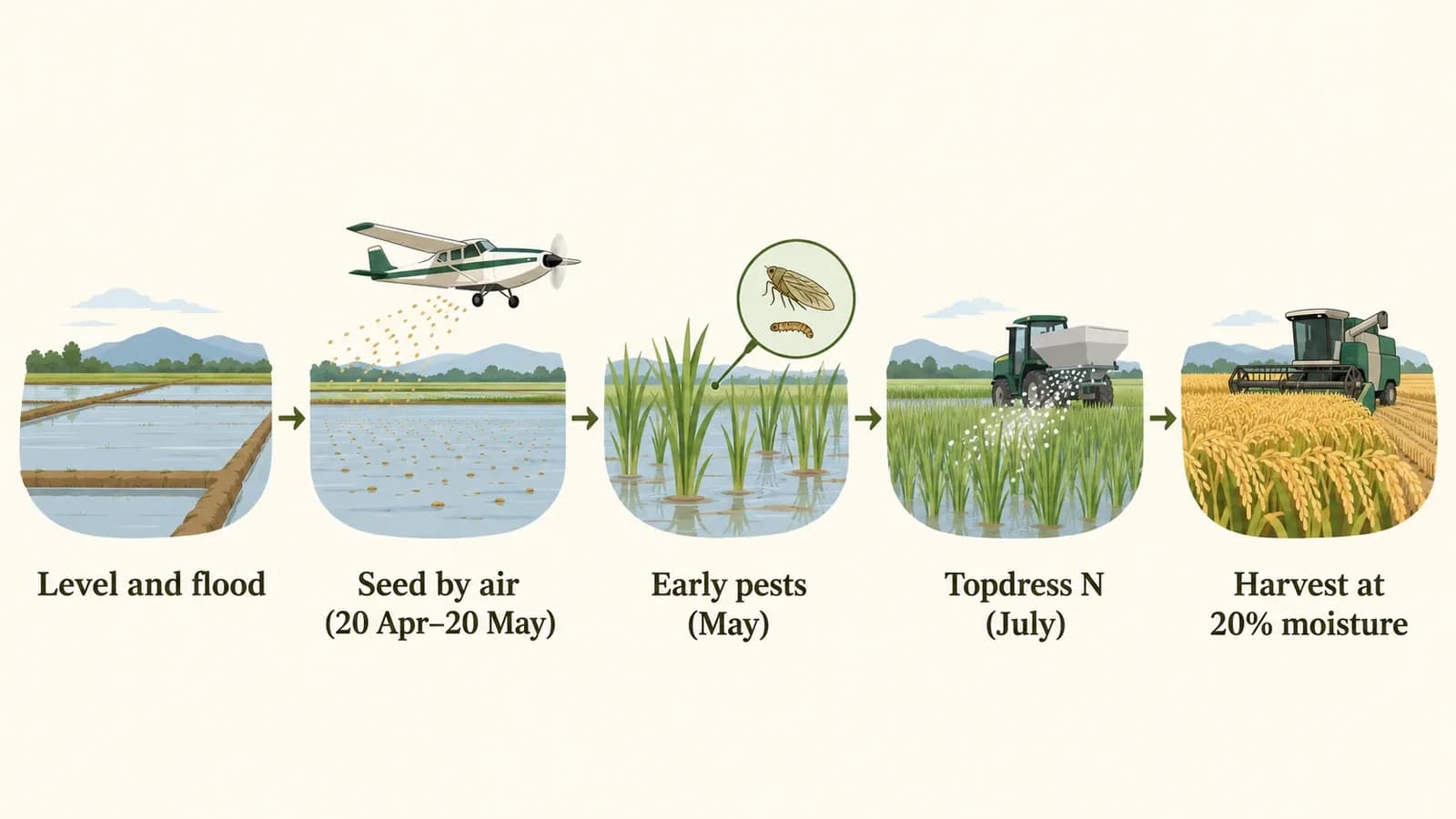
- 1
Prepare
Level, apply preplant N and starter, roll (March–May).
- 2
Flood and seed
Pre-soaked seed flown into a few inches of water at 196 kg/ha, mostly 20 April–20 May.
- 3
Early pests
Herbicides and copper sulfate for algae; seedling pests from May.
- 4
Topdress
About 35 kg N/ha by air in July on 75% of acres; before panicle initiation, 50–55 days after sowing.
- 5
Harvest
Combine at about 20% kernel moisture, then dry to 14%.
- Planting
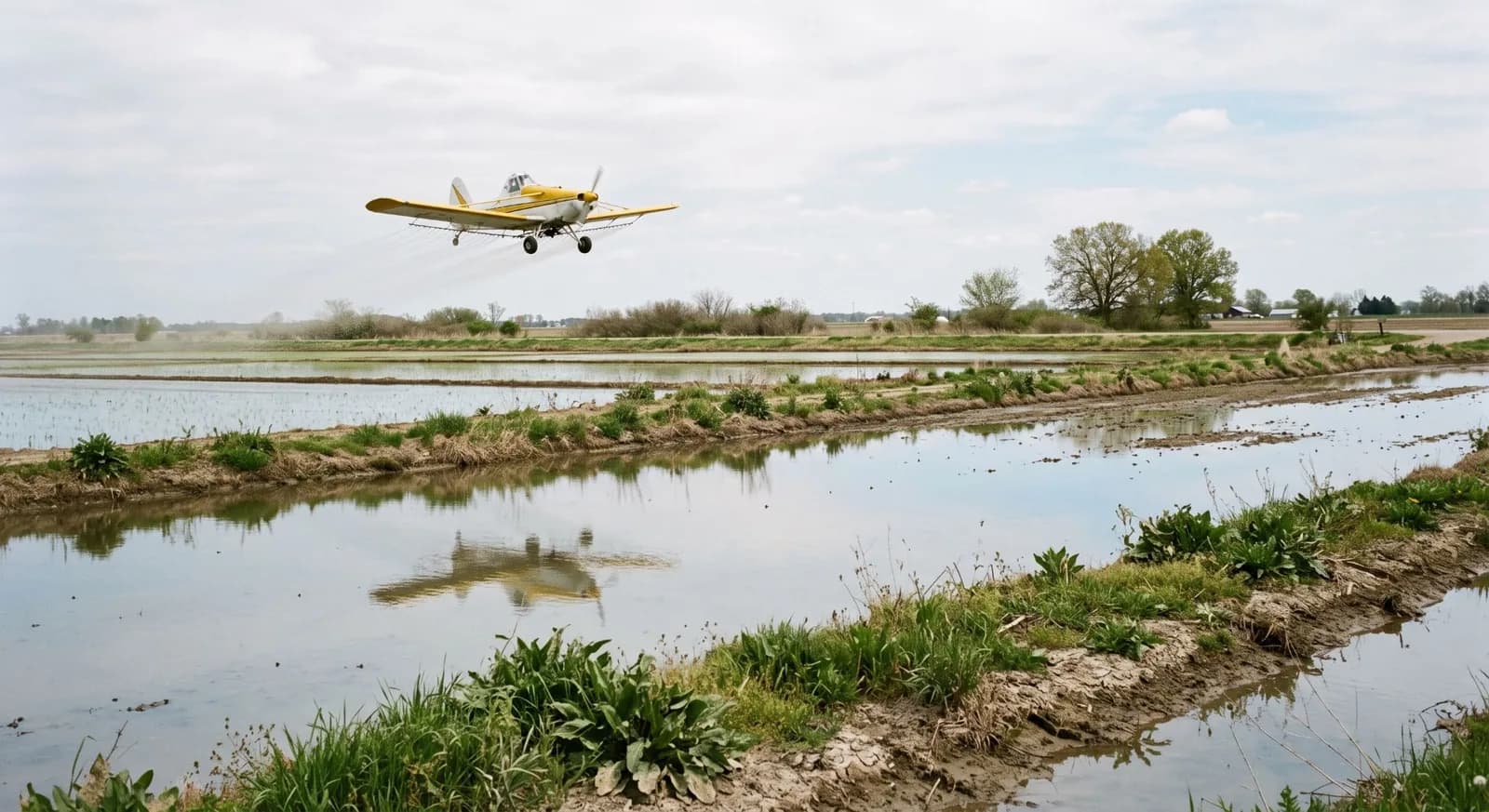
- Water seeding, not drill or dry seeding, is the primary method in California. The field is flooded and the seed is soaked to begin germination, drained, and broadcast by air into a few inches of water at 175 lb/acre. Rates vary by field and variety.1
- Early pests
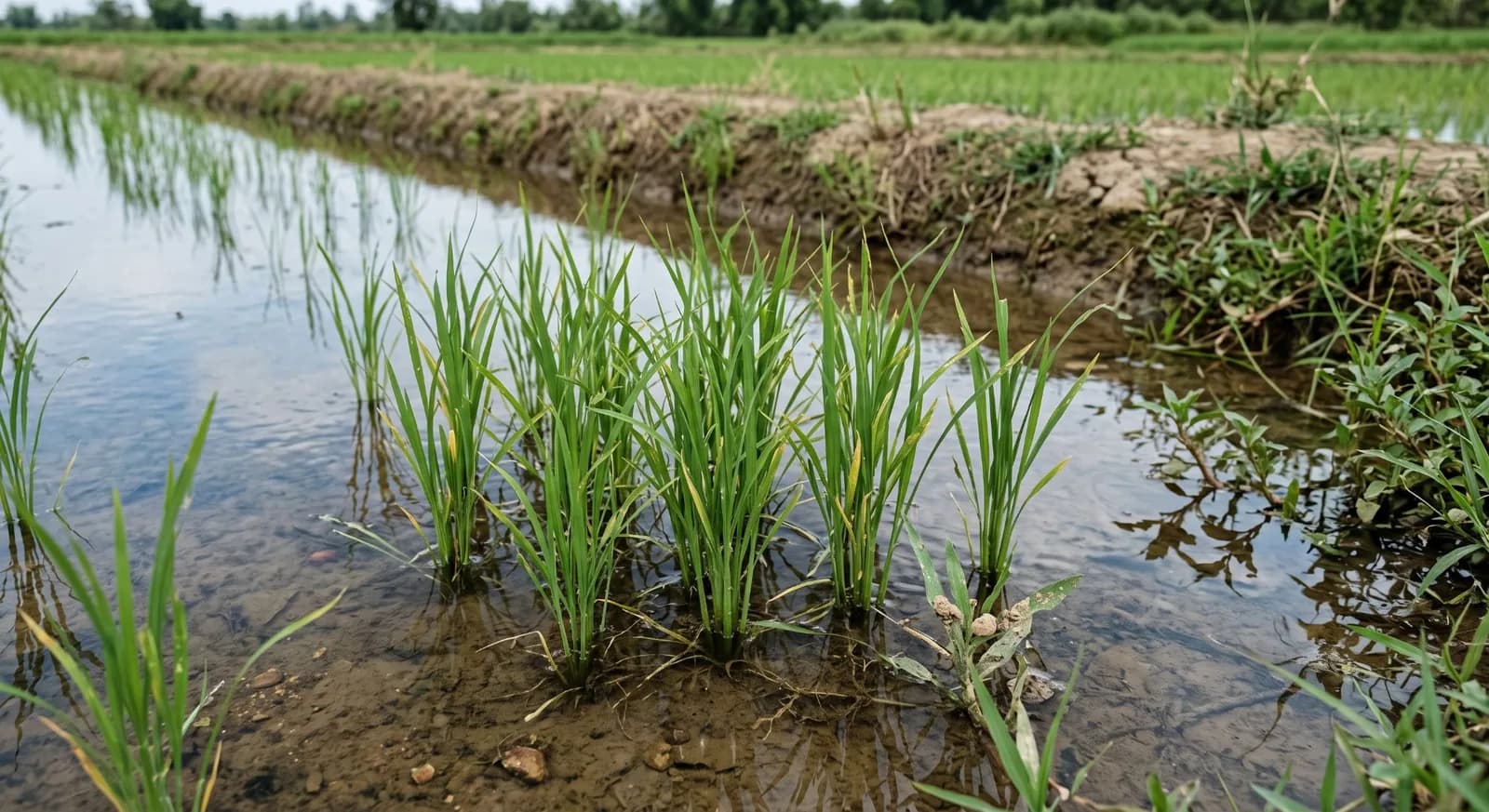
- After planting in May, copper sulfate is applied by air on about 30% of the acres for algae. Seedling pests such as rice water weevil, tadpole shrimp and seed midge are controlled starting in May.1
Nitrogen, phosphorus and potassium
- Preplant aqua ammonia146 kg N/ha
- July topdress (75% of acres)35 kg N/ha
- How much
- CDFA considers 168 kg N/ha (150 lb/acre) average, with maximum yields at 157–213 kg N/ha (140–190 lb/acre). Topdressing is recommended only if fields were drained for long early in the season or leaf analysis shows a shortage: a maximum of 34 kg N/ha (30 lb/acre), with efficiency falling sharply above 67 kg N/ha (60 lb/acre), applied before panicle initiation.2
- Phosphorus
- No phosphorus is needed above 15 ppm Olsen-P. Between 6 and 15 ppm, apply a maintenance 34–56 kg P2O5/ha (30–50 lb/acre); below 6 ppm consider 67 kg P2O5/ha (60 lb/acre).2
- Potassium
- Replace what the crop removes: 28–39 kg K2O/ha (25–35 lb/acre) for grain, or 73–112 kg K2O/ha (65–100 lb/acre) if about half the straw is also removed. Apply preplant and incorporate.2
Water
- Seasonal water
- Typically 4–6 acre-feet per acre (about 12,200–18,300 m³/ha) are applied during the season, not including water used for straw management. The study costed irrigation district water at $150 per acre ($370 per hectare) for the season.1
- Continuous flood
- Continuous flooding is standard. An early drain of more than a week changes the nitrogen strategy.2
Harvest, drying and straw
- Harvest
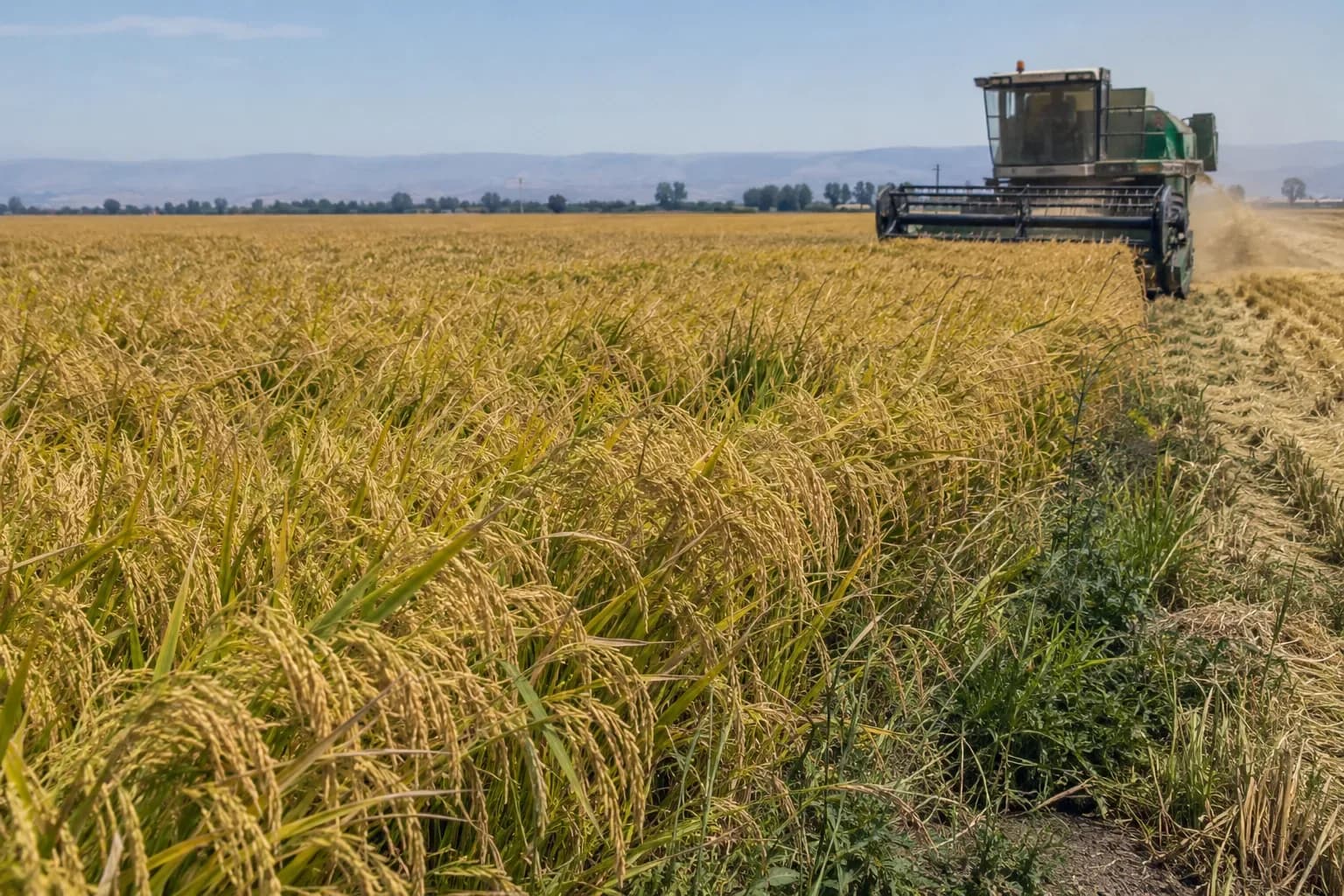
- The crop is combined at about 20% kernel moisture ("green rice") with a cutter-bar header and trucked to a dryer. Drying brings it to 14% moisture; the study costed drying at $0.95 per cwt and storage at $0.78 per cwt.1
- Straw
- After harvest, straw is chopped, disced, flooded and sometimes rolled so it decomposes. Floodwater for straw management is extra to the seasonal water above.1
Yield and economics
- 20149.9 t/ha
- 201510.2 t/ha
- 201610.1 t/ha
- 20179.7 t/ha
- 20189.9 t/ha
- 20199.6 t/ha
- 202010 t/ha
- Yield
- The UC study assumes 9,000 lb per acre at 14% moisture (10.1 t/ha). The average California medium-grain yield was 75.5 cwt/acre in 2005 and 83.5–91 cwt/acre from 2011 to 2020. USDA recorded 8,600 lb/acre (9.6 t/ha) for medium grain in 2025, against a US average of 7,544 lb/acre (8.5 t/ha).1,3
- Price
- The study uses $21.50 per cwt (about $474 per tonne) with a loan value of $7.00 per cwt, and ranges yields of 7,500–10,500 lb per acre across $15.50–27.50 per cwt. Planted area was 524,000 acres of all rice in 2025.1,3
- Test your own site
- Run a field audit for your coordinates and put your own water cost and price into the crop ROI estimator.1
Frequently asked questions
- How is rice planted in California?
- By water seeding: the field is flooded, pre-soaked seed is flown on at about 175 lb per acre (196 kg/ha), mostly between 20 April and 20 May.
- How much water does California rice need?
- Typically 4–6 acre-feet per acre, about 12,200–18,300 m³/ha, not counting water used for straw management.
- How much nitrogen does rice need in California?
- About 150 lb N per acre (168 kg/ha) on average, applied mostly as preplant aqua ammonia, with maximum yields at 140–190 lb per acre.
- What is the average rice yield in California?
- USDA recorded 8,600 lb per acre (about 9.6 t/ha) for medium grain in 2025; UC uses 9,000 lb per acre at 14% moisture in its cost study.
- When is rice harvested in California?
- The California Rice Commission describes September–October harvest. Confirm cultivar maturity and field conditions: the UC study combines at about 20% kernel moisture and dries grain to 14%.
- How much does California rice sell for?
- The 2021 UC cost study uses $21.50 per cwt for grain rice, with a ranging analysis of $15.50 to $27.50 per cwt.
Regional rice guides
Local dates, soil-temperature history and sources for specific regions:
Sources and image credits
- 1. UC Cooperative Extension and UC Davis — Sample Costs to Produce Rice, Sacramento Valley, 2021 — 2021. Water seeding, fertiliser, water, harvest, yields by year and returns.
- 2. CDFA FREP — California Fertilization Guidelines: Water-Seeded Rice — Accessed 2 October 2026. Nitrogen, phosphorus and potassium rates and timing for water-seeded rice.
- 3. USDA NASS — Crop Production 2025 Summary — Published January 2026. US and state rice area, yield and production by class, 2023–2025.
- 4. California Rice Commission — Rice 101 — Reviewed October 2026. Sacramento Valley commercial rice production cycle: April–May seeding, August–September drainage and September–October harvest.
Image credits
- California rice is water-seeded and topdressed from the air over flooded, levee-bordered fields.
- The California season in five steps. Schematic illustration.
- Seedlings emerging through a shallow flood. Weeds and algae are controlled early in the season.
- Rice is combined at about 20% kernel moisture and dried to 14% afterwards.
Figures are published averages or study assumptions for the places named, not guarantees for your field. Check current local recommendations and product labels before acting.
Some visuals in this guide are illustrations rather than photographs of a specific farm. See image credits.