

Growing strawberries in Iowa
Iowa’s commercial reference is a June-bearing matted-row system: plant when the spring ground is workable, establish runners in the first year, then manage a short harvest and renovate the bed. Cultivar hardiness, field condition and local timing matter more than a fixed statewide date.
Scope: Iowa commercial strawberry production, centered on June-bearing matted-row systems. The Iowa State production guide dates to 2008; current field observations add context but do not replace updated local cultivar, pest or input guidance. Updated 2026-10-07.
At a glance
- Commercial system
- June-bearing matted row; allow runners to establish the bed1
- Planting signal
- Early spring, once the field can be worked1
- Stand density after runnering
- Six or seven plants per square foot for most varieties in the Iowa guide1
- Harvest duration
- About four weeks statewide; local timing varies2
- Cultivar priorities
- Winter hardiness, disease resistance and fruit firmness1
Perennial growth and climate in Iowa
A perennial planting remains in the field for multiple years. Establishment is a long-term investment; flowering, fruit development, harvest and plant care recur as the planting matures. Follow the named cultivar and production system.
Establishment: Spring field establishment1
Iowa State’s commercial guide says to plant as early in spring as the ground can be worked. March–April is a broad calendar translation of that wording, not a fixed planting date; wait for a workable field and check current local advice.
Management: Establish the matted row1
During the planting year, remove blossoms so plants establish; then allow selected runners to fill the row. The correct timing follows crop stage and field conditions, not a fixed month.
Management: Renovate after harvest2,3
A June 2026 Iowa State commercial update recommends prompt postharvest renovation and fertilization. June is one recent local marker; harvest and renovation timing vary across Iowa.
Harvest: Short June-bearing season2,3
June is a broad planning marker, not a statewide date. Iowa’s agriculture department describes about four weeks of harvest with timing varying across the state; a June 2026 commercial update records a grower finishing harvest before June 10.
Historical monthly climate
Reference period: 1996-01-01 to 2025-12-31. ERA5-Land monthly mean soil temperature at 0–7 cm, air temperature and frost days at the regional reference point (42, -93.5). Select a month to inspect its historical conditions.
Month tiles show mean air temperature.
March historical conditions
- Mean topsoil temperature
- 3.6°C
- Mean air temperature
- 3.9°C
- Mean frost days per month
- 18.8 days
Use this monthly history to assess winter exposure, seasonal heat and water planning. It does not calculate cultivar chill hours, flowering dates, frost damage during bloom or fruit maturity. Topsoil at 0–7 cm describes shallow soil context, not the full root zone. Harvest periods follow the production evidence above.
Climate source: Open-Meteo Historical Weather APIPlan a multi-year matted-row stand
Iowa’s commercial guide centers on June-bearing plants that send runners and form a bed. The first year establishes the stand; later harvests depend on keeping the row productive and managing it after picking.
- 1
Select a tested cultivar
Prioritize Iowa adaptation, winter hardiness, disease resistance and fruit firmness.
- 2
Plant in workable spring soil
Use a mechanical transplanter when acreage makes it practical; set crowns correctly.
- 3
Establish the first-year stand
Remove early blossoms and manage runners to fill the intended row.
- 4
Harvest the mature bed
Plan labor around the short local season and monitor fruit maturity.
- 5
Renovate promptly
Use the farm’s postharvest plan to maintain the stand for the next season.
- Lower end of Iowa State range6 plants/ft²
- Upper end of Iowa State range7 plants/ft²
- Use locally tested cultivars
- Iowa State notes that strawberry varieties respond to local day length and temperature. Give winter hardiness and disease resistance weight alongside fruit firmness and the buyer’s fresh or processing requirements.1
- Keep the crop cycle distinct from an annual field crop
- The matted-row planting is maintained across seasons. The first planting year is mainly for stand establishment; Iowa State says fruit produced during that year is often poor because plants are not established.1
Prepare the field and planting stock
- Plant when the soil is workable
- The commercial guide places planting as early in spring as ground conditions permit. A calendar month cannot tell whether a specific field is fit to travel or whether the root zone is ready.1
- Set crowns at the right depth
- Keep the crown neither exposed above the soil nor buried deeply enough to rot. Protect roots from drying during planting and check the planter behind the first pass.1
- Base fertility on a soil test
- The 2008 Iowa guide advises soil testing before planting and applying other nutrients from the test. Its numeric nitrogen baseline is dated, so confirm current rates with Iowa State guidance before using it in a budget.1
Build and maintain the stand
| Operation | Source-backed reference | Field decision |
|---|---|---|
| Planting | Early spring as soon as ground is workable | Use field trafficability and current local conditions |
| Planting-year flowers | Remove to support plant and bed establishment | Follow cultivar and crop stage |
| Runnering | Allow selected runners to fill the matted row | Train runners to the intended bed and remove excess only if practical |
| Established density | Six or seven plants per square foot after runnering | Check stand density after the row has filled |
Sources1
- Use density as a mature-bed check
- The six-to-seven plants per square foot figure applies after runnering in the matted-row system. It is not the initial transplant rate or a spacing instruction for every strawberry system.1
- Monitor winter and pest stress
- A June 2026 Iowa State report documented poor yields in some Kalona fields and described dry winters and thrips as possible factors, not proven causes. Inspect crowns, flowers and fruit, and use diagnosis before deciding on a treatment.3
Harvest and renew the planting
- Budget labor for a compressed season
- Iowa’s agriculture department describes a roughly four-week strawberry harvest and says the timing varies across the state. Pick maturity, labor, cooling and delivery schedules should follow the actual field and buyer.2
- Renovate after the final pick
- Iowa State commercial horticulture guidance says prompt renovation and fertilization after final harvest supports the next crop. A Muscatine grower reported success removing half the parent plants each year, but that is one farm’s practice, not a statewide prescription.3
Frequently asked questions
- When do Iowa farms plant strawberries?
- Iowa State’s commercial guide says to plant as early in spring as the ground can be worked. That is a field-condition rule, not a fixed statewide date.
- How long is Iowa strawberry harvest?
- The Iowa Department of Agriculture describes a season of about four weeks, with timing varying across the state. A June 2026 Iowa State commercial update records one grower finishing harvest before June 10.
- How dense should an Iowa matted row be?
- The Iowa State commercial guide reports six or seven plants per square foot after runnering for most varieties. It is an established-bed density, not a transplant spacing target.
- Are Iowa commercial strawberries annual or perennial?
- June-bearing matted-row stands are managed across multiple seasons. The first planting year is mainly for establishment; the page’s calendar treats that system as perennial.
- What should growers prioritize when selecting a variety?
- Iowa State highlights winter hardiness, disease resistance and fruit firmness, and warns that varieties can respond differently to local day length and temperature.
Regional strawberry guides
Local dates, soil-temperature history and sources for specific regions:
Sources and image credits
- 1. Iowa State University Extension — Production Guide for Commercial Strawberries (PM 0672D) — Published September 2008. Commercial Iowa matted-row and spaced-matted-row production, spring planting, crown placement, first-year blossom removal, runnering, mature stand density, soil testing and cultivar adaptation. Confirm dated numeric input recommendations before use.
- 2. Iowa Department of Agriculture and Land Stewardship — Strawberry Season Underway Across Iowa — Accessed October 2026. Statewide harvest duration of about four weeks and variation in timing across Iowa.
- 3. Iowa State University Extension and Outreach Commercial Horticulture — 6/10/26 Notes from “What in the Weather?” — 10 June 2026. Commercial Iowa observations of variable strawberry yields, possible winter and thrips stress, and prompt renovation after final harvest; field observations rather than a statewide trial.
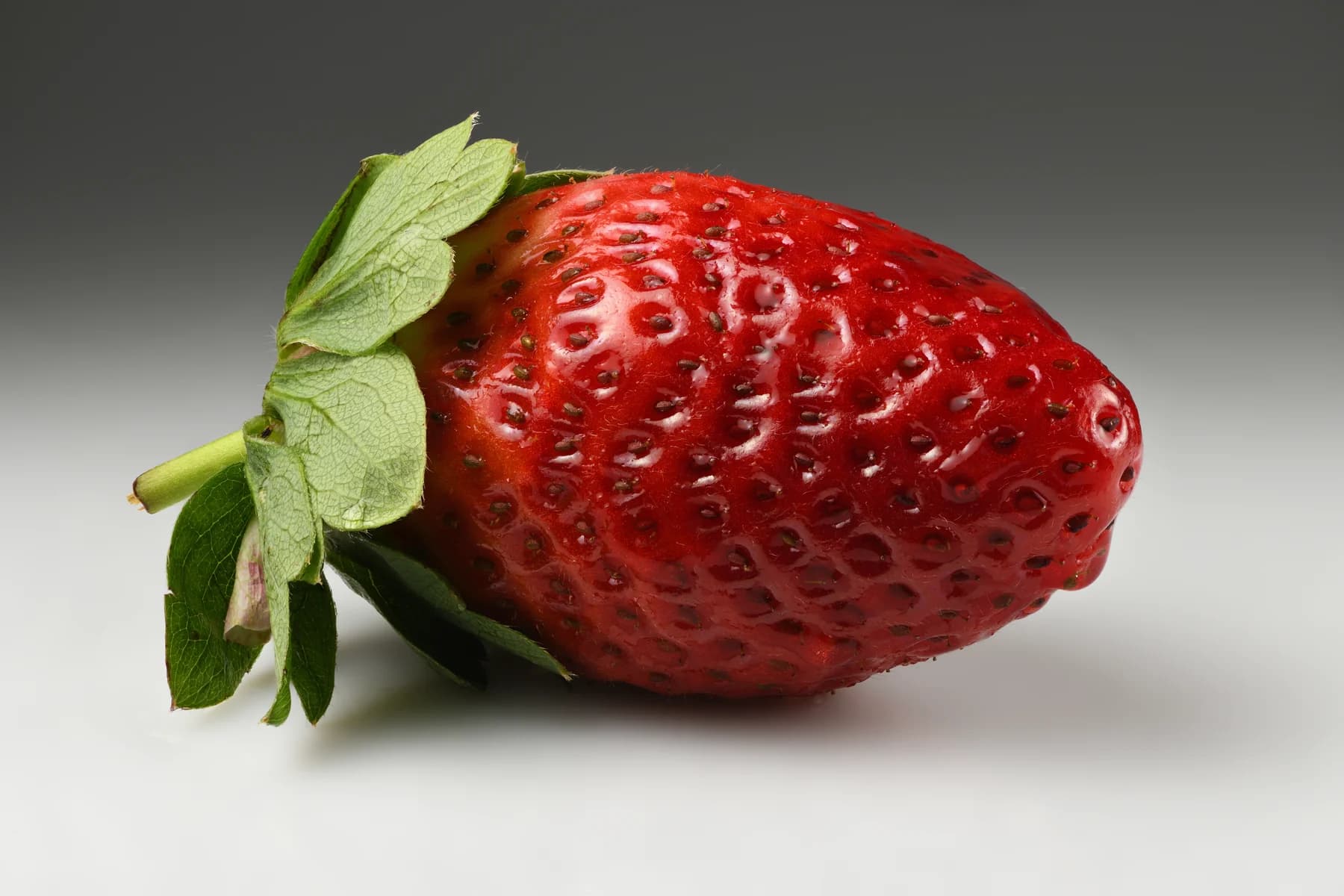
- 4. Strawberry fruit photograph — Ivar Leidus — January 26, 2022; CC BY-SA 4.0. Spain-grown Fragaria × ananassa fruit. Focus-stacked photograph, resized; not a regional field or harvest photograph.
- 5. Strawberry photograph license — CC BY-SA 4.0 — Creative Commons Attribution-ShareAlike 4.0. The resized photograph retains its original share-alike license.
Image credits
- Strawberry fruit grown in Spain. Photo: Ivar Leidus, CC BY-SA 4.0; resized under the same license.
Figures are published averages or study assumptions for the places named, not guarantees for your field. Check current local recommendations and product labels before acting.
Some visuals in this guide are illustrations rather than photographs of a specific farm. See image credits.