

Growing strawberries in California
California commercial strawberry production uses different schedules from south to north. Summer plantings support fall harvest in southern districts, while fall-planted fields in Santa Maria and Salinas–Watsonville carry fruit from spring into fall. Use the district schedule, cultivar and field conditions together; a statewide month is not a planting prescription.
Scope: Commercial fruit production in California. The district calendar uses historical 2018 production periods published in a 2021 state report; statewide acreage and yield are USDA 2025 figures. Bed layouts and crop management follow UC IPM guidance. Updated 2026-10-07.
At a glance
- California planted area, 2025
- 45,800 acres (about 18,535 ha)1
- California harvested area, 2025
- 45,000 acres (about 18,211 ha)1
- State average yield, 2025
- 615 cwt/acre (about 69 t/ha); not a field forecast1
- Central Valley system
- Summer planting2
- Coastal planting system
- Fall planting is most widely used outside the Central Valley2
- Commercial bed options
- Two-row beds: 16,000–20,000 plants/acre in Watsonville–Salinas; four-row beds: 22,000–28,000 plants/acre in Santa Maria and Southern California2
- Critical establishment period
- Keep beds near field capacity through the first four weeks; avoid standing water2
Planting and harvest calendar for California
Use the source-backed production windows to coordinate establishment, crop care and harvest. Production districts and cultivars can have different cycles; the historical climate adds context for the field plan.
Planting: District planting periods5
These months combine separate district systems from the 2018 California schedule: summer planting in southern districts and Oxnard, and fall planting in Santa Maria and Salinas–Watsonville. The month band is a statewide overview, not one farm’s window; use the district table below and confirm current cultivar recommendations.
Harvest: Statewide harvest across districts5,6
California harvest can occur year-round when district systems are considered together. Individual fields have a narrower window: the 2018 schedule ranges from December–April in Southern California to mid-February–November in Santa Maria. Follow cultivar maturity and current local records.
Historical monthly climate
Reference period: 1996-01-01 to 2025-12-31. ERA5-Land monthly mean soil temperature at 0–7 cm, air temperature and frost days at the regional reference point (37, -120). Select a month to inspect its historical conditions.
Month tiles show mean topsoil temperature.
July historical conditions
- Mean topsoil temperature
- 32.8°C
- Mean air temperature
- 29.4°C
- Mean frost days per month
- 0.0 days
These are monthly means at one reference location. They describe seasonal field conditions, not crop maturity, actual seed-zone conditions, frost forecasts or a planting recommendation. Harvest bands follow the crop-specific production sources above.
Climate source: Open-Meteo Historical Weather APIChoose the production system by district
California’s coastal strawberry districts stagger planting and harvest. The historical schedule below distinguishes the systems; it does not describe every current cultivar or operation.
| District | Planting period | Harvest period | System note |
|---|---|---|---|
| Southern California | Mid-September to mid-October | December–April | Fall planting |
| Oxnard | Mid-July–September | October–early June | Summer planting |
| Santa Maria | Mid-October–mid-November | Mid-February–November | Fall planting |
| Salinas–Watsonville | Mid-October–mid-November | Mid-March–November | Fall planting |
Sources5
- 1
Select district and cultivar
Match the seasonal system, market window and cultivar to the production area.
- 2
Prepare the field
Check crop history, soil and water; build beds that drain.
- 3
Plant certified stock
Use the district schedule and keep roots moist during planting.
- 4
Establish the stand
Maintain near field capacity during the first four weeks without ponding.
- 5
Harvest by maturity
District harvest periods differ; monitor fruit, field health and harvest records.
- Treat statewide year-round supply as a sequence of local seasons
- The state report describes production in every month through staggered districts. That does not mean one California field bears continuously. Southern and northern districts use different planting and harvest periods.5
- Annual field cycle
- Strawberry is botanically perennial, but California commercial fruit fields are typically managed as annual crops. A small share may be retained for a second harvest year.5
Prepare a drained field and raised beds
- Check drainage before planting
- UC IPM recommends field slope of at least 0.75% where needed to prevent waterlogging and erosion. Standing water favors root and crown diseases; ideally, rainwater should not remain in a strawberry field for more than about six hours.3
- Plan beds around the district system
- Two-row beds are most common in Watsonville–Salinas; four-row beds are most common in Santa Maria and Southern California. Four-row beds can make salinity management, pest control and harvest more difficult, so compare the system with labor, irrigation and field access before choosing it.3
Plant certified transplants at district density
- Two-row beds · Watsonville–Salinas (low)16,000 plants/acre
- Two-row beds · Watsonville–Salinas (high)20,000 plants/acre
- Four-row beds · Santa Maria / Southern California (low)22,000 plants/acre
- Four-row beds · Santa Maria / Southern California (high)28,000 plants/acre
- Use clean planting stock
- Certified transplants reduce the risk of introducing viruses, foliar nematodes, other pathogens and weed propagules into fruit fields. Confirm cultivar and certification status with the nursery before delivery.2
- Keep roots and crowns correctly placed
- Protect transplants from drying during planting. UC IPM advises placing roots vertically, avoiding a J-shaped root, and leaving the crown properly exposed after the soil is firmed. Place transplants no farther than 6–7 inches from a drip line.2
- Avoid over-crowding
- Plant density varies with cultivar, nursery source, planting date, fertility, soil, bed width and location. UC IPM cautions that excessive density can reduce fruit size, slow picking and increase disease pressure; use the local range as context, then match the planting plan to the field.2
Establish moisture without waterlogging
- First four weeks
- New roots need close soil contact, moisture and protection from salinity. UC IPM calls frequent irrigation critical during the first four weeks and advises keeping bed soil near field capacity while avoiding standing water.2
- Use mulch for the production system
- Polyethylene mulch can regulate bed temperature, conserve moisture, limit salt accumulation at the surface and reduce fruit contact with soil and irrigation water. Choose mulch type and timing for cultivar, planting and harvest season, and weed-control plan.3
- Scout consistently
- Use field records and routine checks for pests, diseases, weeds, soil moisture and irrigation-water salinity. UC IPM’s harvest checklist also calls for removing decayed or water-damaged fruit and continuing field monitoring through harvest.4
Plan harvest by region and fruit maturity
- Harvest window
- In the historical district schedule, harvest begins in December in Southern California, October in Oxnard, mid-February in Santa Maria and mid-March in Salinas–Watsonville. These regional windows overlap to support statewide supply through the year; they are not guaranteed dates for a specific farm.5,6
- Harvest health checks
- During harvest, keep monitoring for insects, mites, diseases and weeds, and remove decayed or water-damaged fruit. Use field-level harvest and pest records to plan labor, cooling and market delivery for the actual crop.4
- Read state yields in context
- USDA NASS reports a California average of 615 cwt per acre for 2025 across 45,000 harvested acres. That statewide result combines production systems and fields; it is not a yield promise or budget for a new planting.1
Frequently asked questions
- When do commercial farms plant strawberries in California?
- It depends on the district. The Central Valley uses summer planting; fall planting is most widely used elsewhere. A historical district schedule lists mid-July to September for Oxnard and mid-October to mid-November for Santa Maria and Salinas–Watsonville.
- Can California strawberries be harvested year-round?
- Statewide, harvest can occur in every month because southern and northern districts have staggered seasons. An individual field has a much narrower harvest period.
- How many strawberry plants go in an acre in California?
- UC IPM reports 16,000–20,000 plants per acre for two-row Watsonville–Salinas beds and 22,000–28,000 for four-row Santa Maria and Southern California beds. These are regional ranges, not universal targets.
- Are commercial strawberry fields perennial in California?
- The plant is perennial, but commercial fruit fields in California are typically managed as annuals. A small portion may be retained for a second harvest year.
- What is the average strawberry yield in California?
- USDA NASS reported 615 cwt per acre across California in 2025. State averages describe established production overall and do not predict the yield of a new field.
Regional strawberry guides
Local dates, soil-temperature history and sources for specific regions:
Sources and image credits
- 1. USDA NASS — 2025 California State Agriculture Overview — 2025 data; accessed October 2026. California planted and harvested acres, average yield, production and value.
- 2. UC IPM — Handling Strawberry Transplants — UC ANR Publication 3468; updated July 2018. Commercial planting seasons, transplant certification and handling, regional bed densities, spacing from drip lines and first-month irrigation.
- 3. UC IPM — Field Preparation for Strawberry — UC ANR Publication 3468; updated July 2023. Commercial field drainage, bed designs, regional two-row and four-row systems, and mulch functions.
- 4. UC IPM — Strawberry Harvest — UC ANR Publication 3468; updated July 2018. Commercial field monitoring, soil moisture, irrigation-water salinity and removal of decayed or water-damaged fruit during harvest.
- 5. California Department of Pesticide Regulation — Economic Impact Report, Strawberry production systems — Published 2021; district schedule and acreage data from 2018. California commercial district planting and harvest periods, seasonal production systems, statewide year-round harvest context and typical annual field management.
- 6. California Strawberry Commission — Where Strawberries Are Grown — Accessed October 2026. California coastal production locations and year-round harvest availability across regions.
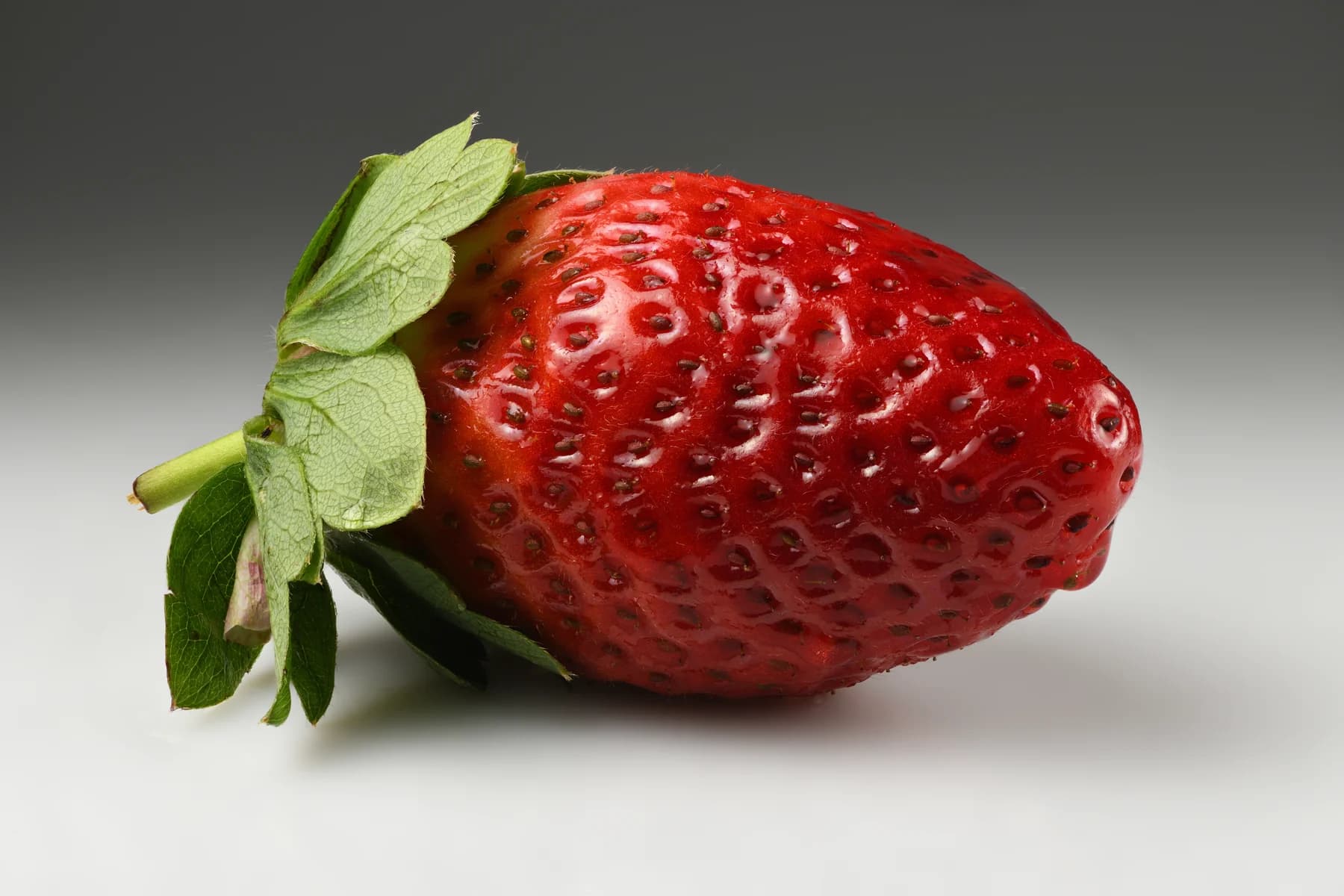
- 7. Strawberry fruit photograph — Ivar Leidus — January 26, 2022; CC BY-SA 4.0. Spain-grown Fragaria × ananassa fruit. Focus-stacked photograph, resized; not a regional field or harvest photograph.
- 8. Strawberry photograph license — CC BY-SA 4.0 — Creative Commons Attribution-ShareAlike 4.0. The resized photograph retains its original share-alike license.
Image credits
- Strawberry fruit grown in Spain. Photo: Ivar Leidus, CC BY-SA 4.0; resized under the same license.
Figures are published averages or study assumptions for the places named, not guarantees for your field. Check current local recommendations and product labels before acting.
Some visuals in this guide are illustrations rather than photographs of a specific farm. See image credits.