

Growing strawberries in Illinois
Illinois commercial strawberry timing depends on the production system. Southern plasticulture growers set plug plants in September for spring harvest; a northern Illinois day-neutral trial planted bare-root stock in May for harvest into fall. Established matted-row fields follow a different, multi-year cycle.
Scope: Regional commercial production examples, not a statewide prescription: annual plasticulture in southern Illinois, a northern Illinois day-neutral on-farm research system, and southern Illinois matted-row observations. The plant is perennial, but some fruit fields are managed as annual crops. Updated 2026-10-07.
At a glance
- Southern Illinois plasticulture
- Plug transplants typically set around September 10–15; field preparation and bed shaping come first1
- Northern Illinois day-neutral example
- Bare-root planting in the first week of May; harvest reported into Halloween3
- Spring plasticulture harvest
- First ripe berries were reported in late April 2025; week two of harvest was reported on May 1, 20262,7
Perennial growth and climate in Illinois
A perennial planting remains in the field for multiple years. Establishment is a long-term investment; flowering, fruit development, harvest and plant care recur as the planting matures. Follow the named cultivar and production system.
Establishment: Separate local establishment systems1,3
The month band combines two different examples: southern Illinois plasticulture plug setting around September 10–15, and bare-root planting in the first week of May in a northern Illinois day-neutral research system. These are not one statewide planting window.
Management: Manage annual day-neutral stands3
In the northern Illinois on-farm example, flowers were removed for the first six weeks after planting, then runners were removed and beds cleaned during July and August. Apply these practices only to a matching annual day-neutral system.
Management: Protect and assess overwintered fields5,6
Southern Illinois sources describe row covers before early winter and spring checks as covers are removed. Matted-row straw and plasticulture floating covers behave differently; use crop growth and local frost conditions to time cover removal.
Harvest: Distinct local harvest examples2,3,7
May represents recent southern Illinois plasticulture harvest reports; September–October comes from a northern Illinois day-neutral on-farm example harvested into Halloween. The months describe separate systems and locations, not a continuous season for one field.
Historical monthly climate
Reference period: 1996-01-01 to 2025-12-31. ERA5-Land monthly mean soil temperature at 0–7 cm, air temperature and frost days at the regional reference point (40, -89). Select a month to inspect its historical conditions.
Month tiles show mean air temperature.
May historical conditions
- Mean topsoil temperature
- 17.9°C
- Mean air temperature
- 18.0°C
- Mean frost days per month
- 0.1 days
Use this monthly history to assess winter exposure, seasonal heat and water planning. It does not calculate cultivar chill hours, flowering dates, frost damage during bloom or fruit maturity. Topsoil at 0–7 cm describes shallow soil context, not the full root zone. Harvest periods follow the production evidence above.
Climate source: Open-Meteo Historical Weather APIChoose and calendar the production system
The documented schedules below come from different parts of Illinois and different field systems. Do not combine them into one farm calendar.
| Region and system | Establishment evidence | Harvest evidence | Scope |
|---|---|---|---|
| Southern Illinois annual plasticulture | Plug transplants are typically set September 10–15; prepare and shape beds before setting | First ripe fruit reported in late April 2025; harvest was underway in early May 2026 | Regional Extension observations, not a statewide forecast |
| Northern Illinois annual day-neutral | Bare-root plants set in the first week of May in an on-farm research system | Harvest continued into Halloween in the cited trial | One local research partnership; not a statewide date range |
| Southern Illinois matted row, June-bearing | Established field system; local source describes spring cover removal as growth resumes | Matted-row plants were in full bloom in the Metro East on April 30, 2025 | A dated regional observation; harvest dates were not specified |
- 1
Select the system and market window
Separate fall-set southern plasticulture, northern annual day-neutral and established matted-row production.
- 2
Prepare beds and stock
Shape beds ahead of southern plug setting; the northern research example used bare-root stock in May.
- 3
Establish the crop
Maintain moisture for new plugs; follow system-specific flower and runner management.
- 4
Protect through winter where needed
Row covers differ between matted-row and plasticulture fields; inspect plants when uncovering.
- 5
Harvest and assess the stand
Use the local field, crop condition and buyer schedule; document disease and plant loss.
- Strawberry is perennial, but fields may be managed annually
- Annual plasticulture and day-neutral examples are replanted on a seasonal schedule. June-bearing matted-row production is a different multi-year system. Select the calendar and stand-management plan together rather than applying one crop type to every field.3,5
Set up the stand for its intended cycle
- Southern annual plasticulture
- Illinois Extension reports plug transplanting around September 10–15 in southern Illinois. Prepare and shape beds ahead of time, then maintain adequate bed moisture while plants establish, especially when early fall heat continues.1
- Northern day-neutral annual trial
- A northern Illinois on-farm research partnership planted bare-root plants in the first week of May. The trial removed flowers for the first six weeks to support root development, then allowed flowering and fruiting.3
- Keep the system-specific stock choice clear
- Illinois Extension distinguishes bare-root plants commonly used in matted-row systems from plug plants typically used in plasticulture. Confirm cultivar, plant health and delivery timing with the nursery before field preparation.4
Manage runners, covers and field health
- Remove runners only in the matching annual system
- The northern day-neutral example removed runners and cleaned beds weekly in July and August. Runners serve a different role in matted-row systems, so do not transfer that practice without checking the production plan.3
- Check row covers by production system
- Illinois Extension describes straw cover in matted-row fields and floating row covers over plasticulture. In southern Illinois, new leaf growth and soil temperature near 40°F in the upper 2–4 inches are cues for matted-row straw removal; short-range cold forecasts still matter.5
- Scout and confirm disease
- Neopestalotiopsis has been reported in Illinois. A 2024 southern Illinois field walk found missing or weak plants but did not submit them for diagnostic confirmation. Record symptoms and request a plant-disease diagnosis before selecting a response.4,6
- Do not assume rainfall replaces irrigation
- A northern Illinois trial lost its non-irrigated plot during drought in May and June, while the reported annual crop used drip irrigation and plastic. This local contrast supports close moisture monitoring; it does not define a statewide water rate.3
Harvest by the field and buyer window
- Plan spring plasticulture harvest
- The St. Louis Metro East report noted first-ripe plasticulture fruit on April 30, 2025, with harvest expected to build the following week. On May 1, 2026, the same regional reporting said plasticulture harvest was in its second week. Both are local observations, not fixed annual dates.2,7
- Keep northern day-neutral records separate
- The Freeport-area research example continued harvest into Halloween. It also found that heat, irrigation and variety influenced crop performance; it cannot be generalized as an Illinois-wide yield or harvest promise.3
Frequently asked questions
- When do Illinois farms plant strawberries?
- The documented systems differ: southern Illinois annual plasticulture plugs are typically set around September 10–15, while a northern Illinois day-neutral on-farm example planted bare-root stock in the first week of May.
- When are Illinois strawberries harvested?
- Southern Metro East plasticulture harvest was reported in late April and early May in 2025–2026. A separate northern day-neutral research example harvested into Halloween. These are different systems and locations.
- Are Illinois strawberries annual or perennial?
- Both production cycles appear in the sources. Some plasticulture and day-neutral systems are managed as annual crops; June-bearing matted-row fields are maintained as multi-year stands.
- Should Illinois growers remove strawberry runners?
- The northern day-neutral annual trial removed runners in July and August. Runners are used to fill matted rows, so the practice depends on the production system.
- What disease should Illinois growers watch for?
- Illinois Extension has reported Neopestalotiopsis in the state. Similar-looking symptoms need diagnosis; confirm the disease before making treatment decisions.
Regional strawberry guides
Local dates, soil-temperature history and sources for specific regions:
Sources and image credits
- 1. Illinois Extension Commercial Fruit and Vegetable Growers — Summer harvest and strawberry transplant timing at Dixon Springs Ag Center — 31 August 2026. Southern Illinois annual plasticulture bed preparation and typical September 10–15 plug transplant timing; local Extension guidance.
- 2. Illinois Extension Commercial Fruit and Vegetable Growers — St. Louis Metro East fruit crop update — 30 April 2025. First-ripe southern Illinois plasticulture strawberries and matted-row June-bearing bloom; one dated regional observation.
- 3. Illinois Extension Commercial Fruit and Vegetable Growers — Day-neutral strawberries still producing — 3 October 2023. Northern Illinois on-farm research: first-week-of-May bare-root planting, harvest into Halloween, six-week flower removal and July–August runner removal; not a statewide schedule.
- 4. Illinois Extension Commercial Fruit and Vegetable Growers — Neopestalotiopsis in strawberry — 27 September 2024. Illinois disease reporting and distinction between bare-root stock for matted rows and plug plants for plasticulture.
- 5. Illinois Extension Commercial Fruit and Vegetable Growers — Time to uncover strawberries — 20 February 2024. Southern Illinois spring management of matted-row straw and plasticulture floating covers; soil-temperature and plant-growth cues.
- 6. Illinois Extension Commercial Fruit and Vegetable Growers — Strawberry plasticulture field observations from southern Illinois — 27 November 2024. Local end-of-fall field observations of plant decline, crown development and winter plant counts; observed symptoms were not diagnostically confirmed.
- 7. Illinois Extension Commercial Fruit and Vegetable Growers — Spring is here again in the St. Louis Metro East — 1 May 2026. Local southern Illinois report that plasticulture strawberry harvest was in its second week.
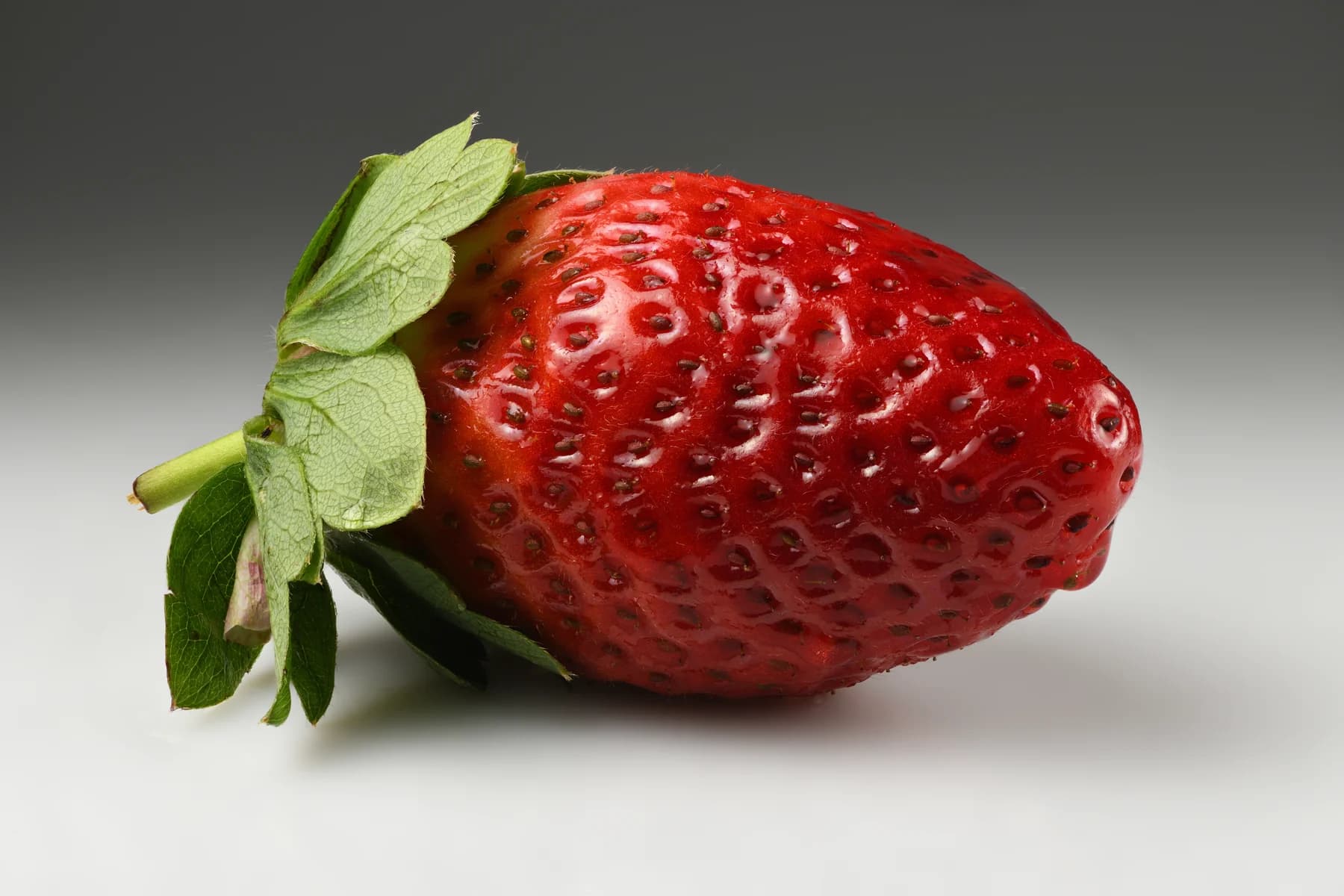
- 8. Strawberry fruit photograph — Ivar Leidus — January 26, 2022; CC BY-SA 4.0. Spain-grown Fragaria × ananassa fruit. Focus-stacked photograph, resized; not a regional field or harvest photograph.
- 9. Strawberry photograph license — CC BY-SA 4.0 — Creative Commons Attribution-ShareAlike 4.0. The resized photograph retains its original share-alike license.
Image credits
- Strawberry fruit grown in Spain. Photo: Ivar Leidus, CC BY-SA 4.0; resized under the same license.
Figures are published averages or study assumptions for the places named, not guarantees for your field. Check current local recommendations and product labels before acting.
Some visuals in this guide are illustrations rather than photographs of a specific farm. See image credits.