

Growing potatoes in Texas
Texas grows potatoes in four regions that plant from late December in the Rio Grande Valley to early April on the High Plains. Heat is the limit: tubers stop forming once the soil gets too warm, so timing matters more than anything else. Texas yields are well above the US average.
Scope: Commercial potatoes in Texas, based on Texas A&M AgriLife Extension (Lubbock) and USDA NASS. Some AgriLife yield figures are old; this guide uses USDA yields. Metric first, with the original US units in brackets. Updated 2026-10-03.
At a glance
- Planting window
- Late December (Rio Grande Valley) to early April (High Plains)1
- Soil temperature
- At least 10°C (50°F) at 15 cm (6 in) before planting1
- Best air temperature
- 16–18°C (60–65°F); tubers stop forming when soil is too hot1
- Seed and spacing
- Rows 81–97 cm (32–38 in); seed pieces 18–23 cm (7–9 in) apart, 50–57 g (1¾–2 oz) each, 10–20 cm (4–8 in) deep1
- Nitrogen
- 200–280 kg N/ha (180–250 lb/acre) for a 45 t/ha (400 cwt) crop1
- Water
- About 678 mm (26.7 in) per season, peaking in June1
- Texas area, 2025
- 6,070 ha planted (15,000 acres)2
- Texas yield, 2025
- 71 t/ha (635 cwt/acre) against a US average of 49 t/ha (435 cwt/acre)2
Planting and harvest calendar for Texas
Use the source-backed production windows to coordinate establishment, crop care and harvest. Production districts and cultivars can have different cycles; the historical climate adds context for the field plan.
Planting: Different Texas production districts1
Planting starts in late December in the Rio Grande Valley, mid-January in the Winter Garden district, mid-February–mid-March in the Rolling Plains, late February around Seminole, March in central High Plains districts and early April around Hereford and Dalhart. These are separate district cycles, not one continuous statewide crop.
Harvest: District-dependent harvest chronology1
Harvest starts in April in the Rio Grande Valley; late April–mid-May in the Winter Garden; early June in the Rolling Plains; mid–late June around Seminole; and July in central High Plains districts. Dalhart harvest is predominantly September–October. Starts are not complete season endpoints; use crop maturity and district records.
Planting climate heatmap
Reference period: 1996-01-01 to 2025-12-31. ERA5-Land monthly mean soil temperature at 0–7 cm, air temperature and frost days at the regional reference point (31.5, -99). Select a month to inspect its historical conditions.
AgriLife’s Texas minimum is 10°C (50°F) at 15 cm (6 in). The upper planting reference, below 21.1°C (70°F), comes from ISU’s commercial guide. The historical 0–7 cm layer is a shallow proxy for the seed zone; verify actual field temperature and the district crop calendar.1,3
Muted green: temperature fits the sourced range and no mean frost days recorded. Neutral tiles name the temperature or frost constraint. Gray: missing data. This screen does not assess the full growing season, field drainage or crop maturity.
December: Frost caution
The monthly mean meets the lower temperature criterion, but frost occurs in the historical record. Check the actual frost forecast and crop protection.
- Mean topsoil temperature
- 11.3°C
- Mean air temperature
- 11.1°C
- Mean frost days per month
- 5.0 days
These are monthly means at one reference location. They describe seasonal field conditions, not crop maturity, actual seed-zone conditions, frost forecasts or a planting recommendation. Harvest bands follow the crop-specific production sources above.
Climate source: Open-Meteo Historical Weather APIPlant by region
| Region | Plant | Harvest |
|---|---|---|
| Rio Grande Valley | Late December | April |
| Winter Garden | Mid-January | Late April to mid-May |
| Rolling Plains (Munday) | Mid-February to mid-March | Early June |
| High Plains–Panhandle (Seminole to Dalhart) | Late February to early April | Mid-June to September–October |
Sources1
- Soil temperature first
- Plant when soil at 15 cm (6 in) depth reaches 10°C (50°F). The frost-free date usually follows 3 to 4 weeks later.1
- Heat limits yield
- Optimum air temperature is 16–18°C (60–65°F). Night temperatures below about 20°C (68°F) favour tuber development; above that, yield falls by roughly 4% per degree (°F).1
- Soil
- Potatoes suit most well-drained Texas soils, best on clay loams, sandy loams and loamy sands.1
Seed pieces and spacing
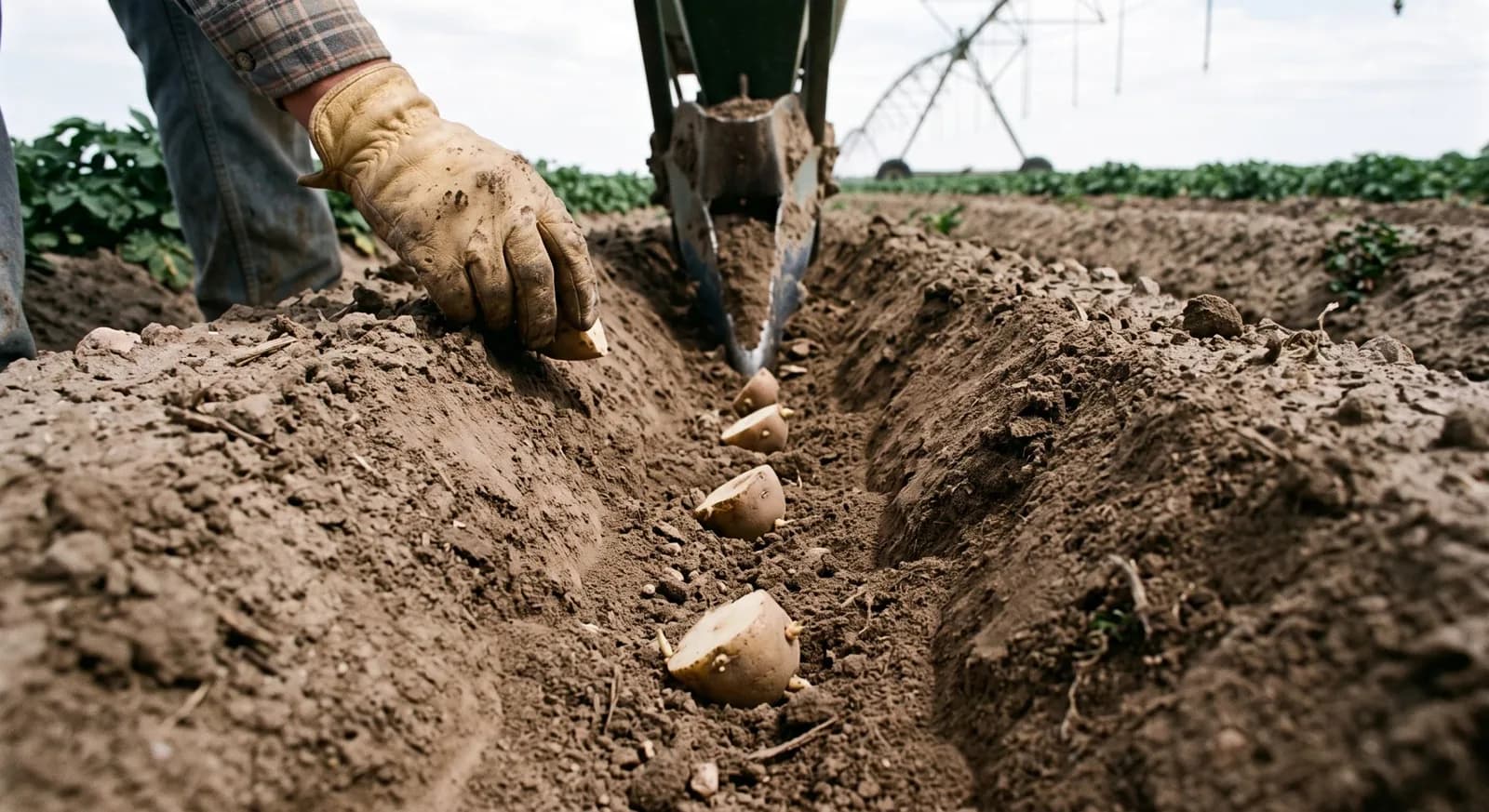
Between rows: 81–97 cm (32–38 in) · Within the row: 18–23 cm (7–9 in)
Seed pieces of 50–57 g (1¾–2 oz), planted 10–20 cm (4–8 in) deep; about 1,790–2,470 kg of seed pieces per hectare (1,600–2,200 lb per acre). Schematic, not to scale.
- Varieties
- Reds: Red La Soda and Viking. Chipping whites: Atlantic, Snowden, Gemchip, Norchip. Russets: Norgold M, Russet Norkotah, Century Russet. Specialty: Yukon Gold.1
Feed and water
- April38 mm
- May183 mm
- June305 mm
- July152 mm
- Nitrogen and potassium
- A 45 t/ha (400 cwt/acre) crop takes up about 235 kg N/ha (210 lb/acre); AgriLife recommends 200–280 kg N/ha (180–250 lb/acre) applied. The High Plains typically need no potassium; other regions apply 56–112 kg K2O/ha (50–100 lb/acre).1
- Irrigation
- The seasonal requirement is about 678 mm (26.7 in): 38 mm in April, 183 mm in May, 305 mm in June and 152 mm in July. Actual applications range from 610 to more than 1,000 mm (24 to over 40 in) in four to ten irrigations, depending on the year.1
Disease, vine kill and harvest
- Diseases and pests
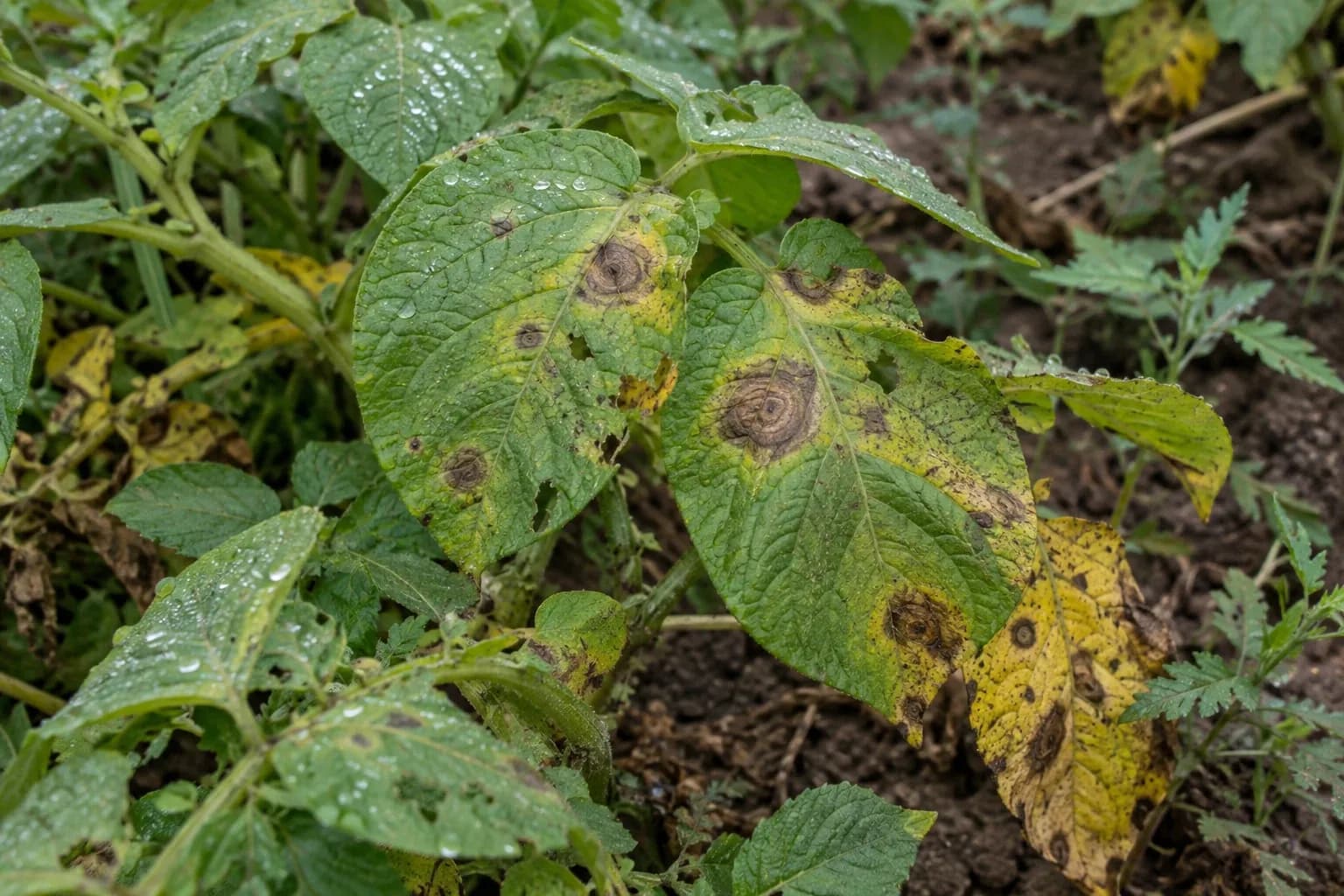
- Blackleg, early and late blight, scab, Rhizoctonia and southern blight are the diseases to watch; aphids, psyllids and flea beetles are the main insects.1
- Harvest
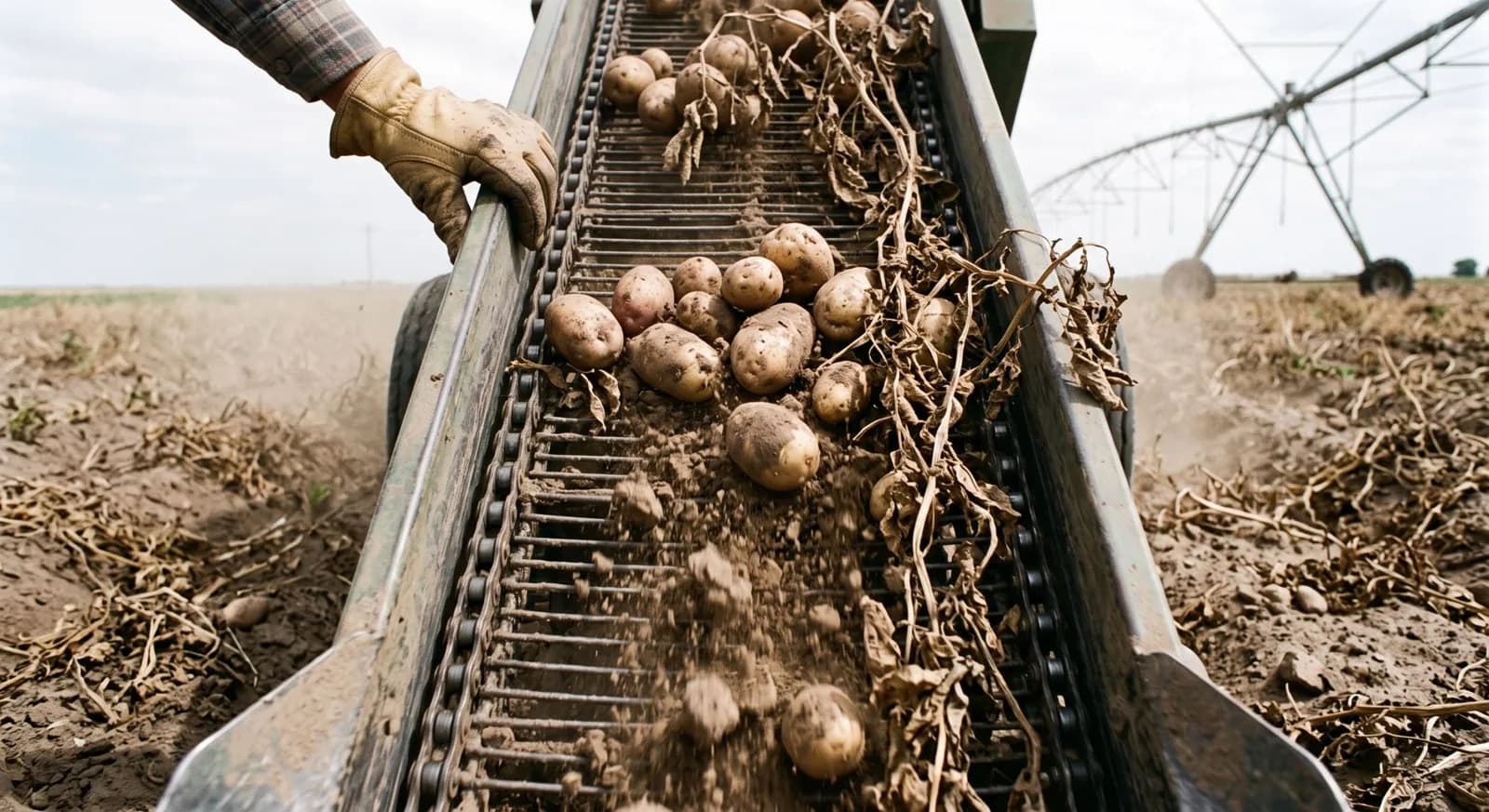
- Dig when tubers weigh 170–340 g (6–12 oz) and the skin is set. A desiccant is applied 3 to 7 days before harvest to kill the vines.1
Yield and area
- Texas71.2 t/ha
- United States48.8 t/ha
- USDA yields
- Texas averaged 620, 610 and 635 cwt/acre (69.5, 68.4 and 71.2 t/ha) in 2023, 2024 and 2025. Planted area was 15,000 acres (6,070 ha) and harvested area 14,600 acres (5,910 ha) in each year, which implies roughly 420,000 t in 2025. AgriLife's older 250–350 cwt/acre range is a conservative planning figure from earlier decades.1,2
Frequently asked questions
- When do you plant potatoes in Texas?
- It depends on the region: late December in the Rio Grande Valley, mid-January in the Winter Garden, mid-February to mid-March in the Rolling Plains and late February to early April on the High Plains.
- What soil temperature do potatoes need in Texas?
- At least 10°C (50°F) at 15 cm (6 in) depth before planting. Tubers stop forming when soil is too hot.
- How far apart do you plant potatoes in Texas?
- Rows 81–97 cm (32–38 in) apart with 50–57 g (1¾–2 oz) seed pieces 18–23 cm (7–9 in) apart and 10–20 cm deep.
- How much water do Texas potatoes need?
- About 678 mm (26.7 in) per season, peaking at roughly 305 mm in June.
- What is the average potato yield in Texas?
- USDA recorded 635 cwt per acre (about 71 t/ha) in 2025, well above the US average of 435 cwt per acre (about 49 t/ha).
- Where are potatoes grown in Texas?
- Four areas: the High Plains–Panhandle, the Rolling Plains near Munday, the Winter Garden and the Rio Grande Valley.
Regional potato guides
Local dates, soil-temperature history and sources for specific regions:
Sources and image credits
- 1. Texas A&M AgriLife Extension (Lubbock) — Texas Potatoes — Accessed 2 October 2026. Texas regions and dates, soil and air temperature, varieties, spacing, fertiliser, irrigation, pests and harvest.
- 2. USDA NASS — Potatoes 2025 Summary — Published September 2026. US and state potato area, yield and production, 2023–2025.
- 3. Iowa State University — Commercial Potato Production Guide — Revised February 2017. Commercial Iowa fresh-market production. Field practices and planting-temperature limits are explicitly transferred references on other regional pages.
Image credits
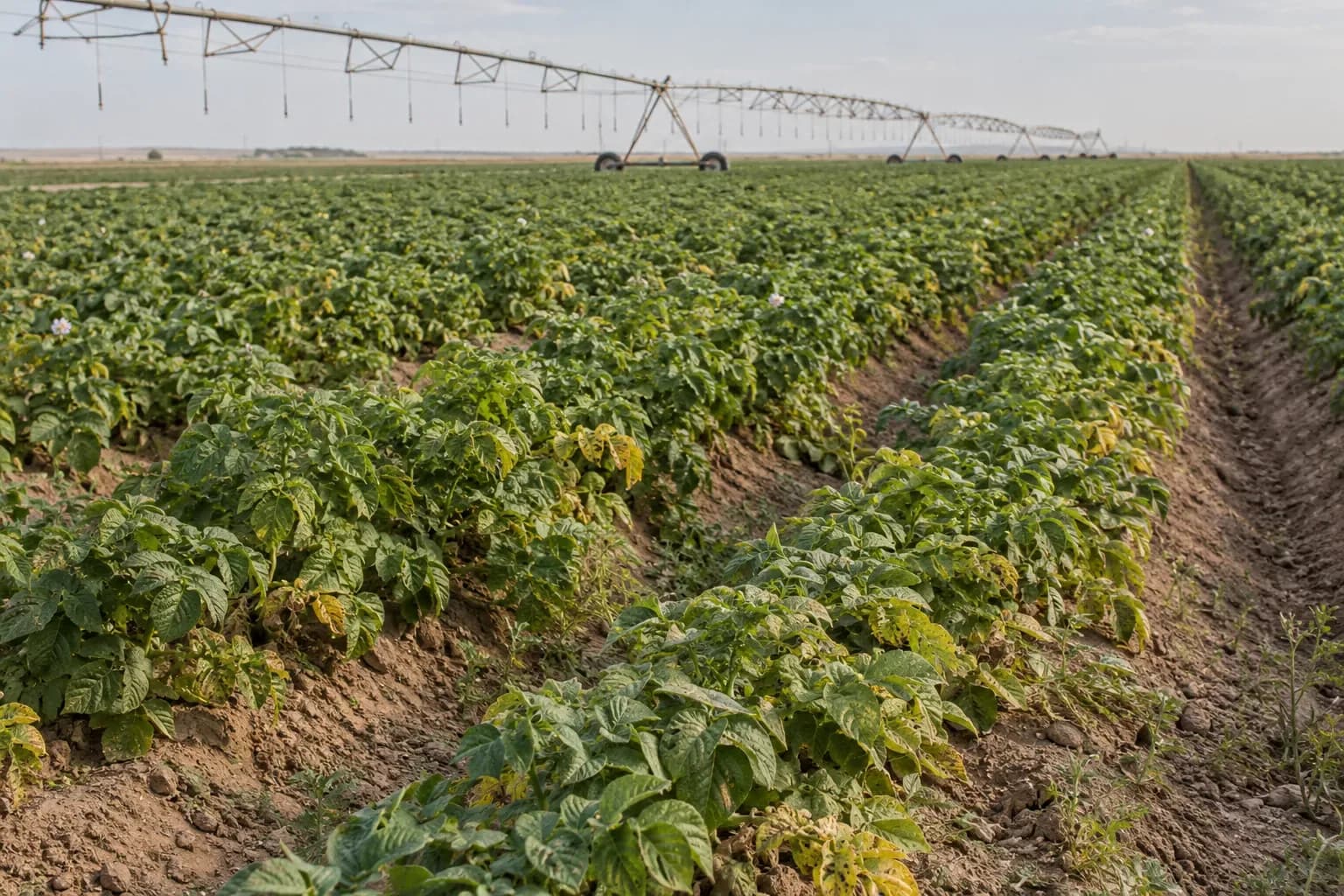
- Irrigated potato rows on the Texas High Plains, watered by a centre pivot.
- Cut seed pieces of about 50 g are planted into an open furrow and covered by the planter.
- Early blight shows as brown lesions with concentric rings on older leaves.
- The harvester lifts tubers onto a conveyor that sheds soil; vines are killed a few days before digging.
Figures are published averages or study assumptions for the places named, not guarantees for your field. Check current local recommendations and product labels before acting.
Some visuals in this guide are illustrations rather than photographs of a specific farm. See image credits.