

Growing potatoes in Minnesota
Minnesota commercial potato fields differ from diversified fresh-market farms in acreage, machinery and delivery schedules. USDA reports document spring planting and late-summer through fall harvest activity. UMN’s irrigated-field guidance adds local nutrient and seed-density decisions; the calendar observations are not statewide start or finish dates.
Scope: Commercial field production in Minnesota. ISU supplies the Midwest field reference; regional sources supply local timing and management context. Match equipment, cultivar and buyer specifications to the farm. Updated 2026-10-03.
At a glance
- Planting material
- Certified seed tubers; pieces about 43–57 g (1.5–2 oz)1
- Midwest row reference
- 76–91 cm (30–36 in) between rows; 20–30 cm (8–12 in) within rows1
- Initial planting depth
- 8–13 cm (3–5 in); later hilling covers developing tubers1
- Harvest readiness
- Buyer grade, tuber maturity and skin set; typically 10–15 days after vine termination1
Planting and harvest calendar for Minnesota
Use the source-backed production windows to coordinate establishment, crop care and harvest. Production districts and cultivars can have different cycles; the historical climate adds context for the field plan.
Planting climate heatmap
Reference period: 1996-01-01 to 2025-12-31. ERA5-Land monthly mean soil temperature at 0–7 cm, air temperature and frost days at the regional reference point (46, -94.5). Select a month to inspect its historical conditions.
ISU’s commercial planting reference specifies soil above 45°F (7.2°C) and below 70°F (21.1°C). Historical 0–7 cm topsoil is a proxy: verify temperature at the actual seed depth. This temperature range is transferred commercial guidance outside Iowa, not a local planting-date recommendation.1
Muted green: temperature fits the sourced range and no mean frost days recorded. Neutral tiles name the temperature or frost constraint. Gray: missing data. This screen does not assess the full growing season, field drainage or crop maturity.
April: Too cold
The monthly mean is outside the lower planting limit of 7.2°C.
- Mean topsoil temperature
- 5.0°C
- Mean air temperature
- 6.3°C
- Mean frost days per month
- 12.4 days
These are monthly means at one reference location. They describe seasonal field conditions, not crop maturity, actual seed-zone conditions, frost forecasts or a planting recommendation. Harvest bands follow the crop-specific production sources above.
Climate source: Open-Meteo Historical Weather APIPlan Minnesota density and irrigated-field nutrition
- Use crop progress as context
- The calendar uses actual USDA planting and harvest reports from separate years. It shows when operations were underway, without promising the same dates for your cultivar, soil or contract.4,5,6,7,8
- Match stem density to tuber grade
- UMN advises discarding cut pieces below about 43 g (1.5 oz); pieces above about 71 g (2.5 oz) give diminishing yield returns and cost more. Closer spacing around 20 cm (8 in) tends toward smaller tubers compared with 30 cm (12 in).3
- Place and split nutrients
- For irrigated Minnesota fields, UMN places nutrient bands about 5–8 cm (2–3 in) below and beside seed without contact. Split nitrogen around emergence and final hilling, then use petiole analysis to guide later supply; avoid late excess nitrogen.2
- Manage the root zone
- UMN locates most roots in the upper 46–61 cm (1.5–2 ft). Soil and tissue tests, prior crop, cultivar and harvest timing guide fertility; correct excessive acidity in a non-potato rotation year rather than applying a universal rate.2
Select and prepare the field
- Drainage and rotation
- Choose loose, well-drained ground. Rotate away from potatoes and other solanaceous crops for 3–4 years. Record disease, weed and soil-pest history before contracting the field.1
- Test before fertilizing
- The Iowa reference favors pH 5.5–6.0 with scab-resistant cultivars. Use field soil tests and regional advice before adjusting pH or nutrient supply; excess nitrogen delays maturity and can reduce quality.1
Prepare certified seed and set the stand
Between rows: 76–91 cm (30–36 in) · Within the row: 20–30 cm (8–12 in)
ISU commercial spacing. Both dimensions refer to seed-piece placement; adapt the layout to machinery and the target grade. Schematic, not to scale.
- Seed quality and sanitation
- Buy certified seed of the cultivar and grade your buyer requires. Inspect each lot; certification reduces disease risk but does not replace inspection. Keep cutting equipment clean and separate suspect lots.1
- Pieces, spacing and depth
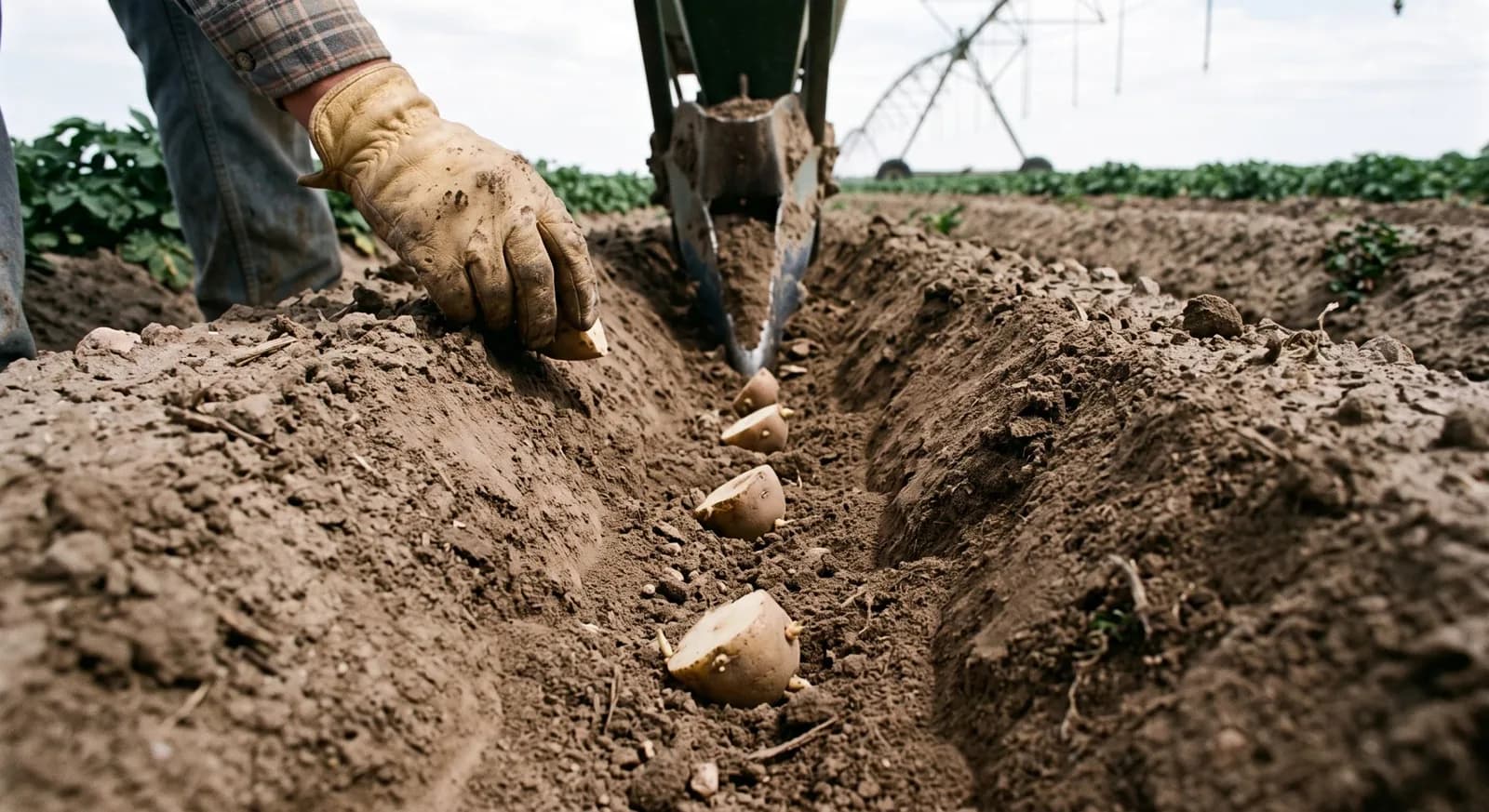
- The commercial Iowa reference uses 43–57 g (1.5–2 oz) pieces with 1–2 eyes, spaced 20–30 cm (8–12 in) apart in 76–91 cm (30–36 in) rows, initially 8–13 cm (3–5 in) deep. Adjust density for stem number, cultivar, equipment and target tuber size.1
- Soil readiness
- Plant into moist, workable soil above 7°C (45°F) and below 21°C (70°F) under the ISU reference. Check the field at seed depth; the historical climate panel is regional context and cannot certify a trafficable seedbed.1
Manage water, weeds and crop health
- Water through tuber growth
- Schedule irrigation from soil water capacity, rooting depth and field measurements. Avoid alternating drought and saturation, especially during tuber initiation and bulking. Monthly rainfall averages are not an irrigation prescription.1
- Hill and scout
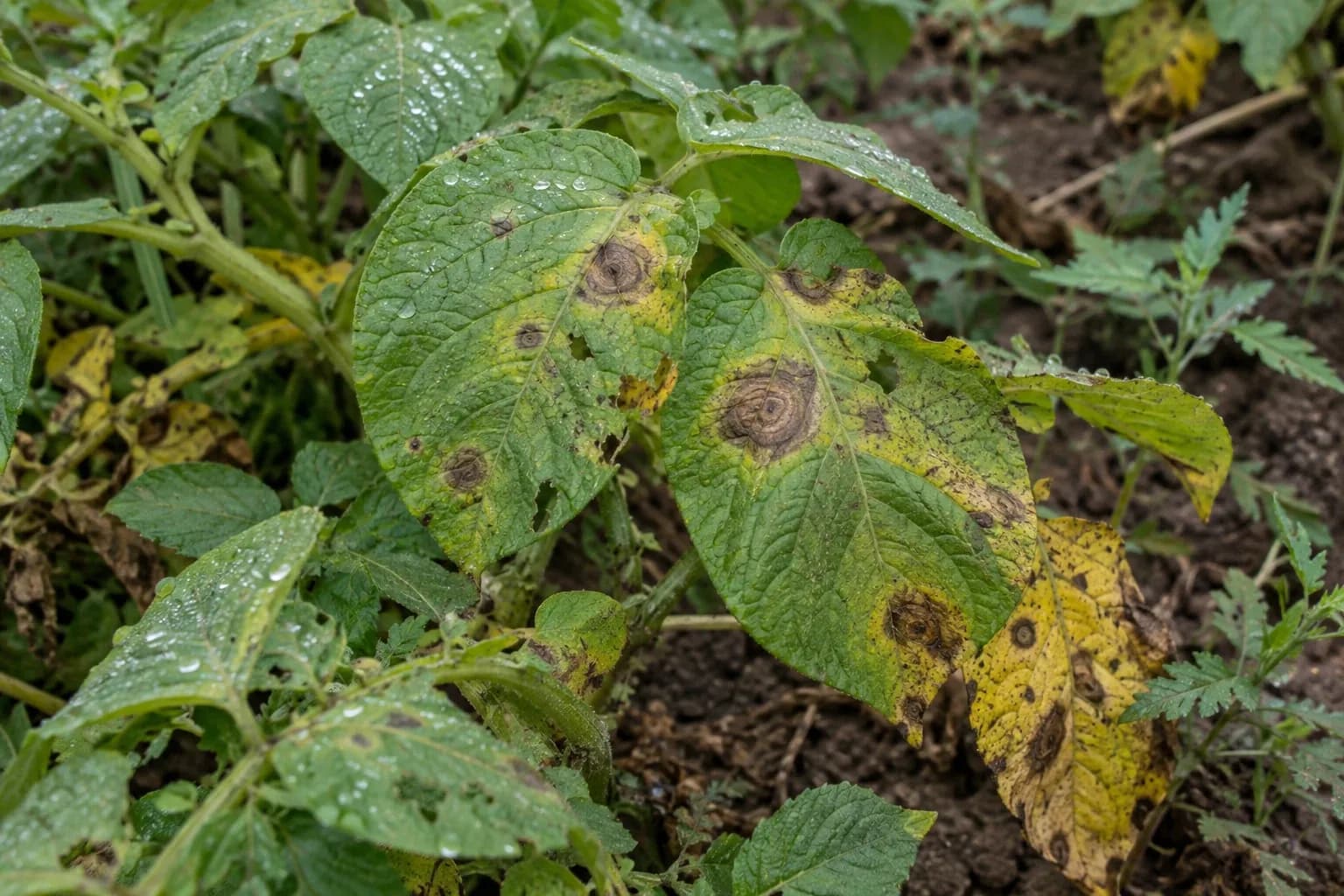
- Control weeds early, then maintain soil cover over developing tubers to prevent greening. Scout foliage and tubers for disease and insect injury; confirm the cause before selecting a locally appropriate treatment.1
- Keep field records
- Track seed lot, cultivar, fertilizer and irrigation applications, scouting findings and harvest grade by field. Use the records to identify recurring losses and choose the next rotation.1
Harvest, cure and store for the buyer
- 1
Sample the crop
Check size, defects and the buyer’s grade.
- 2
Confirm skin set
Commonly 10–15 days after vine termination; inspect tubers.
- 3
Lift gently
Reduce cuts, bruises and transfer drops.
- 4
Cure and hold
Ventilate sound tubers; use the market-specific temperature.
- Check skin set
- Sample tubers for buyer size and maturity. ISU describes harvesting after skins set, commonly 10–15 days after vine termination. Confirm skin resistance in the field rather than relying on a month or days-to-maturity label.1
- Protect the lot
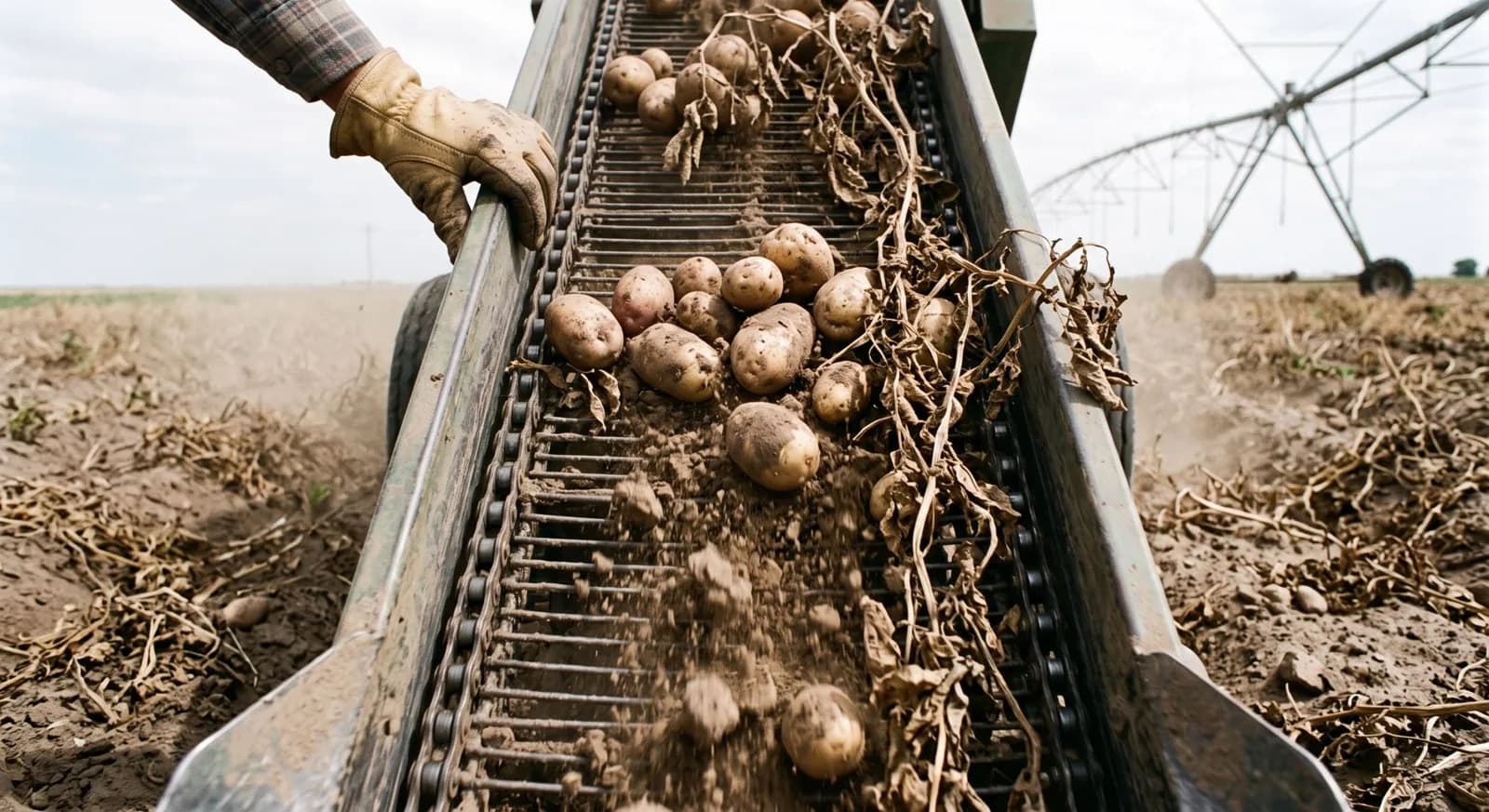
- Adjust digging depth and conveyor speed to reduce cuts, clod impacts and drops. Separate damaged or diseased lots before storage; adequate ventilation cannot repair rotting tubers.1
- Match storage to market
- For sound fresh-market tubers, the Iowa reference cures at 10–13°C (50–55°F) with about 90% relative humidity and ventilation, then holds near 4°C (40°F), 90–95% humidity. Warm to about 10°C (50°F) before movement. Processing contracts require a different holding regime.1
Frequently asked questions
- When should a farm plant potatoes in Minnesota?
- USDA reported 17% of Minnesota potatoes planted by April 27 and 93% by May 25, 2025. April–May marks observed commercial activity, not a complete start/end window or a fixed annual schedule.
- Which harvest months apply in Minnesota?
- USDA reported harvest 9% complete August 25, 68% September 29 and 77% October 6, 2024. These months show observed activity; harvest was not complete at the October observation.
- Are these potatoes grown from botanical seed?
- This field guide covers seed tubers and cut seed pieces. Use certified planting stock and inspect each lot; grocery potatoes are not a substitute for a traceable seed supply.
- What spacing should a commercial field use?
- The cited Midwest reference is 76–91 cm (30–36 in) between rows and 20–30 cm (8–12 in) between seed pieces. Cultivar, stem density, target size and machinery can require a different layout.
- Does the climate calendar determine irrigation or harvest?
- No. Historical air and shallow-soil climate at the regional reference point helps planning. Farm soil moisture, rooting depth, maturity, skin set and the buyer’s schedule determine operations.
- Can fresh-market and processing potatoes share a storage temperature?
- Storage must meet the market specification. The fresh-market holding reference near 4°C (40°F) is not a processing recommendation; verify temperature, humidity and ventilation requirements with the buyer.
Regional potatoes guides
Local dates, soil-temperature history and sources for specific regions:
Sources and image credits
- 1. Iowa State University — Commercial Potato Production Guide — Revised February 2017. Commercial Iowa fresh-market production. Field practices and planting-temperature limits are explicitly transferred references on other regional pages.
- 2. University of Minnesota — Potato fertilization on irrigated soils — Reviewed October 2026. Minnesota commercial irrigated potato nutrition, soil testing, nutrient placement and tissue sampling.
- 3. University of Minnesota — Crop planning deep dive: pondering potatoes — Updated April 2026. Commercial vegetable-farm seed-piece size, density, disease prevention and handling.
- 4. USDA NASS — Minnesota crop progress, 04-28-25 — 2025 weekly report. 17% planted by April 27; five-year average 12%.
- 5. USDA NASS — Minnesota crop progress, 05-27-25 — 2025 weekly report. 93% planted by May 25; five-year average 80%.
- 6. USDA NASS — Minnesota crop progress, 08-26-24 — 2024 weekly report. 9% harvested by August 25; five-year average 15%.
- 7. USDA NASS — Minnesota crop progress, 09-30-24 — 2024 weekly report. 68% harvested by September 29; five-year average 69%.
- 8. USDA NASS — Minnesota crop progress, 10-07-24 — 2024 weekly report. 77% harvested by October 6; five-year average 81%.
Image credits
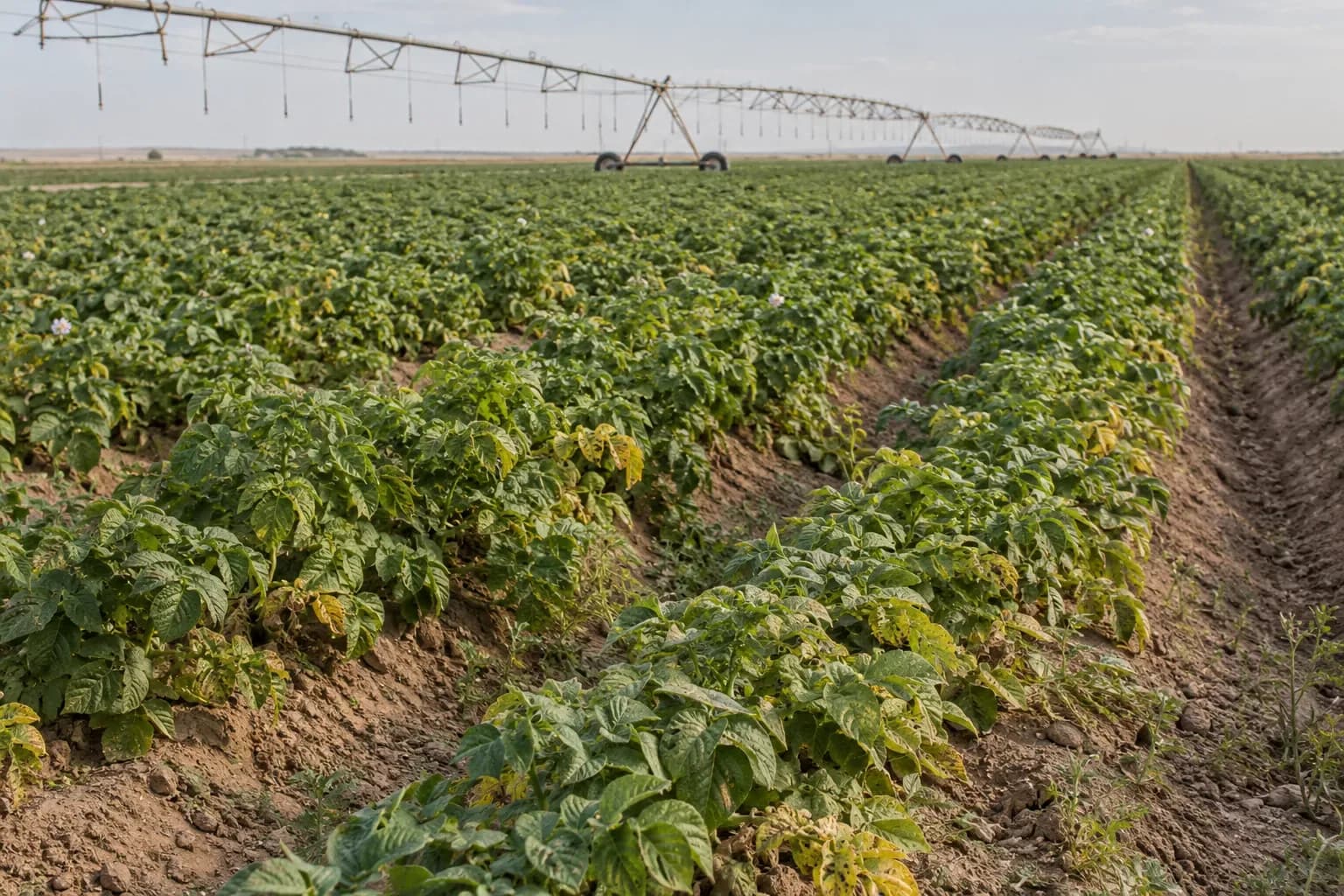
- Irrigated potato field illustration.
- Seed-piece placement before covering and hilling.
- Leaf lesions warrant scouting and diagnosis before treatment.
- Adjust the harvester to limit drops and tuber damage.
Figures are published averages or study assumptions for the places named, not guarantees for your field. Check current local recommendations and product labels before acting.
Some visuals in this guide are illustrations rather than photographs of a specific farm. See image credits.