

Growing potatoes in California
California potato production spans distinct districts. Kern County’s winter and early-spring planting differs from the May planting used near Tulelake. Plan seed, irrigation, harvest capacity and storage for the district and market; a statewide climate average cannot stand in for either field.
Scope: Commercial California production. UC IPM supplies statewide management; the 2023 Klamath Basin budget is a historical fresh-market example. The Central Coast layout below describes a separate organic production system. Updated 2026-10-03.
At a glance
- Klamath budget crop
- May planting; October harvest in the 2023 fresh-market model2
- Central Coast organic layout
- 122 cm (48 in) beds; 20–30 cm (8–12 in) seed-piece spacing3
- Seed handling
- About 43–71 g (1.5–2.5 oz) pieces; keep lots traceable4
- Fresh-market holding
- About 3–7°C (38–45°F); processing requirements differ7
Planting and harvest calendar for California
Use the source-backed production windows to coordinate establishment, crop care and harvest. Production districts and cultivars can have different cycles; the historical climate adds context for the field plan.
Planting: Separate California district windows1,2
UC IPM describes Kern planting from late November to early March for spring/summer crops, plus July planting for a smaller winter crop. Tulelake planting is in May. These are separate systems, not one continuous statewide window.
Harvest: Documented district harvest examples1,2
UC IPM describes May/June harvest in Kern rotation planning; the 2023 Klamath fresh-market budget models October harvest. The reviewed July-planted Kern reference does not specify a winter harvest month.
Planting climate heatmap
Reference period: 1996-01-01 to 2025-12-31. ERA5-Land monthly mean soil temperature at 0–7 cm, air temperature and frost days at the regional reference point (37, -120). Select a month to inspect its historical conditions.
ISU’s commercial planting reference specifies soil above 45°F (7.2°C) and below 70°F (21.1°C). Historical 0–7 cm topsoil is a proxy: verify temperature at the actual seed depth. This temperature range is transferred commercial guidance outside Iowa, not a local planting-date recommendation.8
Muted green: temperature fits the sourced range and no mean frost days recorded. Neutral tiles name the temperature or frost constraint. Gray: missing data. This screen does not assess the full growing season, field drainage or crop maturity.
November: Frost caution
The monthly mean meets the lower temperature criterion, but frost occurs in the historical record. Check the actual frost forecast and crop protection.
- Mean topsoil temperature
- 13.6°C
- Mean air temperature
- 13.3°C
- Mean frost days per month
- 0.4 days
These are monthly means at one reference location. They describe seasonal field conditions, not crop maturity, actual seed-zone conditions, frost forecasts or a planting recommendation. Harvest bands follow the crop-specific production sources above.
Climate source: Open-Meteo Historical Weather APIChoose the district, field and market
- Keep the production systems separate
- Kern’s winter/early-spring crop and Tulelake’s May crop require different field schedules. The Klamath budget models May planting, September vine preparation and October harvest; its costs and inputs are historical assumptions, not current farm recommendations.1,2
- Rotate and assess soil pests
- Use field history and soil testing before selecting ground. UC IPM favors rotations such as cereals over related solanaceous crops; alfalfa can host root-knot nematodes. Soil drainage and pest history can rule out a field despite a suitable climate.1
Handle seed and prepare a measured layout
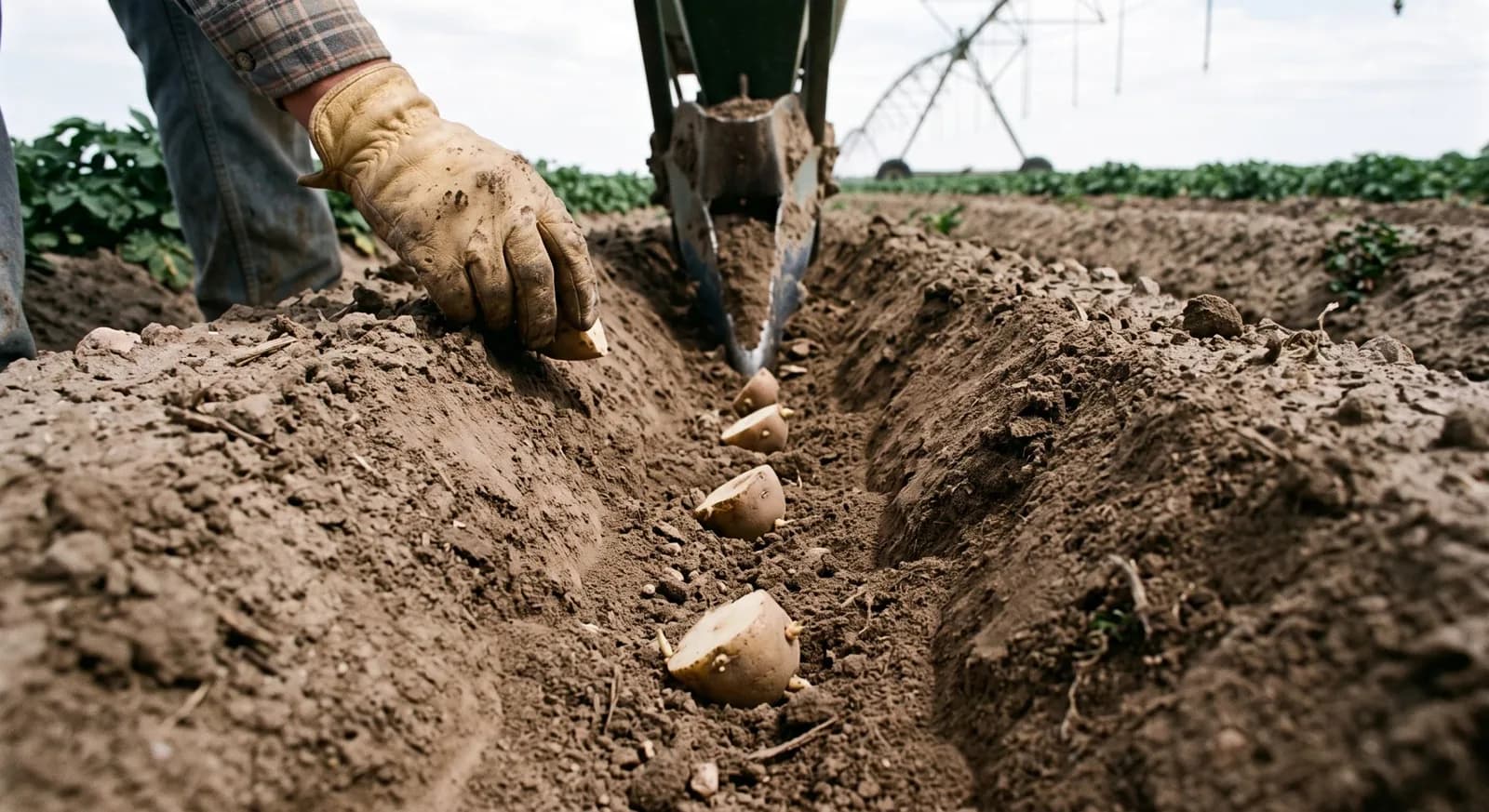
Between rows: 122 cm (48 in) bed centers · Within the row: 20–30 cm (8–12 in)
One planted line per bed. This Central Coast layout is not a statewide spacing prescription; Klamath uses a different system. Schematic, not to scale.
- Inspect certified lots
- Certification reduces risk but does not guarantee disease-free seed. Inspect tubers and keep lots separate. UC recommends warming seed gradually to 10–13°C (50–55°F) before cutting, with humid air and ventilation; clean and disinfect cutters between lots.4
Measure water and nutrient demand in the field
- Protect tuber initiation
- UC places about 90% of roots in the top 30–46 cm (12–18 in). Its irrigation reference limits available-water depletion to about 30–40%, and about 20% during tuber initiation where common scab is a concern. Use field sensors and local evapotranspiration, with drainage checks.5
- Keep moisture uniform
- Avoid drought/saturation cycles and waterlogging. Monthly historical climate helps compare seasons but cannot determine today’s irrigation amount or field water balance.5
- Test rather than copy a budget rate
- The 2023 Klamath budget includes seasonal water and fertilizer assumptions and weekly petiole testing. Use soil and tissue analysis to plan supply; do not treat a cost-model input as a prescription for another field.2
Keep the crop clean through early growth
- Early weed control
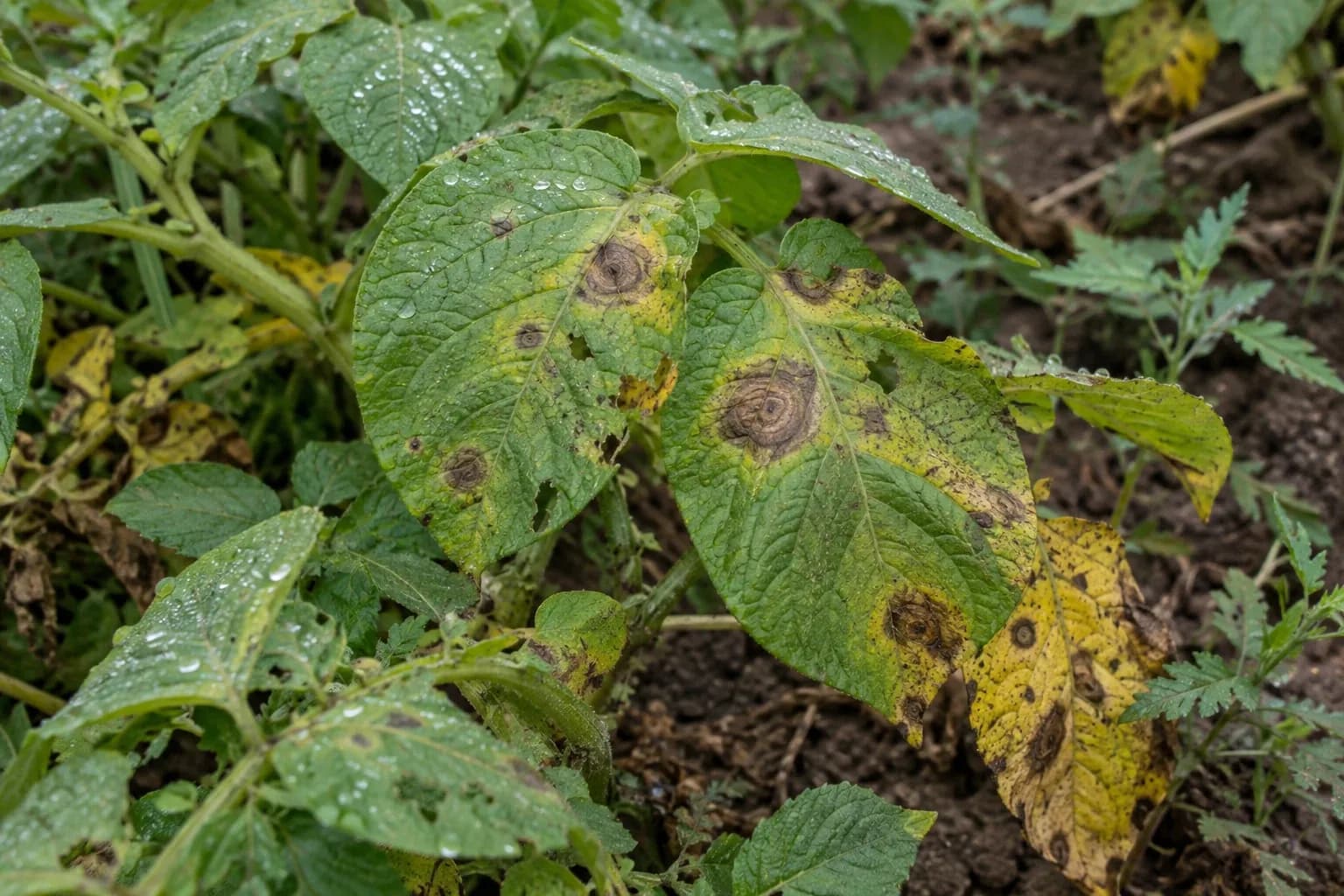
- UC IPM emphasizes a weed-free period during the first 4–6 weeks after emergence and weekly field surveys. Combine rotation, cultivation and an appropriate crop-protection plan before competition reduces yield.1
Harvest gently and store for the contracted market
- Fresh market3.3–7.2 °C38–45°F
- French fries7.2–10 °C45–50°F
- Chipping10–12.8 °C50–55°F
- Seed tubers2.8–4.4 °C37–40°F
- Check conditions before digging
- UC’s harvest reference targets soil near 60–80% of field capacity. Cold soil below 10°C (50°F) increases shatter risk; warm pulp above about 16°C (60°F) raises rot concerns. Check maturity, skin set and lot condition before lifting.6
- Limit damage and separate suspect lots
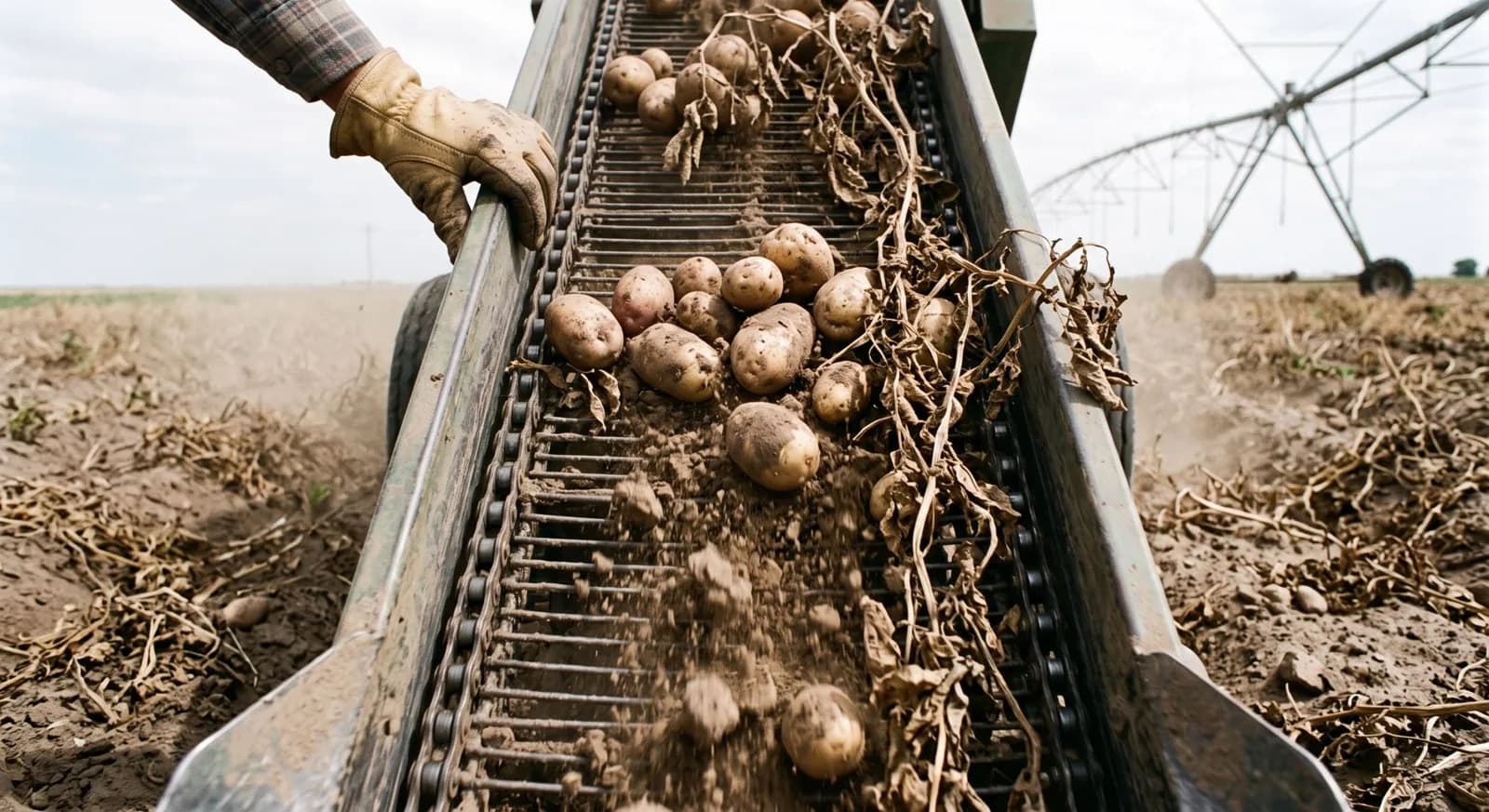
- Adjust equipment and transfer points to minimize drops and bruising. Remove wet or rotting tubers rather than mixing them into sound storage lots. Ventilation and temperature management require regular inspection.6,7
- Cure sound tubers, then cool
- UC describes curing sound tubers at 10–13°C (50–55°F), above 95% relative humidity, for at least two weeks with ventilation. Cool gradually and prevent condensation; holding temperature then follows the market specification.7
Frequently asked questions
- When are potatoes planted in California?
- UC describes late November–early March planting in Kern for spring/summer crops, July for a smaller winter crop, and May near Tulelake. Match the district and market; there is no single statewide planting window.
- Which California harvest months are documented?
- The reviewed sources describe May/June Kern harvest and October harvest in a 2023 Klamath fresh-market budget. They do not give a harvest month for the July-planted Kern crop.
- Should every California field use 48-inch beds?
- No. That figure describes a Central Coast organic system. The Klamath budget uses 36-inch beds. Equipment, cultivar, density and the production system determine the layout.
- Does certified seed guarantee a clean crop?
- No. UC advises inspecting certified lots and keeping them traceable, with clean cutting equipment and careful handling. Certification reduces risk without removing the need for field monitoring.
- Can monthly climate data set the irrigation schedule?
- No. The historical panel describes a regional reference point. Use field soil-water measurements, rooting depth, local evapotranspiration and actual crop stage to set irrigation.
- Why does storage temperature depend on the buyer?
- UC specifies different holding ranges for fresh-market, fry, chipping and seed tubers. Confirm the contracted market and storage protocol before planting; the curing phase is separate from long-term holding.
Regional potatoes guides
Local dates, soil-temperature history and sources for specific regions:
Sources and image credits
- 1. UC IPM — Integrated weed management — Reviewed October 2026. California commercial district planting, Kern harvest/rotation context and early weed control.
- 2. UC Davis — Fresh-market potato production costs, Klamath Basin — 2023 study; published 2024. Historical Klamath fresh-market production budget: May planting, October harvest and 36-inch beds; not current field rates or prices.
- 3. UC Santa Cruz — Organic potato production — Reviewed October 2026. Central Coast commercial organic production: 48-inch beds, 8–12-inch spacing, 2–4-inch initial depth and hilling.
- 4. UC IPM — Seed certification and seed tuber handling — Reviewed October 2026. Commercial seed inspection, warming, cutting, sanitation and planting conditions.
- 5. UC IPM — Irrigation — Reviewed October 2026. Root distribution, available-water depletion and moisture management for commercial potatoes.
- 6. UC IPM — Harvest — Reviewed October 2026. Soil moisture, temperature and mechanical handling to reduce tuber injury.
- 7. UC IPM — Storage — Reviewed October 2026. Curing, ventilation, cooling and different holding temperatures for fresh, processing and seed markets.
- 8. Iowa State University — Commercial Potato Production Guide — Revised February 2017. Commercial Iowa fresh-market production. Field practices and planting-temperature limits are explicitly transferred references on other regional pages.
Image credits
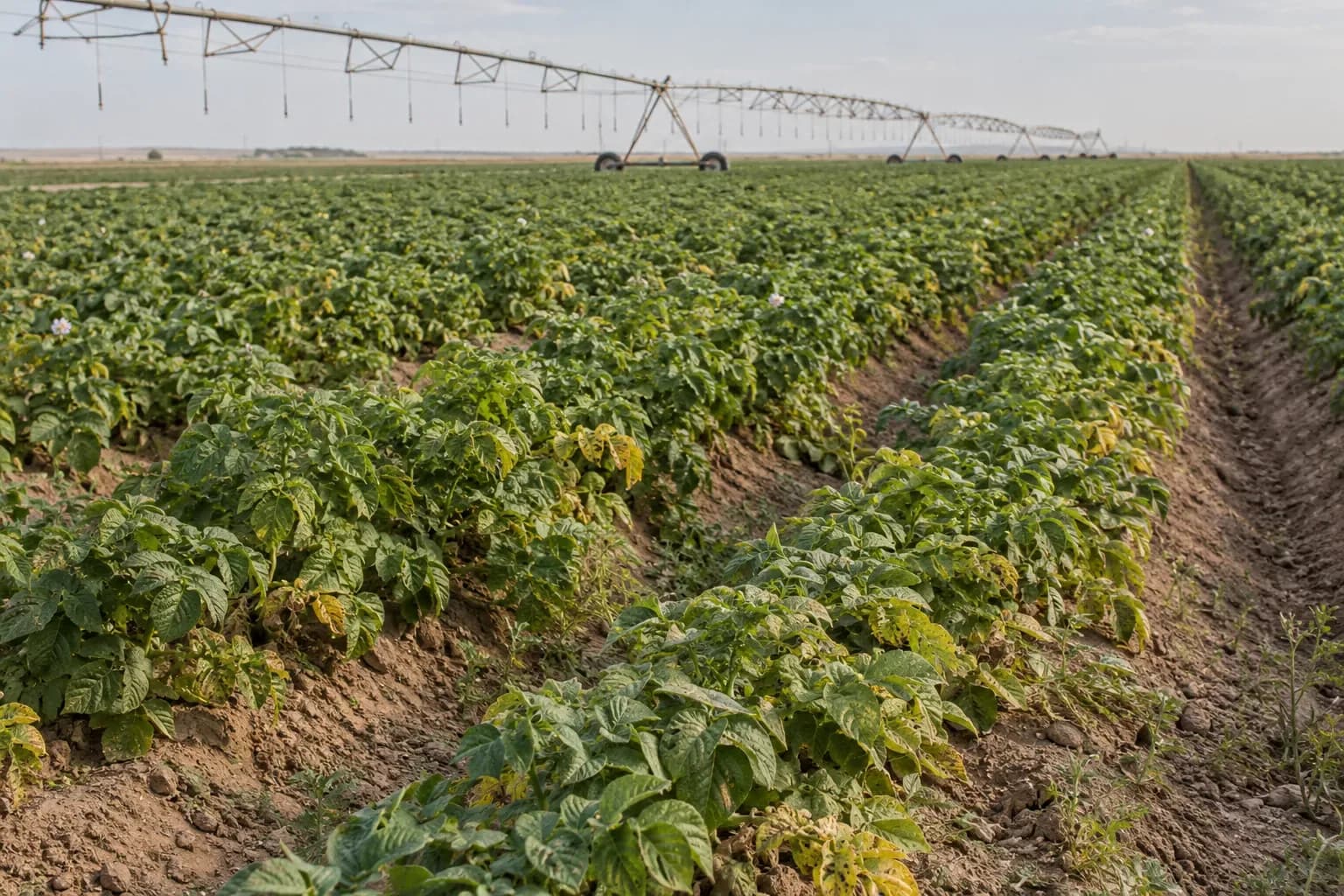
- Irrigated potato field illustration.
- Seed-piece placement before covering and hilling.
- Leaf lesions warrant scouting and diagnosis before treatment.
- Adjust the harvester to limit drops and tuber damage.
Figures are published averages or study assumptions for the places named, not guarantees for your field. Check current local recommendations and product labels before acting.
Some visuals in this guide are illustrations rather than photographs of a specific farm. See image credits.