

How to grow potatoes commercially
Commercial potatoes are grown from seed tubers or cut seed pieces and managed for a defined market such as fresh, processing or seed. Site, planting date, cultivar, spacing, irrigation, skin set and storage all depend on the region and buyer. Use the Iowa, California and Minnesota references below as separate examples, not one production prescription.
Scope: Commercial field production. Midwest field practices are drawn from the Iowa State guide; California production systems and Minnesota nutrient guidance provide regional contrasts. Confirm current local recommendations and buyer requirements. Updated 2026-10-16.
At a glance
Planting and harvest calendar for Potatoes
Use the source-backed production windows to coordinate establishment, crop care and harvest. Production districts and cultivars can have different cycles; the historical climate adds context for the field plan.
Planting: Plant certified seed into a ready seedbed1,2,3
No global planting months apply. Planting date depends on local frost risk, soil condition, cultivar, market, seed-lot condition and harvest target. The Iowa State commercial temperature and spacing references are one regional guide; use local field observations and extension timing.
Select fields for drainage, rotation and market
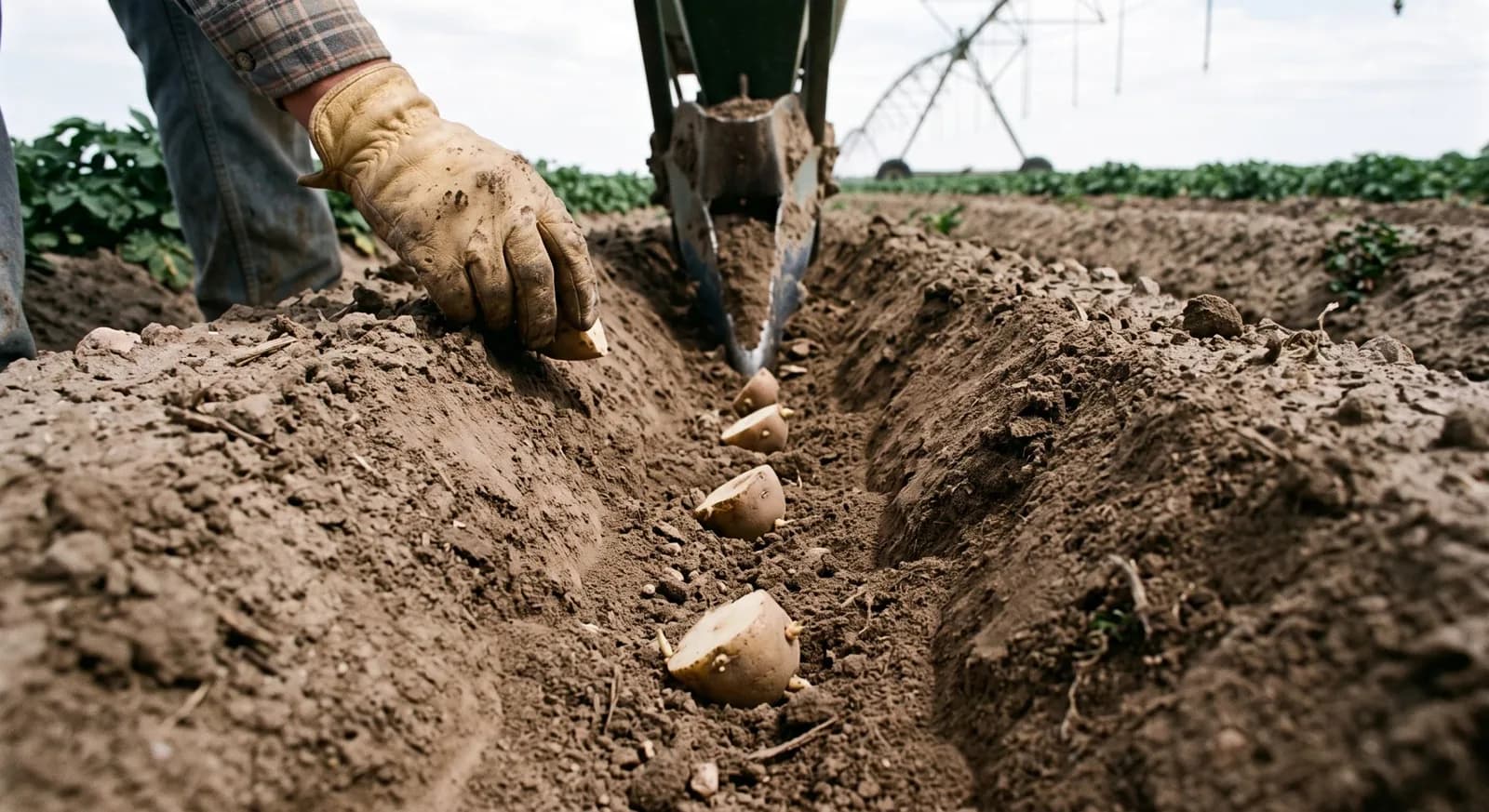
Prepare seed and establish an even stand
Between rows: 76–91 cm (30–36 in) · Within the row: 20–30 cm (8–12 in)
Spacing from the Iowa State commercial guide. Adjust seed-piece size and spacing for cultivar, stem number, target tuber grade, planter and local recommendations. Schematic, not to scale.
- 1
Buy certified seed
Match cultivar and grade to the buyer.
- 2
Warm and inspect the lot
Follow local seed-handling guidance and remove suspect pieces.
- 3
Cut and sanitize
Use clean equipment and consistent seed-piece size.
- 4
Plant into a fit field
Check moisture, temperature and planter performance at seed depth.
Manage hilling, water, nutrition and crop health
- Hill to protect developing tubers
- Maintain soil cover over developing tubers to reduce greening and protect them from exposure. Timing and equipment depend on the production system and field conditions.1,3
- Irrigate with field measurements
- Schedule irrigation from soil texture, rooting depth, crop stage, weather and measured soil water. Avoid both prolonged saturation and stress during tuber initiation and bulking.1,10
Harvest carefully and store by market
- 1
Sample tubers
Check size, maturity and buyer grade.
- 2
Confirm skin set
Use field checks and the local vine-termination interval.
- 3
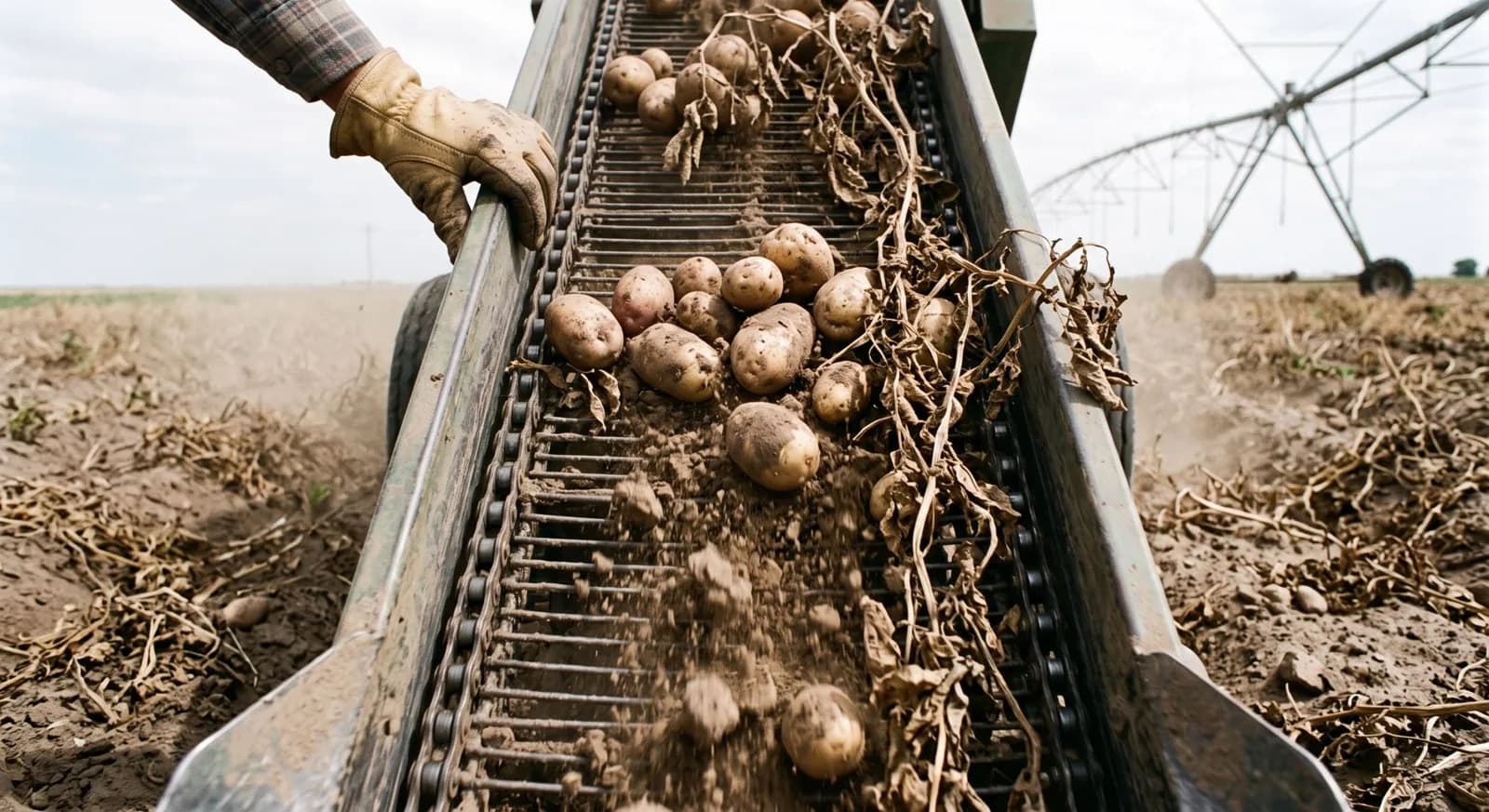
Lift with care
Tune the harvester to limit cuts, drops and bruising.
- 4
Cure and hold
Use the temperature, humidity and ventilation for the market.
Frequently asked questions
- When should potatoes be planted?
- Plant when local field conditions are suitable for the cultivar and market. Regional dates, frost risk, soil temperature, moisture and seed condition differ, so the root guide does not give one calendar.
- Should commercial potatoes be grown from seed?
- This guide covers seed tubers or cut seed pieces used for field production. Use traceable certified planting stock that meets local and buyer requirements.
- How far apart should potatoes be planted?
- Spacing depends on cultivar, target tuber size, stem density and equipment. Iowa State’s commercial reference is 76–91 cm (30–36 in) between rows and 20–30 cm (8–12 in) between seed pieces.
- How should harvested potatoes be stored?
- Cure sound tubers with ventilation, then use a temperature and humidity suited to the market. Fresh-market, processing and seed lots are not interchangeable.
Regional guides and field planning
Sources and image credits
- 1. Iowa State University — Commercial Potato Production Guide — Revised February 2017. Commercial Iowa fresh-market production. Field practices and planting-temperature limits are explicitly transferred references on other regional pages.
- 2. UC Davis — Fresh-market potato production costs, Klamath Basin — 2023 study; published 2024. Historical Klamath fresh-market production budget: May planting, October harvest and 36-inch beds; not current field rates or prices.
- 3. UC Santa Cruz — Organic potato production — Reviewed October 2026. Central Coast commercial organic production: 48-inch beds, 8–12-inch spacing, 2–4-inch initial depth and hilling.
- 4. UC IPM — Harvest — Reviewed October 2026. Soil moisture, temperature and mechanical handling to reduce tuber injury.
- 5. UC IPM — Storage — Reviewed October 2026. Curing, ventilation, cooling and different holding temperatures for fresh, processing and seed markets.
- 6. USDA NASS — Minnesota crop progress, 04-28-25 — 2025 weekly report. 17% planted by April 27; five-year average 12%.
- 7. UC IPM — Seed certification and seed tuber handling — Reviewed October 2026. Commercial seed inspection, warming, cutting, sanitation and planting conditions.
- 8. University of Minnesota — Crop planning deep dive: pondering potatoes — Updated April 2026. Commercial vegetable-farm seed-piece size, density, disease prevention and handling.
- 9. UC IPM — Integrated weed management — Reviewed October 2026. California commercial district planting, Kern harvest/rotation context and early weed control.
- 10. UC IPM — Irrigation — Reviewed October 2026. Root distribution, available-water depletion and moisture management for commercial potatoes.
Image credits
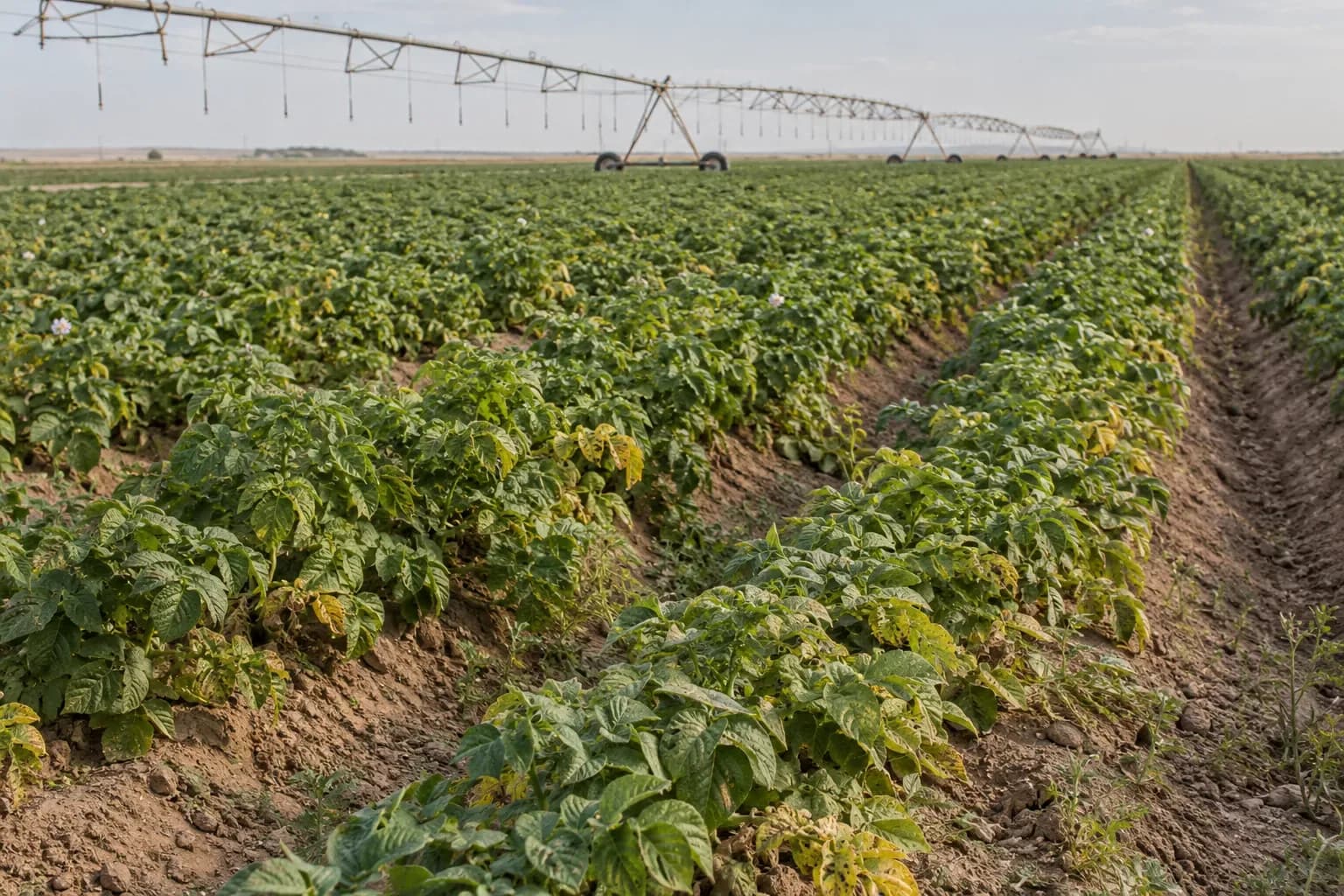
- Irrigated potato field illustration.
- Seed-piece placement before covering and hilling.
- Adjust the harvester to limit drops and tuber damage.
Figures are published averages or study assumptions for the places named, not guarantees for your field. Check current local recommendations and product labels before acting.
Some visuals in this guide are illustrations rather than photographs of a specific farm. See image credits.