

Growing oranges in Spain
Spain’s orange sector is large but varied by autonomous community, cultivar and water supply. MAPA’s initial 2026/27 forecast says the Navel group represents most expected orange production; regional research and old harvest profiles show why a national planting date or one orchard layout would be misleading.
Scope: Commercial sweet-orange production, using current national sector context and regional Valencia/Andalusia evidence. Historical harvest data and experimental layouts are clearly identified and are not current national prescriptions. Updated 2026-10-07.
At a glance
- 2026/27 initial orange forecast
- About 2.8 million tonnes; an initial campaign estimate, not final output1
- Forecast variety mix
- About 72% of forecast orange volume in the Navel group1
- Current local trial evidence
- IFAPA is evaluating Navelina under super-high-density systems in the Guadalquivir Valley2
- Irrigation planning
- Use parcel weather, soil and orchard data rather than a national fixed rate3
- Harvest timing
- Cultivar-specific; historical Valencia data span winter into late spring4
Perennial growth and climate in Spain
A perennial planting remains in the field for multiple years. Establishment is a long-term investment; flowering, fruit development, harvest and plant care recur as the planting matures. Follow the named cultivar and production system.
Establish a long-lived planting2,3,5
Establish trees only after checking the parcel’s soil, drainage, water rights and supply, cultivar and rootstock, frost and heat exposure, and market. The reviewed Spanish sources support parcel-level planning but do not establish one nationwide establishment month.
Management: Schedule water from parcel and weather data3
IFAPA’s Riego Citrus tool uses weather, soil and orchard data to return parcel-specific irrigation plans. It supports a local decision process, not a fixed water volume for all Spanish orange farms.
Harvest: Historical Valencia orange harvest profile4
MAPA’s 2014–2016 calendar for Comunitat Valenciana shows Navel and Navelate groups harvested in winter and Valencia Late extending into spring and early summer. This combines several cultivars and is dated historical evidence; use current block maturity and buyer specifications.
Historical monthly climate
Reference period: 1996-01-01 to 2025-12-31. ERA5-Land monthly mean soil temperature at 0–7 cm, air temperature and frost days at the regional reference point (40.2, -3.7). Select a month to inspect its historical conditions.
Month tiles show mean air temperature.
December historical conditions
- Mean topsoil temperature
- 5.6°C
- Mean air temperature
- 6.1°C
- Mean frost days per month
- 10.9 days
Use this monthly history to assess winter exposure, seasonal heat and water planning. It does not calculate cultivar chill hours, flowering dates, frost damage during bloom or fruit maturity. Topsoil at 0–7 cm describes shallow soil context, not the full root zone. Harvest periods follow the production evidence above.
Climate source: Open-Meteo Historical Weather APIEvaluate the parcel before establishing an orchard
- 1
Check regional fit
Use local climate and crop evidence for the autonomous community.
- 2
Measure soil and drainage
Assess waterlogging, root-zone depth and field access.
- 3
Confirm sustainable water
Verify supply, rights, quality and drought response.
- 4
Select the market system
Match variety, density, rootstock and buyer requirements.
- Treat the national forecast as context
- MAPA’s September 2026 forecast is an initial campaign estimate, not final production or a farm-yield expectation. Its 72% Navel share describes forecast national orange volume.1
Match cultivar, rootstock and market timing
- Plan around the buyer’s window
- Navel types dominate the initial MAPA forecast, while Valencia Late is a distinct later-maturing group. Fresh-market, juice and protected-product routes need different fruit quality and harvest plans.1,4
- Treat high-density trials as trials
- IFAPA’s 2026 Navelina report evaluates different rootstocks and super-high-density plantings in the Guadalquivir Valley. The project highlights that success depends on design, training and rootstock; its experimental system is not a default for other districts.2
Design rows for the orchard and harvest system
- 1
Confirm tree vigor
Use the chosen cultivar and rootstock information.
- 2
Select the canopy system
Plan the training and pruning needed for the chosen density.
- 3
Fit machinery and access
Map row spacing, headlands, roads and equipment clearance.
- 4
Validate the trial evidence
Compare local trial results before scaling the design.
- Do not copy an experimental density without results
- The available IFAPA summary identifies a super-high-density Navelina trial but does not provide a transferable spacing result. Review the full trial and match any layout to rootstock vigor, training, labor, machinery and local water constraints.2
Use parcel-level irrigation and plant-health advice
- Schedule irrigation from orchard data
- IFAPA’s Riego Citrus tool uses local weather, soil and orchard information to produce parcel-specific plans. It does not support applying one water figure to all regions or farms.3
- Respond to waterlogging as well as drought
- Prolonged rain can reduce root oxygen and increase disease risk. Follow current IFAPA regional advice for drainage, post-rain inspection and plant-health response rather than relying on a drought-only plan.5
Harvest by cultivar and measured maturity
- 1
Identify cultivar and market
Separate Navel, Valencia Late and other orange groups.
- 2
Check fruit maturity
Use the packer’s current maturity and quality criteria.
- 3
Book labor and delivery
Align picking with transport and packing capacity.
- 4
Update the block record
Record pick dates, packout, grade and water context.
- Use the old calendar as a comparison, not a forecast
- MAPA’s 2014–2016 Comunitat Valenciana profile shows winter harvest for Navel/Navelate types and later harvest for Valencia Late. Current weather, cultivar, fruit maturity and buyer timing set the actual date.4
- Manage risk across the campaign
- The initial 2026/27 national forecast attributes lower expectations partly to summer heat and fruit drop. Monitor the current season and sample each block rather than assuming last year’s crop load or maturity.1
Frequently asked questions
- When are oranges harvested in Spain?
- It depends on cultivar and district. Historical Comunitat Valenciana data show Navel/Navelate harvest in winter and Valencia Late later into spring; check current fruit maturity and packer requirements.
- Which orange varieties are common in Spain?
- MAPA’s initial 2026/27 forecast places about 72% of orange output in the Navel group. Valencia Late and other varieties are also important in regional production.
- When should I plant orange trees in Spain?
- There is no single supported national month. Set establishment from local soil and weather conditions, water availability, cultivar/rootstock and nursery advice.
- How much water do orange trees need in Spain?
- Use parcel-level scheduling. IFAPA’s Riego Citrus tool considers weather, soil and orchard data; a national fixed quantity is not supported.
- What spacing should I use for a Spanish orange orchard?
- Do not use a single nationwide spacing. Match rootstock, training, machinery, water, site and harvest system; evaluate local IFAPA trial results before copying a high-density layout.
Regional oranges guides
Local dates, soil-temperature history and sources for specific regions:
Sources and image credits
- 1. MAPA — Initial citrus forecast for 2026/27 — 15 September 2026. Initial national orange forecast and Navel share; campaign estimate, not final production or farm yield.
- 2. IFAPA — Navelina super-high-density planting and rootstock trial, Guadalquivir Valley — 7 June 2026. Local experimental evaluation of Navelina, rootstocks, growth, production and fruit quality; not a general spacing recommendation.
- 3. IFAPA — Riego Citrus irrigation-planning application — 22 May 2025. Parcel-specific irrigation planning using weather, soil and orchard data; no universal irrigation amount.
- 4. MAPA — Crop calendar for Comunitat Valenciana, 2014–2016 — 2014–2016 data. Historical regional flowering, harvest and commercialization profiles for named orange groups, including Navel, Navelate, Salustiana and Valencia Late.
- 5. IFAPA — Citrus recommendations following waterlogging — 15 March 2026. Regional grower recommendations for prolonged rain, waterlogging and citrus root health; follow the linked current local guidance.
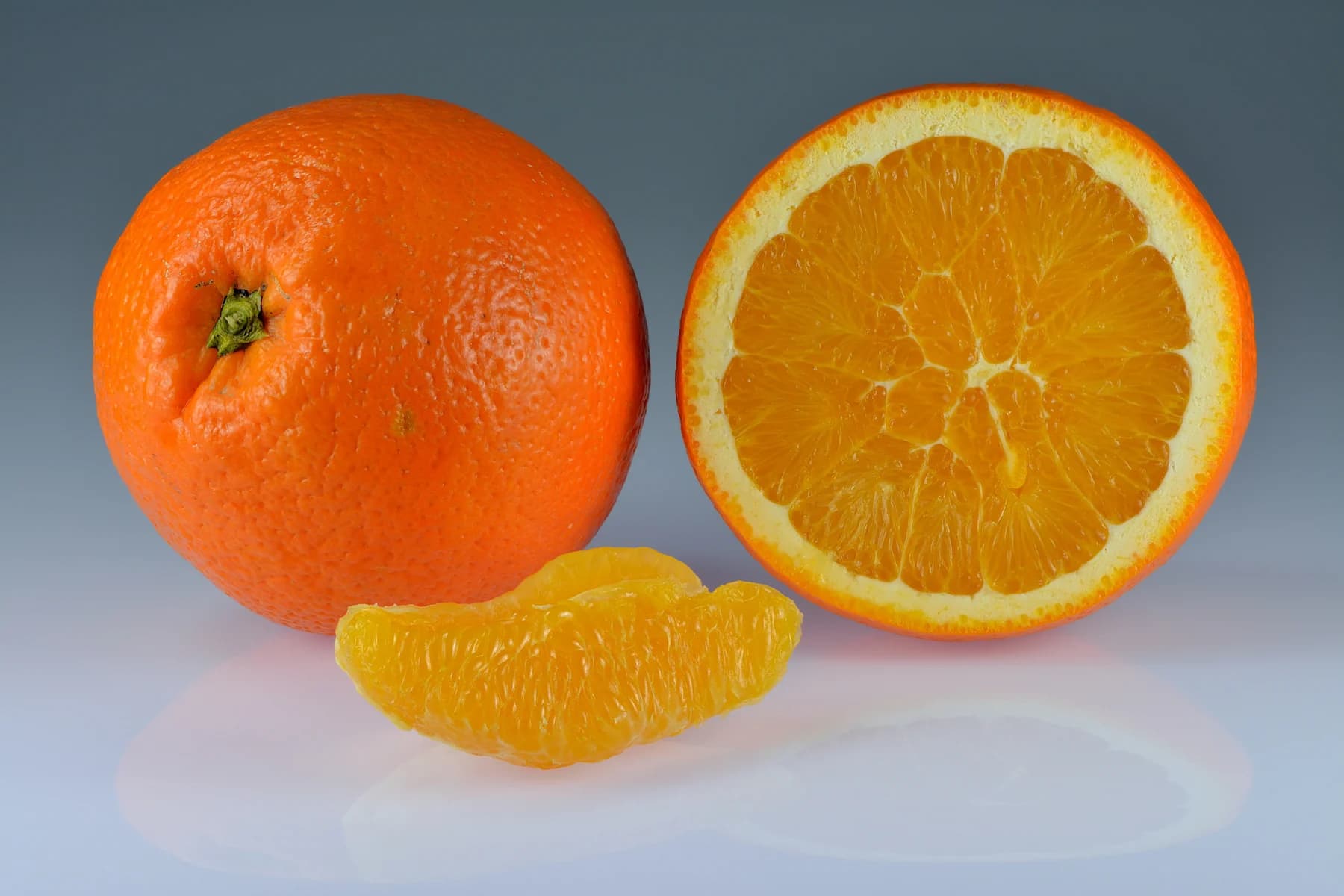
- 6. Orange fruit photograph — Ivar Leidus — January 3, 2021; CC BY-SA 4.0. Focus-stacked fruit photograph, resized. Crop identification; location and cultivar are not specified.
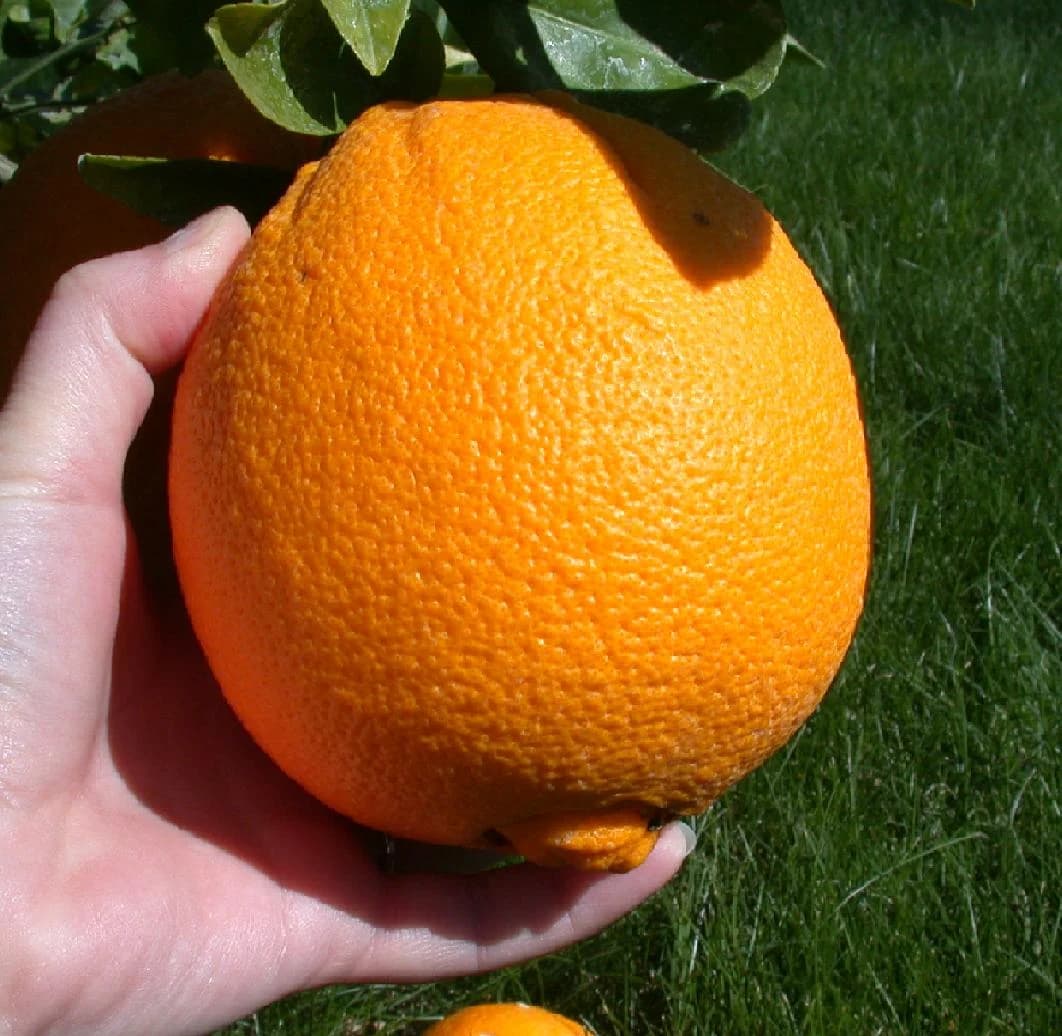
- 7. Picking an orange photograph — Dvortygirl — March 18, 2007; CC BY-SA 3.0. A hand supporting an orange on a tree. Source location and cultivar are not specified; not a demonstration of detachment, pruning-tool use or commercial harvest safety.
- 8. Orange fruit photograph license — CC BY-SA 4.0 — Creative Commons Attribution-ShareAlike 4.0. The resized fruit photograph retains its original share-alike license.
- 9. Orange picking photograph license — CC BY-SA 3.0 — Creative Commons Attribution-ShareAlike 3.0. The WebP photograph retains its original share-alike license.
Image credits
- Orange fruit and cut section. Photo: Ivar Leidus, CC BY-SA 4.0; resized under the same license.
- Picking an orange. Photo: Dvortygirl, CC BY-SA 3.0; converted to WebP.
Figures are published averages or study assumptions for the places named, not guarantees for your field. Check current local recommendations and product labels before acting.