

Growing oranges in Argentina
Argentina’s orange production is concentrated in the northeast citrus belt. The strongest local evidence here comes from Corrientes and Entre Ríos, including a recent Valencia Late fertigation trial and regional packing data. Use these as local production references, not as a single national orchard recipe.
Scope: Commercial sweet-orange production, with evidence anchored in Corrientes and Entre Ríos. The sources do not establish one current national spacing, yield or fertilizer rate. Updated 2026-10-07.
At a glance
- Entre Ríos crop mix
- In the reported citrus area, oranges were 57% and mandarins 39%2
- Recent water evidence
- Monte Caseros Valencia Late trial: low-retention sandy soils and rainfall/crop-demand mismatch1
- Layout example
- One older farm case: Valencia 7 × 3.5 m; Washington navel 6 × 7 m3
- Harvest evidence
- Corrientes citrus offer spans much of March–December; late orange supply peaks later in the year4
Perennial growth and climate in Argentina
A perennial planting remains in the field for multiple years. Establishment is a long-term investment; flowering, fruit development, harvest and plant care recur as the planting matures. Follow the named cultivar and production system.
Establish a long-lived planting1,3
Do not use a generic month to establish a long-lived orchard. Select the scion and rootstock for the local frost and water conditions, confirm drainage and irrigation supply, and obtain healthy, true-to-type nursery stock. The regional examples are not a national planting prescription.
Management: Set water and nutrition from block measurements1
An INTA Valencia Late trial in Monte Caseros found sandy soil with low water and nutrient retention; rainfall did not always match crop demand. Use soil and leaf analyses and monitor block moisture before setting fertigation or fertilizer rates.
Harvest: Corrientes citrus supply and late-orange reference4
An INTA regional report describes citrus supply from about March to December, with late varieties—mainly Valencia—concentrated around August through October or November. This is a dated Corrientes market profile, not a current calendar for every province or cultivar. Sample fruit and coordinate harvest with the buyer or packhouse.
Historical monthly climate
Reference period: 1996-01-01 to 2025-12-31. ERA5-Land monthly mean soil temperature at 0–7 cm, air temperature and frost days at the regional reference point (-34, -62). Select a month to inspect its historical conditions.
Month tiles show mean air temperature.
March historical conditions
- Mean topsoil temperature
- 22.6°C
- Mean air temperature
- 21.4°C
- Mean frost days per month
- 0.0 days
Use this monthly history to assess winter exposure, seasonal heat and water planning. It does not calculate cultivar chill hours, flowering dates, frost damage during bloom or fruit maturity. Topsoil at 0–7 cm describes shallow soil context, not the full root zone. Harvest periods follow the production evidence above.
Climate source: Open-Meteo Historical Weather APIPlan for the northeast citrus production belt
- 1
Choose the production corridor
Match the planned farm to the local citrus chain and packhouse access.
- 2
Check the field
Assess soil depth, drainage, water quality and seasonal water availability.
- 3
Select tree material
Match scion and rootstock to the site, market and plant-health requirements.
- 4
Budget the orchard
Use measured block costs and realistic packout, not a national yield promise.
- Use regional production evidence carefully
- SENASA reports 30,598 hectares of citrus in Entre Ríos, concentrated in Federación and Concordia. The 57% orange share is within that regional citrus area; it is not a national orange-area estimate.2
Use spacing examples as a starting point for design
Between rows: 6–7 m between rows · Within the row: 3.5–7 m between trees
A 2009 family-farm case reported Valencia at 7 × 3.5 m and Washington navel at 6 × 7 m. These are examples from one operation, not a current regional standard. Set final distances from rootstock, canopy, equipment and harvest system.
- Design roads and headlands with the trees
- Survey turning space for spray, mowing and harvest equipment, then calculate tree numbers from plantable block area. The INTA case shows that cultivar and orchard block affected the chosen layout.3
- Do not scale the old layout blindly
- The farm examples date from 2009. Verify current rootstock, disease, labor, machinery and market requirements before reusing those spacings in a new orchard.3
Manage water and nutrition by block
- Measure before fertigation
- The recent Monte Caseros Valencia Late demonstration adjusted nutrition using leaf and soil tests. Its reported treatment results are specific to that orchard and do not justify copying a fertilizer rate elsewhere.1
- Match irrigation to soil storage and crop demand
- The INTA trial describes sandy soils with low water retention and periods when rainfall did not coincide with citrus demand. Track rainfall and soil moisture, then schedule irrigation for the block rather than from a fixed national amount.1
- Keep the production lot traceable
- Maintain block, cultivar, input and harvest records and verify the current SENASA rules for plant-health movement and packing operations.2
Harvest to the cultivar and buyer specification
- 1
Sample fruit
Check maturity and internal quality for the intended market.
- 2
Schedule crews
Match cultivar maturity with labor and packhouse capacity.
- 3
Separate lots
Keep block and variety identity through picking and delivery.
- 4
Review the season
Compare packout, grade, water use and costs by block.
- Use months as a regional reference only
- The INTA Corrientes profile describes an extended citrus supply season, with late oranges concentrated around August–November. Variety, province, season and buyer requirements change the actual pick date.4
- Confirm plant-health and packhouse requirements
- SENASA reports inspection of citrus packing establishments in Entre Ríos. Check current export, domestic-market, traceability and phytosanitary requirements for the destination before harvest begins.2
Build a farm budget from observed results
- Do not treat a demonstration projection as a yield
- The 2025 INTA report includes a projected production figure for its demonstration orchard. It is not a measured national average or a promise for a new block; budget from local harvest and packout records.1
Frequently asked questions
- Where are oranges grown in Argentina?
- The reviewed commercial evidence centers on the northeast citrus belt, including Entre Ríos and Corrientes. SENASA reports citrus packing and production activity in Federación and Concordia; local farm conditions still need to be checked.
- When are oranges harvested in Argentina?
- A regional Corrientes profile describes citrus availability from roughly March to December, with late orange varieties concentrated around August to October or November. Treat that as a historical local reference, not a national calendar.
- How far apart should orange trees be planted in Argentina?
- An older INTA farm case used 7 × 3.5 m for Valencia and 6 × 7 m for Washington navel. These are one farm’s examples, not a current general recommendation.
- How should orange irrigation be planned?
- Measure soil moisture and rainfall, then schedule for the block. An INTA Valencia Late trial in Monte Caseros describes low-retention sandy soils and demand that did not always align with rain.
- What fertilizer rate should I use?
- The sources do not support one rate for Argentina. Use local soil and leaf analyses and current INTA advice; the Monte Caseros trial adjusted nutrition from those tests.
Regional oranges guides
Local dates, soil-temperature history and sources for specific regions:
Sources and image credits
- 1. INTA EEA Mercedes — Valencia Late fertigation demonstration, Monte Caseros — October 2025. One commercial Valencia Late orchard; soil and rainfall context, irrigation and soil/leaf-test-based nutrition. Trial outcomes are not a national yield or fertilizer prescription.
- 2. SENASA — Citrus packhouse inspections in Entre Ríos — 13 November 2024. Entre Ríos citrus area and crop mix, and inspection of packing establishments.
- 3. INTA EEA Mercedes — Good agricultural practices on a Uruguay River family citrus farm — December 2009. Historical single-farm cultivars and orange spacing examples; not a current regional standard.
- 4. INTA EEA Bella Vista — Constraints on Corrientes citrus development, Volume II — Regional report; accessed 7 October 2026. Corrientes citrus supply season, late-orange/Valencia context and regional market destinations; historical regional evidence.
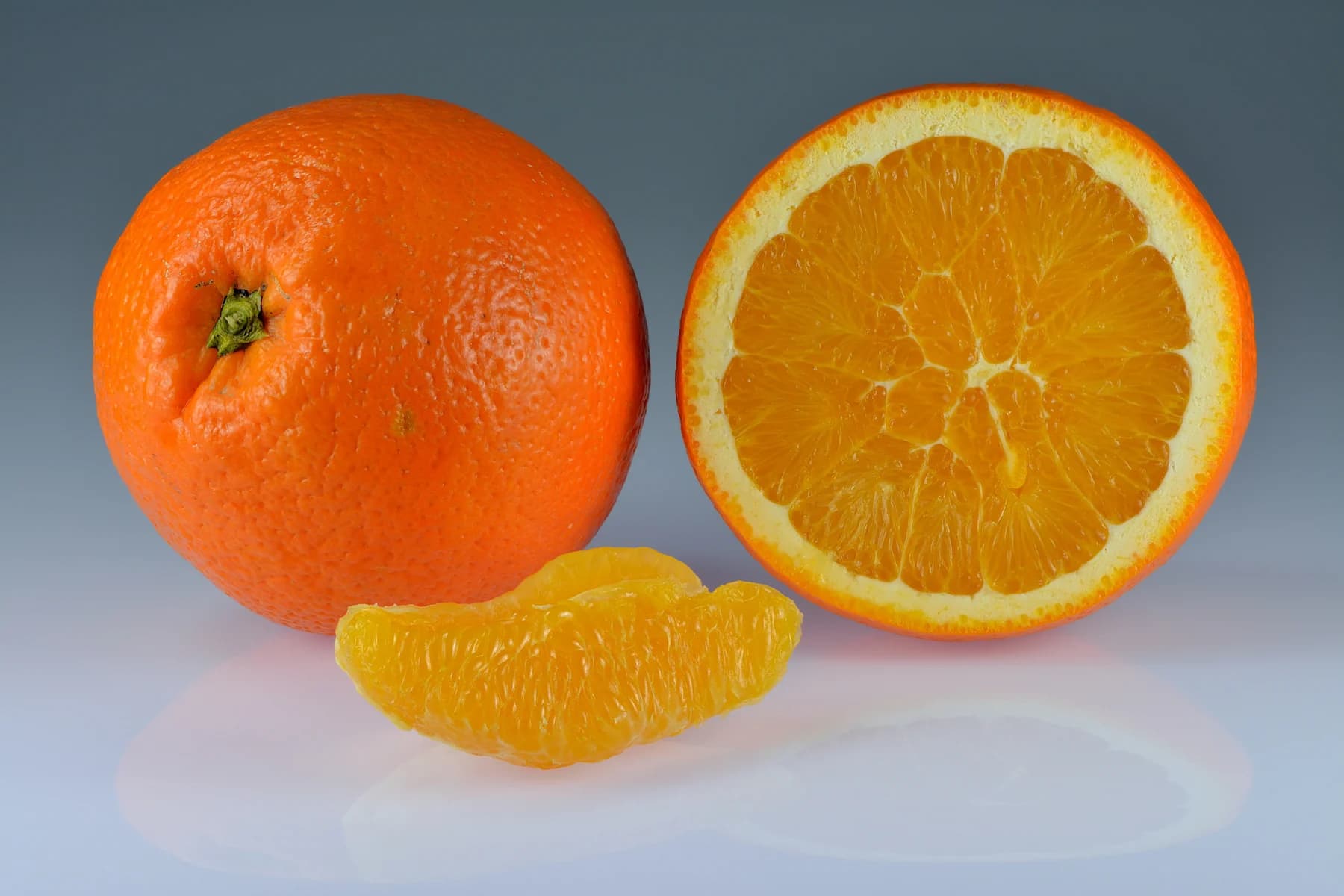
- 5. Orange fruit photograph — Ivar Leidus — January 3, 2021; CC BY-SA 4.0. Focus-stacked fruit photograph, resized. Crop identification; location and cultivar are not specified.
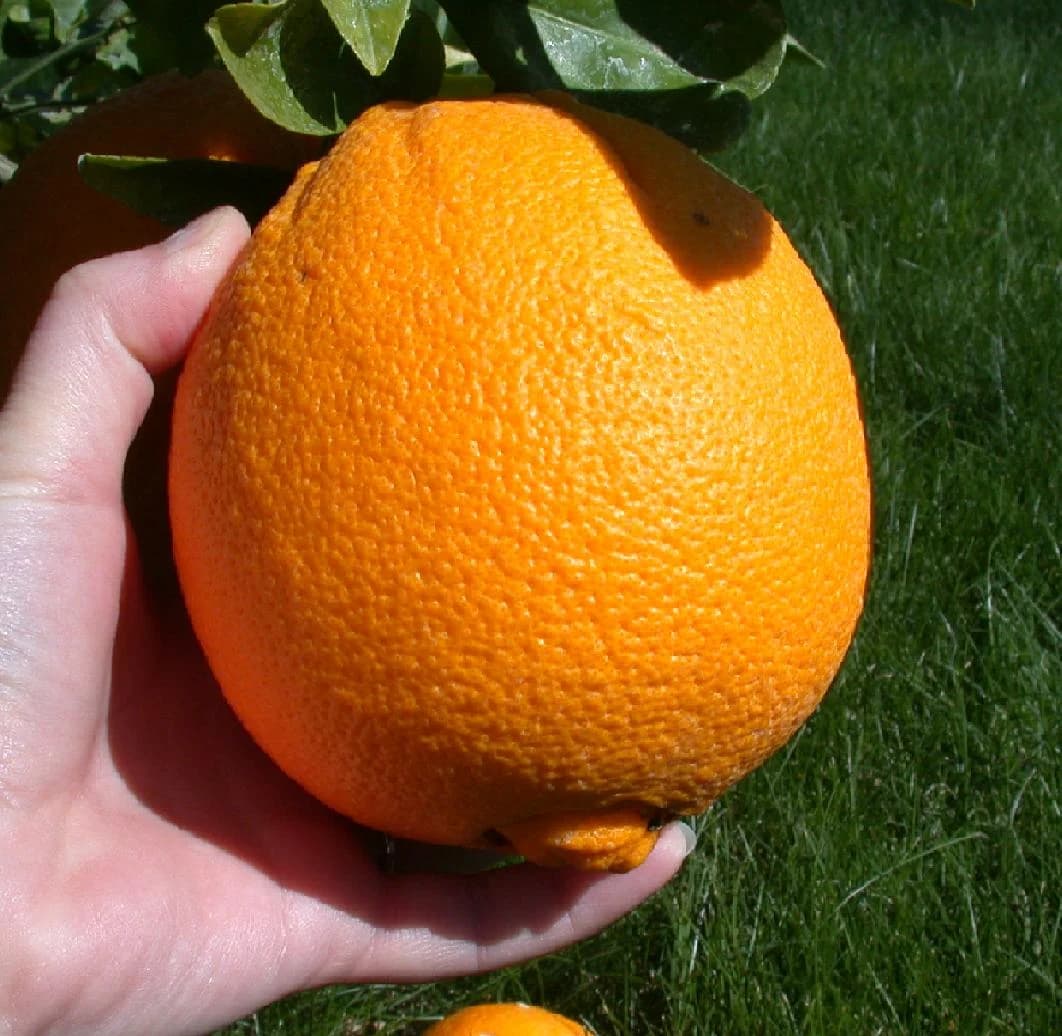
- 6. Picking an orange photograph — Dvortygirl — March 18, 2007; CC BY-SA 3.0. A hand supporting an orange on a tree. Source location and cultivar are not specified; not a demonstration of detachment, pruning-tool use or commercial harvest safety.
- 7. Orange fruit photograph license — CC BY-SA 4.0 — Creative Commons Attribution-ShareAlike 4.0. The resized fruit photograph retains its original share-alike license.
- 8. Orange picking photograph license — CC BY-SA 3.0 — Creative Commons Attribution-ShareAlike 3.0. The WebP photograph retains its original share-alike license.
Image credits
- Orange fruit and cut section. Photo: Ivar Leidus, CC BY-SA 4.0; resized under the same license.
- Picking an orange. Photo: Dvortygirl, CC BY-SA 3.0; converted to WebP.
Figures are published averages or study assumptions for the places named, not guarantees for your field. Check current local recommendations and product labels before acting.