

Growing oranges in Australia
Australian orange production is organized around cultivars and staggered maturity. NSW production sources identify the Riverina and Murray Valley among the main citrus districts; navels serve the winter season while Valencia extends supply into summer. Choose trees, layout and harvest plans for the specific district and buyer.
Scope: Commercial sweet-orange production, using NSW and southern-Australia evidence. Regional variety dates are indicative and vary with rootstock, block, season and market. Updated 2026-10-07.
At a glance
- Major NSW production areas
- Riverina and Murray Valley, with smaller districts elsewhere1
- Navel market season
- Mainly June–October in the Australian industry calendar3
- Valencia market season
- Mainly November–February; widely used for juice3
- Maturity shifts
- Riverina is generally about two weeks later than Sunraysia; variety and rootstock also matter2
- Spacing case study
- Sunraysia examples ranged from about 440 to 952 trees/ha across different systems4
Perennial growth and climate in Australia
A perennial planting remains in the field for multiple years. Establishment is a long-term investment; flowering, fruit development, harvest and plant care recur as the planting matures. Follow the named cultivar and production system.
Establish a long-lived planting1,2,5
Select scion and rootstock for local climate and market, confirm irrigation and drainage, and obtain healthy high-status propagation material from a reputable nursery. The available planting source is old and regional, so it does not support one current Australian establishment month.
Management: Schedule water and nutrition for the orchard block1,6
Water demand changes with weather, soil, tree age, crop load and irrigation system. Use a block water budget, irrigation scheduling and current regional advice; the sources do not justify a single national rate or fertilizer program.
Harvest: Southern-Australia navel and Valencia supply seasons2,3
Citrus Australia lists navels mainly from June–October and Valencia from November–February. NSW DPI maturity charts say the Riverina is generally about two weeks later than Sunraysia, with differences by variety, rootstock and season. Confirm maturity in the block and with the packer.
Historical monthly climate
Reference period: 1996-01-01 to 2025-12-31. ERA5-Land monthly mean soil temperature at 0–7 cm, air temperature and frost days at the regional reference point (-34.5, 147). Select a month to inspect its historical conditions.
Month tiles show mean air temperature.
June historical conditions
- Mean topsoil temperature
- 10.5°C
- Mean air temperature
- 9.9°C
- Mean frost days per month
- 0.7 days
Use this monthly history to assess winter exposure, seasonal heat and water planning. It does not calculate cultivar chill hours, flowering dates, frost damage during bloom or fruit maturity. Topsoil at 0–7 cm describes shallow soil context, not the full root zone. Harvest periods follow the production evidence above.
Climate source: Open-Meteo Historical Weather APIChoose a production district and assess the block
- 1
Define the market
Decide on fresh navels, juice oranges or a planned variety sequence.
- 2
Match the district
Compare local climate, frost exposure, water supply and harvest window.
- 3
Check the orchard site
Assess soil, drainage, salinity and equipment access.
- 4
Secure planting material
Confirm cultivar identity, rootstock and nursery health status.
- Plan around the main growing districts
- The NSW citrus industry hub identifies the Riverina and Murray Valley as major citrus areas, with smaller plantings in other NSW districts. Do not assume the maturity profile of one district applies across Australia.1,2
- Secure water before committing to trees
- Check allocation, quality, delivery infrastructure and drought scenarios. Citrus remains in the ground for years, so a water plan needs to account for both establishment and mature-canopy demand.1,6
- Consider frost, heat and fruit exposure
- Use local station records and block observations for frost and heat risk. Rootstock, canopy design and district influence fruit quality and maturity; obtain current advice for the proposed site.2
Select varieties to fit the supply season
| Orange group | Indicative season | Production use |
|---|---|---|
| Navel | June–October | Mainly fresh market |
| Valencia | November–February | Juice and some fresh market |
Sources3
- Match scion to local market timing
- NSW DPI lists orange maturity timing and characteristics and advises growers to match variety to local climate and market. The Primefact is from 2020; verify current commercial availability, intellectual-property terms and buyer specifications.2
- Confirm maturity for the district
- The NSW maturity charts use Sunraysia as the reference and say Riverina is generally about two weeks later. The shift varies with season, variety and rootstock, so use local maturity sampling rather than the table alone.2
Design orchard spacing around the production system
Between rows: 5.2 m between rows · Within the row: 3.2 m between trees
A 2018 NSW DPI case study reported this layout at about 600 trees/ha. The same orchard compared traditional and twin-row systems. This is a grower example, not a general recommendation; match density to rootstock, pruning, machinery, water and labor.
- Choose density with machinery and labor in mind
- The Sunmar Orchards case study compared roughly 440 trees/ha in a traditional block, about 600 trees/ha in a high-density block and a twin-row layout near 952 trees/ha. The closer systems required more intensive pruning and had different spray and irrigation needs.4
Manage water and nutrition with current block data
- Use water budgeting and scheduling
- Agriculture Victoria recommends managing citrus water from supply, orchard priorities and irrigation scheduling during shortages. Its guidance supports a decision method, not a universal application volume.6
- Use current analysis before fertilizing
- Older NSW citrus nutrition material emphasizes correctly sampled leaf analysis, but its historic rates should not be copied without current local validation. Base the program on current block tests and an adviser’s interpretation.1
- Prune and spray for the actual canopy
- High-density rows can need annual pruning and alter spray and irrigation requirements. Keep canopy access, airflow, light penetration and spray coverage in the management plan.4
Harvest at maturity and protect fruit quality
- 1
Check the block
Sample maturity by cultivar and orchard section.
- 2
Book harvest capacity
Align crews, bins, transport and packhouse slots.
- 3
Pick and handle carefully
Use trained crews and reduce fruit damage.
- 4
Segregate lots
Keep variety, block and market traceability through packing.
- Treat month ranges as market references
- Industry season summaries place navels mainly in winter and Valencia in summer, while NSW DPI charts show cultivar-level shifts between Sunraysia and Riverina. Fruit maturity and buyer specifications determine the actual harvest date.2,3
- Use safe picking and handling procedures
- The Australian fresh citrus harvest handbook covers orange picking, ladders, tools and fruit-damage reduction. Follow current workplace safety and packhouse procedures for the operation.7
Frequently asked questions
- Where are oranges grown in Australia?
- Major southern production districts include the Riverina, Murray Valley and Riverland. NSW DPI also identifies smaller citrus areas in the state; local climate and water access determine whether an orchard is suitable.
- When are Australian navel oranges harvested?
- Citrus Australia gives June to October as the main navel season. NSW maturity charts show timing varies by cultivar, rootstock, district and year.
- When are Valencia oranges harvested in Australia?
- The industry reference season is mainly November to February. Valencia is an important juice orange, and cultivar and district shift the exact maturity period.
- How far apart should orange trees be planted?
- A Sunraysia case study compared traditional, high-density and twin-row layouts from about 440 to 952 trees/ha. Choose actual spacing for rootstock, equipment, canopy management, water and labor.
- What irrigation amount do orange trees need?
- There is no one national volume. Use orchard water supply, weather, soil, tree age and crop load to plan and schedule irrigation, with local technical advice.
Regional oranges guides
Local dates, soil-temperature history and sources for specific regions:
Sources and image credits
- 1. NSW Department of Primary Industries and Regional Development — Citrus industry hub — Accessed 7 October 2026. NSW citrus districts and commercial orchard resources for planting, varieties, management, harvest and postharvest.
- 2. NSW DPI — Orange scions and varieties, Primefact 20/919 — November 2020. Orange variety choice and maturity charts for southern Australia; Riverina timing, rootstock and season caveats.
- 3. Citrus Australia — What’s in season — Industry season guide; accessed 7 October 2026. Main navel and Valencia market seasons and growing-region context; indicative industry supply timing.
- 4. NSW DPI — High-density planting and pruning: Sunmar Orchards case study — March 2018. One 100-ha commercial orchard case comparing traditional, high-density and twin-row layouts and management trade-offs.
- 5. NSW DPI — Planting citrus trees — November 2004. Older commercial establishment notes; used only for basic stock-handling and planting-condition considerations.
- 6. Agriculture Victoria — Managing citrus orchards with less water — Updated 6 September 2026. Water-budgeting and irrigation-scheduling decisions for citrus during water shortages; no universal irrigation volume.
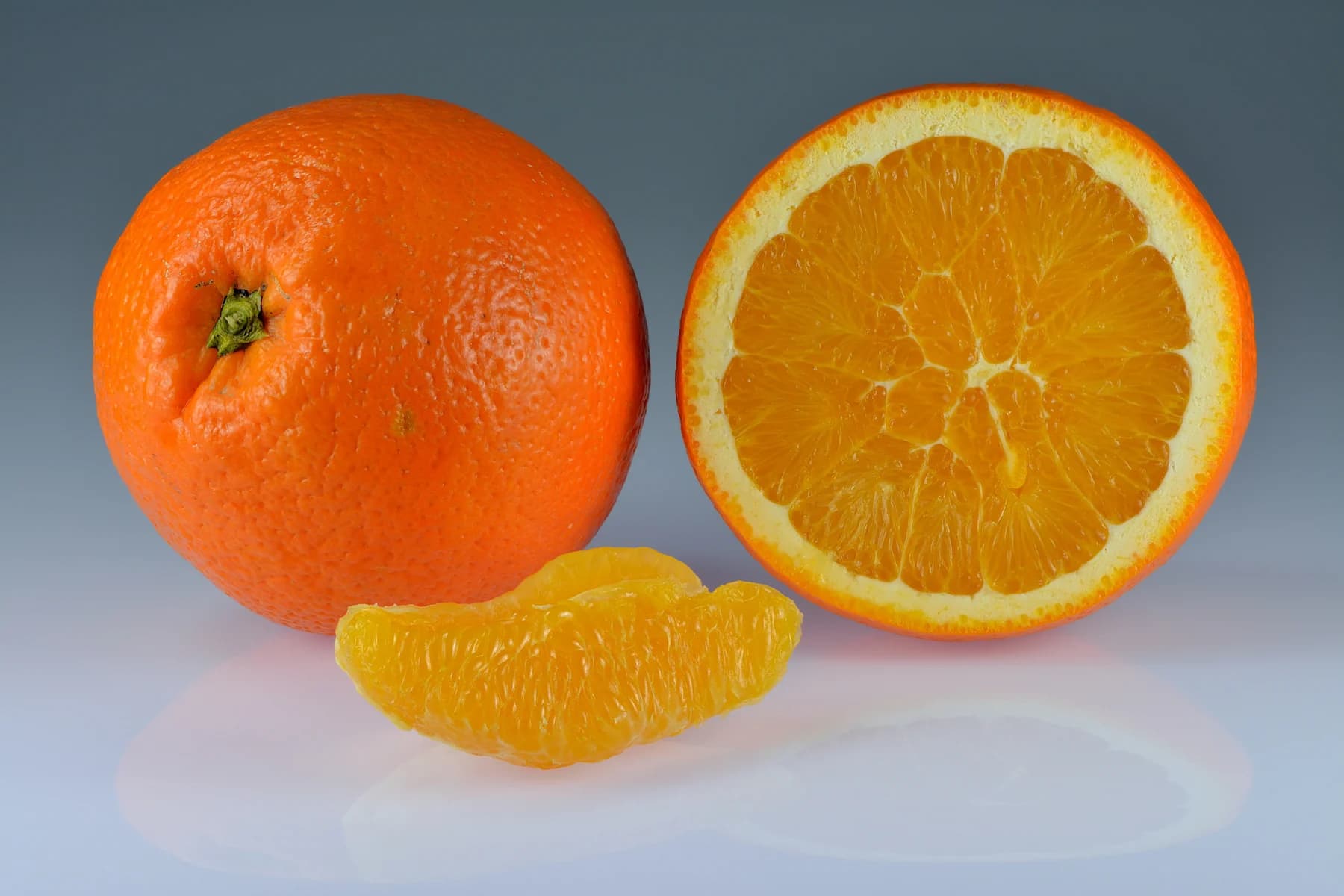
- 7. Orange fruit photograph — Ivar Leidus — January 3, 2021; CC BY-SA 4.0. Focus-stacked fruit photograph, resized. Crop identification; location and cultivar are not specified.
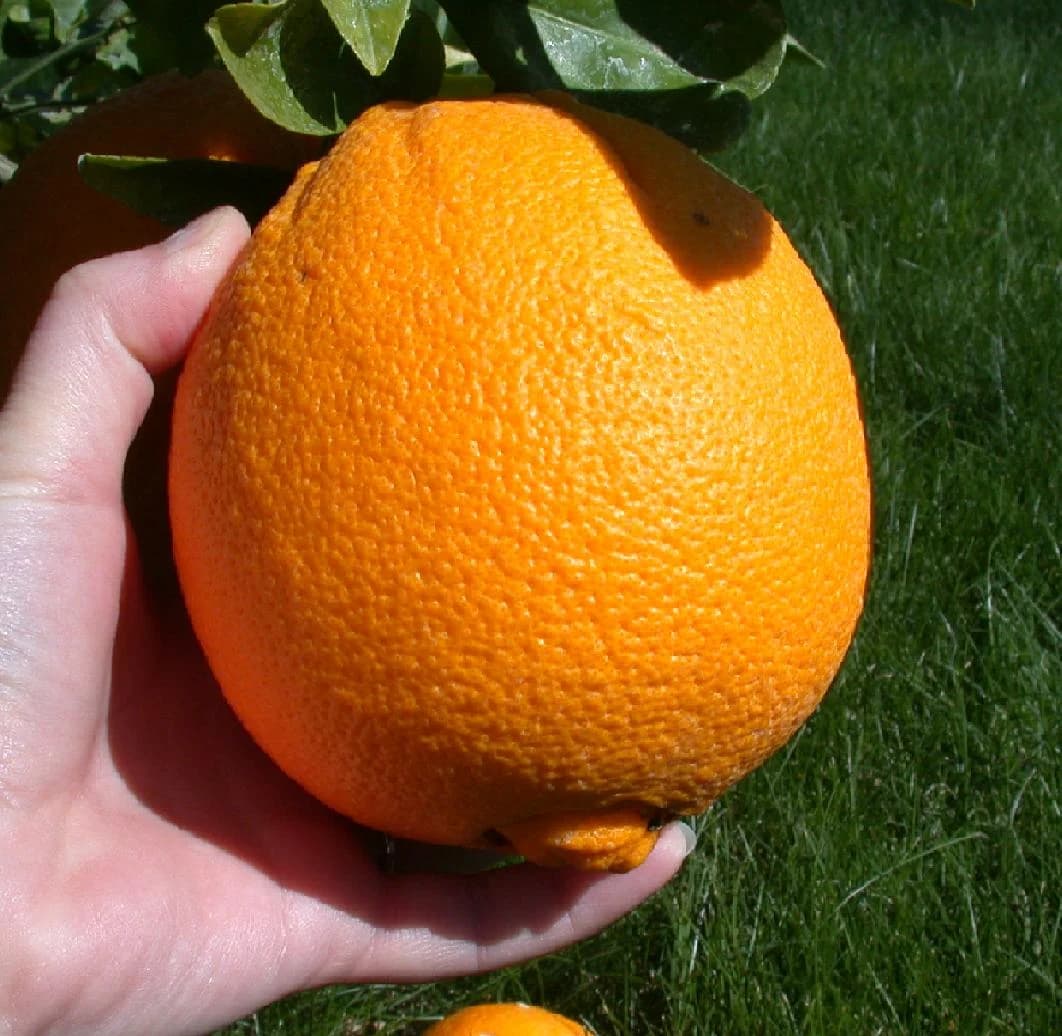
- 8. Picking an orange photograph — Dvortygirl — March 18, 2007; CC BY-SA 3.0. A hand supporting an orange on a tree. Source location and cultivar are not specified; not a demonstration of detachment, pruning-tool use or commercial harvest safety.
- 9. Orange fruit photograph license — CC BY-SA 4.0 — Creative Commons Attribution-ShareAlike 4.0. The resized fruit photograph retains its original share-alike license.
- 10. Orange picking photograph license — CC BY-SA 3.0 — Creative Commons Attribution-ShareAlike 3.0. The WebP photograph retains its original share-alike license.
Image credits
- Orange fruit and cut section. Photo: Ivar Leidus, CC BY-SA 4.0; resized under the same license.
- Picking an orange. Photo: Dvortygirl, CC BY-SA 3.0; converted to WebP.
Figures are published averages or study assumptions for the places named, not guarantees for your field. Check current local recommendations and product labels before acting.