

Growing olives in Texas
Olives can crop in parts of Texas, but the state is a high-risk production environment. Winter freezes can kill trees, while the warm Lower Rio Grande Valley may not provide enough winter chill for consistent bloom. The first farm decision is whether a site balances flowering, freeze survival, drainage and access to an olive mill.
Scope: Texas commercial and small-farm olive production. The regional source describes state trials and grower experience; it does not establish a dependable statewide yield or profit forecast. Updated 2026-10-07.
At a glance
- Main production constraint
- Freeze survival and enough winter chill for flowering1
- More favourable zones
- Winter Garden north of Laredo and southwest of San Antonio; western Hill Country, especially Val Verde County1
- Traditional hand-harvest layout
- 9.1 × 9.1 m (30 × 30 ft), about 119 trees/ha (48/acre)1
- Growing-season irrigation reference
- About 25 mm (1 acre-inch) per week for mature orchards; adjust to weekly ET and soil1
- Bearing and yield limits
- First harvestable crop in 3–5 years under proper conditions; high-density orchards have reached about 2 t/acre, often less1
Perennial growth and climate in Texas
A perennial planting remains in the field for multiple years. Establishment is a long-term investment; flowering, fruit development, harvest and plant care recur as the planting matures. Follow the named cultivar and production system.
Establish a long-lived planting1
Texas A&M recommends establishing trees in early spring after freeze danger has passed. Treat that as an establishment condition, not an annual planting calendar: compare winter freeze exposure and cultivar-specific winter chilling at the actual site first.
Management: Protect flowering and early fruit set1
Maintain adequate soil moisture from at least six weeks before the local bloom through early fruit development. AgriLife places this lead-in around mid-March in southern, early April in central and mid-April in northern olive-growing areas; maintain moisture until late June.
Management: Prepare trees for winter1
Avoid nitrogen after September and begin reducing irrigation in October to slow growth and support cold acclimation. Freeze tolerance changes with cultivar, tree condition and the weather before the freeze.
Harvest: Harvest usually begins in September1
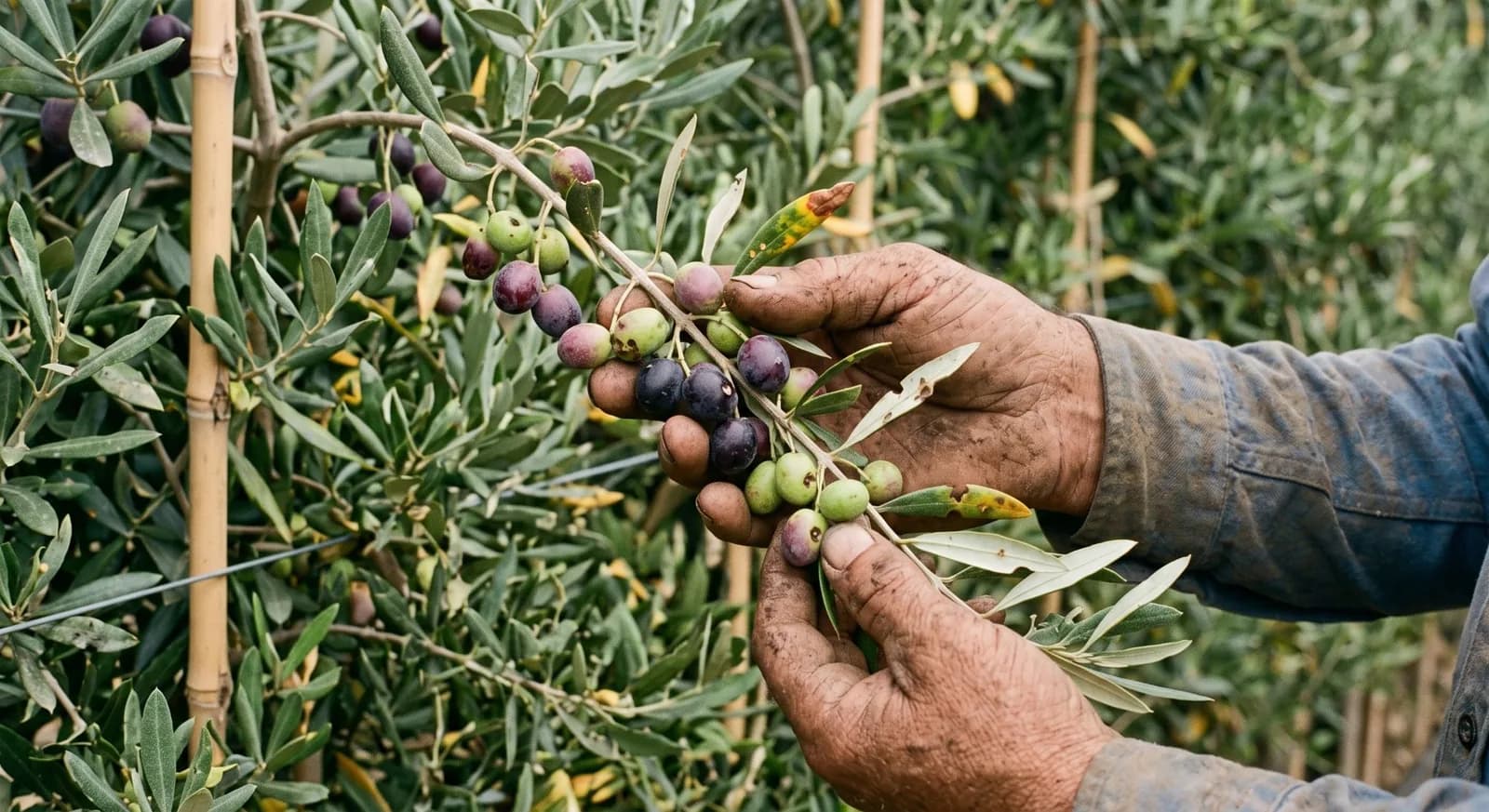
Texas harvest typically begins in early September. Many orchards pick as the fruit changes from green to purple to balance oil quantity and flavour; arrange prompt milling before harvest.
Historical monthly climate
Reference period: 1996-01-01 to 2025-12-31. ERA5-Land monthly mean soil temperature at 0–7 cm, air temperature and frost days at the regional reference point (31.5, -99). Select a month to inspect its historical conditions.
Month tiles show mean air temperature.
March historical conditions
- Mean topsoil temperature
- 16.7°C
- Mean air temperature
- 16.6°C
- Mean frost days per month
- 1.2 days
Use this monthly history to assess winter exposure, seasonal heat and water planning. It does not calculate cultivar chill hours, flowering dates, frost damage during bloom or fruit maturity. Topsoil at 0–7 cm describes shallow soil context, not the full root zone. Harvest periods follow the production evidence above.
Climate source: Open-Meteo Historical Weather APIScreen climate and drainage before buying trees
- 1
Winter chill
Cool nights and mildly warm days are needed to induce flower buds; needs vary by variety.
- 2
Freeze exposure
Warm spells can remove cold hardiness before a severe freeze.
- 3
Flower and set
Rain, very high humidity, near-freezing weather and hot dry winds can reduce flowering or fruit set.
- 4
Choose the site
Balance reliable winter chill with freeze risk, drainage and irrigation access.
- Do not equate tree survival with a crop
- The Lower Rio Grande Valley has little freeze risk but olives often flower inconsistently there because winter chill is insufficient. Farther north, chill is more available but damaging freezes are more likely. Texas A&M identifies the Winter Garden and western Hill Country as the more favourable areas to attempt fruit production.1
- Drainage is essential
- Olives tolerate a range of soil textures and pH, but waterlogged roots are vulnerable to Phytophthora. Use raised berms unless both surface and internal drainage are excellent; avoid sites with a history of cotton root rot.1
- Plan for pollination
- Bloom and fruit set are variable in Texas. AgriLife recommends mixing compatible varieties; pollenizer trees should be placed about every 30 m (100 ft) or closer, while confirming that their bloom overlaps under local chill conditions.1
Choose orchard spacing around the harvest system
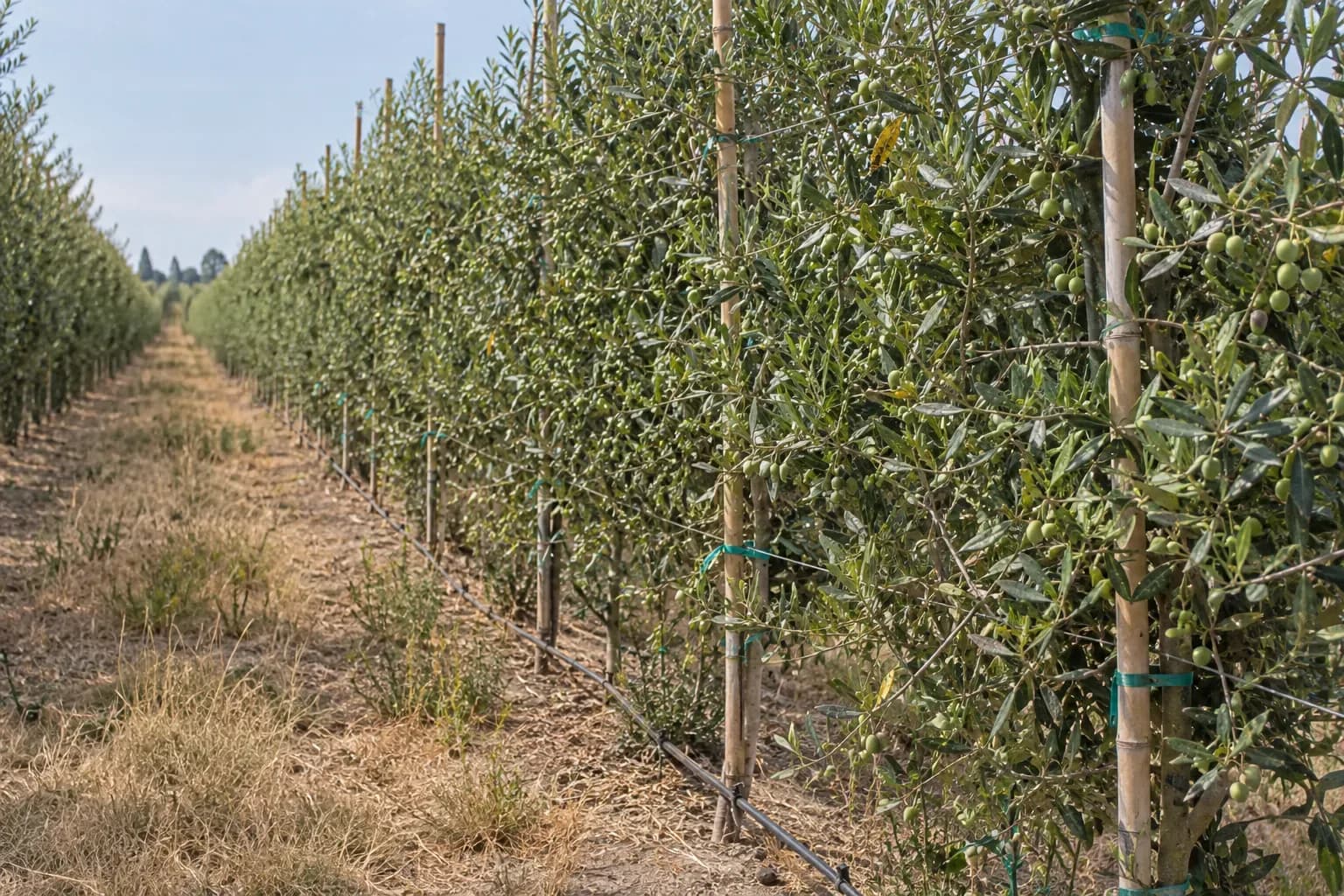
Between rows: 4.6 m (15 ft) · Within the row: 2.1 m (7 ft)
One Texas A&M medium-density example; other systems range from 9.1 × 9.1 m traditional spacing to closer hedgerows. Match variety, canopy, machine access and costs. Schematic, not to scale.
- Traditional and compact trees
- For most varieties harvested by hand, the Texas guide gives 9.1 × 9.1 m (30 × 30 ft), about 119 trees/ha (48/acre). Compact Arbequina and Arbosana may use 6.1 × 6.1 m (20 × 20 ft), about 267 trees/ha (108/acre).1
- Hedgerows need a business case
- Medium-density examples are 2.1 × 4.6 m (7 × 15 ft; 415 trees/acre) and 3.0 × 4.9 m (10 × 16 ft; 290/acre). Over-the-row systems use closer rows and require expensive equipment, fruit volume and an available contractor or mill.1
- Allow light into fruiting wood
- Olives crop on the previous season’s sun-exposed growth. Avoid crowding that shades the canopy; decide whether the orchard will be hand-picked, trunk-shaken or grown as a hedgerow before fixing the layout.1
Manage water, nutrition and winter injury
- Irrigate to crop stage and soil
- Newly planted trees need frequent establishment water. The Texas reference for mature orchards is about 25 mm (1 acre-inch) per week during the growing season, adjusted using weekly evapotranspiration and soil drying. Keep moisture available before bloom, through fruit set and early fruit growth.1
- Reduce water stress without stopping irrigation
- After pit hardening, AgriLife allows a gradual reduction to 65–75% of normal irrigation during fruit growth. Do not stop completely: the tree still needs water for fruit development and energy reserves for the next crop.1
- Use tests to guide fertilizer
- Soil tests help with site preparation; mid-July to mid-August is the recommended leaf-sampling period. Excess nitrogen drives late growth that is more vulnerable to freeze injury and can reduce fruiting.1
- Scout for Texas-specific risks
- Prioritize freeze injury, Phytophthora root rot in wet soils, cotton root rot in susceptible sites and four-spotted palpita moth. Inspect planting stock and coordinate pest decisions with the local AgriLife office.1
Harvest by fruit maturity and secure milling first
- 1
Winter
Observe chill accumulation and freeze injury; bloom can be absent after insufficient chilling.
- 2
Spring
Track bloom, cross-pollination and fruit set; protect moisture before and after bloom.
- 3
Early September onward
Harvest commonly begins as fruit moves from green toward purple.
- 4
Promptly after picking
Move fruit to an available mill; olives deteriorate quickly after harvest.
- Be realistic about bearing and yield
- Under suitable conditions, a harvestable crop may begin 3–5 years after planting. Texas high-density orchards have produced a maximum near 2 tons/acre, with many lower crops; freeze injury and inconsistent yields make profitability uncertain.1
- Confirm the processing outlet
- Most Texas olive fruit is pressed for oil. Contact a mill before planting and confirm its service area, minimum lot and harvest appointment; a good-looking crop without a processing route is not a market plan.1
- Harvest at the intended oil style
- Greener olives can produce a brighter, more pungent oil with lower extraction; riper fruit can be smoother. The regional source describes picking near the green-to-purple transition to balance quality and quantity.1
Treat Texas olives as a high-risk orchard investment
- Budget for variable crops
- Texas A&M reports limited commercial success despite high-quality oil from some orchards. Freeze damage, inconsistent flowering and low fruit yields prevent a reliable statewide profitability benchmark.1
- Price processing, labor and protection
- Before establishing acreage, price compatible pollenizers, freeze response, fencing, irrigation, harvest labour, transport and milling. Use conservative multi-year yield scenarios rather than the high-density maximum.1
Frequently asked questions
- Can you grow olives commercially in Texas?
- Fruit production is possible in selected parts of Texas, but it remains high-risk. Texas A&M points to the Winter Garden and western Hill Country as more favourable areas and warns that freeze injury and inconsistent yields limit profitability.
- Where do olives grow best in Texas?
- The southwest region north of Laredo and southwest of San Antonio, plus parts of the western Hill Country, are the stronger areas to evaluate. The Lower Rio Grande Valley has less freeze risk but often lacks enough winter chill for reliable flowering.
- How far apart should olive trees be planted in Texas?
- For a traditional hand-harvest orchard, Texas A&M gives 9.1 × 9.1 m (30 × 30 ft), about 119 trees/ha (48/acre). A medium-density hedgerow reference is 2.1 × 4.6 m (7 × 15 ft); select spacing for the variety and harvest system.
- When are Texas olives harvested?
- Harvest typically begins in early September. Many Texas orchards pick around the green-to-purple colour transition and move fruit promptly to a mill.
- How long until an olive tree produces in Texas?
- A harvestable crop may begin 3–5 years after planting when conditions are suitable. Freeze damage can delay production and reduce consistency.
Regional olive guides
Local dates, soil-temperature history and sources for specific regions:
Sources and image credits
- 1. Texas A&M AgriLife Extension — Olives: Texas Fruit and Nut Production (HORT-PU-027) — Published August 2024. Texas climate and vernalization, soil and drainage, cultivar and pollenizer choices, spacing, irrigation, fertility, freeze response, pest management, harvest and limits on profitability.
Image credits
- Olive orchard layout. Illustration; not a region-specific farm.
- Olive fruit changing colour as it matures. Illustration.
Figures are published averages or study assumptions for the places named, not guarantees for your field. Check current local recommendations and product labels before acting.
Some visuals in this guide are illustrations rather than photographs of a specific farm. See image credits.