

Growing olives in California
California olives are grown in the Central Valley for oil and for canning. The oil model that spreads fastest is super-high-density hedgerow planting with drip irrigation and over-the-row harvesting. The decisions that matter are spacing, a deficit-irrigation plan, copper sprays for olive knot and alternate-bearing yields.
Scope: Super-high-density olive oil in the Sacramento Valley and Manzanillo table olives, based on UC cost studies (2016) and USDA NASS statewide figures. Metric first, with the original US units in brackets. Updated 2026-10-03.
At a glance
- Bearing area, 2025
- 17,800 ha (44,000 acres)3
- Super-high-density spacing
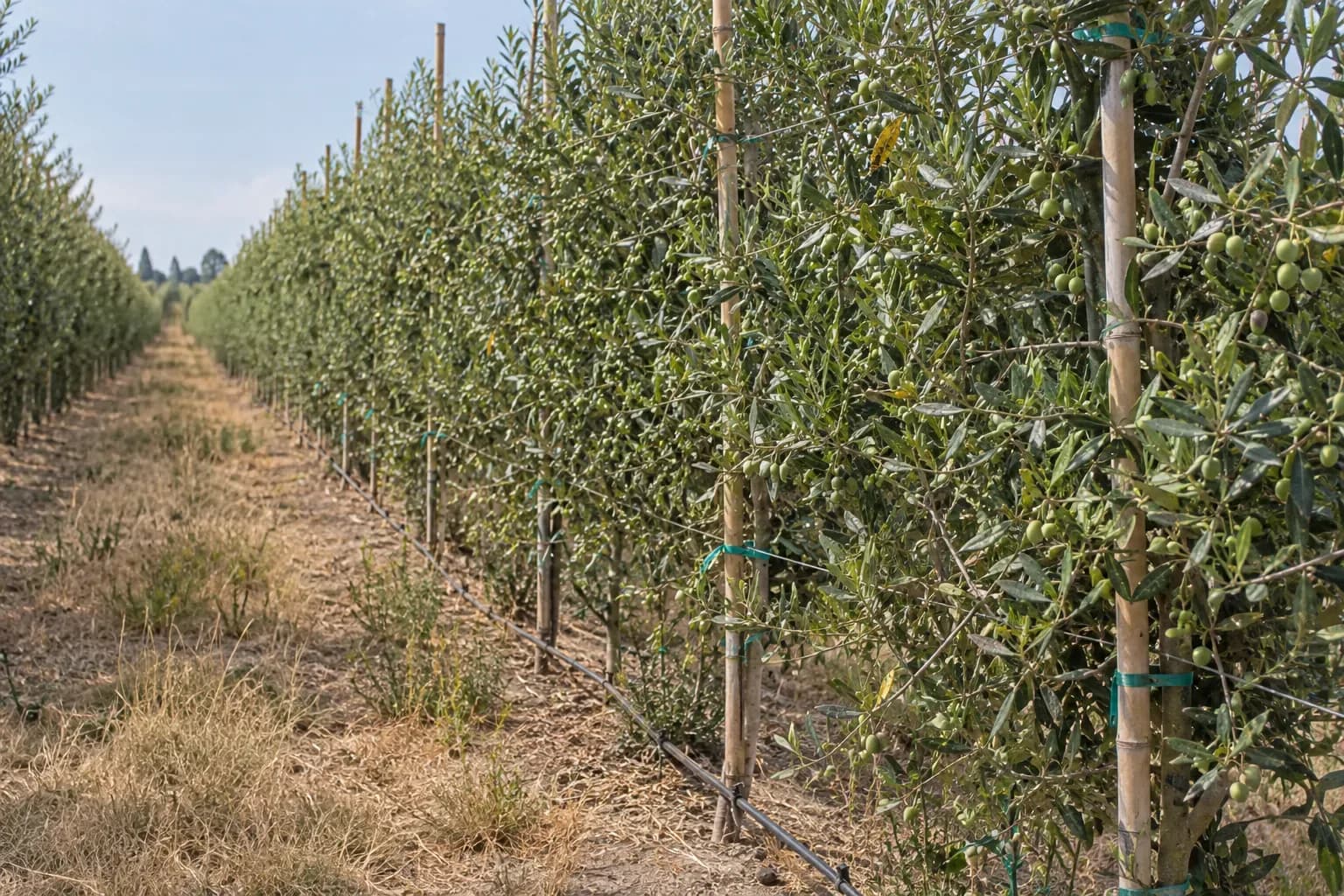
- 1.5 × 3.7 m (5 × 12 ft), about 1,790 trees/ha (726 per acre)1
- First crop
- Economic crop in year 3, full yield in year 51
- Water
- 457 mm (18 acre-inches) a year under controlled deficit irrigation1
- Nitrogen
- 45 kg N/ha (40 lb/acre) a year from year 31
- Mature yield
- 11.2 t/ha (5 tons/acre) of fruit, 1,780–1,960 L oil/ha (190–210 gal/acre)1
- Main disease
- Olive knot (copper after harvest and in March); Verticillium wilt kills trees1
- California yield, 2025
- 7.3 t/ha fruit (3.27 tons/acre) at $1,012/t ($918/ton)3
Perennial growth and climate in California
A perennial planting remains in the field for multiple years. Establishment is a long-term investment; flowering, fruit development, harvest and plant care recur as the planting matures. Follow the named cultivar and production system.
Establish a long-lived planting1,2
Choose an oil or table market and an orchard system before establishing trees. The Sacramento Valley Arbequina oil study reaches economic bearing in year three and maximum study yield in year five.
Management: Nutrient and irrigation review: oil study1
The oil study splits establishment nutrition across March–July; mature nutrition depends on tissue analysis. Review irrigation and crop demand, and manage canopy from orchard age and actual growth.
Harvest: Arbequina oil system: Sacramento Valley1
The oil study harvests mechanically in October–November at color change and sends fruit promptly for processing. This period applies to the oil system; the reviewed table-olive source does not support a general table-olive month band.
Historical monthly climate
Reference period: 1996-01-01 to 2025-12-31. ERA5-Land monthly mean soil temperature at 0–7 cm, air temperature and frost days at the regional reference point (37, -120). Select a month to inspect its historical conditions.
Month tiles show mean air temperature.
March historical conditions
- Mean topsoil temperature
- 13.4°C
- Mean air temperature
- 13.4°C
- Mean frost days per month
- 0.1 days
Use this monthly history to assess winter exposure, seasonal heat and water planning. It does not calculate cultivar chill hours, flowering dates, frost damage during bloom or fruit maturity. Topsoil at 0–7 cm describes shallow soil context, not the full root zone. Harvest periods follow the production evidence above.
Climate source: Open-Meteo Historical Weather APIPlant a hedgerow on a trellis
Between rows: 3.7 m (12 ft) · Within the row: 1.5 m (5 ft)
About 1,790 trees/ha (726 per acre) in north-south rows on a trellis with bamboo stakes. Super-high-density spacing in the study ranges from 0.9 m within the row to 4.3 m between rows. Schematic, not to scale.
- Site and varieties
- The study plants Arbequina on drip irrigation with trees at $2.15 each. Oil cultivars give about 30 to 50 gallons of oil per US ton (about 125–210 L per tonne of fruit); Arbequina gives 40 to 45.1
- Avoid Verticillium
- Verticillium wilt kills olive trees. Do not plant on ground with a Verticillium history or recently farmed to cotton or other Verticillium hosts.1
- Pruning
- All pruning is mechanical from year 3: skirting, hedging and topping each year, with trees topped at 2.4–2.7 m (8–9 ft) in summer to hold a height of about 3–3.7 m (10–12 ft) for the harvester.1
Water, nitrogen and disease
- Year 1203 mm
- Year 2406 mm
- Years 3+457 mm
- Controlled deficit irrigation
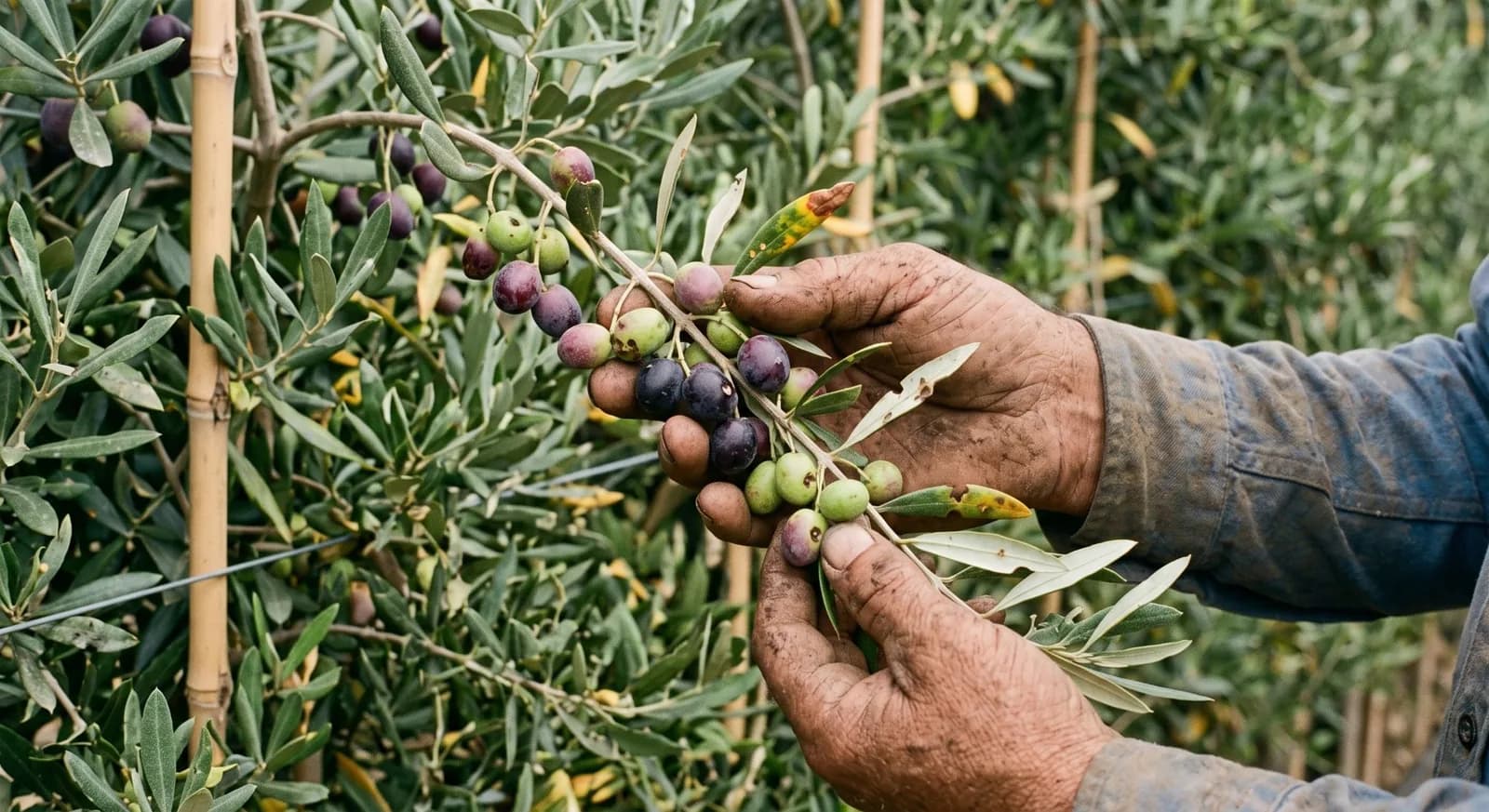
- Drip irrigation applies 203 mm (8 acre-inches) in year 1, 406 mm in year 2 and 457 mm (18 acre-inches, 1.5 acre-feet) from year 3. Groundwater pumping was costed at $90 per acre-foot. Controlled deficit irrigation and picking when the fruit begins to colour can raise oil content.1
- Nitrogen
- Young trees get 17 kg N/ha (15 lb/acre) a year through the drip line in years 1 and 2; from year 3 the study applies 45 kg N/ha (40 lb/acre) a year as UAN-32.1
- Olive knot and fruit fly
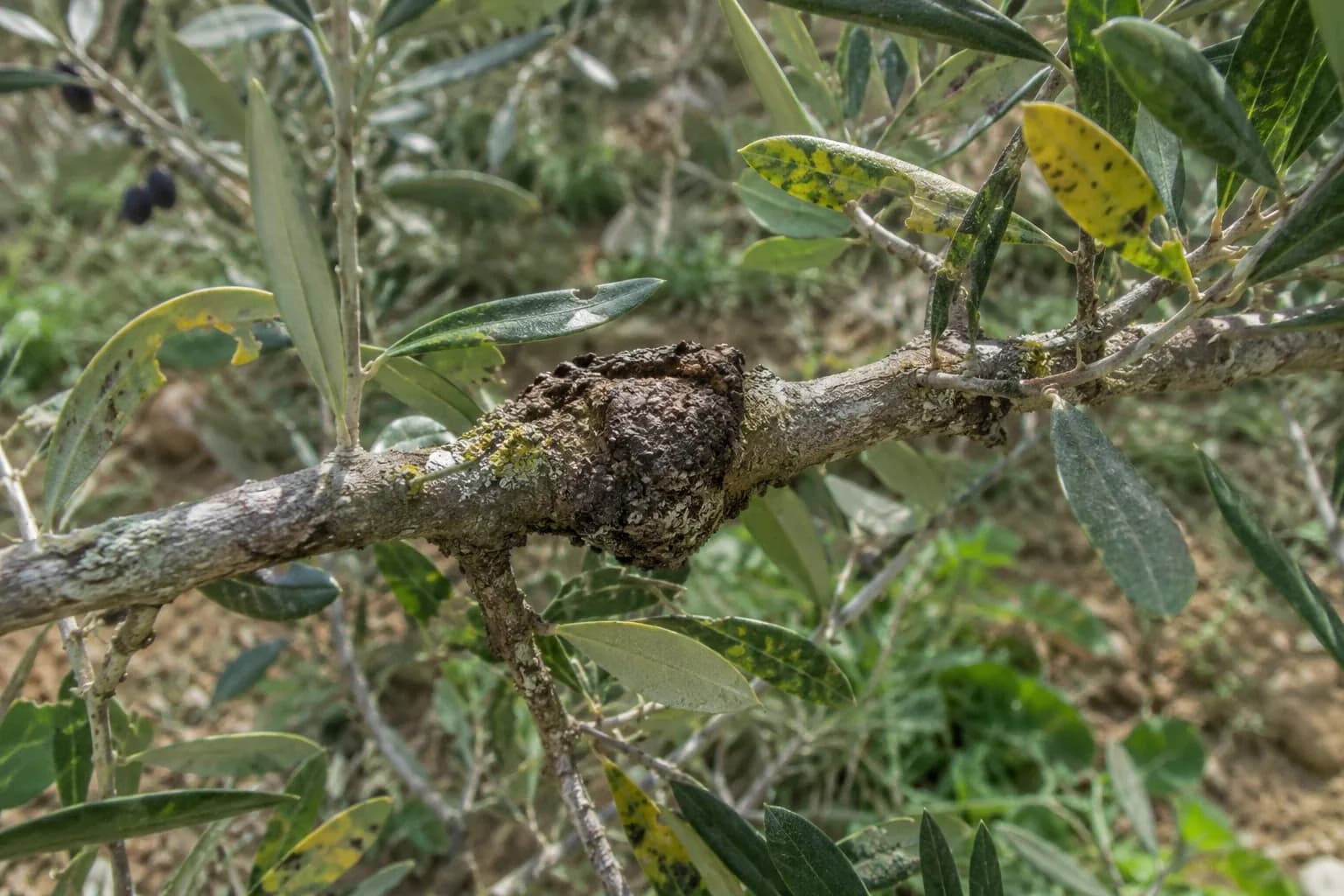
- Two copper sprays control olive knot, the major disease: just after harvest and in March before bloom. Monitor for olive fruit fly once pit hardening begins; the study does not spray for it.1
Harvest and yield by age
- Year 36.1 t/ha
- Year 49 t/ha
- Year 5+11.2 t/ha
- Mechanical harvest
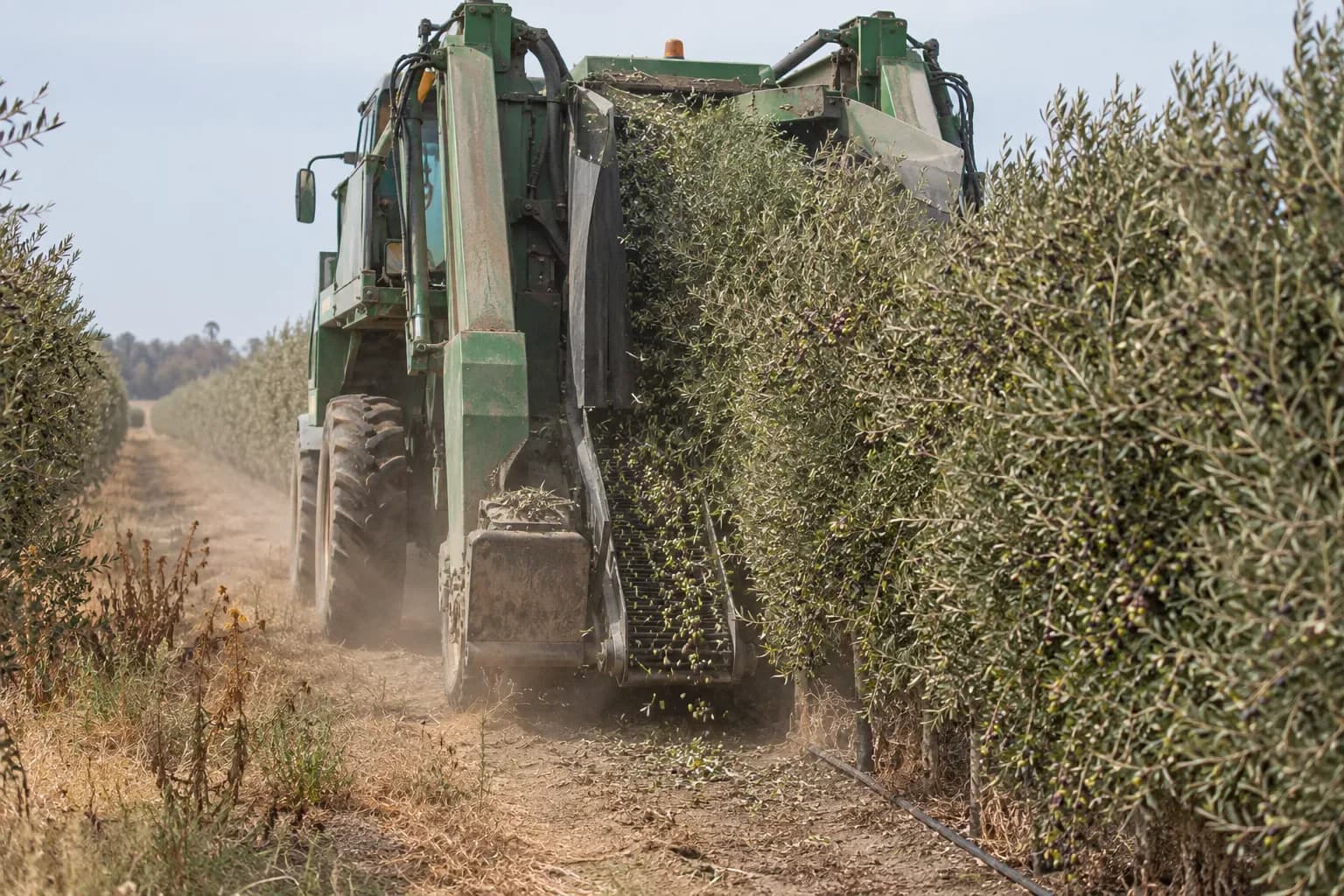
- A contractor uses an over-the-row harvester to shake fruit into field bins, charged at $350 per acre ($865 per hectare). Olives go straight from the field to processing.1
- Oil yield
- Fruit yield of 2.7, 4.0 and 5.0 tons/acre (6.1, 9.0 and 11.2 t/ha) in years 3, 4 and 5 gives about 1,010–1,110, 1,500–1,650 and 1,780–1,960 L of oil per hectare (108–119, 160–176 and 190–210 gal/acre).1
- Table olives
- Manzanillo table olives are hand-picked by a contractor at $500 per ton ($551 per tonne). Olives are alternate-bearing: a well-managed orchard can average 6 tons/acre (13.4 t/ha), others 3 (6.7 t/ha), and the study assumes 5 (11.2 t/ha).2
Costs and returns
- 20236.8 t/ha
- 20248.5 t/ha
- 20257.3 t/ha
- Establishment
- Establishing the super-high-density orchard cost $4,403 per acre ($10,880 per hectare) through year 3 in the study, on top of land value.1
- Oil economics
- At $16 per gallon ($4.23 per litre) and 210 gal/acre, total cost at maturity was $1,946 per acre ($4,810 per hectare), about $9 per gallon ($2.38 per litre), and net return above total cost was $1,414 per acre ($3,490 per hectare). The study ranged 147–273 gal/acre and $13–19 per gallon.1
- State figures
- California utilised about 130,000 t (143,000 tons) of olives in 2025, all for processing, worth $131 million at $1,012 per tonne ($918 per ton). Yields swung from 6.8 to 8.5 to 7.3 t/ha over 2023–2025.3
Frequently asked questions
- How many olive trees per acre in California?
- Super-high-density oil orchards use about 726 trees per acre (about 1,790 per hectare) at 5 × 12 ft in the UC cost study.
- How long until olive trees produce in California?
- Super-high-density olives begin bearing an economic crop in the third year and reach maximum yield in the fifth.
- How much water do olives need in California?
- About 457 mm (18 acre-inches) a year from year 3 under controlled deficit drip irrigation in the UC study.
- What is the average olive yield in California?
- USDA recorded 3.27 tons per acre (about 7.3 t/ha) in 2025, from 44,000 bearing acres.
- What disease kills olive trees in California?
- Verticillium wilt; avoid fields with a Verticillium history or recently planted to cotton. Olive knot is the major disease, controlled with two copper sprays.
- How much oil does a ton of olives give?
- Oil cultivars give 30 to 50 gallons per ton; Arbequina about 40 to 45, so about 190–210 gal/acre at 5 tons per acre.
Regional olive guides
Local dates, soil-temperature history and sources for specific regions:
Sources and image credits
- 1. UC Cooperative Extension and UC Davis — Sample Costs for Olive Oil, Sacramento Valley, 2016 (super-high-density, Arbequina) — 2016. Spacing, water, nitrogen, disease management, harvest, yields by age, costs and returns.
- 2. UC Cooperative Extension and UC Davis — Sample Costs to Produce Table Olives, Manzanillo Variety, Sacramento Valley, 2016 — 2016. Hand-harvest cost, alternate bearing and assumed table-olive yield and price.
- 3. USDA NASS — Noncitrus Fruits and Nuts 2025 Summary — Published May 2026. US and state bearing acreage, yield, production, price and value for avocados, almonds, olives and other fruit and nut crops, 2023–2025.
Image credits
- Super-high-density olives are grown as a continuous hedge on a trellis with drip irrigation.
- Olive knot appears as rough galls on branches and is controlled with copper sprays after harvest and before bloom.
- An over-the-row harvester straddles the hedge and shakes fruit onto a conveyor.
- Olives ripen from green to purple to black; picking when fruit begins to colour can raise oil content.
Figures are published averages or study assumptions for the places named, not guarantees for your field. Check current local recommendations and product labels before acting.
Some visuals in this guide are illustrations rather than photographs of a specific farm. See image credits.