

How to grow olives commercially
Olives are perennial orchard trees. A successful planting starts with a site and cultivar that can flower and set fruit, then a market, orchard layout and harvest system that fit the farm. Spain, California and Texas use different climates and production systems, so their dates, spacing and input figures are regional examples rather than one universal olive program.
Scope: Commercial orchard planning synthesized from existing regional guides for California, Texas, Spain, Italy and Malaysia. Production figures and practices remain tied to the named source region; no global yield, spacing or planting calendar is implied. Updated 2026-10-16.
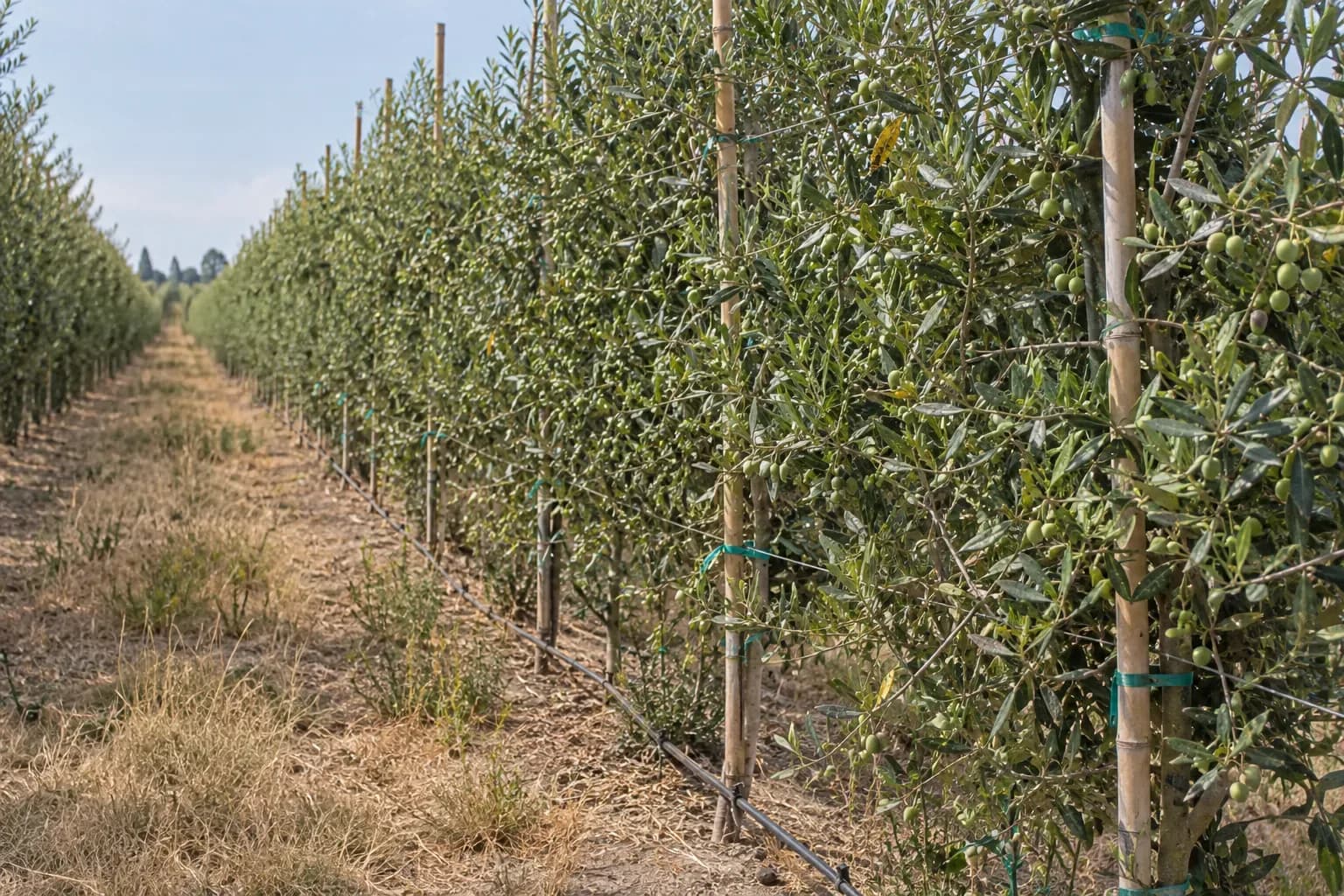
At a glance
- Crop life cycle
- Perennial orchard; plan establishment, canopy development and bearing over multiple years1,5
- First field decision
- Choose oil, table olives or a dual-purpose market before selecting cultivars and harvest equipment5,7,10
- Traditional layout example
- Spanish sources report many traditional groves at about 7–8 m spacing; this is not a universal prescription1,2
- Hedgerow layout example
- A Sacramento Valley study uses 1.5 × 3.7 m (5 × 12 ft) for super-high-density Arbequina olives6
Perennial olive growth calendar
A perennial planting remains in the field for multiple years. Establishment is a long-term investment; flowering, fruit development, harvest and plant care recur as the planting matures. Follow the named cultivar and production system.
Establish a long-lived planting1,5,7
Olives are a perennial tree crop, not an annually replanted field crop. Set establishment timing from nursery-stock dormancy, soil moisture, drainage and local frost or heat risk. Spanish sources describe dormant-season planting, while Texas A&M advises waiting until freeze danger has passed; neither is a global month rule.
Management: Manage bloom, pollination and early fruit set3,5,7,8
Track bud development, bloom overlap, pollinator activity and fruit set at the orchard. Cultivar chilling and flowering responses differ; set work from observed crop stage and local conditions.
Check climate, drainage and flowering potential first
- 1
Match cultivar to climate
Check winter chill, bloom needs, freeze exposure and summer heat for named cultivars.
- 2
Assess the field
Test soil depth, drainage, slope, salinity and water availability.
- 3
Verify fruit set
Confirm compatible bloom timing and pollination requirements before commercial scale-up.
- 4
Plan the market route
Choose oil or table use and check access to a mill, processor or buyer.
- Tree survival is not proof of a commercial crop
- Olive cultivars differ in their chill and heat responses, and winter temperatures can both support floral induction and cause freeze injury. Texas A&M describes this trade-off in Texas; research from newer olive-growing environments likewise recommends evaluating flowering and fruit set rather than judging suitability from vegetative growth alone.7,8
Choose the orchard and harvest system together
Between rows: 7.5 m · Within the row: 7.5 m
A midpoint illustration within a traditional Spanish spacing range of about 7–8 m. It is not a universal layout; match density to soil, water, slope, cultivar and harvest equipment.
- Define the product
- Oil and table olives have different cultivar, harvest and processing requirements. Confirm buyer specifications, fruit handling and processing access before ordering trees.5,7,10
- Match density to machinery and resources
- Traditional groves, intensive blocks and hedgerows need different tree spacing, pruning, access and harvest equipment. The California Arbequina cost study is a super-high-density example; Spain’s traditional spacing data describe a different system. Do not transfer either layout without a farm plan.1,2,5,6
Establish healthy trees and compatible cultivars
- Buy correctly identified nursery stock
- Select healthy, true-to-type trees from a reputable nursery and keep cultivar and lot records. Confirm rootstock or propagation details, local plant-health requirements and whether the named cultivar fits the intended oil or table market.1,5,7
- Plan for pollination
- Some orchards use compatible cultivars to improve pollination. Texas A&M recommends mixing varieties with overlapping bloom in Texas conditions; confirm compatibility and bloom overlap for the cultivars and site being planted.7
- Set planting date from field conditions
- Plant into workable, well-drained soil when local frost, heat and moisture conditions are suitable for establishment. Dormant-season planting is described in Spanish sources; the Texas guide recommends waiting until freeze danger has passed. Consult the local guide rather than copying a month from another climate.1,5,7
Manage water, nutrition and canopy by orchard stage
- Schedule irrigation to the block
- Use local weather, soil-water status, crop load and tree age to set irrigation. The Sacramento Valley study budgets 457 mm (18 acre-inches) annually under its controlled-deficit drip system; Texas guidance uses weekly evapotranspiration and soil conditions. These are separate regional examples, not a single olive water requirement.3,6,7
- Base nutrition on analysis
- Use soil tests for preplant decisions and appropriately timed leaf or tissue analysis for orchard nutrition. Avoid blanket fertilizer rates: soil, irrigation water, crop load, tree age and regional guidance all affect nutrient needs.3,6,7
- Prune for light and the chosen harvest method
- Train the canopy for the intended system, whether hand-harvested trees or a hedgerow designed for mechanical harvest. Preserve productive light-exposed wood and machine clearance; Spanish guidance treats vase and hedgerow forms as distinct pruning systems.5,6,10
- Scout locally important pests and diseases
- Use clean planting stock, inspect trees through the season and follow regional integrated pest-management advice. California sources highlight olive knot and Verticillium wilt; pest pressure and approved controls vary by region, so follow local labels and extension guidance.6,7
Harvest for the product and arrange processing early
- 1
Set the product target
Agree whether the block is being picked for oil, table olives or another buyer specification.
- 2
Sample fruit
Track maturity and, for oil, measure oil yield as the season progresses.
- 3
Book capacity
Coordinate crews, bins, transport, mill or table-olive processing before harvest.
- 4
Move fruit promptly
Protect quality by limiting delays between picking and processing.
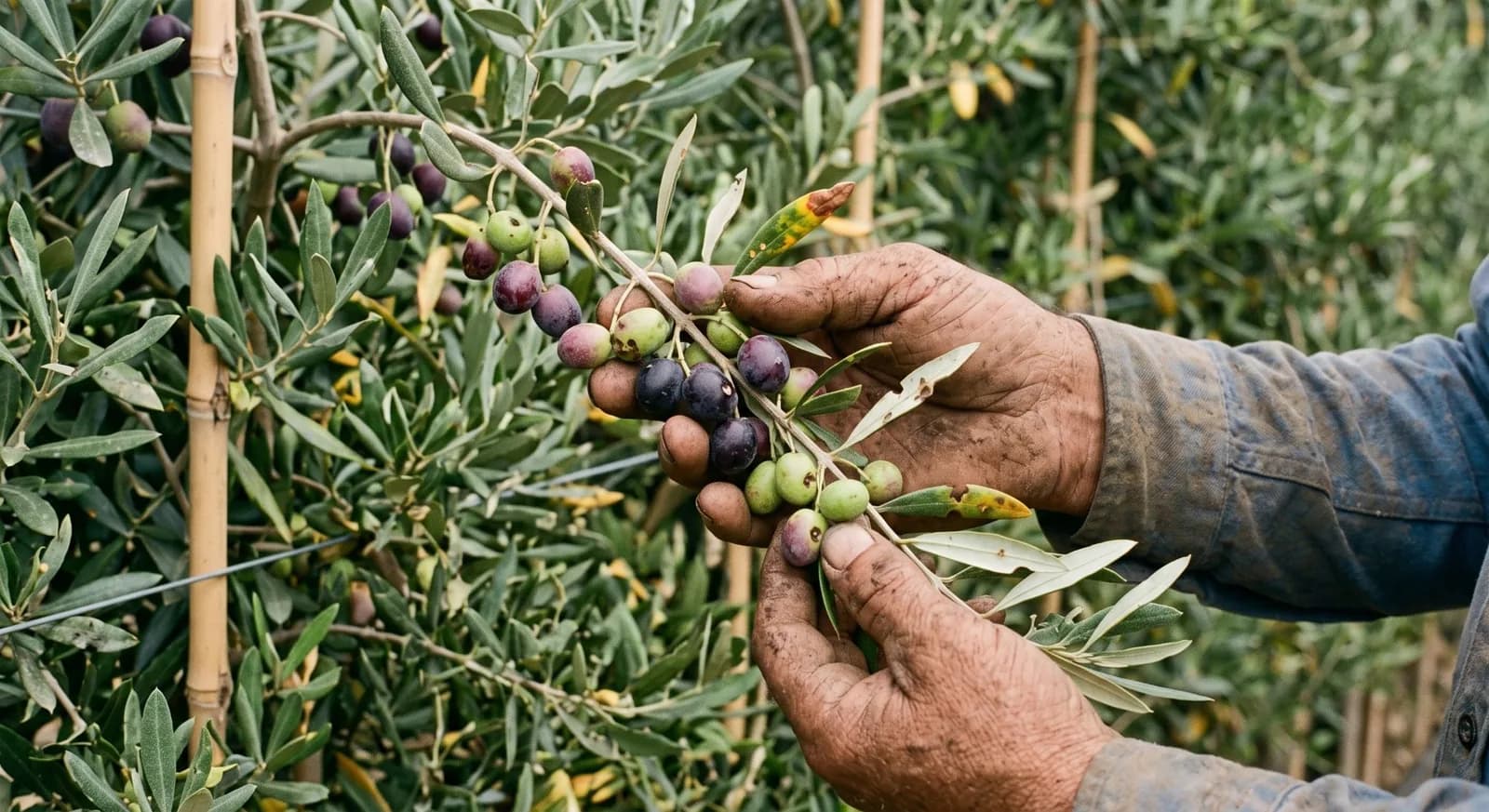
- There is no universal harvest month
- IFAPA describes early-harvest oil examples in October–November and later periods extending into winter; the Sacramento Valley study harvests in October–November, while Texas harvest commonly begins in September. Use these only as regional context. Determine the actual date from local maturity and the product target.4,6,7
- Avoid delaying processing
- Secure mill or processor capacity, transport and field labour before harvest. California and Texas guidance both emphasize moving harvested fruit promptly; the operating details depend on the market and local supply chain.6,7,10
- Budget for bearing cycles and local prices
- Olives can alternate between heavier and lighter crops. Build a multi-year budget with local yield records, labour, irrigation, machinery, processing fees and buyer prices. The California cost studies are historical regional budgets, not a current global profitability forecast.2,6,10
Frequently asked questions
- When should olive trees be planted?
- Set the date from local frost, heat, soil moisture and nursery-stock dormancy. Spanish sources describe dormant-season planting, while Texas A&M advises waiting until freeze danger has passed; neither timing applies everywhere.
- How far apart should olive trees be planted?
- There is no single spacing. Traditional Spanish examples commonly use about 7–8 m, while a Sacramento Valley super-high-density Arbequina study uses 1.5 × 3.7 m. Choose spacing for the site, cultivar, water supply and harvest equipment.
- How much water do olive trees need?
- Use local rainfall, soil, evapotranspiration, orchard age and crop stage. One California cost study budgets 457 mm per year under controlled-deficit drip irrigation, but this is not a universal rate.
- When are olives harvested?
- Harvest date varies by region, cultivar and product. Sample fruit maturity and, for oil, follow oil-yield measurements; book labour and processing capacity before the expected local harvest.
- Can one olive-growing guide give a reliable yield forecast?
- No. Yield depends on cultivar, climate, orchard age and density, alternate bearing, water, management and market grade. Use nearby commercial records and a farm-specific budget.
Regional guides and field planning
Sources and image credits
- 1. MAPA — Olea europaea L., Spanish Inventory of Traditional Agricultural Knowledge — 2018. Spanish olive establishment, traditional spacing, tree age and the influence of water availability on density.
- 2. MAPA — ESYRCE, Analysis of olive plantings 2024 — 2024 survey. Olive planting systems and national and regional context from a georeferenced field survey.
- 3. IFAPA — Soil, irrigation, nutrition and environment in olive production — 2010. Olive climate and soil needs, soil management, weeds, crop water demand, irrigation and nutrition.
- 4. IFAPA — Optimal olive harvest timing — 22 October 2019. Regional harvest timing, early oil production and the lack of one general optimum harvest date.
- 5. International Olive Council — Production techniques in olive growing — 2007 manual. Olive orchard design, cover crops, irrigation, crop growth and oil accumulation.
- 6. UC Cooperative Extension and UC Davis — Sample Costs for Olive Oil, Sacramento Valley — 2016. A historical super-high-density Arbequina budget: spacing, water, nutrition, disease management, harvest, yields by age, costs and returns.
- 7. Texas A&M AgriLife Extension — Olives: Texas Fruit and Nut Production (HORT-PU-027) — Published August 2024. Texas climate and flowering, soil and drainage, cultivar and pollenizer choices, spacing, irrigation, freeze response, pests, harvest and profitability limits.
- 8. Olive cultivation in the Southern Hemisphere: flowering, water requirements and oil quality responses to new crop environments — 2017 review. Cultivar response, flowering, water management and olive performance in newer production environments.
- 9. IFAPA — Olive pruning training manual — 2020. Training and pruning decisions for vase-shaped and hedgerow olive orchards.
- 10. UC Cooperative Extension and UC Davis — Sample Costs to Produce Table Olives, Manzanillo Variety, Sacramento Valley — 2016. A historical California table-olive budget covering hand harvest, alternate bearing and yield and price assumptions.
Image credits
- A hedgerow orchard is one olive production system. Illustration; layout varies by cultivar, site and harvest equipment.
- Olive colour changes as fruit matures. Illustration; assess maturity for the intended product and local harvest system.
Figures are published averages or study assumptions for the places named, not guarantees for your field. Check current local recommendations and product labels before acting.