

Growing olives in Spain
Spain’s olive farms range from rainfed traditional groves to irrigated, mechanised hedgerows. There is no single national spacing or irrigation rate: cultivar, slope, soil depth, water supply, product market and harvesting equipment determine the system. Plan the orchard around those constraints before planting.
Scope: Spain-wide production context, with cultivation detail anchored in official Spanish and Andalusian sources and the International Olive Council manual. Month bands are regional references, not a national prescription. Updated 2026-10-07.
At a glance
Perennial growth and climate in Spain
A perennial planting remains in the field for multiple years. Establishment is a long-term investment; flowering, fruit development, harvest and plant care recur as the planting matures. Follow the named cultivar and production system.
Establish a long-lived planting1
Olives are perennial trees. Spanish cultivation evidence describes planting during dormancy, commonly from November through December and sometimes later where winter cold risk affects the decision. Set the exact establishment plan from local soil moisture, frost risk and planting-stock advice.
Management: Manage orchard floor and cover5
Where a cereal cover is part of the system, the IOC describes autumn-winter growth followed by control in late winter or early spring. Avoid letting the cover compete with trees where water is limited.
Management: Track oil accumulation and fruit growth5
Mediterranean production guidance places oil accumulation and fruit growth across summer and autumn. Timing shifts with cultivar, altitude, water status and year; use local crop observations.
Harvest: Harvest timing varies by product and region4
IFAPA describes early-harvest oils in October–November and later harvest periods extending through December–January. The best date depends on the target balance of oil quantity and quality; measure fruit maturity and oil accumulation instead of using a single Spain-wide date.
Historical monthly climate
Reference period: 1996-01-01 to 2025-12-31. ERA5-Land monthly mean soil temperature at 0–7 cm, air temperature and frost days at the regional reference point (40.2, -3.7). Select a month to inspect its historical conditions.
Month tiles show mean air temperature.
February historical conditions
- Mean topsoil temperature
- 6.4°C
- Mean air temperature
- 7.0°C
- Mean frost days per month
- 8.6 days
Use this monthly history to assess winter exposure, seasonal heat and water planning. It does not calculate cultivar chill hours, flowering dates, frost damage during bloom or fruit maturity. Topsoil at 0–7 cm describes shallow soil context, not the full root zone. Harvest periods follow the production evidence above.
Climate source: Open-Meteo Historical Weather APIChoose the orchard system for the site
- 1
Define the market
Choose oil, table olives or a dual-purpose cultivar and processing route.
- 2
Assess the field
Check soil depth, slope, drainage, water supply and erosion risk.
- 3
Select a layout
Set spacing and training from tree vigour, water and harvest machinery.
- 4
Plan perennial care
Manage canopy, ground cover, irrigation and harvest by growth stage.
- Match planting density to water and vigour
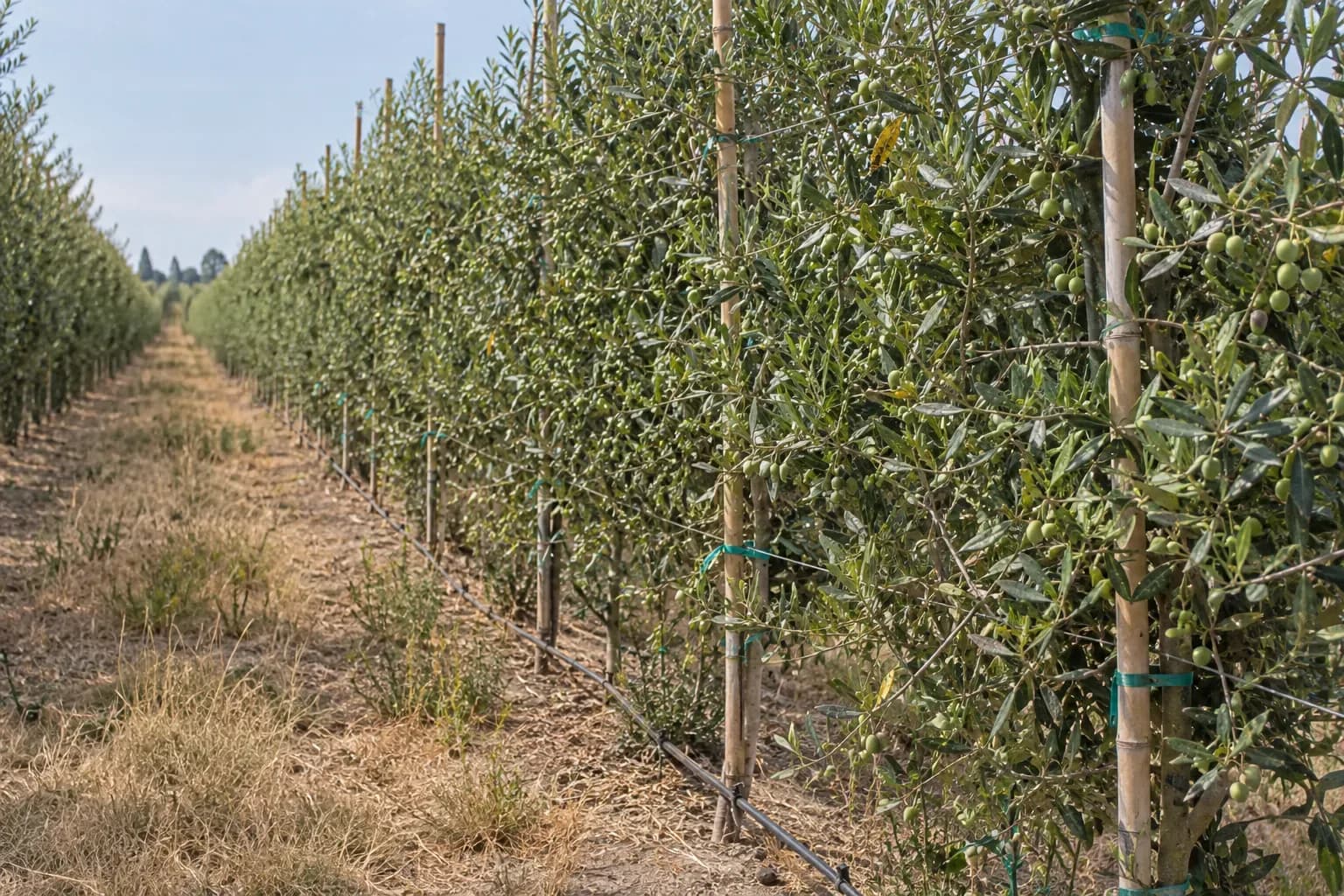
- Traditional Spanish groves often use about 7–8 m spacing, with reported layouts from 4 to 10 m. Rainfed groves are generally wider than irrigated ones to reduce competition for limited water; treat those historic ranges as examples, not a universal prescription.1
Use a measured reference layout
Between rows: 7.5 m · Within the row: 7.5 m
A midpoint illustration within the traditional 7–8 m spacing commonly reported in the Spanish source. Adjust the actual plan for tree vigour, slope, water, machinery and the local technical adviser. Schematic, not to scale.
Manage soil, water and canopy
- Start with soil and water tests
- Assess soil depth, texture, drainage and salinity, plus irrigation-water quality where applicable. IFAPA’s production material treats soil, water, nutrition and environmental impact together; avoid applying blanket fertilizer or irrigation rates across unlike farms.3
- Protect soil on slopes
- Keep a managed ground cover where it helps reduce erosion, and control it before it competes strongly with olive trees for water. Match mowing or other control to rainfall and soil-moisture conditions.3,5
- Prune for productive light
- Use the orchard’s training form and canopy volume to guide pruning. IFAPA’s technical manual treats vase and hedgerow pruning as distinct systems; schedule work to retain productive wood, access and light rather than imposing one shape on every grove.2
Harvest for the market and maturity target
- 1
Early oil harvest
Some producers begin in October–November for early-harvest oils.
- 2
Assess the fruit
Sample maturity and measure oil yield as the season progresses.
- 3
Later harvest
Many areas historically continued through December and into January.
- 4
Process promptly
Keep the harvest plan coordinated with mill capacity and fruit condition.
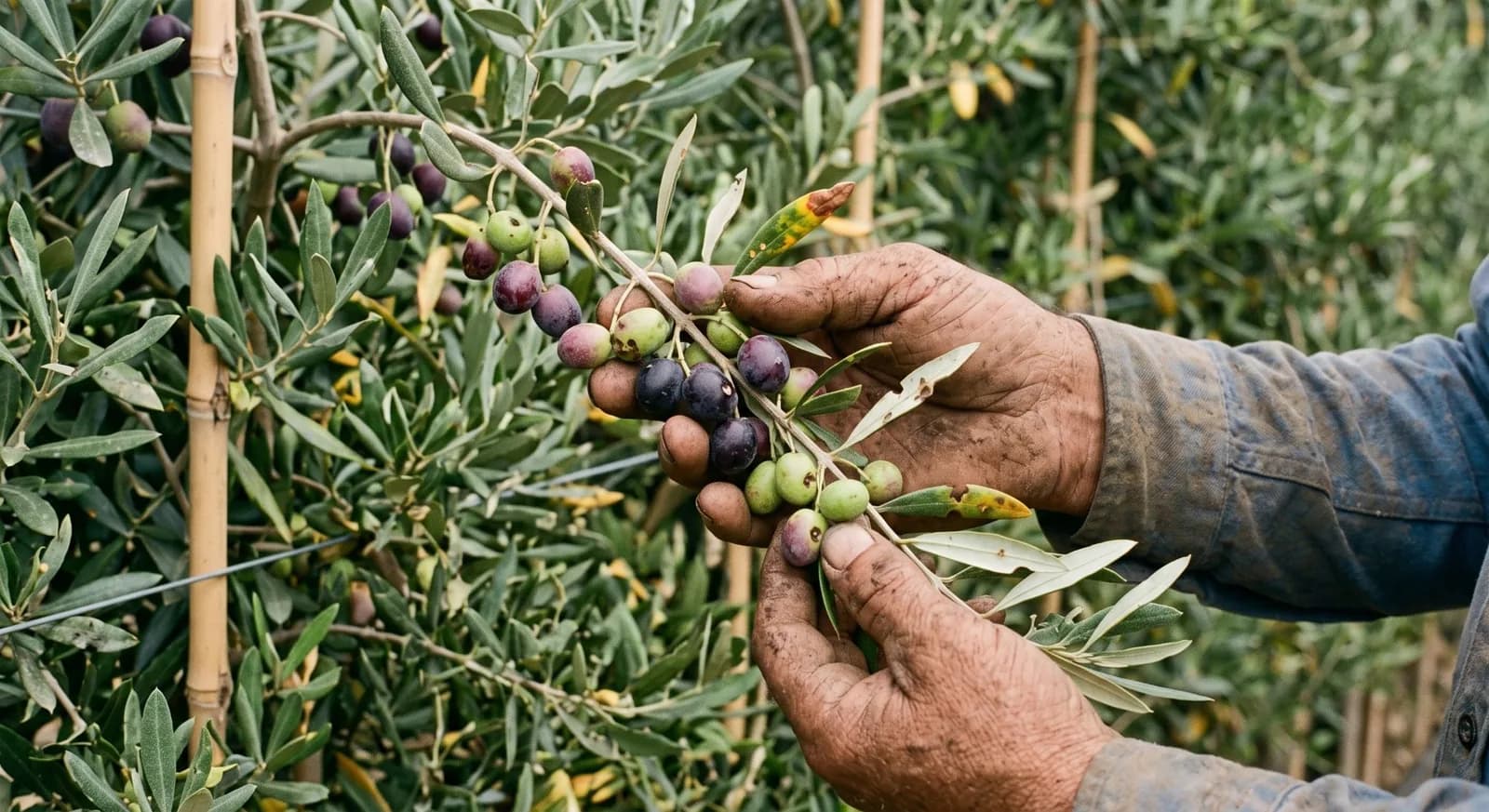
- There is no one optimum date for Spain
- IFAPA notes that no general criterion fixes the best olive harvest date. Its research recommends measuring dry oil yield sequentially through autumn and harvesting when the increase stabilises or no longer compensates for delaying.4
Build a farm budget from local system data
- Compare rainfed and irrigated budgets separately
- MAPA’s field survey tracks olive production systems, irrigation, yields and regional distribution. Use its autonomous-community data and a local farm budget; national averages conceal major differences in density, water and terrain.2
Frequently asked questions
- How far apart are olive trees planted in Spain?
- Traditional groves commonly use about 7–8 m spacing, with historical layouts ranging roughly from 4 to 10 m. Irrigation, soil, slope, tree vigour and machinery change the suitable layout.
- When are olives harvested in Spain?
- It varies by cultivar, region and product. IFAPA describes some early-harvest oils in October–November and other harvest periods extending through December and January.
- When should olive trees be established in Spain?
- Olives are perennial. Spanish cultivation evidence describes dormant-season establishment, commonly in late autumn and winter; use local frost, soil-moisture and nursery advice to set the field date.
- How much water do olive trees need in Spain?
- There is no single national rate. Rainfed or irrigated system, soil storage, rainfall, density and crop load all affect requirements; schedule from local water balance and technical advice.
- How do I choose the best olive harvest date?
- Sample fruit maturity and measure dry oil yield repeatedly through autumn. IFAPA recommends harvesting when the oil-yield increase stabilises or no longer offsets the quality and operational costs of delaying.
Regional olive guides
Local dates, soil-temperature history and sources for specific regions:
Sources and image credits
- 1. MAPA — Olea europaea L. var. europaea, Spanish Inventory of Traditional Agricultural Knowledge — 2018. Spanish olive establishment, traditional spacing, tree age and the influence of water availability on density.
- 2. MAPA — ESYRCE, Analysis of olive plantings 2024 — 2024 survey. Olive planting systems and national/regional context from a georeferenced field survey.
- 3. IFAPA — Soil, irrigation, nutrition and environment in olive production — 2010. Olive climate and soil needs, soil management, weeds, crop water demand, irrigation and nutrition.
- 4. IFAPA — Optimal olive harvest timing — 22 October 2019. Regional harvest timing, early oil production and the lack of one general optimum harvest date.
- 5. International Olive Council — Production techniques in olive growing — 2007 manual. Olive orchard design, cover crops, irrigation and crop growth and oil accumulation.
- 6. IFAPA — Olive pruning training manual — 2020. Training and pruning decisions for vase-shaped and hedgerow olive orchards.
Image credits
- Olive orchard layout. Illustration; not a region-specific farm.
- Olive fruit changing colour as it matures. Illustration.
Figures are published averages or study assumptions for the places named, not guarantees for your field. Check current local recommendations and product labels before acting.
Some visuals in this guide are illustrations rather than photographs of a specific farm. See image credits.