

Hop farming in Malaysia: site feasibility
Evaluate hop flowering, cone yield and quality in a local trial before planning commercial acreage in Malaysia. Equatorial daylength, humidity, rainfall and drainage can change how a cultivar performs compared with temperate production regions. Confirm planting material, drying costs and buyer specifications alongside the field trial.
By AgriAuditor. Updated .
Scope: Commercial hop feasibility in Malaysia: site assessment, cultivar trials, cone handling and buyer requirements for Humulus lupulus.
At a glance
Perennial growth and climate in Malaysia
A perennial planting remains in the field for multiple years. Establishment is a long-term investment; flowering, fruit development, harvest and plant care recur as the planting matures. Follow the named cultivar and production system.
Establish a long-lived planting1,2,3,4
No Malaysia-specific commercial establishment date or method was verified. Before planting, identify a suitable trial site, obtain verified planting material and measure daylength response, humidity, rainfall, drainage, disease pressure and the cost of any protected system.
Historical monthly climate
Reference period: 1996-01-01 to 2025-12-31. ERA5-Land monthly mean soil temperature at 0–7 cm, air temperature and frost days at the regional reference point (3.5, 102). Select a month to inspect its historical conditions.
Month tiles show mean air temperature.
January historical conditions
- Mean topsoil temperature
- 25.3°C
- Mean air temperature
- 25.5°C
- Mean frost days per month
- 0.0 days
Use this monthly history to assess winter exposure, seasonal heat and water planning. It does not calculate cultivar chill hours, flowering dates, frost damage during bloom or fruit maturity. Topsoil at 0–7 cm describes shallow soil context, not the full root zone. The monthly history does not establish a local flowering, maturity or harvest period.
Climate source: Open-Meteo Historical Weather APIStart with the local evidence gap
- 1
Verify varieties and planting stock
Obtain a documented cultivar and traceable source.
- 2
Measure flowering response
Track daylength, emergence, flower initiation and cone development.
- 3
Test disease and production conditions
Measure humidity, rainfall, drainage, pests and any protected-culture needs.
- 4
Confirm processing and buyers
Test cone yield and chemistry, drying cost, quality and contracts.
- Do not repeat unverified cultivar claims
- One non-primary web article claims Malaysian hop varieties and production acreage, but the research review found no corroborating MARDI or Department of Agriculture release or trial report. Those claims are not repeated here.1
- Separate climate description from crop validation
- Official Malaysian sources describe a near-equatorial location, high humidity, abundant rainfall and limited annual temperature variation. These national descriptions do not establish whether an individual highland or protected site can produce hops.2,3
Investigate photoperiod and wet-climate constraints
- 1
Measure the site and daylength
Track exposure, altitude, temperatures, rainfall, humidity and photoperiod.
- 2
Compare cultivar response
Test local flowering and cone initiation rather than importing a temperate calendar.
- 3
Manage rain and drainage
Assess canopy drying, root-zone water and disease risks.
- 4
Evaluate system costs
Test whether selected cultivars or controlled conditions justify added expense.
- Treat daylength as a crop-development variable
- Primary hop-physiology research identifies daylength as a major control on flower initiation and describes ways photoperiod manipulation can enable production without the commonly assumed chilling requirement. This is biological evidence, not Malaysian field validation.4
Verify a market before building processing capacity
Frequently asked questions
- Are hops grown commercially in Malaysia?
- The sources reviewed did not verify a Malaysian commercial trial or farm protocol. This is an evidence gap, not proof that no one has experimented with the crop.
- What spacing should a Malaysian hop farm use?
- No Malaysia-specific row spacing or plant spacing was verified. Measure a local trial and match it to cultivar, trellis, equipment and climate.
- When should hops be planted in Malaysia?
- No local planting month was established in the reviewed sources. Hops are perennial; a Malaysian trial needs verified stock and local phenology observations.
- Can hops flower near the Equator?
- The reviewed physiology research shows daylength strongly affects flowering and that photoperiod manipulation may change the response. It does not establish a Malaysian commercial method.
- Does Malaysia import hops?
- WITS/UN Comtrade reports imports in selected whole-cone and processed-hop customs categories in 2024. Those values are not a farm-gate price or proof of a local buyer.
Regional hops guides
Sources and image credits
- 1. Malaysia Department of Agriculture — Public Crop Variety Registration — Accessed 7 October 2026. Official variety-register context; this review did not verify a hops entry or commercial production protocol.
- 2. MyGovernment — Malaysia location — Accessed 7 October 2026. Equatorial geographic location.
- 3. METMalaysia — Malaysia’s climate — Accessed 7 October 2026. National climate context including humidity, rainfall and temperature variation.
- 4. Campbell and Kipping — hop photoperiod, vernalization and dormancy — 2019. Primary hop-physiology research on flowering response and photoperiod manipulation; not a Malaysian field trial.
- 5. Agehara and Marceddu — growing hops in subtropical climates — 2025. Florida field-trial context for nontraditional hop latitudes; not a Malaysian production recommendation.
- 6. WITS / UN Comtrade — Malaysia imports of HS 121020 — 2024. Selected processed-hop product imports.
- 7. WITS / UN Comtrade — Malaysia imports of HS 121010 — 2024. Selected whole-cone imports.
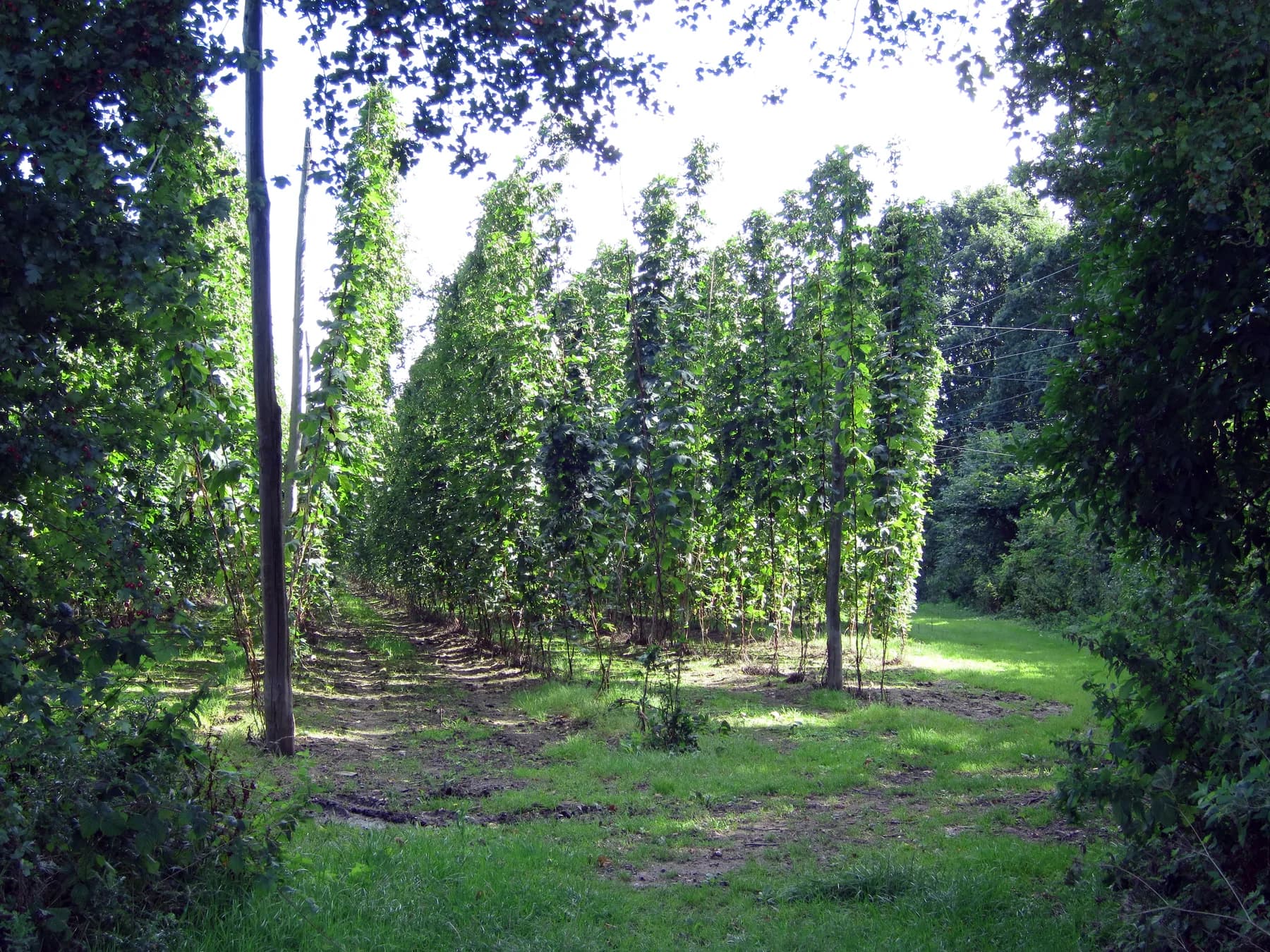
- 8. Hops photograph — Oast House Archive — CC BY-SA 2.0. Hop field at Huggins Farm by Oast House Archive, Kent, England. CC BY-SA 2.0; resized under the same license. A trellis-system example, not a photograph of the named region.
- 9. Hops photograph license — CC BY-SA 2.0. Reuse terms for the credited photograph; resizing is noted in its caption.
Image credits
- Hop field at Huggins Farm by Oast House Archive, Kent, England. CC BY-SA 2.0; resized under the same license. A trellis-system example, not a photograph of the named region.
Figures are published averages or study assumptions for the places named, not guarantees for your field. Check current local recommendations and product labels before acting.