

Growing hops in India
A CSIR-IIIM agrotechnology package names Kashmir Valley, Lahaul-Spiti and the Champawat hills as Indian hop-growing regions. Its spacing, trellis, irrigation and harvest details are useful institutional references, but the publication does not identify cultivars, trial sites or methods behind its yield figures. Confirm current planting stock and brewery demand before scaling.
Scope: Himalayan hop production evidence in India. The published CSIR-IIIM package is a dated institutional reference, not a modern region-by-region commercial validation. Updated 2026-10-07.
At a glance
Perennial growth and climate in India
A perennial planting remains in the field for multiple years. Establishment is a long-term investment; flowering, fruit development, harvest and plant care recur as the planting matures. Follow the named cultivar and production system.
Establish a long-lived planting1,2
The 2019 CSIR-IIIM package lists November–December or March planting, but does not provide cultivar names, trial sites or current local validation. Treat the dates as a published institutional reference, not a general planting recommendation; confirm local stock, field conditions and specialist advice.
Management: Irrigation emphasis in the institutional package1
The CSIR-IIIM package emphasizes repeated irrigation after bine training, especially June–July. This is a dated, national-level package, not a validated irrigation schedule for each Himalayan site.
Harvest: Harvest month in the published package1
The package lists August harvest followed by immediate kiln drying, pressing and baling. It does not report a cultivar-specific maturity trial; confirm cone condition and processing capacity locally.
Historical monthly climate
Reference period: 1996-01-01 to 2025-12-31. ERA5-Land monthly mean soil temperature at 0–7 cm, air temperature and frost days at the regional reference point (22, 79). Select a month to inspect its historical conditions.
Month tiles show mean air temperature.
June historical conditions
- Mean topsoil temperature
- 30.7°C
- Mean air temperature
- 29.0°C
- Mean frost days per month
- 0.0 days
Use this monthly history to assess winter exposure, seasonal heat and water planning. It does not calculate cultivar chill hours, flowering dates, frost damage during bloom or fruit maturity. Topsoil at 0–7 cm describes shallow soil context, not the full root zone. Harvest periods follow the production evidence above.
Climate source: Open-Meteo Historical Weather APITreat the published package as a starting reference
- 1
Identify a current cultivar
The reviewed package does not name a variety.
- 2
Confirm local planting stock
Check availability, identity and health with research or extension institutions.
- 3
Run a measured block trial
Record survival, phenology, yield, cone chemistry and disease.
- 4
Secure drying and buyers
Verify kiln capacity, quality requirements and brewery demand.
Use the reported layout only as a dated reference
Between rows: 2 m between rows · Within the row: 2 m between plants
The 2019 package also lists a 5–6 m trellis and about 2,500 plants/ha. It does not state cultivar, trial design or machinery assumptions; verify the system locally before using these dimensions.
- Do not mistake establishment timing for an annual crop calendar
- The package lists November–December or March as planting periods, but the page presents these as historical institutional notes rather than a current recommendation. Field readiness, plant material and local conditions must be checked.1
- Plan for drying immediately after harvest
- Hops are harvested for cones that need prompt drying and handling. The historical Botanical Survey account records delay-related concerns; use a current kiln protocol and buyer moisture specification rather than copying historical processing directions.4
Validate water, disease and photoperiod locally
- 1
Log spring shoot emergence
CSIR-IIIM describes perennial rhizomes sending shoots in early spring.
- 2
Measure daylength and flowering
Record cultivar response and cone initiation at each site.
- 3
Track irrigation and disease
Use local soil moisture and crop observations rather than a fixed package schedule.
- 4
Analyze cone quality
Test alpha acids and other buyer-required quality measures.
- Interpret the reported irrigation notes cautiously
- The institutional package notes repeated irrigation after training, especially in June–July. It does not provide site-specific water quantities or modern trial data; measure field response and check local water supply.1
Confirm demand and processing before expansion
- Imports show a product channel, not a farm price
- UN Comtrade data surfaced through WITS show 428,123 kg of pelleted, powdered or ground hops imported to India in 2024, valued at about US$4.4 million. That customs category does not measure all hop products or a prospective grower’s achievable price.6
Frequently asked questions
- Where does the Indian hops package identify suitable regions?
- The 2019 CSIR-IIIM package names Kashmir Valley, Lahaul-Spiti and the hills around Champawat, now in Uttarakhand. It is not a current district-level validation.
- What spacing is listed for hops in India?
- The institutional package lists 2 m × 2 m and a 5–6 m trellis. It does not provide cultivar or trial details, so verify the system before investment.
- When are Indian hops harvested?
- The CSIR-IIIM package lists August harvest and immediate kiln drying, pressing and baling. Treat it as a dated reference and confirm maturity locally.
- Are Indian hop yields commercially established?
- The sources reviewed do not establish a current commercial performance series. The package’s yield figures lack named cultivars, trial sites and methods.
- Is there a market for hops in India?
- WITS/UN Comtrade reports imports for selected processed hop product categories in 2024. This is not a farm-gate price or buyer commitment; confirm specifications and contracts directly.
Regional hops guides
Local dates, soil-temperature history and sources for specific regions:
Sources and image credits
- 1. CSIR technologies for the rural sector — hop agrotechnology package — 2019. Indian locations, establishment notes, spacing, trellis, irrigation and harvest; no trial methods or named varieties given.
- 2. CSIR-IIIM — Annual Report 2023–24 — 2024. Wild distribution and perennial spring-shoot context; not a commercial protocol.
- 3. CSIR-IIIM Herbarium — Humulus lupulus — Specimen collected 8 June 2005. Cultivated institutional specimen; not commercial acreage or a replicated trial.
- 4. Botanical Survey of India — Dictionary of the Economic Products of India, vol. 4 — Historical entries from 1883–1885. Kashmir and Chamba hop shipments and historical production/handling challenges.
- 5. Press Information Bureau — CSIR-IIIM achievements — 2018. Institutional crop-development history; not current farm-scale validation.
- 6. WITS / UN Comtrade — India imports of HS 121020 — 2024. Imports of pelleted, powdered or ground hops; not all products or farm-gate prices.
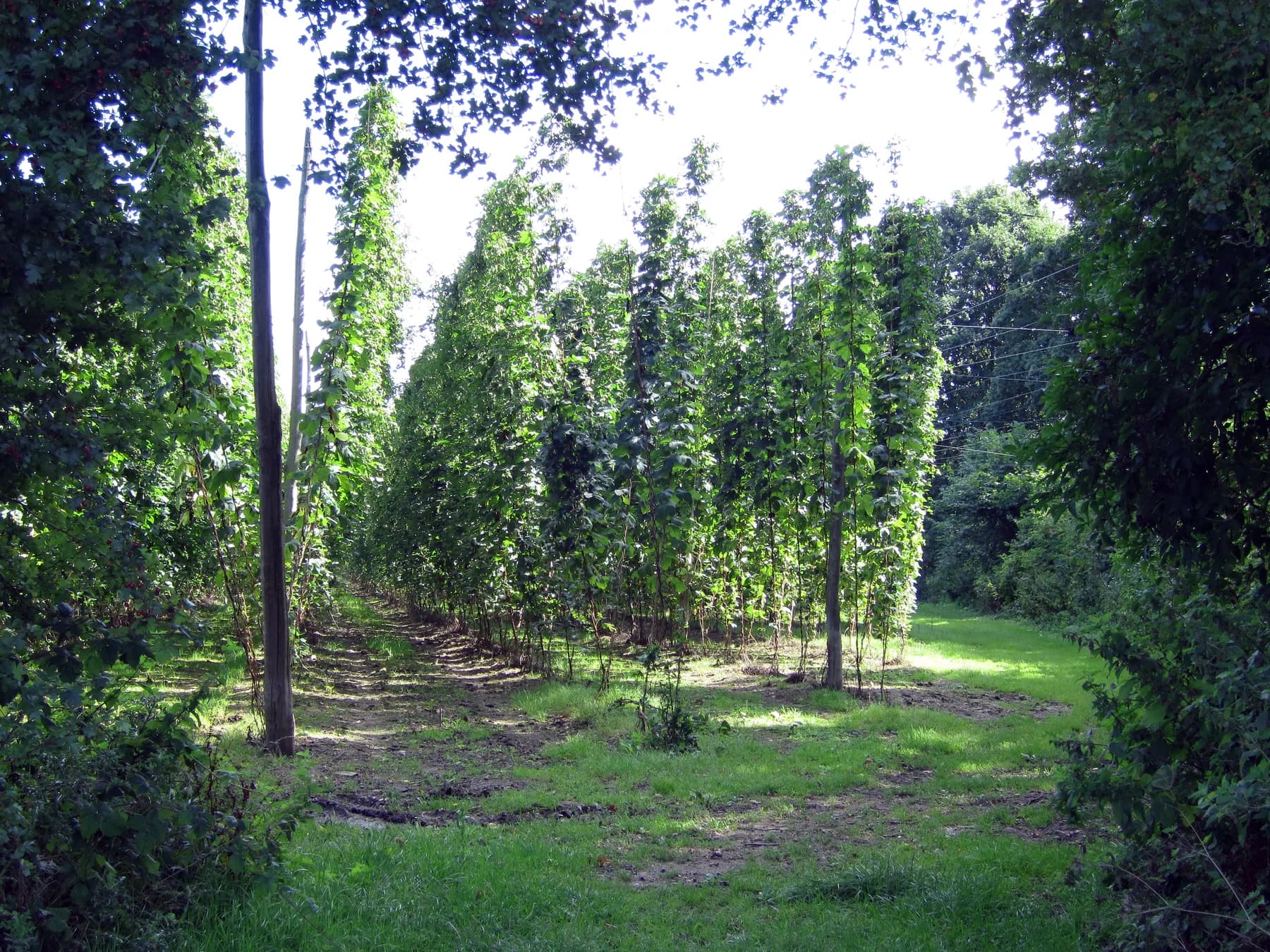
- 7. Hops photograph — Oast House Archive — CC BY-SA 2.0. Hop field at Huggins Farm by Oast House Archive, Kent, England. CC BY-SA 2.0; resized under the same license. A trellis-system example, not a photograph of the named region.
- 8. Hops photograph license — CC BY-SA 2.0. Reuse terms for the credited photograph; resizing is noted in its caption.
Image credits
- Hop field at Huggins Farm by Oast House Archive, Kent, England. CC BY-SA 2.0; resized under the same license. A trellis-system example, not a photograph of the named region.
Figures are published averages or study assumptions for the places named, not guarantees for your field. Check current local recommendations and product labels before acting.