

Growing hops in Illinois
Hops are an emerging specialty crop in Illinois. University of Illinois Extension provides state-specific production notes, and local farms document current harvesting and processing. The available advice is limited and dated, so confirm present varieties, buyers, equipment and disease guidance before establishing a yard.
Scope: Commercial hop yards in Illinois. Extension dates are from 2017 unless otherwise noted; no Illinois-tested row or within-row spacing was verified in the sources reviewed. Updated 2026-10-07.
At a glance
- Crop stage
- Perennial yard; first two years emphasize rhizome and bine establishment1
- Trellis reference
- Illinois Extension describes trellis systems generally upwards of 25 ft1
- Harvest cue
- Yellow lupulin, characteristic aroma and soft cones1
- Illinois producer example
- A Lewistown farm lists Mackinac, Chinook, Cascade and Crystal5
Perennial growth and climate in Illinois
A perennial planting remains in the field for multiple years. Establishment is a long-term investment; flowering, fruit development, harvest and plant care recur as the planting matures. Follow the named cultivar and production system.
Establish a long-lived planting1
Illinois Extension describes spring establishment but does not provide a month-specific schedule. Plan planting around locally adapted rhizomes or plants, prepared trellis, workable soil, drainage and current county advice; first years prioritize bine and rhizome development.
Management: Bines emerge and are trained1
A 2017 Illinois Extension account describes bines emerging and being trained in May. Treat this as a dated local observation, not a calendar forecast for every Illinois farm.
Management: Cones begin to develop1
The same Extension report says cones began in mid-June at the described yard. Scout the actual cultivar and site; this observation is not a maturity rule.
Historical monthly climate
Reference period: 1996-01-01 to 2025-12-31. ERA5-Land monthly mean soil temperature at 0–7 cm, air temperature and frost days at the regional reference point (40, -89). Select a month to inspect its historical conditions.
Month tiles show mean air temperature.
May historical conditions
- Mean topsoil temperature
- 17.9°C
- Mean air temperature
- 18.0°C
- Mean frost days per month
- 0.1 days
Use this monthly history to assess winter exposure, seasonal heat and water planning. It does not calculate cultivar chill hours, flowering dates, frost damage during bloom or fruit maturity. Topsoil at 0–7 cm describes shallow soil context, not the full root zone. Harvest periods follow the production evidence above.
Climate source: Open-Meteo Historical Weather APIPlan the yard around its trellis and buyer
- 1
Confirm brewery demand
Align aroma, alpha/beta acids, storage stability and cultivar with likely buyers.
- 2
Budget a tall trellis
Plan structural loads, access, harvest equipment and worker safety.
- 3
Choose the harvest route
Decide whether cones will be sold wet, dried, or pelletized and packaged.
- 4
Check local disease pressure
Plan scouting and a current, label-compliant crop-protection approach.
- Confirm demand before planting acreage
- Illinois Extension advises matching varieties to local climate performance and brewer requirements. Local production exists, but a farm’s acreage, processing capacity, contract terms and buyer demand must be checked directly.2,5
- Keep historic costs in date
- The 2017 Extension article estimated establishment near $10,000 per acre and noted hand harvest for yards under five acres. These are dated observations, not a current budget; price the current trellis, labor, harvest and processing system.1
Build safe trellis access without inventing spacing
- 1
Engineer the support structure
Extension describes trellises generally upwards of 25 ft; confirm current structural design locally.
- 2
Fit access to harvest equipment
Reserve lanes and turning space for the chosen picker and transport.
- 3
Check dimensions against the farm
No Illinois-tested row and plant spacing was verified in this source review.
- 4
Protect worker access
Design safe climbing, tying and maintenance procedures for the tall yard.
- Do not copy another state’s dimensions as Illinois guidance
- The reviewed Illinois sources do not publish verified row spacing or within-row distance. Wisconsin Extension has a neighboring-state comparator, but it is not an Illinois recommendation; use a named local system and equipment plan before drawing measurements.1
- Use the early years to establish the perennial stand
- Illinois Extension says the first two years emphasize rhizome development, with adequate yields around year three. Treat this as a 2017 Extension expectation, not a guaranteed yield curve or investment return.1
Scout canopy disease and feed from field evidence
- 1
Inspect bines and leaf surfaces
Look for powdery and downy mildew symptoms.
- 2
Keep canopy conditions in view
The state guidance stresses avoiding persistently wet plant material.
- 3
Use soil or tissue diagnosis
Do not treat one demonstration-plot nitrogen rate as an Illinois optimum.
- 4
Check current labels and timing
Height and harvest stage affect safe access and application decisions.
- Treat mildew as a priority risk
- Illinois Extension identifies powdery and downy mildew as major hop diseases and emphasizes keeping plant material dry. Use current local scouting and crop-protection advice rather than older product recommendations.3
- Do not copy a blanket nitrogen rate
- A University of Illinois field note repeats a rate attributed to Michigan State Extension for a demonstration planting. It is not an Illinois replicated fertilizer trial; use soil and tissue tests and stop nitrogen when local crop stage and adviser guidance call for it.4
Harvest to cone condition and protect processing quality
- 1
Check cone condition
Look for yellow lupulin, the characteristic aroma and a soft cone feel.
- 2
Coordinate labor and harvest method
The 2017 state account says small yards were commonly hand-harvested.
- 3
Dry or process promptly
Wet hops and dried/pelletized products have different buyer requirements.
- 4
Protect the finished lot
Local producers describe drying, nitrogen-purged packaging and cold storage.
Frequently asked questions
- Can hops be grown commercially in Illinois?
- University of Illinois Extension describes hops as an emerging specialty crop, and current Illinois producers document active yards and processing. Local scale and buyer access need direct confirmation.
- How tall should an Illinois hop trellis be?
- A 2017 Illinois Extension guide describes trellises generally upwards of 25 ft. Confirm engineering and worker-safety requirements for the actual site.
- What spacing should Illinois growers use?
- The sources reviewed do not provide Illinois-tested row or plant spacing. Do not substitute Wisconsin dimensions as an Illinois recommendation.
- When are Illinois hops harvested?
- The Extension source gives cone maturity cues rather than one statewide month: yellow lupulin, hop aroma and soft cones. Coordinate harvest with the cultivar and drying capacity.
- Which hop varieties grow in Illinois?
- A current Lewistown producer lists Mackinac, Chinook, Cascade and Crystal. That is one farm’s cultivar list, not a statewide yield ranking.
Regional hops guides
Local dates, soil-temperature history and sources for specific regions:
Sources and image credits
- 1. University of Illinois Extension — Hops Highlight: Getting Started — 2017. Illinois specialty-crop context, spring establishment, trellis, first years, harvest cues and dated cost observations.
- 2. University of Illinois Extension — Hops Highlight: Variety Selection — 2017. Cultivar selection factors and Midwest variety context.
- 3. University of Illinois Extension — Hops Highlight: Insect and Disease Management — 2017. Illinois hop disease and pest-management considerations; product-era advice is not repeated.
- 4. University of Illinois Extension — hop nitrogen note — Accessed 7 October 2026. Demonstration-planting nitrogen note attributed to Michigan State Extension; not an Illinois trial.
- 5. Hallowed Hops Farm — Illinois producer — Accessed 7 October 2026. Current farm-listed cultivars, harvest, drying, packaging and cold-storage operations.
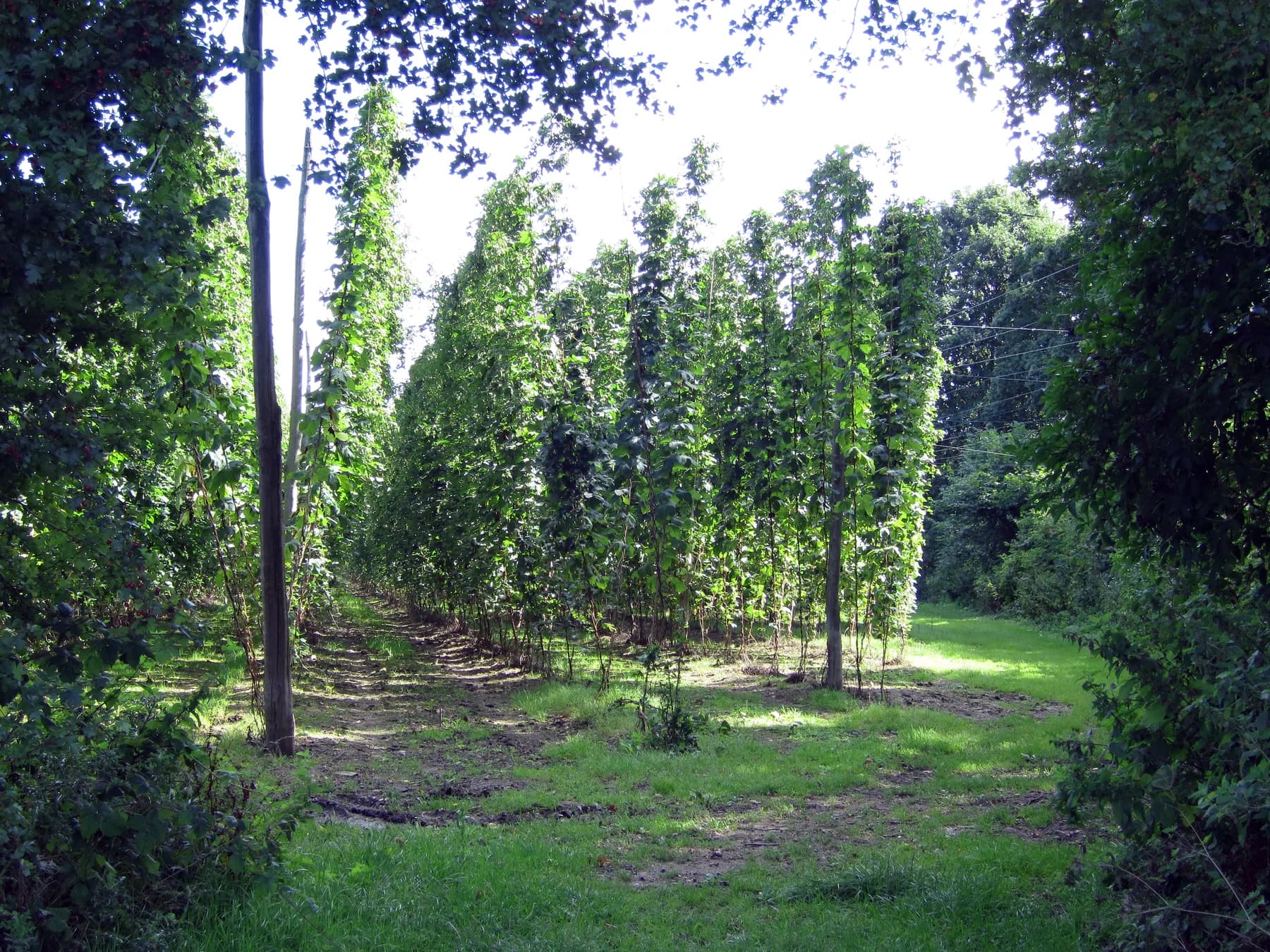
- 6. Hops photograph — Oast House Archive — CC BY-SA 2.0. Hop field at Huggins Farm by Oast House Archive, Kent, England. CC BY-SA 2.0; resized under the same license. A trellis-system example, not a photograph of the named region.
- 7. Hops photograph license — CC BY-SA 2.0. Reuse terms for the credited photograph; resizing is noted in its caption.
Image credits
- Hop field at Huggins Farm by Oast House Archive, Kent, England. CC BY-SA 2.0; resized under the same license. A trellis-system example, not a photograph of the named region.
Figures are published averages or study assumptions for the places named, not guarantees for your field. Check current local recommendations and product labels before acting.