

Growing artichokes in Iowa
Iowa State Extension says globe artichokes can be grown in colder regions such as Iowa as annual vegetables. That establishes feasibility, not a commercial production package. Short-season cultivars and cold exposure are central to a field trial, while Iowa-specific yield, planting-date and market standards remain undocumented in the sources reviewed.
Scope: Research-led annual crop trial planning for Iowa. Cultivar and spacing values from other regions are labeled as transfer references, not local commercial recommendations. Updated 2026-10-05.
At a glance
- Iowa production approach
- Treat globe artichokes as an annual trial crop; winter survival is not assumed1,2
- Short-season cultivar references
- Imperial Star: 85 days; Wonder: 88 days; Green Globe: 120 days2
- Cold exposure for bud induction
- About one to two weeks near 10°C (50°F), per Illinois Extension2
- Commercial Iowa data
- No Iowa yield, field spacing or crop calendar standard found in the sources reviewed1
Planting and harvest calendar for Iowa
Use the source-backed production windows to coordinate establishment, crop care and harvest. Production districts and cultivars can have different cycles; the historical climate adds context for the field plan.
Planting: Annual-cultivar trial establishment1,2
Iowa State confirms annual production is possible but does not give an artichoke field planting date. Illinois Extension describes 7–14 days near 10°C (50°F) to vernalize annual cultivars; use local frost conditions and a small trial to set transplant timing.
Harvest: Record first marketable heads2
Illinois Extension lists 85 days for Imperial Star and 88 days for Wonder, but those maturity references are not Iowa commercial trial results. Measure from the same crop stage each season and record actual head quality.
Historical monthly climate
Reference period: 1996-01-01 to 2025-12-31. ERA5-Land monthly mean soil temperature at 0–7 cm, air temperature and frost days at the regional reference point (42, -93.5). Select a month to inspect its historical conditions.
Month tiles show mean topsoil temperature.
January historical conditions
- Mean topsoil temperature
- -1.6°C
- Mean air temperature
- -5.8°C
- Mean frost days per month
- 29.5 days
These are monthly means at one reference location. They describe seasonal field conditions, not crop maturity, actual seed-zone conditions, frost forecasts or a planting recommendation. Harvest bands follow the crop-specific production sources above.
Climate source: Open-Meteo Historical Weather APIUse an annual cultivar and prove the crop cycle
- Imperial Star85 days
- Wonder88 days
- Green Globe120 days
- 1
Select cultivar
Use a short-season annual type for the first comparison.
- 2
Vernalize
Provide the cited cool exposure and log temperatures.
- 3
Establish
Set a small, uniform field block after local frost risk.
- 4
Measure
Record first marketable bud, head grade and total harvest.
- Do not expect perennial overwintering
- Iowa State’s crop note says colder regions such as Iowa can grow globe artichokes as annuals. Illinois Extension notes that artichokes are perennial plants in milder regions; northern production depends on annual cultivars and a successful flower-induction cycle.1,2
- Shorten the maturity window
- Illinois Extension names Imperial Star at 85 days and Wonder at 88 days, compared with 120 days for Green Globe. Treat these as cultivar references, not validated Iowa days-to-harvest guarantees.2
Account for the cool exposure needed for flowering
- Vernalization matters
- Illinois Extension describes about one or two weeks with temperatures in the 50s°F as a flowering signal for annual artichoke cultivars. Seedling timing must preserve that exposure; warm indoor holding can prevent the cool period.2
Keep the first block small and measurable
- Compare establishment methods
- In a two-year Texas field study, transplants had higher marketable yield than direct-seeded plants in both seasons. Compare the methods in a small Iowa block before deciding whether the extra nursery and transplant cost pays.3
Validate market and harvest labor before scaling
- Check the outlet first
- Iowa Extension identifies the annual-crop option but does not document commercial Iowa acreage or buyers. Confirm whether local restaurants, wholesalers or processors want the chosen head size and can take repeated small harvests.1
Frequently asked questions
- Can artichokes grow in Iowa?
- Yes, Iowa State Extension says they can be grown in colder regions like Iowa as annual vegetables. The sources do not provide a commercial Iowa production standard.
- Which artichoke cultivars are suited to a short season?
- Illinois Extension lists Imperial Star at 85 days and Wonder at 88 days. Use these as cultivar references and verify maturity in an Iowa trial.
- Do annual artichokes need cold exposure?
- Illinois Extension describes about one or two weeks in temperatures in the 50s°F to trigger flowering in annual cultivars.
- When should artichokes be planted in Iowa?
- The reviewed sources do not set an Iowa commercial planting date. Time a small trial around local frost conditions while preserving the cultivar’s required cool exposure.
Regional artichokes guides
Local dates, soil-temperature history and sources for specific regions:
Sources and image credits
- 1. Iowa State University Extension and Outreach AnswerLine — Artichokes — Published 19 March 2025. Confirms artichokes can be grown in colder regions such as Iowa as an annual vegetable; does not provide commercial field rates or timing.
- 2. University of Illinois Extension — Ep. 169: Growing Perennial Vegetables, Asparagus, Rhubarb & More — Good Growing podcast, episode 169. Cold-climate annual artichoke cultivar maturity references and vernalization discussion; not Iowa field-trial or yield data.
- 3. Othman et al. — Direct Seeding and Transplanting Influence Root Dynamics, Morpho-Physiology, Yield, and Head Quality of Globe Artichoke — Published 2021. Two-year Texas field study comparing establishment methods, cultivars and a 1.5 m by 0.9 m layout; transfer reference only.
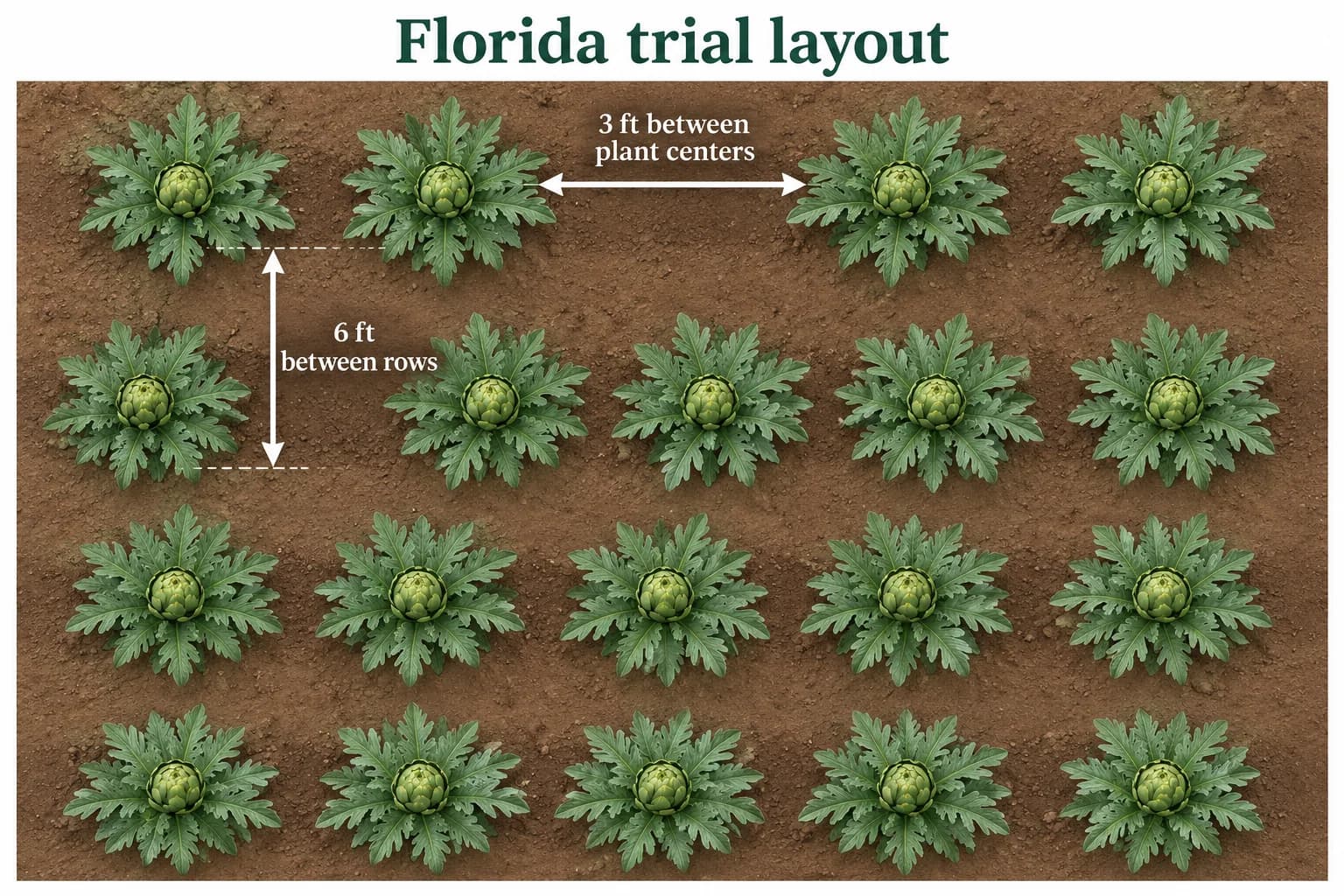
- 4. UF/IFAS Highlands County — Alternative crop research: Artichoke, blackberry, and hops — Alternative Crop Panel, February 2025. The separate Florida field-layout example shown in the spacing illustration: 6 ft between rows and 3 ft between plants. Not an Iowa recommendation.
Image credits
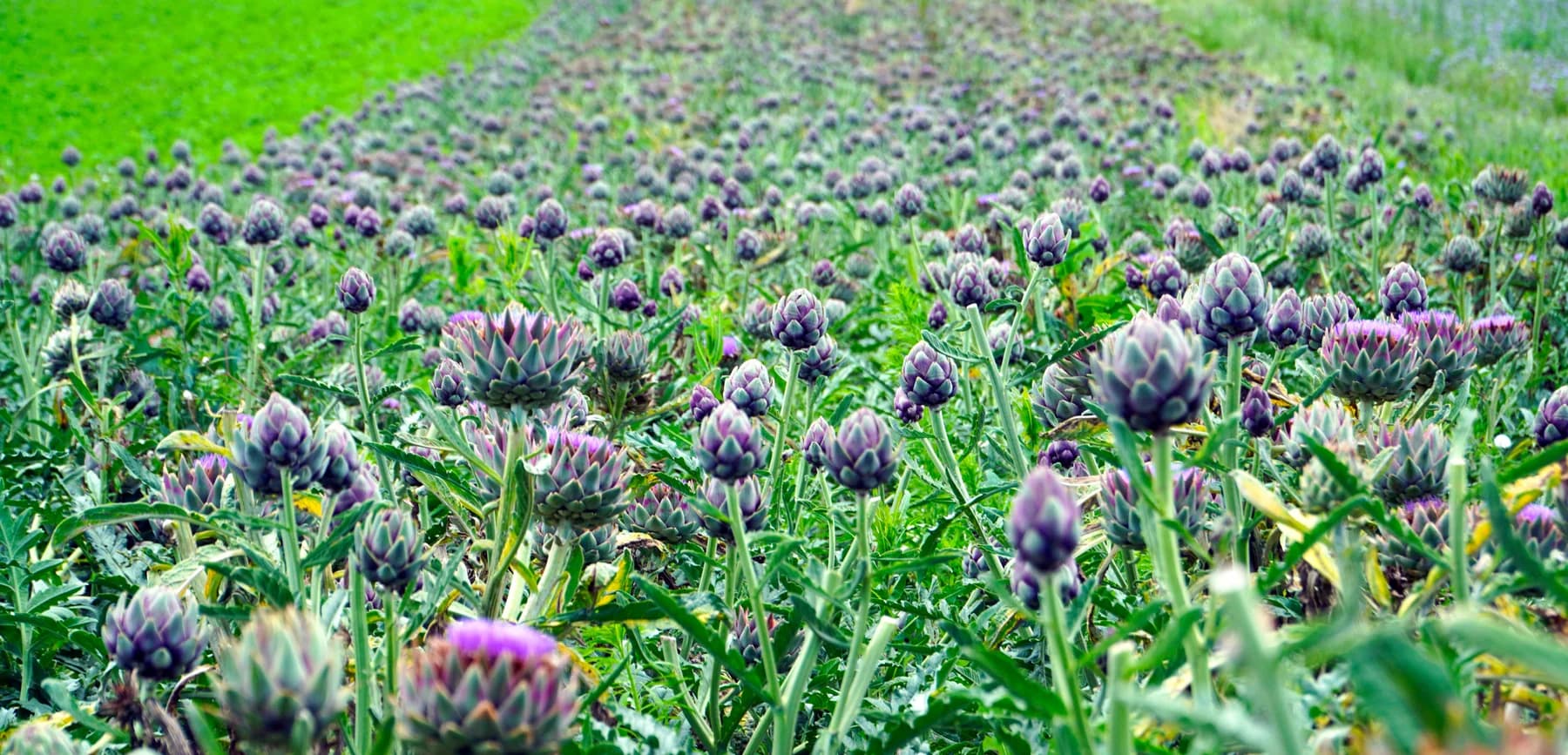
- Artichoke field. Photo: Matthias Böckel / Pixabay (image 5313977).
- Florida trial spacing example: 6 ft between rows and 3 ft between plants. Illustration, not an Iowa recommendation.
Figures are published averages or study assumptions for the places named, not guarantees for your field. Check current local recommendations and product labels before acting.
Some visuals in this guide are illustrations rather than photographs of a specific farm. See image credits.