

Growing artichokes in India
Plan artichoke production around your district’s temperatures, cultivar and crop system. India is too climatically diverse for one planting calendar. ICAR researchers in Srinagar describe the crop for temperate horticulture, but those conditions cannot establish performance elsewhere in India. Start with a small field trial and record establishment, flowering, marketable buds and buyer demand before expanding.
Scope: India-level site-screening guide with a temperate Srinagar research reference. FAO climate values are crop-level screening bounds, not Indian district recommendations. Updated 2026-10-05.
At a glance
- FAO EcoCrop optimal temperature reference
- 15–25°C; crop-level screening range, not a transplant threshold2
- FAO EcoCrop optimal annual rainfall
- 900–1,200 mm with well-drained soil; actual irrigation depends on site2
- Soil screening reference
- pH 6.0–6.5; medium-depth soil and good drainage2
- India-specific crop reference
- ICAR Indian Horticulture article by CITH Srinagar researchers, 20111
- Published field layout example
- Uvalde, Texas trial: 1.5 m beds and 0.9 m between plants; not an India recommendation3
Perennial growth and climate in India
A perennial planting remains in the field for multiple years. Establishment is a long-term investment; flowering, fruit development, harvest and plant care recur as the planting matures. Follow the named cultivar and production system.
Establish a long-lived planting1,2
Artichoke is listed as a perennial crop by FAO EcoCrop. Establish a trial only where seasonal temperature, drainage, soil pH, water supply and winter survival can be measured at the field site; the sources reviewed do not support a national planting month.
Management: Record the local crop cycle1,2
Track establishment, winter survival, bud initiation, marketable head quality and water use across more than one season before scaling. The ICAR Srinagar reference is crop-specific but its public record does not provide a current all-India production calendar.
Historical monthly climate
Reference period: 1996-01-01 to 2025-12-31. ERA5-Land monthly mean soil temperature at 0–7 cm, air temperature and frost days at the regional reference point (22, 79). Select a month to inspect its historical conditions.
Month tiles show mean air temperature.
January historical conditions
- Mean topsoil temperature
- 19.8°C
- Mean air temperature
- 18.5°C
- Mean frost days per month
- 0.0 days
Use this monthly history to assess winter exposure, seasonal heat and water planning. It does not calculate cultivar chill hours, flowering dates, frost damage during bloom or fruit maturity. Topsoil at 0–7 cm describes shallow soil context, not the full root zone. The monthly history does not establish a local flowering, maturity or harvest period.
Climate source: Open-Meteo Historical Weather APIScreen the climate before committing land
- Optimal minimum15 °C
- Optimal maximum25 °C
- Absolute minimum5 °C
- Absolute maximum30 °C
- Optimal minimum900 mm/year
- Optimal maximum1,200 mm/year
- Absolute minimum300 mm/year
- Absolute maximum1,500 mm/year
- Use the temperature range as a screen
- FAO EcoCrop lists 15–25°C as the optimal temperature range and 5–30°C as absolute bounds. The record does not define a monthly planting threshold or a cultivar-specific heat response for Indian districts.2
- Do not generalize from Srinagar to all India
- The ICAR article’s authors are affiliated with the Central Institute of Temperate Horticulture in Srinagar. It is a relevant temperate-region reference, not evidence that artichokes suit every Indian climate.1
Test soil, drainage and water at the proposed site
- Check pH and drainage
- FAO EcoCrop lists pH 6.0–6.5 as the optimal crop-level range and notes a medium-depth, well-drained soil context. These values can screen candidate fields; confirm them with a local soil test before choosing amendments.2
- Compare seasonal water supply
- The database lists 900–1,200 mm annual rainfall as optimal and 300–1,500 mm as its absolute range. Annual totals do not show dry spells, irrigation reliability or drainage after intense rain, so measure those at the proposed field.2
Use a measured pilot instead of borrowed yield targets
- 1
Establishment
Record survival, transplant uniformity and irrigation.
- 2
Bud initiation
Record date, temperature and cultivar.
- 3
Marketable heads
Grade head size, quality and market acceptance.
- 4
Stand persistence
Check crown survival and regrowth after the first cycle.
- Transplant response is a testable variable
- A two-year Texas field study found higher marketable yield from transplants than direct seeding in both seasons. Those results support comparing establishment methods in a local pilot; they do not predict Indian yield.3
Verify the buyer and postharvest chain
- Confirm demand before expanding
- The sources reviewed do not establish current Indian artichoke acreage, farm-gate pricing or a national market window. Speak with produce buyers and processors about head size, pack format, volume and cold-chain requirements before making a commercial investment.1
Frequently asked questions
- Can artichokes grow in India?
- The ICAR record includes an artichoke article by researchers at the Central Institute of Temperate Horticulture in Srinagar. Suitability still depends on the district’s temperatures, drainage and water supply; there is no single all-India calendar in the sources reviewed.
- What temperatures suit globe artichokes?
- FAO EcoCrop lists 15–25°C as the optimal crop-level temperature range and 5–30°C as absolute bounds. These are screening values, not a planting threshold for a particular Indian site.
- When should artichokes be planted in India?
- A national planting month is not supported by the available sources. Match establishment to the local climate and validate the timing with a multi-season field trial.
- What soil is suitable for artichokes?
- FAO EcoCrop lists pH 6.0–6.5, medium-depth soil and good drainage as crop-level references. Use local soil and water tests before setting a field plan.
Regional artichokes guides
Local dates, soil-temperature history and sources for specific regions:
Sources and image credits
- 1. ICAR Indian Horticulture — Globe artichoke: a nutritious vegetable for health and delicacy — Indian Horticulture, volume 56, issue 2, 2011. India-specific crop article authored by researchers affiliated with the Central Institute of Temperate Horticulture, Srinagar. The public record does not expose a current planting calendar or commercial yield series.
- 2. FAO EcoCrop — Cynara scolymus data sheet — Crop database record. General crop life span, temperature, annual rainfall, soil pH, soil depth and drainage screening values; not a local agronomic prescription.
- 3. Othman et al. — Direct Seeding and Transplanting Influence Root Dynamics, Morpho-Physiology, Yield, and Head Quality of Globe Artichoke — Published 2021. Two-year field experiment at Texas A&M AgriLife Uvalde, Texas: transplant versus direct-seeding results and the tested field layout. Not an Indian recommendation.
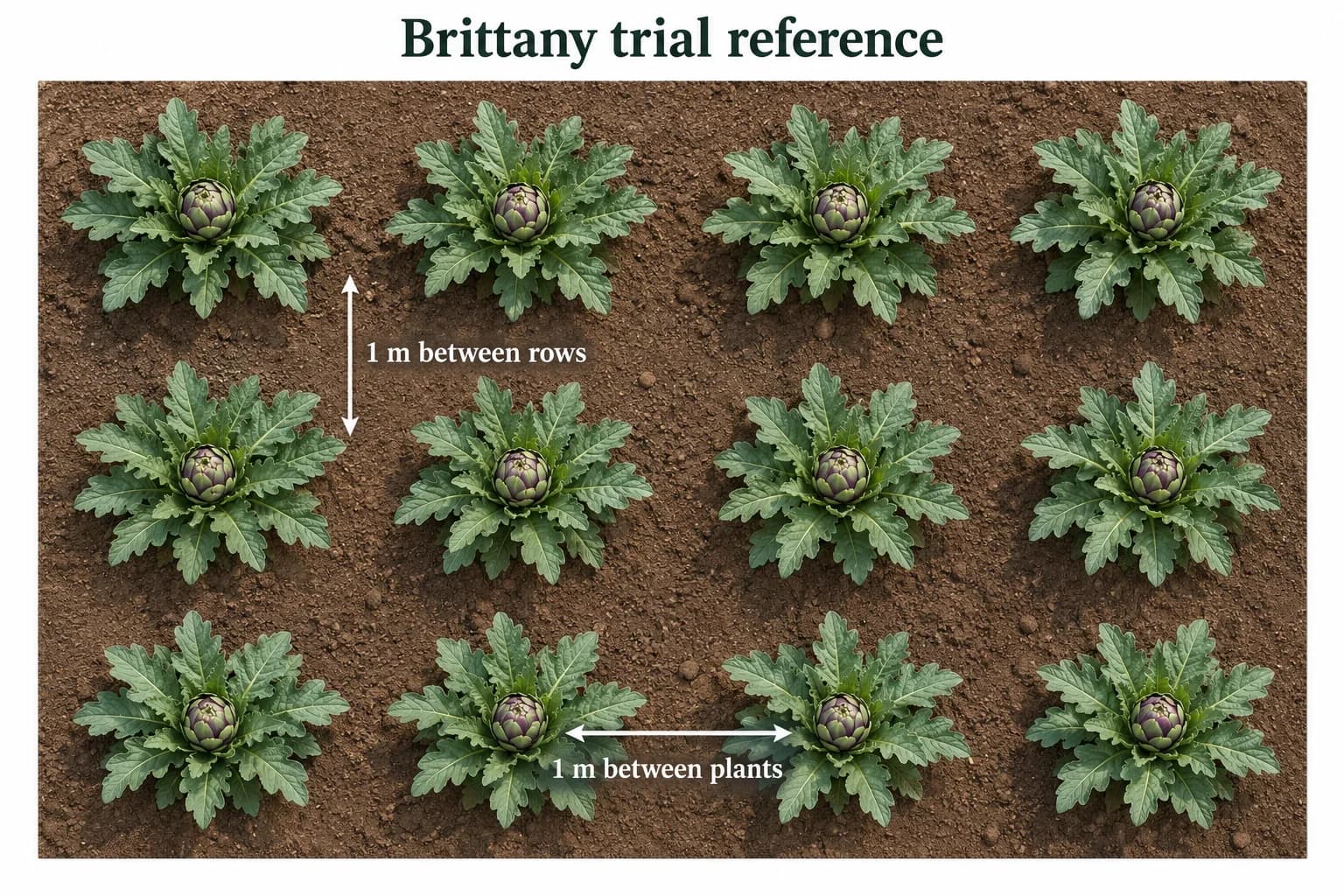
- 4. Chambre d’agriculture de Bretagne — Artichaut de semis: une nouvelle opportunité en Bretagne? — 2025 field follow-up; observations from 2023–2025. The separate Brittany comparison behind the 1 m square spacing illustration; not an Indian spacing recommendation.
Image credits
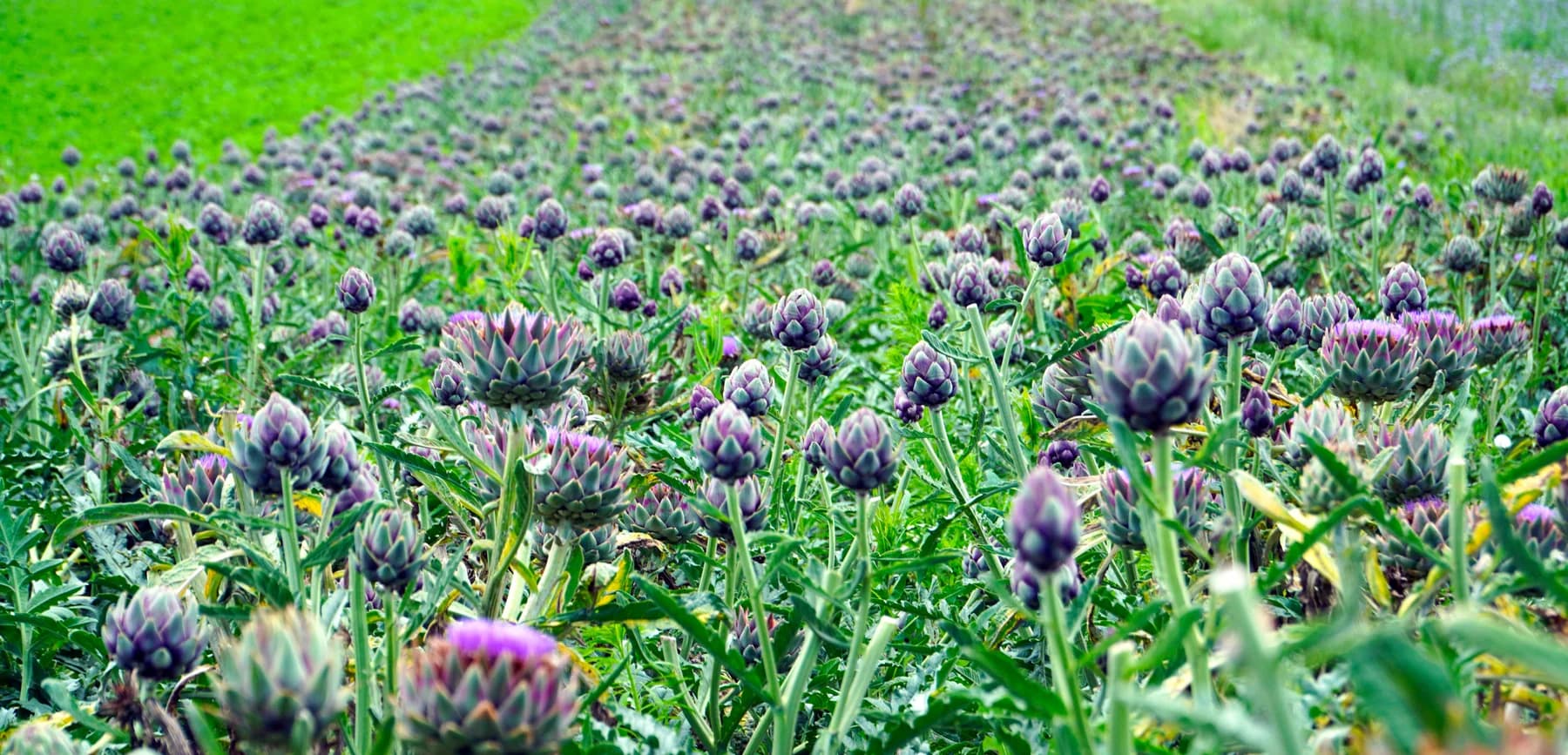
- Artichoke field. Photo: Matthias Böckel / Pixabay (image 5313977).
- Brittany trial spacing example: 1 m between rows and plants. Illustration, not an India recommendation.
Figures are published averages or study assumptions for the places named, not guarantees for your field. Check current local recommendations and product labels before acting.
Some visuals in this guide are illustrations rather than photographs of a specific farm. See image credits.