

How to grow grapes: a commercial guide
A vineyard is a 30-year capital investment with no real crop for three years. Site (frost, drainage, sun), variety and trellis are fixed at planting, so most of the decisions below are made before a vine goes in.
Scope: Commercial vineyards (wine and table grapes), US examples. Home vines are noted where they differ. Updated 2026-10-16.
At a glance
- Productive life
- At least 30 years1
- Row and vine spacing
- Rows about 2.4–3.7 m (8–12 ft); vines 1.8–2.4 m (6–8 ft) table grapes; 1,960 (1.5 × 3.4 m (5 × 11 ft)) to 3,840 (2.1 × 1.2 m (7 × 4 ft)) vines/ha in UC wine studies (792 to 1,555 per acre)1,2,3,4
- Establishment cost (UC Davis, Lodi 2021)
- $73,600/ha ($29,793/acre) accumulated by year 33
Choose the site first
- Sun and slope
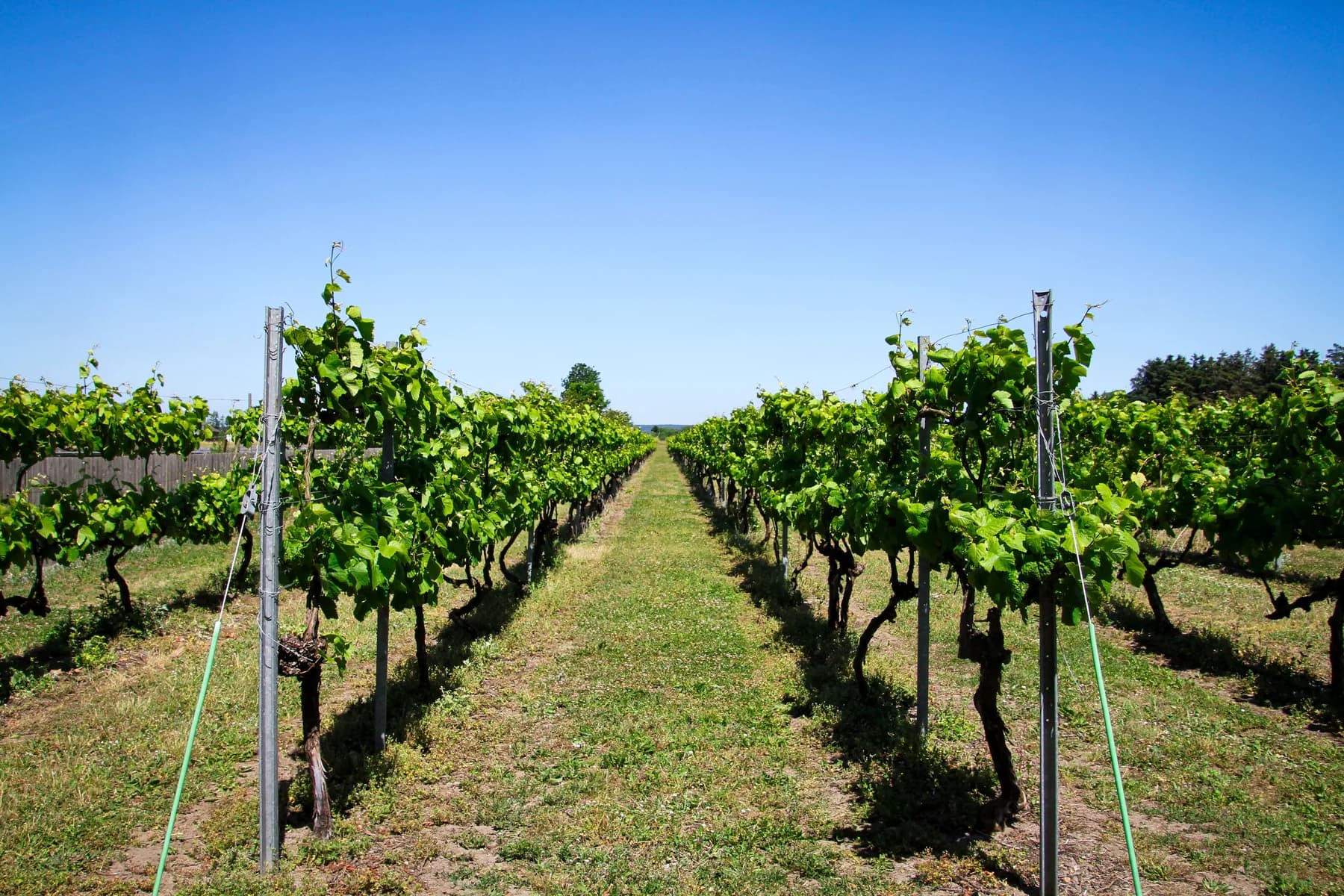
- Full sun is required for good production. Run rows north–south where possible, prefer south or southwest slopes and avoid low spots where spring frost collects. A sunny hillside also gives air drainage that lowers frost risk.1,2
- Climate and season length
- Check winter minimum temperatures, late-spring frost frequency and growing degree days (base 10°C (50°F), April 1 – October 31) against the variety you intend to grow.1
- Soil
- Well-drained soil; deeper soil supports a larger root system. Fertilize only when a soil test or leaf-tissue analysis shows a deficiency.1
Design the vineyard layout
| Source | Row spacing | Vine spacing | Vines/ha |
|---|---|---|---|
| Penn State (table grapes) | commonly 2.4 m (8 ft) | 2.1–2.4 m (7–8 ft) | — |
| Oregon State (table grapes) | 2.7–3 m (9–10 ft) single canopy; 3.4–3.7 m (11–12 ft) Geneva Double Curtain | 1.8 m (6 ft) European, 1.8–2.4 m (6–8 ft) American | — |
| UC Davis, Lodi 2021 (Cabernet) | 3.4 m (11 ft) | 1.5 m (5 ft) | 1,960 |
| UC Davis, Napa 2020 (Cabernet) | 2.1 m (7 ft) | 1.2 m (4 ft) | 3,840 |
- End posts: at least 6 in diameter, set at a 60-degree angle
- Line posts: at least 3 in diameter; all posts 8 ft long
- Fruiting wire: at least 12.5-gauge high-tensile; end-post wires 9-gauge
Schematic, not to scale. Dimensions are Penn State's table-grape example; wine-grape systems vary.
- Midwest hybrids (2.4 × 3 m (8 × 10 ft))1,350 vines/ha
- Lodi Cabernet (1.5 × 3.4 m (5 × 11 ft))1,960 vines/ha
- Finger Lakes (1.8 × 2.7 m (6 × 9 ft))1,990 vines/ha
- Yakima Merlot (1.5 × 2.7 m (5 × 9 ft))2,390 vines/ha
- Ontario Chardonnay (2.7 × 1.2 m (9 × 4 ft))2,990 vines/ha
- Willamette Pinot (1.5 × 2.1 m (5 × 7 ft))3,080 vines/ha
- Napa Cabernet (2.1 × 1.2 m (7 × 4 ft))3,840 vines/ha
- Rows no closer than trellis height
- Do not plant rows closer together than the height of the intended trellis, and leave headlands wide enough for your tractor and sprayer.1
- Trellis specification
- Penn State’s table-grape example uses 2.4 m (8-foot) posts, end posts at least 15 cm (6 inches) in diameter set at a 60-degree angle, line posts at least 7.5 cm (3 inches), and fruiting wire of at least 12.5-gauge high-tensile.1
Plant and train the young vine
- 1
Year 1
Plant, cut back to one cane of two buds, train a single shoot. Remove fruit.
- 2
Year 2
Build trunk and cordons. Still remove fruit.
- 3
Year 3
First crop, often small (3.4–11.2 t/ha (1.5–5 t/acre) in the UC budgets).
- 4
Years 5–6
Full production, depending on cultivar and management.
- 5
30+ years
Expected productive life for a well-managed vineyard (Penn State).
- Year 1 training
- Prune off all but one vigorous one-year-old cane from nursery stock and cut it back to two buds.2
Prune every year
- Timing and severity
- Prune as late as possible in winter but before buds open. Typically about 90% of the previous season’s growth is removed.1,2
- Bud load
- Leave roughly 20–60 buds per mature vine depending on climate, soil and cultivar. A well-managed mature table-grape vine yields 6.8–16 kg (15–35 lb).2
Expect disease and insect pressure
- Diseases
- Black rot, botrytis bunch rot, downy mildew, powdery mildew, Phomopsis cane and leaf spot and crown gall are the main diseases in Penn State’s guide.1
- Insects
- Grape berry moth, leafhoppers, phylloxera, grape root borers, Japanese beetles and spotted-wing drosophila.1,2
- Vertebrates
- Oregon State also lists birds, deer and rodents as pests; budget for exclusion.2
Harvest
- Table grapes
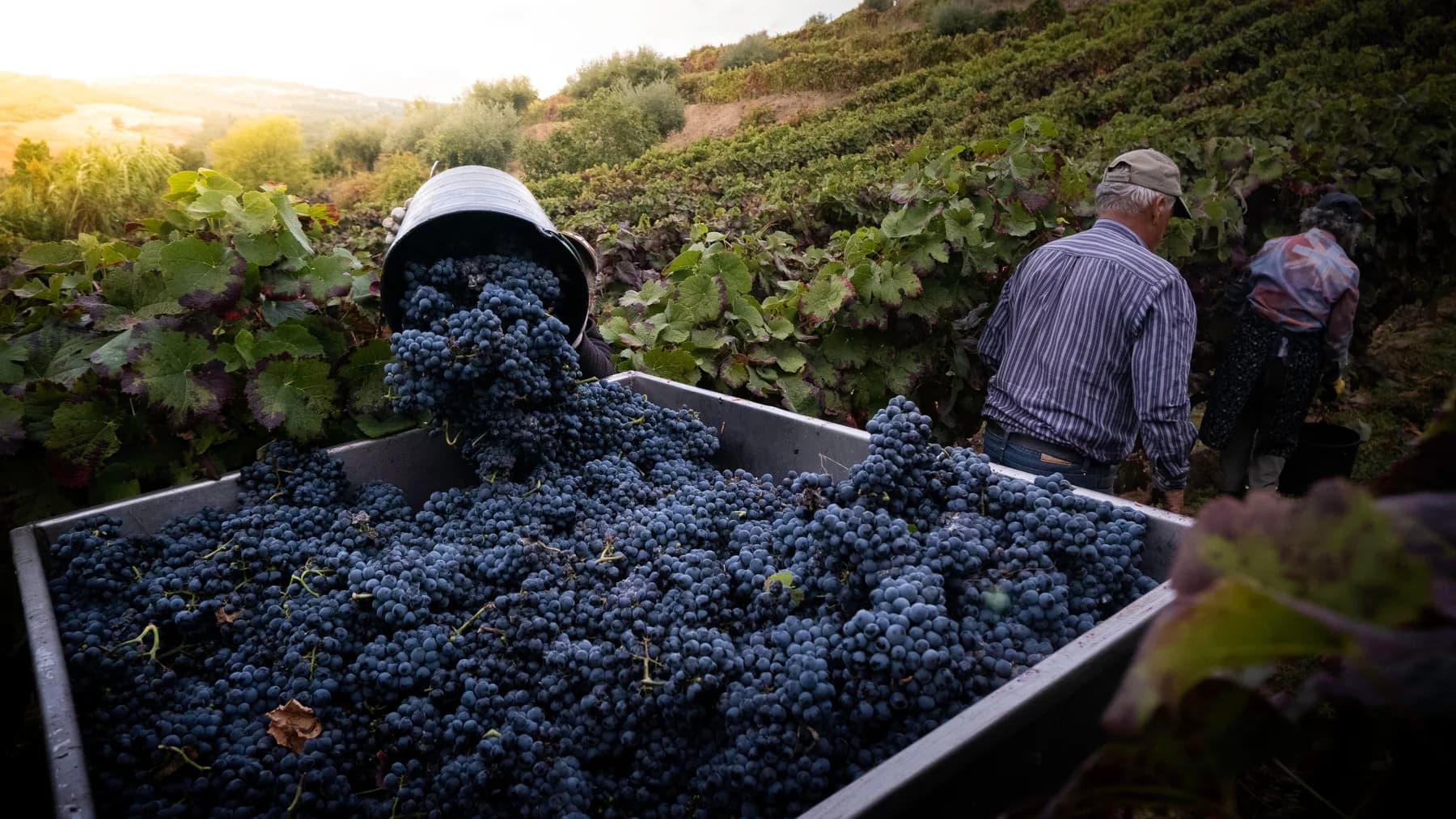
- In Pennsylvania picking generally starts in mid-August and continues through late September, in several passes for ripeness. Pick by eating quality, cluster condition and buyer grade.1
- Wine grapes
- Sample berries from many vines and track °Brix, pH and titratable acidity against the winery’s target, then set the pick date.5
What a vineyard costs and returns
These are California wine-grape cost studies, not a forecast for your site. They show the shape of the investment: heavy spend up front, little income until year 3–4.
| Study | Accumulated net cost by year 3 | Yield assumption | Price assumption |
|---|---|---|---|
| San Joaquin Valley North (Lodi), 2021 | $73,600/ha ($29,793/acre) (year 1 $19,437; year 2 $26,573) | Year 3: 11.2 t/ha (5 t/acre); mature (year 4+): 22.4 t/ha (10 t/acre) | $660/t ($600/short ton) |
| Napa County, 2020 | $196,000/ha ($79,333/acre) (includes non-cash ownership overhead; land assumed $494,200/ha ($200,000/acre)) | Year 3: 3.4 t/ha (1.5 t/acre); long-run 9.0 t/ha (4.0 t/acre) | $9,040/t ($8,200/short ton) |
- Lodi, 202173,600 $/ha
- Napa, 2020 (incl. ownership overhead)196,000 $/ha
Frequently asked questions
- How long until grapevines produce a crop?
- A small crop in year 3 and full production in years 5–6. Remove clusters in the first two years.
- How far apart do you plant grapevines?
- Table-grape examples use rows about 2.4–3.7 m (8–12 feet) apart and vines 1.8–2.4 m (6–8 feet) apart. UC Davis wine-grape cost studies use 1,960 vines per ha (792 vines/acre) (1.5 × 3.4 m (5 × 11 ft)) and 3,840 vines per ha (1,555 vines/acre) (2.1 × 1.2 m (7 × 4 ft)). Choose spacing for trellis, vigour and equipment.
- When do you prune grapevines?
- In late winter, as late as possible but before buds open, removing about 90% of the previous season’s growth.
- How much does it cost to establish a vineyard?
- UC Davis sample costs accumulated $73,600 per hectare ($29,793 per acre) by year 3 in Lodi (2021) and $196,000 per hectare ($79,333 per acre) in Napa (2020, including ownership overhead). Your costs depend on land, vines, trellis and irrigation.
- Can grapes grow in cold climates?
- Yes with cold-hardy cultivars, good air drainage and frost-free sites. Check winter minimums and growing degree days for the cultivar; see the regional guides for documented examples.
Regional guides and field planning
Sources and image credits
- 1. Penn State Extension — Table Grape Production — Accessed 30 September 2026. Site selection, spacing, trellis posts and wire, years to crop, pruning, diseases and insects, harvest timing. Pennsylvania table grapes.
- 2. Oregon State University Extension — Growing Table Grapes (EC 1639) — Accessed 30 September 2026. Spacing, training, pruning, bud load, yield per vine, production timeline and pests. Oregon table grapes.
- 3. UC Davis — Sample Costs to Establish a Vineyard and Produce Winegrapes, San Joaquin Valley North 2021 (Cabernet Sauvignon) — 2021, amended February 2022. Lodi sample vineyard; one study, not a recommendation.
- 4. UC Davis — Sample Costs to Establish a Vineyard and Produce Winegrapes, Napa County 2020 (Cabernet Sauvignon) — 2020. Napa sample vineyard with high land value; one study, not a recommendation.
- 5. Iowa State University — Grape Sampling for Maturity Analysis — 9 December 2020. Representative sampling and °Brix, pH and titratable-acidity checks before harvest.
- 6. Purdue University — Economics of Midwestern Grape Production (B. Bordelon) — Older budget; prices are outdated. Own-rooted French-hybrid budget: 2.4 × 3 m (8 × 10 ft), 1,350 vines per ha (545 vines/acre). Used for density only.
- 7. Washington State University — Wine Grape Establishment and Production Costs in Washington (EB1955) — 2003; prices are outdated. Yakima Valley budget: 1.5 × 2.7 m (5 × 9 ft), 2,390 vines per ha (968 vines/acre). Used for density only.
- 8. Cornell University — Cost of Establishment and Production of V. vinifera Grapes in the Finger Lakes (EB 2014-01) — February 2014 (2013 costs). 1.8 × 2.7 m (6 × 9 ft), 1,990 vines per ha (807 vines/acre). Used for density only.
- 9. Oregon State University — Establishing and Producing Pinot Noir Wine Grapes in Western Oregon (EM 8969-E) — Budget using 2007 statistics. 1.5 × 2.1 m (5 × 7 ft), 3,080 vines per ha (1,245 vines/acre). Used for density only.
- 10. Grape Growers of Ontario — Establishment & Production Costs for Grapes in Ontario, 2023 — 2023. Chardonnay and Cabernet franc 2.7 × 1.2 m (9 × 4 ft), 2,990 vines per ha (1,210 vines/acre). Used for density only.
Image credits
- Trellised vineyard rows. Photo: Eva Kristiansson, via Pexels (Pexels License).
- Hand harvest. Photo: Pedro Rebelo Pereira, via Pexels (Pexels License).
Figures are published averages or study assumptions for the places named, not guarantees for your field. Check current local recommendations and product labels before acting.