

How to grow cucumbers: a commercial guide
Cucumbers are a fast, frost-tender vine that pays for steady water and frequent picking. The decisions that matter are planting only into warm soil, the spacing for slicing or pickling, keeping beetles under a threshold that is lower than for melons, and harvesting every second or third day. Figures are Midwest and Pennsylvania commercial practice.
Scope: Commercial field cucumbers, northern US. Greenhouse and southern production differ in dates and inputs. Updated 2026-10-16.
At a glance
- Slicing spacing
- Midwest: rows 1.2–1.8 m (4–6 ft), plants 38–46 cm (15–18 in). Penn State: rows 1.5–2.1 m (5–7 ft), plants 23–30 cm (9–12 in)1,2
- Pickling (machine harvest)
- Rows 46–51 cm (18–20 in), plants 12.5–18 cm (5–7 in); 135,910–160,620 plants per ha (55,000–65,000 plants/acre)1,2
- Water
- About 2.5–5 cm (1–2 in) per week, steady through blossoming and fruiting1
- Storage
- 13°C (55°F) and 95% humidity; about 10–14 days2
- US average yield, 2025
- About 19.1 t/ha (170 cwt/acre); 649,000 t (14.3 million cwt) from 34,100 ha harvested (84,300 acres)3
Slicing, pickling and other types
- Types
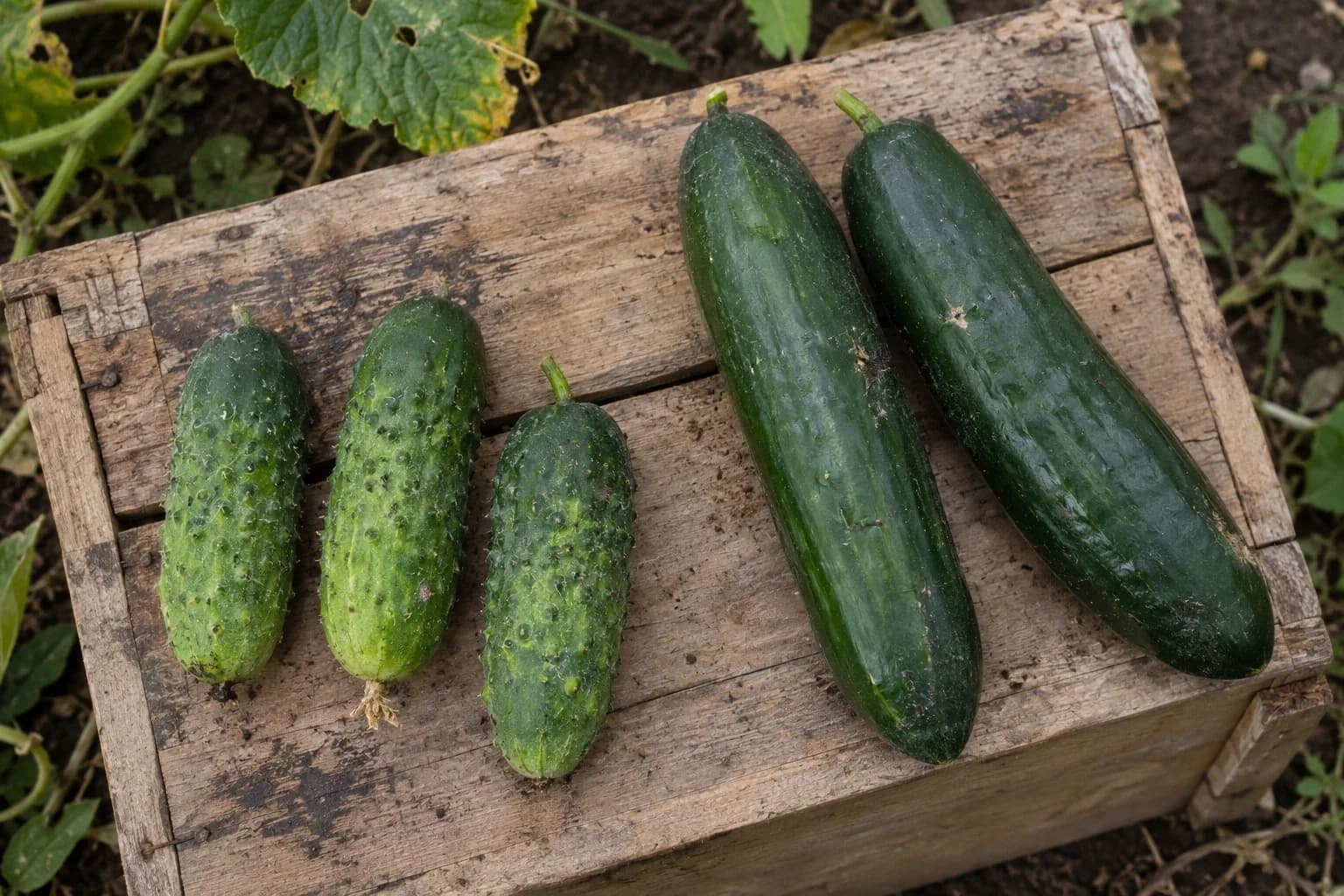
- All are Cucumis sativus. Fresh-market slicers have thick dark skin and a few large spines and are usually grown on the ground. European greenhouse types are long, thin-skinned, seedless and trellised in greenhouses. Beit alpha types are shorter, thin-skinned and spineless, grown in the field or under cover. Pickling types are short with thin skins and large spines and suit field production; they can also be sold fresh.1
- Gynoecious and parthenocarpic varieties
- Gynoecious varieties make mainly female flowers and, unless they are also parthenocarpic, need a pollenizer variety, which is usually included in the seed packet. Parthenocarpic varieties set fruit without pollination and stay seedless; if they are pollinated they do make seeds.1
Plant into warm soil
Between rows: 1.2–1.8 m (4–6 ft) · Within the row: 38–46 cm (15–18 in)
Pickling cucumbers for machine harvest are far tighter: rows 46–51 cm (18–20 in), plants 12.5–18 cm (5–7 in). Penn State slicing: rows 1.5–2.1 m (5–7 ft), plants 23–30 cm (9–12 in). Schematic, not to scale.
- Date and temperature
- Plant after the danger of frost. Air below 10°C (50°F) causes chilling injury and direct-seeded crops need soil above 16°C (60°F); Penn State waits until soil 7.5 cm (3 inches) deep reaches 16°C (60°F). Planting into cold, wet soil gives poor emergence. Growth is best between 18°C (65°F) and 35°C (95°F).1,2
- Seed or transplant
- Transplants are started 18–24 days before field planting at Penn State.2
- Spacing
- The Midwest guide gives fresh-market rows 1.2–1.8 m (4–6 ft) apart with plants 38–46 cm (15–18 inches) apart. Penn State uses rows 1.5–2.1 m (5–7 ft) apart with plants 23–30 cm (9–12 inches) apart. Machine-harvested pickles are grown at 135,910–160,620 plants per ha (55,000–65,000 plants per acre).1,2
- Soil
- Penn State recommends pH 5.8–6.6 and soil with good infiltration and moisture-holding capacity.2
Feed and water evenly
- Penn State (half preplant, half through drip)84 kg N/ha
- Processing: preplant45 kg N/ha
- Processing: sidedress45 kg N/ha
- Nutrient uptake
- Melons, pumpkins, squash and fresh-market cucumbers accumulate roughly 165–180 kg/ha (145–160 lb/acre) N, 34–50 kg/ha (30–45 lb/acre) P2O5 and 180–200 kg K2O/ha (160–180 lb K2O per acre) in vines and fruit. Adjust nitrogen for soil organic matter and credits; set phosphorus and potassium from a soil test.1
- Programmes
- On plastic with drip, apply 34–39 kg/ha (30–35 lb/acre) N before planting and fertigate 0.6–2.2 kg N/ha (0.5–2 lb N per acre) per day. Processing cucumbers get 45 kg/ha (40 lb/acre) N before planting and another 45 kg/ha (40 lb/acre) sidedressed. Penn State applies 85 kg/ha (75 lb/acre) N, half before planting and the rest through the drip line.1,2
- Water
- Plan on roughly 2.5–5 cm (1–2 inches) of water a week, depending on soil. An irregular supply during blossoming and fruit development raises the share of nubs and hooked fruit.1
Scout beetles, then mildew
- Cucumber beetles
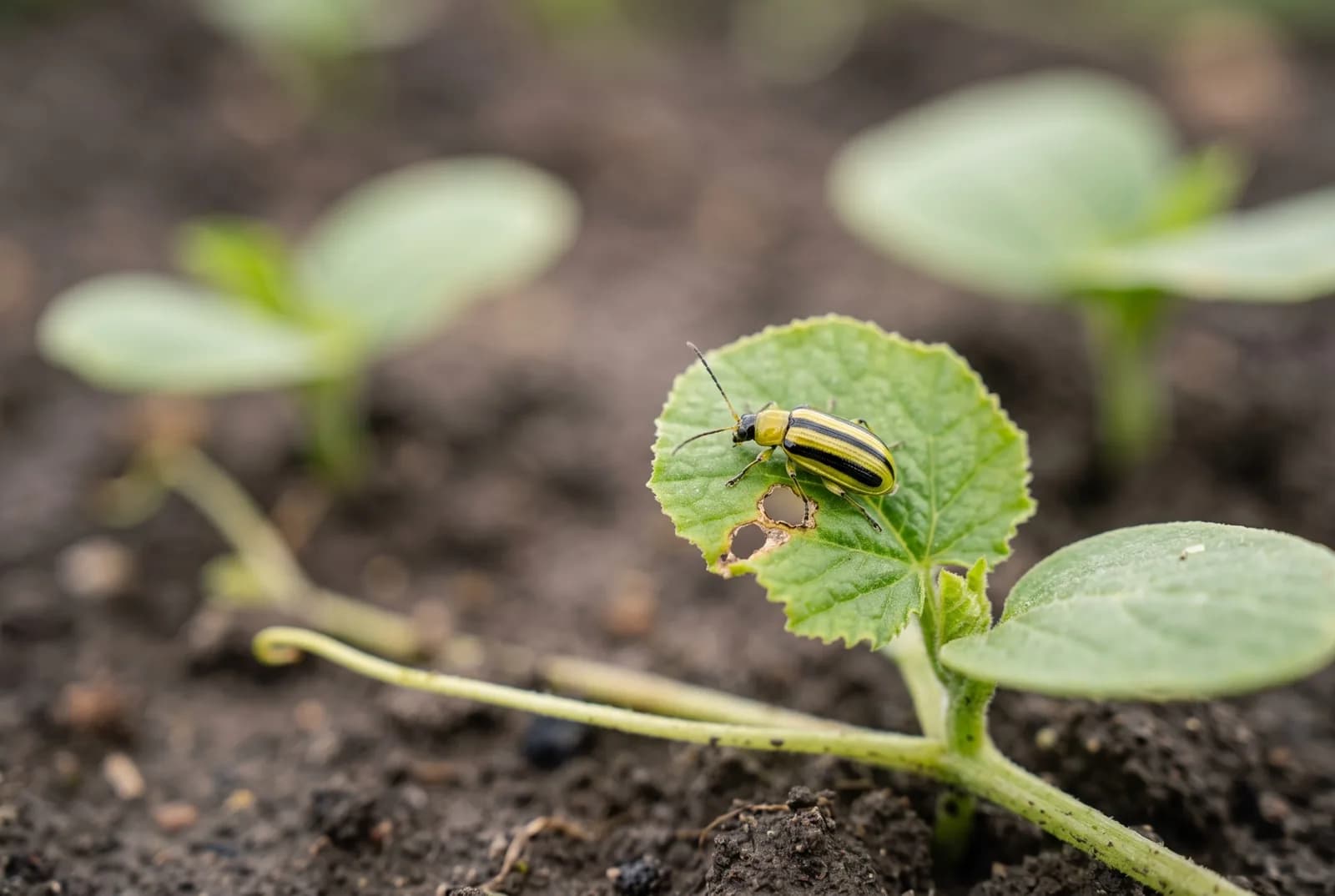
- Cucumbers are less tolerant than melons. Treat at 0.5 beetle per plant from seedling to the 4-leaf stage and at 1 beetle per plant from 4-leaf to harvest. Watermelon, pumpkin and squash are allowed 1 and 5. Weekly scouting is enough, and contact insecticides go on in the evening when bees are not foraging.1
- Bacterial wilt
- Wilt is mainly a disease of cucumber and melon and is spread by the beetles, so control depends on beetle control. Apply a systemic insecticide at transplant, then contact insecticides when it wears off after 2–3 weeks.1
- Downy mildew
- Clade 2 of the pathogen attacks cucumber and cantaloupe. It does not overwinter in the Midwest; wind brings spores north as early as July, or not at all. Clade 2 resists some fungicides quickly, including strobilurins and mefenoxam. Partially resistant cucumber varieties exist.1
- Powdery mildew
- Powdery mildew is primarily a disease of cantaloupe, cucumber, pumpkin and squash and does not need leaf wetness. Resistance to fungicide groups 1 and 11 has been found in the Midwest, so alternate modes of action.1
Pick every second or third day
- 1
Wait for warmth
Soil 7.5 cm (3 in) deep above 16°C (60°F), nights above 10°C (50°F).
- 2
Sow or transplant
Rows and spacing for slicing or pickling.
- 3
Scout beetles
0.5 per plant to 4-leaf, then 1 per plant.
- 4
Pick often
Every 2–4 days; slicers 12.5–20 cm (5–8 in) long, 4–5 cm (1.5–2 in) across.
- 5
Cool
13°C (55°F) and 95% humidity.
- 6
Sell
About 10–14 days shelf life.
- Frequency
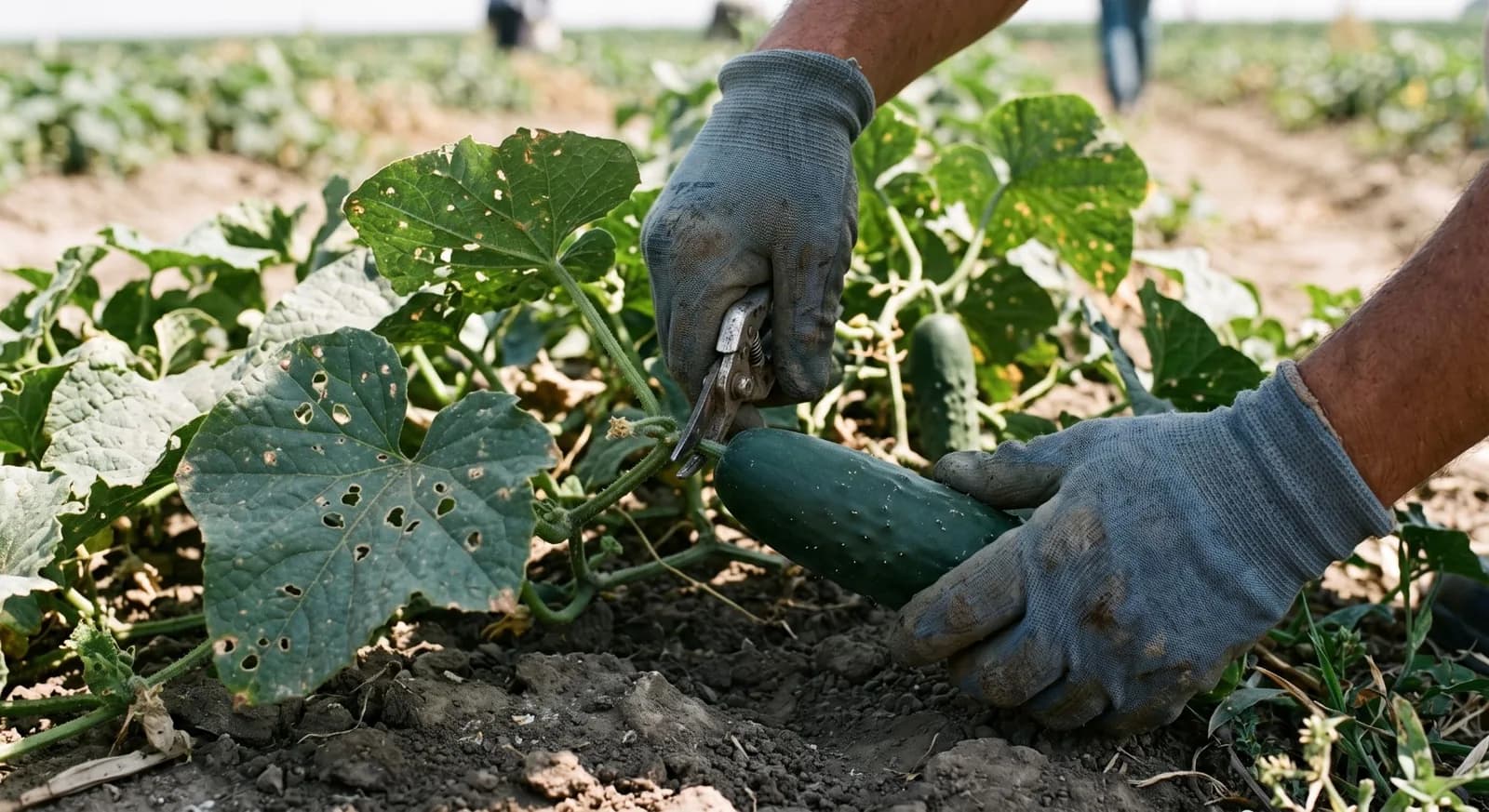
- Unless a once-over mechanical harvester is used, pick every two to four days to avoid oversized, over-mature fruit. Penn State picks about every other day.1,2
- Size
- Slicers are picked at 12.5–20 cm (5–8 inches) long and 4–5 cm (1.5–2 inches) across (Penn State: 15–20 cm (6–8 inches) and 3–5 cm (1.25–2 inches)). Processors pay by size grade, so read the contract before the season.1,2
- Storage
- Hold at 13°C (55°F) and 95% relative humidity for about 10–14 days.2
Yield and economics
US cucumber production in 2025 was 649,000 t (14.3 million cwt) from 34,100 ha harvested (84,300 acres; 85,500 acres or about 34,600 ha planted), worth $256 million. Of the utilized crop, 147,000 t (3.24 million cwt) went to the fresh market and 494,000 t (544,452 short tons) to processing. The national average was about 19.1 t/ha (170 cwt per harvested acre), and states vary widely.
- Georgia24.7 t/ha
- Florida23 t/ha
- North Carolina21.9 t/ha
- California19.1 t/ha
- Wisconsin17.4 t/ha
- Michigan16.8 t/ha
- Texas12.9 t/ha
- What drives margin
- Yield, picking labour and the fresh-versus-processing split decide returns; state averages mix both markets. Put your own numbers into the crop ROI estimator before choosing acreage.3
Frequently asked questions
- When do you plant cucumbers?
- After the danger of frost, once soil 7.5 cm (3 inches) deep is above 16°C (60°F) and nights stay above 10°C (50°F). Cold, wet soil gives poor emergence.
- How far apart do you plant cucumbers?
- The Midwest guide gives fresh-market rows 1.2–1.8 m (4–6 feet) apart with plants 38–46 cm (15–18 inches) apart; Penn State uses rows 1.5–2.1 m (5–7 feet) apart and plants 23–30 cm (9–12 inches) apart. Machine-harvested pickles go at 135,910–160,620 plants per ha (55,000–65,000 plants per acre).
- How much water do cucumbers need?
- About 2.5–5 cm (1–2 inches) a week depending on soil. An irregular supply during flowering and fruiting raises the share of nubs and hooked fruit.
- How often do you pick cucumbers?
- Every two to four days. Slicers are picked at 12.5–20 cm (5–8 inches) long and 4–5 cm (1.5–2 inches) across, and leaving fruit on the vine produces oversized fruit.
- What is the cucumber beetle threshold?
- Treat at 0.5 beetle per plant from seedling to the 4-leaf stage and at 1 beetle per plant from 4-leaf to harvest. That is lower than for watermelon, pumpkin and squash.
- How long do cucumbers keep?
- About 10–14 days at 13°C (55°F) and 95% relative humidity.
Regional guides and field planning
Sources and image credits
- 1. Midwest Vegetable Production Guide 2026 — Cucurbit Crops: Horticulture, Diseases and Insects — 2026 edition; horticulture reviewed 2022, diseases 2023, insects 2025. Midwest commercial melons, watermelon, pumpkins and squash: types, planting dates, spacing, fertility, harvest signs, bacterial wilt, Phytophthora, powdery mildew and cucumber-beetle thresholds.
- 2. Penn State Extension — Cucumber Production — Accessed 1 October 2026. Pennsylvania seeding and transplant timing, slicing and pickling populations, pH, nitrogen, harvest size, storage and diseases.
- 3. USDA NASS — Vegetables 2025 Summary — Published February 2026. US planted and harvested area, production and value; per-acre yields here are derived as production ÷ harvested acres.
Image credits
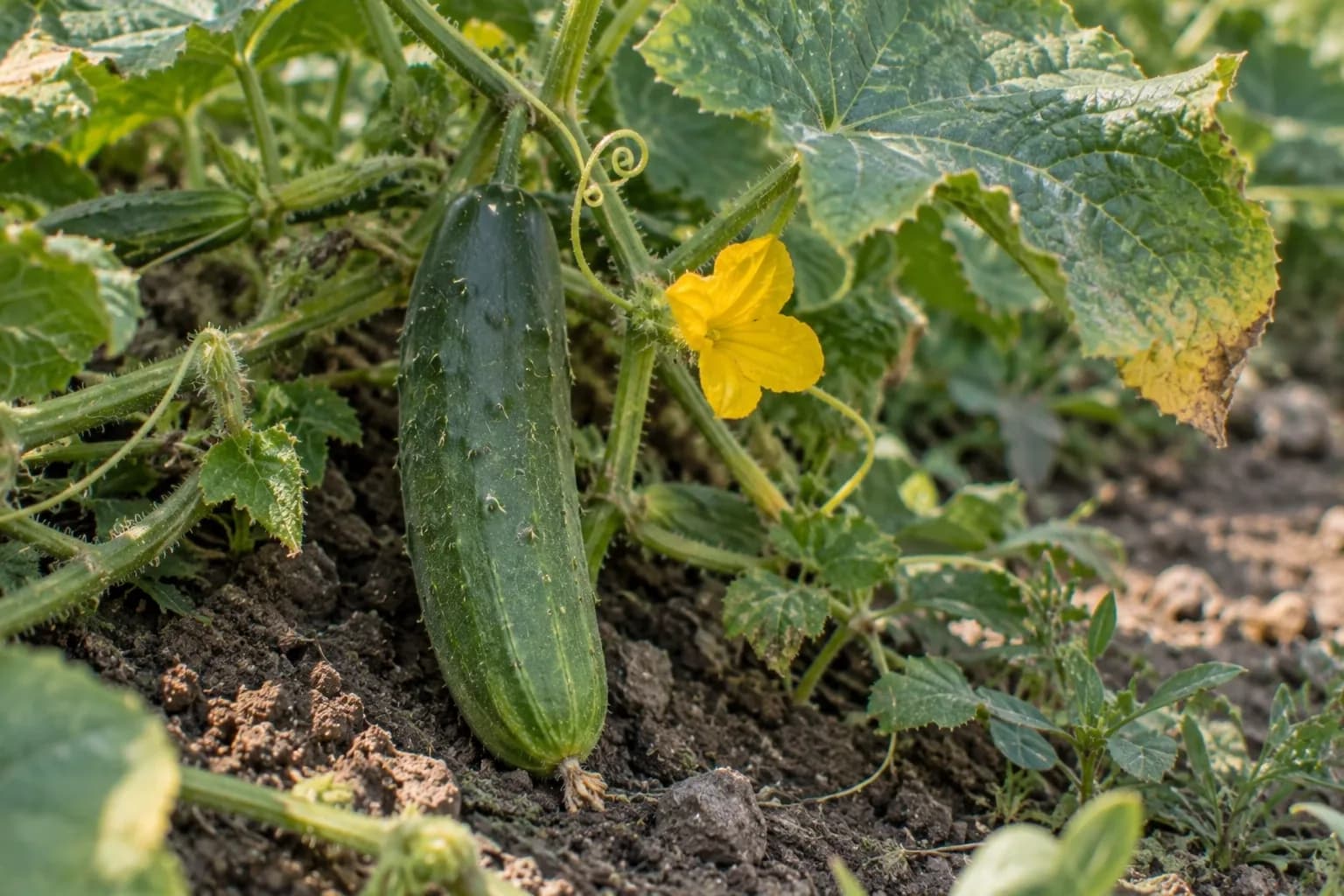
- A slicing cucumber at picking size on a ground vine, with a flower open beside it.
- Pickling types (left) are short and spiny; slicing types (right) are longer and smoother.
- Cut slicing cucumbers at 12.5–20 cm (5–8 inches) long; fruit is picked every two to four days.
- Striped cucumber beetle on a seedling. Cucumbers have a lower beetle threshold than melons: treat at 0.5 per plant before the 4-leaf stage.
Figures are published averages or study assumptions for the places named, not guarantees for your field. Check current local recommendations and product labels before acting.
Some visuals in this guide are illustrations rather than photographs of a specific farm. See image credits.