

Growing cucumbers in India
Cucumber is grown through different windows across India. Kerala has separate irrigated and rainfed calendars, Tamil Nadu guidance lists summer and monsoon sowing, and ICAR gives a mid-April to May example for Kashmir. Choose the local production system first; these dates are regional examples, not one all-India schedule.
Scope: Open-field cucumber with state and regional extension examples from Tamil Nadu, Kerala, Kashmir and Anjaw. Dates, spacing, varieties and input rates vary by agro-climate and market; no national yield or profit is implied. Updated 2026-10-07.
At a glance
- Planting dates
- Local examples range from January to June; follow the state and production-system calendar1,2,3
- Kashmir spacing example
- Varieties: 1.2 × 0.3 m; hybrids: 1.5 × 0.5 m1
- Climate example
- Frost-free conditions; KVK Anjaw lists 24–28°C as a favourable range4
- First harvest
- About 60–70 days after sowing in the Anjaw package; varies with season and cultivar4
Planting and harvest calendar for India
Use the source-backed production windows to coordinate establishment, crop care and harvest. Production districts and cultivars can have different cycles; the historical climate adds context for the field plan.
Planting: Regional sowing examples1,2,3
This combines different local recommendations, not a continuous nationwide window: TNAU lists January–April or June; Kerala lists January–March with irrigation and May–June rainfed after early rains; ICAR gives mid-April–May for Kashmir.
Harvest: First harvest reference4
The KVK Anjaw package gives about 60–70 days from sowing, depending on variety and season. Use fruit size and market grade, not the calendar alone, to schedule repeated picking.
Historical monthly climate
Reference period: 1996-01-01 to 2025-12-31. ERA5-Land monthly mean soil temperature at 0–7 cm, air temperature and frost days at the regional reference point (22, 79). Select a month to inspect its historical conditions.
Month tiles show mean topsoil temperature.
January historical conditions
- Mean topsoil temperature
- 19.8°C
- Mean air temperature
- 18.5°C
- Mean frost days per month
- 0.0 days
These are monthly means at one reference location. They describe seasonal field conditions, not crop maturity, actual seed-zone conditions, frost forecasts or a planting recommendation. Harvest bands follow the crop-specific production sources above.
Climate source: Open-Meteo Historical Weather APIChoose the local season and system
India does not have one cucumber planting calendar. Temperature, monsoon timing, irrigation and market type change the local crop plan.
| Region or source area | Sowing example | Basis |
|---|---|---|
| Tamil Nadu | January–April or June | State agricultural university guidance |
| Kerala | January–March irrigated; May–June rainfed after early rains | State agricultural university guidance |
| Kashmir | Mid-April–May | ICAR Kharif 2025 advisory |
| Anjaw hills | April–May | KVK package |
- Match the crop to a frost-free period
- Cucumber is frost-tender. The Anjaw package lists 24–28°C as a favourable temperature range and calls for good sunshine; avoid applying that hill-region figure as a national forecast.4
- Select the market type first
- Choose a locally accepted fresh-market variety or hybrid and confirm seed availability before preparing a large area. The 2025 ICAR advisory names Kashmir-specific varieties and hybrids; it does not establish a national cultivar ranking.1
Set a field layout for the cultivar
Between rows: 1.2 m (variety) or 1.5 m (hybrid) · Within the row: 30 cm (variety) or 50 cm (hybrid)
The advisory also gives 2–3 seeds per hill. This is a Kashmir reference, not a default for every Indian field. Schematic, not to scale.
- Direct seeding and spacing
- For Kashmir conditions, ICAR gives 1.2 × 0.3 m for listed varieties and 1.5 × 0.5 m for hybrids, with 2–3 seeds per hill. TNAU instead describes planting on a channel side at 0.6 m between hills; use the locally recommended layout for your production system.1,2
- Raised beds or channels
- TNAU describes channels for open-field production and raised beds with drip for hybrid cucumber. Keep the bed or channel drained and make sure the layout leaves room for vines, picking and irrigation lines.2
- Train where the system calls for it
- The Anjaw KVK package describes supporting vines on a bower once plants reach about 20–30 cm. This is a local practice; do not treat it as mandatory in every production system.4
Manage moisture and nutrients by field evidence
- Keep moisture steady
- Use irrigation to avoid moisture stress during flowering and fruit enlargement, while preventing waterlogging. TNAU recommends irrigation before dibbling and then weekly in its field example; frequency will change with soil, rainfall, bed design and crop stage.2
- Base fertilizer on soil and system
- TNAU separates a channel-grown crop from a drip-fertigated hybrid programme. Do not transfer the hybrid rate or one state’s nutrient schedule to a different soil without a soil test and local recommendation.2
- Drip can improve root-zone delivery
- An ICAR field study in eastern India found improved soil-moisture uniformity with subsurface drip. Its tested fertigation and lateral depth are research treatments, not a universal cucumber prescription.5
Pick at the stage your market wants
- Japanese Long Green9 t/ha
- Pusa Sanyog20 t/ha
- Shalimar Hybrid 155 t/ha
- Shalimar Hybrid 262.5 t/ha
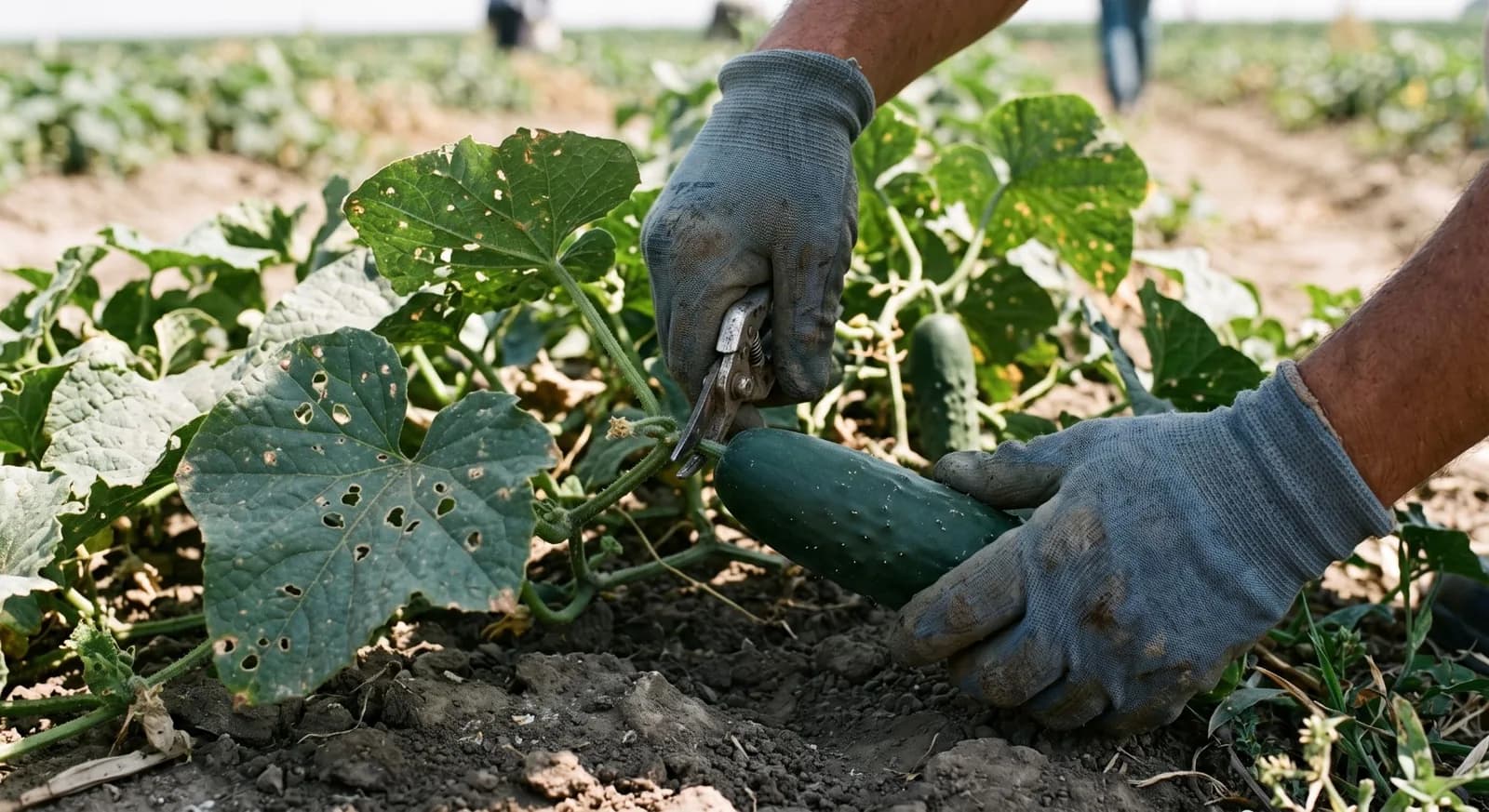
- Harvest tender fruit repeatedly
- The Anjaw package estimates first harvest at 60–70 days, depending on variety and season, and describes fruit with immature seeds as ready. Pick size should match the buyer’s fresh-market or processing grade.4
- Use local output claims cautiously
- ICAR’s 2025 advisory lists different yield estimates for named Kashmir varieties and hybrids. Those figures are advisory targets for the named material and region, not observed Indian averages or a farm-profit forecast.1
Frequently asked questions
- When should cucumbers be planted in India?
- There is no single national window. TNAU lists January–April or June, Kerala separates irrigated and rainfed seasons, and ICAR gives a mid-April–May example for Kashmir.
- How far apart should cucumbers be planted?
- For Kashmir, ICAR lists 1.2 × 0.3 m for varieties and 1.5 × 0.5 m for hybrids. TNAU gives a different 0.6 m hill interval on channels.
- What temperatures suit cucumbers?
- Cucumbers need frost-free weather. The KVK Anjaw package gives 24–28°C as a favourable range for its regional context.
- How long until cucumber harvest?
- The KVK Anjaw package estimates 60–70 days after sowing, depending on variety and season. Check fruit size and maturity for the target market.
- Can cucumbers be grown with drip irrigation in India?
- Yes. TNAU describes drip layouts for hybrid production, and an ICAR study evaluated subsurface drip. Design and fertigation should match the soil and local recommendations.
Regional cucumber guides
Local dates, soil-temperature history and sources for specific regions:
Sources and image credits
- 1. ICAR — Kharif Agro-Advisories for Farmers 2025 — 2025. Cucumber varieties, sowing, spacing and fertilizer examples for Kashmir conditions; these are not national recommendations.
- 2. Tamil Nadu Agricultural University — Cucumber production — Accessed 7 October 2026. Tamil Nadu sowing seasons, field and drip layout, crop care and harvest.
- 3. Kerala Agricultural University — Cucumber: climate and season — Accessed 7 October 2026. Kerala irrigated and rainfed sowing periods and production context.
- 4. Krishi Vigyan Kendra Anjaw — Cucumber package — Accessed 7 October 2026. Frost-free climate, temperature range, hill sowing, bower training and days to first harvest.
- 5. ICAR — Influence of drip lateral placement depth and fertigation level on cucumber — 2016. Three-year cucumber field study in eastern India on subsurface drip placement, fertigation and yield response.
Image credits
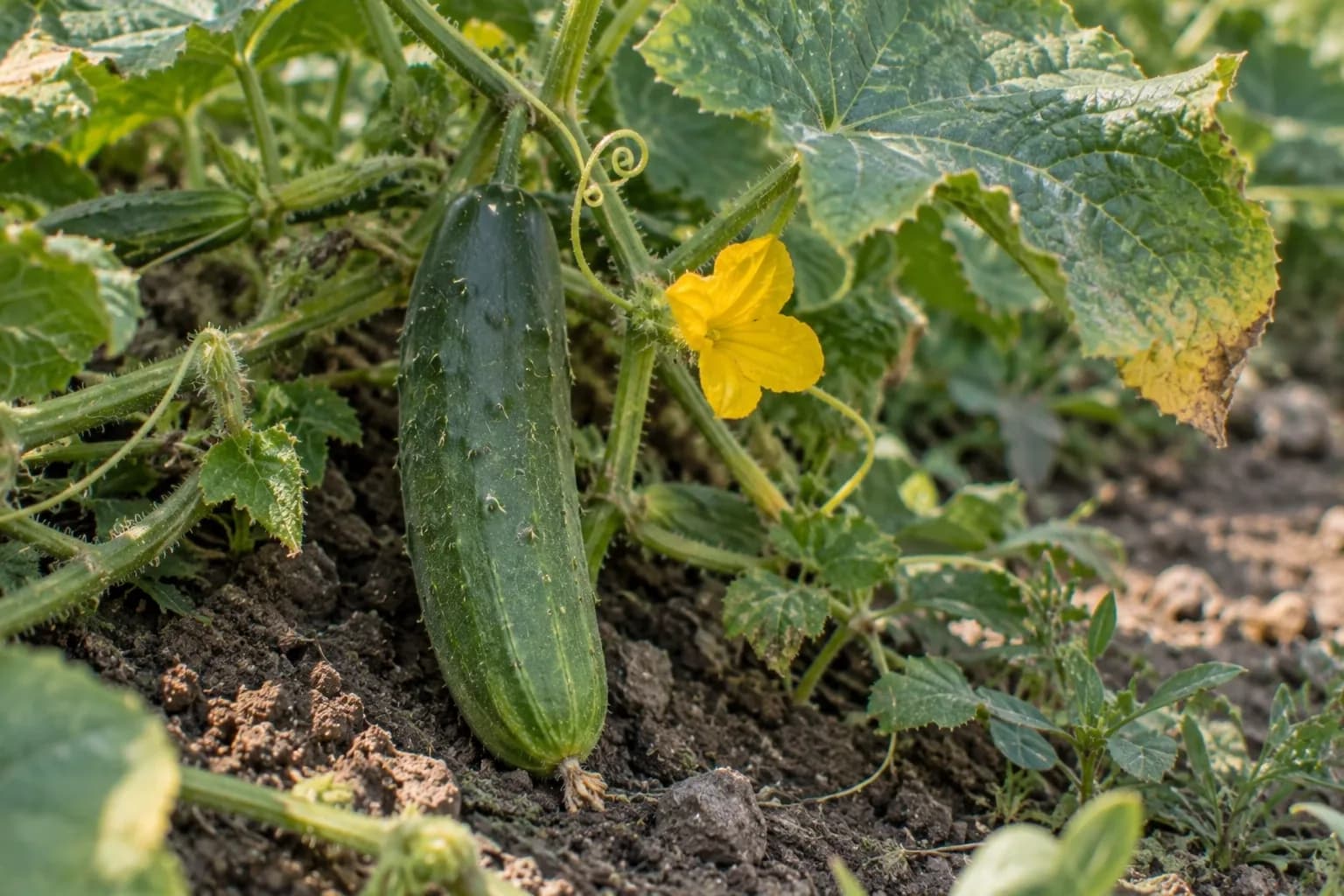
- Cucumber fruit on the vine. Illustration; growing systems and cultivars vary by region.
- Cucumber harvest example. Illustration; harvest size depends on market type.
Figures are published averages or study assumptions for the places named, not guarantees for your field. Check current local recommendations and product labels before acting.
Some visuals in this guide are illustrations rather than photographs of a specific farm. See image credits.