

Growing peach in Washington
Commercial peach orchards are documented in Washington’s Yakima County. Public WSU material supports site establishment and tree-fruit water-quality planning, but current peach-specific spacing, thinning rates and harvest protocols remain less complete than for other tree fruits.
By AgriAuditor. Updated .
Scope: Commercial fresh-market peach orchards in Washington, centered on documented Yakima production. Home-orchard instructions and apple-specific rates are excluded.
At a glance
- Commercial presence
- WSU lists more than 1,000 peach acres in Yakima County; source page year is unspecified1
- Production area
- Yakima County: WSU reports more than 1,000 peach acres; statistic year unspecified1,2
- Water planning
- WSU describes irrigation as the largest seasonal input in Central Washington orchards3
- Harvest context
- A state food-season chart shows late June–September market availability, not block maturity dates4
Perennial growth and climate in Washington
A perennial planting remains in the field for multiple years. Establishment is a long-term investment; flowering, fruit development, harvest and plant care recur as the planting matures. Follow the named cultivar and production system.
Establish a long-lived planting1,2,3,4,5
Choose establishment timing with a local adviser using your cultivar, planting material and field conditions in Washington. A single month cannot cover every site and production system. The historical climate display describes one regional reference point.
Historical monthly climate
Reference period: 1996-01-01 to 2025-12-31. ERA5-Land monthly mean soil temperature at 0–7 cm, air temperature and frost days at the regional reference point (47, -119.5). Select a month to inspect its historical conditions.
Month tiles show mean air temperature.
January historical conditions
- Mean topsoil temperature
- -0.1°C
- Mean air temperature
- -0.4°C
- Mean frost days per month
- 26.8 days
Use this monthly history to assess winter exposure, seasonal heat and water planning. It does not calculate cultivar chill hours, flowering dates, frost damage during bloom or fruit maturity. Topsoil at 0–7 cm describes shallow soil context, not the full root zone. The monthly history does not establish a local flowering, maturity or harvest period.
Climate source: Open-Meteo Historical Weather APISelect an orchard site and cultivar with local support
- 1
Choose a production district
Use documented Yakima production and seek peach-specific evidence for other districts.
- 2
Test field soil
Review drainage, pH, compaction and replant history.
- 3
Assess frost exposure
Use local weather history and proposed cultivar bloom.
- 4
Plan market and rootstock
Confirm harvest timing and buyer specifications.
- Use tree-fruit establishment guidance carefully
- WSU orchard-establishment guidance emphasizes soil drainage, pH, soil testing, frost history, replant conditions, rootstock and market planning. These are tree-fruit establishment principles; confirm peach-specific cultivar and chill needs before planting.2
Test irrigation water and soil before setting inputs
- 1
Test irrigation water
Check salinity and nutrient contribution.
- 2
Sample soil and foliage
Use current crop and local extension protocols.
- 3
Schedule by block
Account for soil, canopy and weather differences.
- 4
Record inputs and response
Use harvest performance to refine the next season.
- Water quality affects the orchard plan
- WSU’s Central Washington tree-fruit nutrition guidance identifies irrigation as the largest seasonal input and recommends testing water because it can contribute minerals and nitrate-N. This supports water-quality testing, not a fixed peach irrigation or fertilizer schedule.3
Do not copy unverified peach rates
- 1
Confirm cultivar protocol
Use peach-specific chilling, bloom and maturity data.
- 2
Set a tested canopy system
Align rootstock and row design to machinery.
- 3
Monitor crop load
Use local experience and fruit-size requirements.
- 4
Check product registrations
Follow current Washington labels and extension advice.
- Public peach-specific detail is limited
- The sources reviewed do not establish current Washington peach spacing, fertilizer rates, crop-load thinning distances or field irrigation volumes. Use current WSU or local grower guidance for these decisions rather than borrowing apple maturity, pesticide or canopy recommendations.2,3
Meet fresh-fruit grade and handling requirements
- 1
Estimate crop maturity
Use current cultivar and district guidance.
- 2
Sample fruit quality
Check firmness, size and buyer criteria.
- 3
Pack to current standards
Follow WSDA commercial grade and packing requirements.
- 4
Coordinate delivery
Plan labor, cooling and market windows.
- Market availability is not a harvest prescription
- Washington’s broad late-June-to-September chart is a food-availability indicator, not a block-level maturity protocol. WSDA’s commercial trucker reference gives fresh peach grading and packing requirements; use cultivar-specific maturity advice for actual picking.4,5
Frequently asked questions
- Where are peaches grown commercially in Washington?
- WSU identifies more than 1,000 peach acres in Yakima County; its page does not state the statistic year. Confirm current county data when planning acreage.
- When are Washington peaches harvested?
- The state food-season chart shows broad availability from late June to September. It is not a cultivar-specific orchard harvest calendar.
- How much should Washington peach orchards be irrigated?
- WSU emphasizes water testing and block-specific irrigation planning but the reviewed sources do not provide a fixed peach rate. Use current local scheduling guidance and field measurements.
- What peach spacing should I use in Washington?
- The sources reviewed do not establish one current commercial spacing. Confirm cultivar, rootstock, canopy system and equipment with peach-specific local expertise.
Regional peach guides
Sources and image credits
- 1. WSU Extension — Yakima County crop production — Current county extension page; statistic year not stated. Commercial crop presence and peach-acre context for Yakima County.
- 2. WSU Tree Fruit — Orchard establishment — Extension guidance. Site, soil, frost, replant, rootstock and market planning for orchard establishment.
- 3. WSU Extension — Tree fruit soil fertility and plant nutrition in Central Washington — Central Washington technical publication. Irrigation water, nutrient testing and general tree-fruit inputs; not peach-specific rate recommendations.
- 4. Washington Office of Superintendent of Public Instruction — Harvest of the Month: Peaches — 2025. Broad state market availability window, not field harvest maturity.
- 5. Washington State Department of Agriculture — Trucker’s Reference: Peaches — Current commercial standard page. Fresh peach commercial grade, pack and shipment requirements.
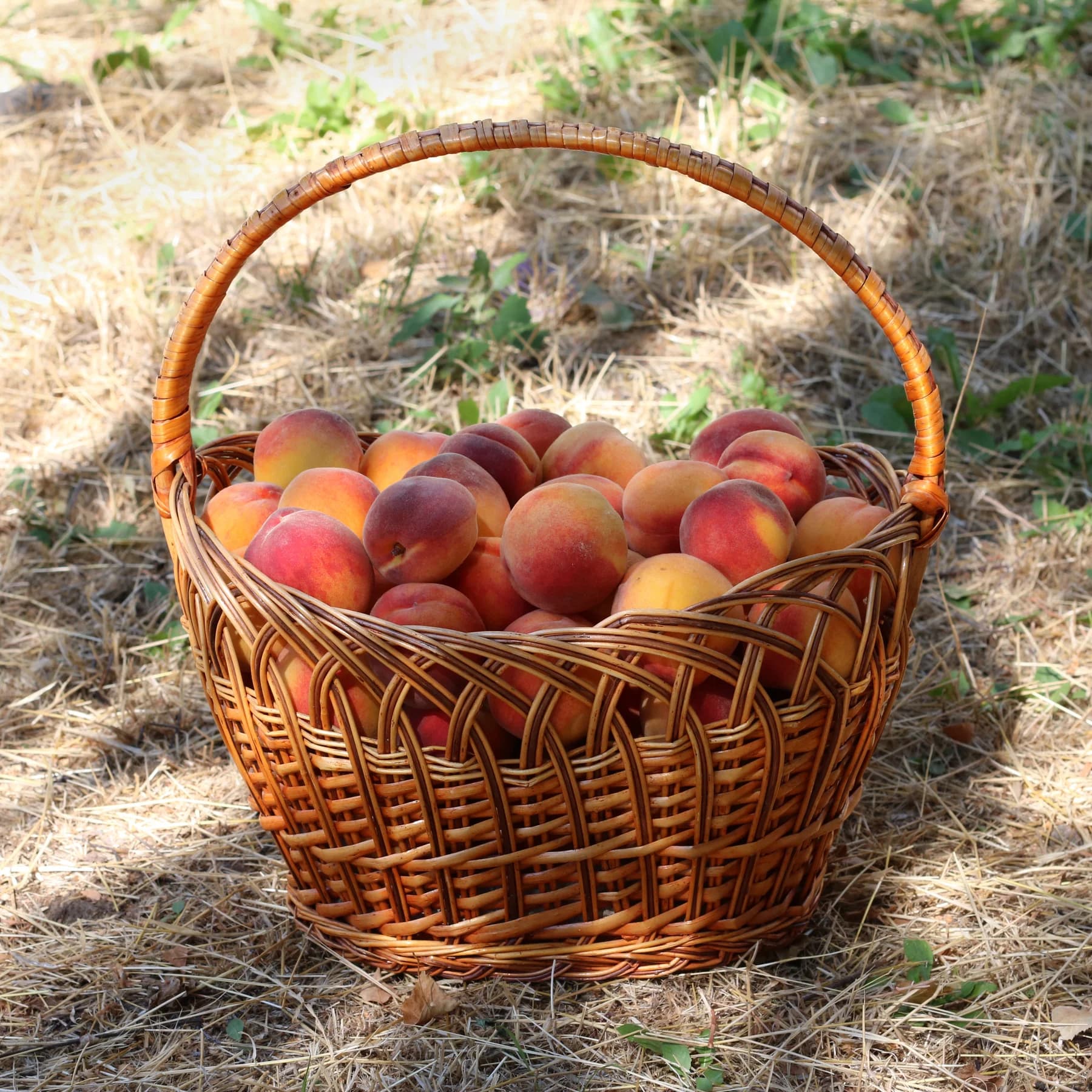
- 6. Peaches in basket 2026 G1 — George Chernilevsky — August 14, 2026. Harvested fruit photographed in Vinnytsia district, Ukraine. Product reference; does not document Spanish or Washington orchard production, picking technique or grading.
- 7. Peach photograph license — CC BY 4.0 — Creative Commons Attribution 4.0. Peach photograph resized and converted to WebP with photographer attribution.
Image credits
- Harvested peaches in Ukraine. Photo: George Chernilevsky, CC BY 4.0; resized and converted to WebP.
Figures are published averages or study assumptions for the places named, not guarantees for your field. Check current local recommendations and product labels before acting.