

Growing peach in Spain
Spanish peach production includes early and late fresh-market peaches, flat peaches and nectarines across distinct regions. Intensive canopy systems and commercial spacing differ among farms; the Calanda DOP is a specific late-yellow-peach system, not a national recipe or harvest calendar.
Scope: Commercial fresh-market peach orchards in Spain. Nectarines and flat peaches are distinguished where relevant; Calanda DOP details apply only to its protected regional system. Updated 2026-10-07.
At a glance
Perennial growth and climate in Spain
A perennial planting remains in the field for multiple years. Establishment is a long-term investment; flowering, fruit development, harvest and plant care recur as the planting matures. Follow the named cultivar and production system.
Establish a long-lived planting1,2,3,4
Choose establishment timing with a local adviser using your cultivar, planting material and field conditions in Spain. A single month cannot cover every site and production system. The historical climate display describes one regional reference point.
Historical monthly climate
Reference period: 1996-01-01 to 2025-12-31. ERA5-Land monthly mean soil temperature at 0–7 cm, air temperature and frost days at the regional reference point (40.2, -3.7). Select a month to inspect its historical conditions.
Month tiles show mean air temperature.
January historical conditions
- Mean topsoil temperature
- 4.7°C
- Mean air temperature
- 5.4°C
- Mean frost days per month
- 13.6 days
Use this monthly history to assess winter exposure, seasonal heat and water planning. It does not calculate cultivar chill hours, flowering dates, frost damage during bloom or fruit maturity. Topsoil at 0–7 cm describes shallow soil context, not the full root zone. The monthly history does not establish a local flowering, maturity or harvest period.
Climate source: Open-Meteo Historical Weather APIChoose cultivar and maturity class for the region
- 1
Choose production region
Match site conditions to the target cultivar.
- 2
Define maturity class
Early, late, flat peach and nectarine markets differ.
- 3
Choose canopy design
Evaluate labor, equipment and density tradeoffs.
- 4
Set buyer specification
Confirm size, maturity, packing and delivery requirements.
- A national label hides distinct orchard systems
- MAPA’s 2022 typical-farm report separates early, late and DOP operations. The IRTA review documents intensive central-leader and bi-axis canopy systems. Keep chill needs, harvest season, labor and buyer class tied to the specific region and cultivar.1,2
Interpret spacing and density as farm examples
- 1
Read farm profile
Keep region, crop class and year attached to each layout.
- 2
Check rootstock and vigor
These affect tree density and canopy management.
- 3
Plan labor access
Align rows and training with pruning and harvest equipment.
- 4
Validate locally
Obtain current regional advice before planting.
Keep Calanda DOP practices within scope
- 1
Verify DOP area and population
Use the official specification for the protected system.
- 2
Assess local chill
The cited requirement is for the Calanda late population.
- 3
Plan crop load
Follow local thinning and bagging practice.
- 4
Coordinate water and harvest
Use the DOP protocol and actual fruit maturity.
- The DOP is a specific late-peach system
- The Calanda specification describes at least 1,000 chill hours for its late population, drip irrigation/fertigation, thinning and fruit bagging. These practices and timings apply to that Bajo Aragón designation and should not be generalized to Spain’s early or other regional orchards.3
Use current production and market data
- 1
Select region and cultivar class
Estimate yield and date from current local evidence.
- 2
Price labor and inputs
Include thinning, pruning, bagging where relevant, picking and packing.
- 3
Check market outlet
Use current buyer and export specifications.
- 4
Update public statistics
Use the latest MAPA production advance, not a dated forecast.
Frequently asked questions
- When are peaches harvested in Spain?
- Spanish harvest timing varies by region, cultivar and maturity class. Older national summaries span a broad season; use current local cultivar and buyer information.
- What spacing is used in Spanish peach orchards?
- MAPA’s 2022 typical-farm profiles show several layouts, and intensive studies use higher densities. Match spacing to rootstock, canopy, region and equipment.
- Does the Calanda peach chill requirement apply to all Spain?
- No. At least 1,000 chill hours is specified for the Calanda late population, a particular Bajo Aragón system.
- Are peaches and nectarines managed the same way?
- They share some orchard operations, but market class, maturity and cultivar-specific requirements differ. Plan each block around its fruit type and buyer.
Regional peach guides
Local dates, soil-temperature history and sources for specific regions:
Sources and image credits
- 1. Iglesias and Echeverria — Current situation, trends and challenges for efficient and sustainable peach production — 2022. Spanish intensive orchard systems, evaluated densities, canopy forms and labor context.
- 2. Spanish Ministry of Agriculture — Peach typical-farm results, 2022 campaign — 2022 campaign. Surveyed farm layouts, maturity systems and farm economics; dated benchmark, not prescription.
- 3. Spanish Ministry of Agriculture — Melocotón de Calanda DOP specification — Protected designation specification. Local late-peach chill, crop management, bloom and fruit-handling requirements.
- 4. Spanish Ministry of Agriculture — Agricultural area and production advances — Updated releases. Use the latest national area and output release for current market statistics.
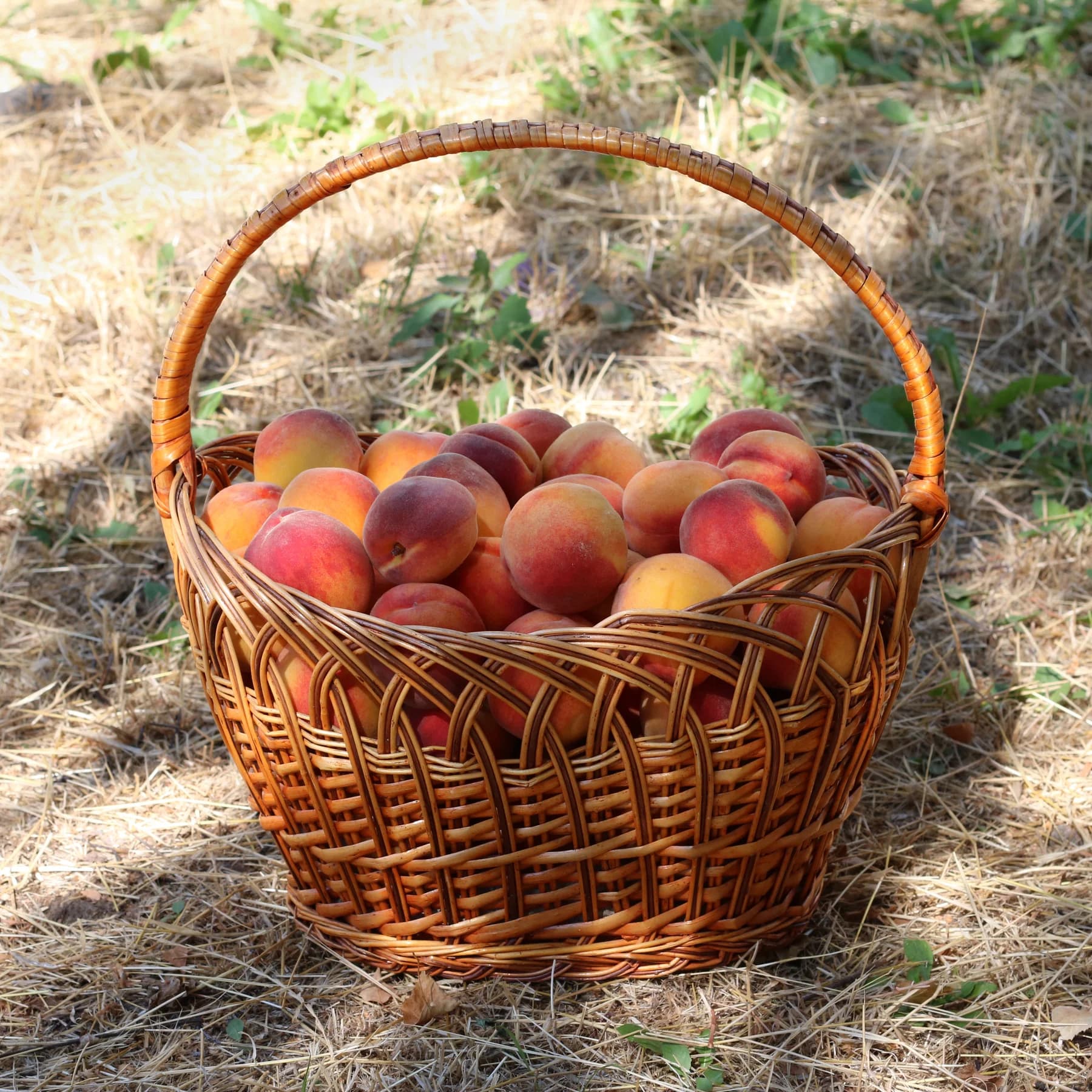
- 5. Peaches in basket 2026 G1 — George Chernilevsky — August 14, 2026. Harvested fruit photographed in Vinnytsia district, Ukraine. Product reference; does not document Spanish or Washington orchard production, picking technique or grading.
- 6. Peach photograph license — CC BY 4.0 — Creative Commons Attribution 4.0. Peach photograph resized and converted to WebP with photographer attribution.
Image credits
- Harvested peaches in Ukraine. Photo: George Chernilevsky, CC BY 4.0; resized and converted to WebP.
Figures are published averages or study assumptions for the places named, not guarantees for your field. Check current local recommendations and product labels before acting.