

Hazelnuts in India: species and evidence
Before investing in a hazelnut orchard in India, confirm the species and obtain local cultivar, pollination and yield records. Native Himalayan hazel occurs in forests, and ICAR lists hazelnut as a diversification candidate in Jammu and Kashmir. Forest observations alone cannot establish commercial orchard spacing, productivity or harvest timing. Test planting material and buyer demand in a monitored local pilot before expanding.
Scope: India-focused evidence review for hazelnut production. Native Corylus jacquemontii records are not evidence of a commercial European-hazelnut orchard system. Updated 2026-10-07.
At a glance
- Native Indian species in the reviewed record
- Corylus jacquemontii (Himalayan hazel); its taxonomy is debated in the literature1,3
- Documented locations
- Records include Uttarakhand and Kinnaur, Himachal Pradesh, within a broader western-Himalayan range1
- Botanical elevation record
- Native forest and shrub records extend up to 3,000 m1
- Commercial evidence
- ICAR lists hazelnut as a diversification candidate; an India-validated orchard system was not found in this review2,3
- Wild phenology example
- Pabbar Valley field observations: flowering April–May; fruiting August–September4
Perennial growth and climate in India
A perennial planting remains in the field for multiple years. Establishment is a long-term investment; flowering, fruit development, harvest and plant care recur as the planting matures. Follow the named cultivar and production system.
Establish a long-lived planting2,3
The reviewed Indian sources do not validate commercial cultivar selection, orchard spacing, pollinizer layout, planting conditions or establishment timing. Before investment, consult ICAR-CITH or the relevant SKUAST team and establish a monitored local trial; do not copy China or European orchard prescriptions.
Management: Wild Himalayan hazel flowering observation4
A field study in Pabbar Valley observed wild Corylus jacquemontii flowering in April–May. This is local forest phenology, not a commercial orchard bloom calendar.
Harvest: Wild Himalayan hazel fruiting observation4,1
The same Pabbar Valley study observed wild fruiting in August–September. India Flora Online lists a broader March–May flower/fruit period; available botanical records do not define a commercial harvest schedule.
Historical monthly climate
Reference period: 1996-01-01 to 2025-12-31. ERA5-Land monthly mean soil temperature at 0–7 cm, air temperature and frost days at the regional reference point (22, 79). Select a month to inspect its historical conditions.
Month tiles show mean air temperature.
April historical conditions
- Mean topsoil temperature
- 32.1°C
- Mean air temperature
- 29.9°C
- Mean frost days per month
- 0.0 days
Use this monthly history to assess winter exposure, seasonal heat and water planning. It does not calculate cultivar chill hours, flowering dates, frost damage during bloom or fruit maturity. Topsoil at 0–7 cm describes shallow soil context, not the full root zone. Harvest periods follow the production evidence above.
Climate source: Open-Meteo Historical Weather APISeparate native hazel from commercial cultivars
- Himalayan hazel upper botanical record3,000–3,000 mForest/shrub record; not a commercial orchard limit
- 1
Confirm the species
Distinguish native Himalayan hazel from European hazel and Chinese hybrids.
- 2
Locate validated trial material
Ask ICAR-CITH or SKUAST about locally evaluated cultivars and propagation stock.
- 3
Measure the site
Record elevation, winter and spring frost, soil, water and bloom conditions.
- 4
Run a monitored trial
Measure survival, pollination, nut set, maturity, quality and costs before scaling.
- Use the right species name
- India Flora Online records Corylus jacquemontii as a native western-Himalayan tree of forests and shrubberies. The review notes taxonomic debate, so verify plant identity with a recognized botanical or horticultural authority.1,3
- Do not claim a proven commercial sector
- ICAR names hazelnut among high-value diversification candidates considered by Jammu and Kashmir institutes. That supports research interest; it does not establish commercial orchard performance, yield or profitability.2
Treat production as a research question
- Confirm planting material and pollination first
- The reviewed sources do not validate commercial Indian cultivars, pollinizers, orchard spacing or establishment conditions. Obtain trial results from ICAR-CITH or SKUAST before selecting imported or wild plant material.2,3
- Protect native populations
- The ICFRE-HFRI review warns that complete fruit collection by local collectors can threaten natural regeneration. A production trial should use authorized planting material and avoid stripping wild stands.3
Interpret Himalayan records as wild phenology
- 1
Flowering
The field study records April–May for wild Corylus jacquemontii.
- 2
Fruit development
The source documents native plants in their local forest setting.
- 3
Fruiting
The study records August–September; it does not report orchard picking or commercial grade.
- Do not turn wild dates into a farm calendar
- The April–May flowering and August–September fruiting observations come from one Pabbar Valley field study. They do not set transplant timing, yield, maturity or harvest dates for a commercial orchard.4
Frequently asked questions
- Are hazelnuts grown commercially in India?
- The reviewed sources do not establish an India-tested commercial orchard system. ICAR identifies hazelnut as a diversification candidate in Jammu and Kashmir, while botanical sources document native Himalayan hazel.
- Which hazelnut species is native to India?
- India Flora Online records Corylus jacquemontii in the western Himalaya. Its taxonomy is discussed as uncertain, so confirm species identity with a botanical authority.
- When does Himalayan hazel flower and fruit?
- A Pabbar Valley field study observed wild flowering in April–May and fruiting in August–September. These are wild-species observations, not a commercial orchard calendar.
- How far apart should hazelnuts be planted in India?
- The sources reviewed do not support an India-specific commercial spacing. Do not copy China or German layouts without local trials and expert advice.
- Can I use the monthly climate chart to decide if a hazelnut orchard will succeed?
- No. It shows historical conditions at a representative point. It does not verify cultivar needs, frost at bloom, pollination, root-zone conditions or commercial performance.
Regional hazelnuts guides
Local dates, soil-temperature history and sources for specific regions:
Sources and image credits
- 1. India Flora Online — Corylus jacquemontii species record — Accessed 7 October 2026. Native range, habitat, elevation and botanical flower/fruit record.
- 2. ICAR — Doubling of Farmers’ Income: Jammu and Kashmir strategy — 2020. Lists hazelnut as a crop-diversification candidate for institutes and departments; not a commercial orchard trial.
- 3. ICFRE-Himalayan Forest Research Institute — review of Corylus jacquemontii — 2023. Western-Himalayan distribution, taxonomic discussion and natural-regeneration concerns.
- 4. Pabbar Valley wild-fruit field study — 2016. Local wild Corylus jacquemontii flowering and fruiting observations; not a commercial orchard calendar.
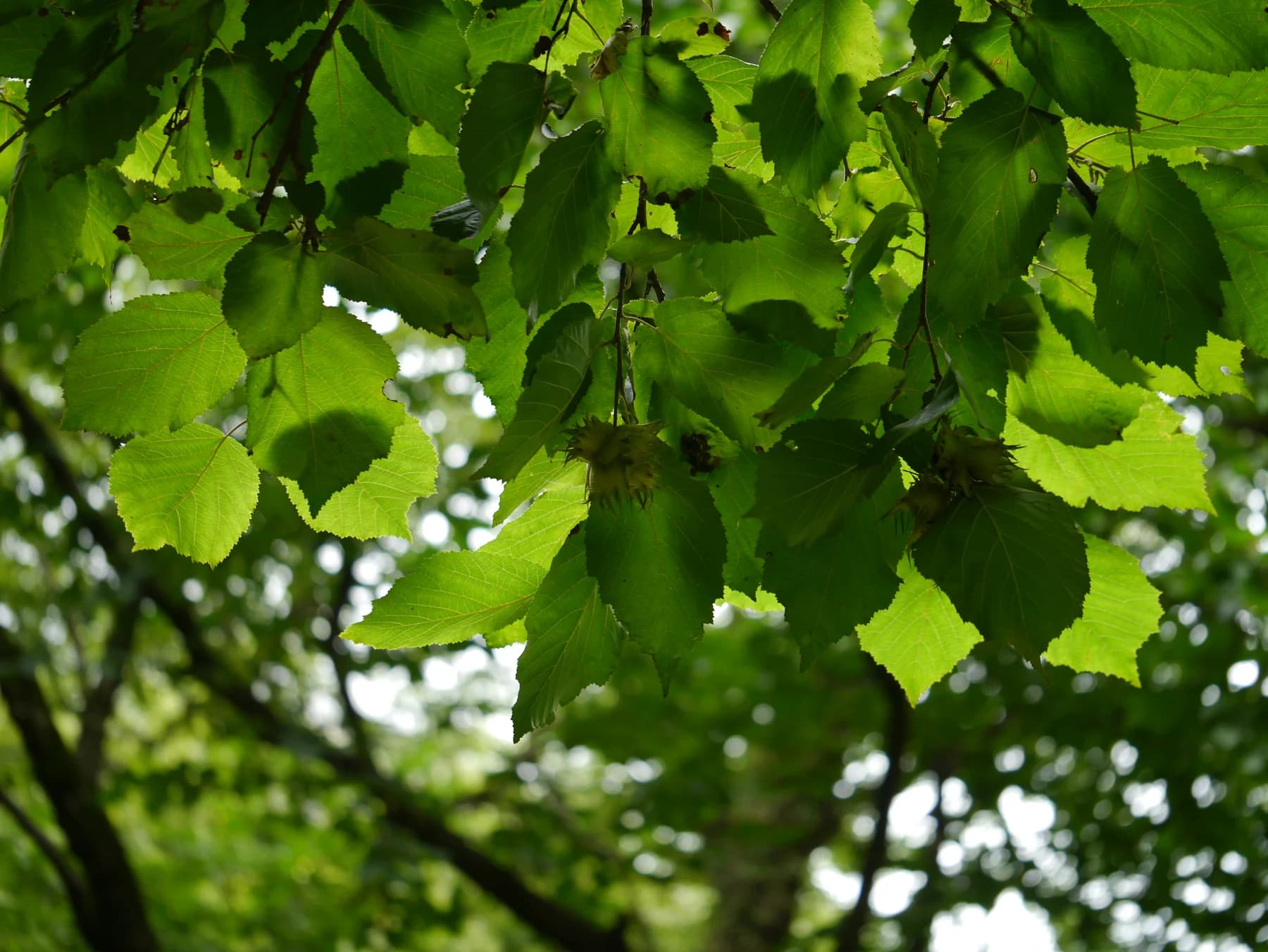
- 5. Corylus jacquemontii — Dinesh Valke — August 1, 2012; CC BY-SA 2.0. Indian Himalayan hazel identification photograph. The resized derivative retains CC BY-SA 2.0.
- 6. Himalayan hazel photo license — CC BY-SA 2.0 — Creative Commons Attribution-ShareAlike 2.0. The resized Dinesh Valke photograph retains this license.
Image credits
- Himalayan hazel (Corylus jacquemontii), photographed in India on August 1, 2012. Photo: Dinesh Valke, CC BY-SA 2.0; resized under the same license. Species reference, not a commercial orchard or harvest-maturity example.
Figures are published averages or study assumptions for the places named, not guarantees for your field. Check current local recommendations and product labels before acting.