

Growing hazelnuts in China
Commercial hazelnut production in China centers on Ping’ou hybrid hazel, a cross of Chinese hazel and European hazel. National guidance gives broad ecological ranges and orchard layouts, but cultivars must be matched to local climate, elevation, soil and pollination partners.
Scope: Commercial Ping’ou hybrid hazel orchard planning. National criteria are screening references; local cultivar performance and field conditions still require confirmation. Updated 2026-10-07.
At a glance
- Commercial type
- Ping’ou hybrid hazel, Corylus heterophylla × C. avellana1
- Published annual mean temperature
- 3.2–15°C ecological screening range; cultivar group and snow cover change the interpretation2
- Published precipitation range
- 650–1,300 mm/year; the standard calls for irrigation where annual precipitation is below 500 mm2
- Orchard spacing reference
- 4–5 m between rows and 1.5–2.5 m between plants1
- Harvest evidence
- Liuhe County example: 25 August–15 September in 20235
Perennial growth and climate in China
A perennial planting remains in the field for multiple years. Establishment is a long-term investment; flowering, fruit development, harvest and plant care recur as the planting matures. Follow the named cultivar and production system.
Establish a long-lived planting1
Establish nursery trees when site and soil conditions are suitable for the selected cultivar. National guidance differs by region and supports spring establishment north of North China and spring or autumn farther south; confirm the local cultivar’s dormancy, frost, irrigation and nursery-stock requirements before setting an orchard.
Management: Pollination and canopy planning1,4
Select compatible main and pollinizer cultivars with overlapping pollen release. The forestry administration reports poor pollen supply in some expanded orchards where cultivar combinations were unsuitable; check bloom overlap for the varieties actually available to the farm.
Harvest: Regional nut-drop examples5,6
One Liuhe County cooperative began harvest on 25 August and continued through 15 September in 2023. A separate Liaoning catalogue gives an August maturity period for the named cultivar Yuzhui. These are local examples, not a national harvest calendar; monitor nut maturity and drop in each block.
Historical monthly climate
Reference period: 1996-01-01 to 2025-12-31. ERA5-Land monthly mean soil temperature at 0–7 cm, air temperature and frost days at the regional reference point (34, 113). Select a month to inspect its historical conditions.
Month tiles show mean air temperature.
August historical conditions
- Mean topsoil temperature
- 26.8°C
- Mean air temperature
- 26.3°C
- Mean frost days per month
- 0.0 days
Use this monthly history to assess winter exposure, seasonal heat and water planning. It does not calculate cultivar chill hours, flowering dates, frost damage during bloom or fruit maturity. Topsoil at 0–7 cm describes shallow soil context, not the full root zone. Harvest periods follow the production evidence above.
Climate source: Open-Meteo Historical Weather APIMatch the cultivar to the production zone
- 1
Identify the cultivar group
Use the official suitability group and the cultivar’s own winter and heat limits.
- 2
Check elevation and frost
Compare local annual conditions, snow cover and cold-air drainage.
- 3
Test the field
Confirm soil depth, pH, drainage, water supply and access.
- 4
Confirm pollen partners
Choose compatible cultivars with overlapping pollen release.
- Use the national zone list as a screen
- China’s forestry industry plan identifies suitable parts of Northeast, North, Northwest and East China for Ping’ou hybrid hazel. Those broad zones do not establish suitability for every county or field.3
- Interpret climate by cultivar group
- LY/T 2205-2013 lists 3.2–15°C annual mean temperature, 650–1,300 mm annual precipitation and more than 2,100 sunshine hours. At the cold end of its temperature range it requires more than three months of winter snow cover. The standard also gives different latitude and temperature bands for different cultivar groups.2,1
- Read the climate calendar as regional context
- The monthly history shows one representative point. It cannot verify snow duration, elevation, soil depth, summer moisture or the climate response of a named cultivar; compare those field observations with the forestry standard before committing capital.2
Set out a pollinated orchard
Between rows: 4–5 m between rows · Within the row: 1.5–2.5 m between plants
The national guide gives this range for a modern orchard. It is not a universal planting prescription; adapt tree form, density, equipment access and pollinizer arrangement to the site and cultivar.
- Plan the block for pollination
- Hazelnut is wind-pollinated. The national guide calls for a main variety and pollinizer chosen for local conditions; do not assume a single pollinizer ratio or cultivar combination fits every orchard.1
- Design access before calculating tree numbers
- Map headlands, lanes and equipment turns on the surveyed plantable area. The guide says spacing, tree form, pruning and water or fertility management must adapt to climate, topography, soil and orchard operations.1
Protect bloom and match water to the site
- Monitor pollen availability
- China’s forestry administration reports inadequate catkins and pollen in some orchards after rapid expansion and unsuitable variety combinations. Record flowering overlap and check pollen availability rather than relying on cultivar names alone.4
- Plan irrigation from measured supply
- The ecological standard signals an irrigation need below 500 mm annual precipitation, but that is not an irrigation quantity or a block schedule. Use local rainfall, soil-water storage, orchard age and system capacity to build the farm water plan.2
Harvest by nut maturity and handle each pass promptly
- 1
Check nut maturity
Follow the selected cultivar and local nut-drop stage.
- 2
Start the first pass
Use the Liuhe cooperative’s dates only as a local seasonal reference.
- 3
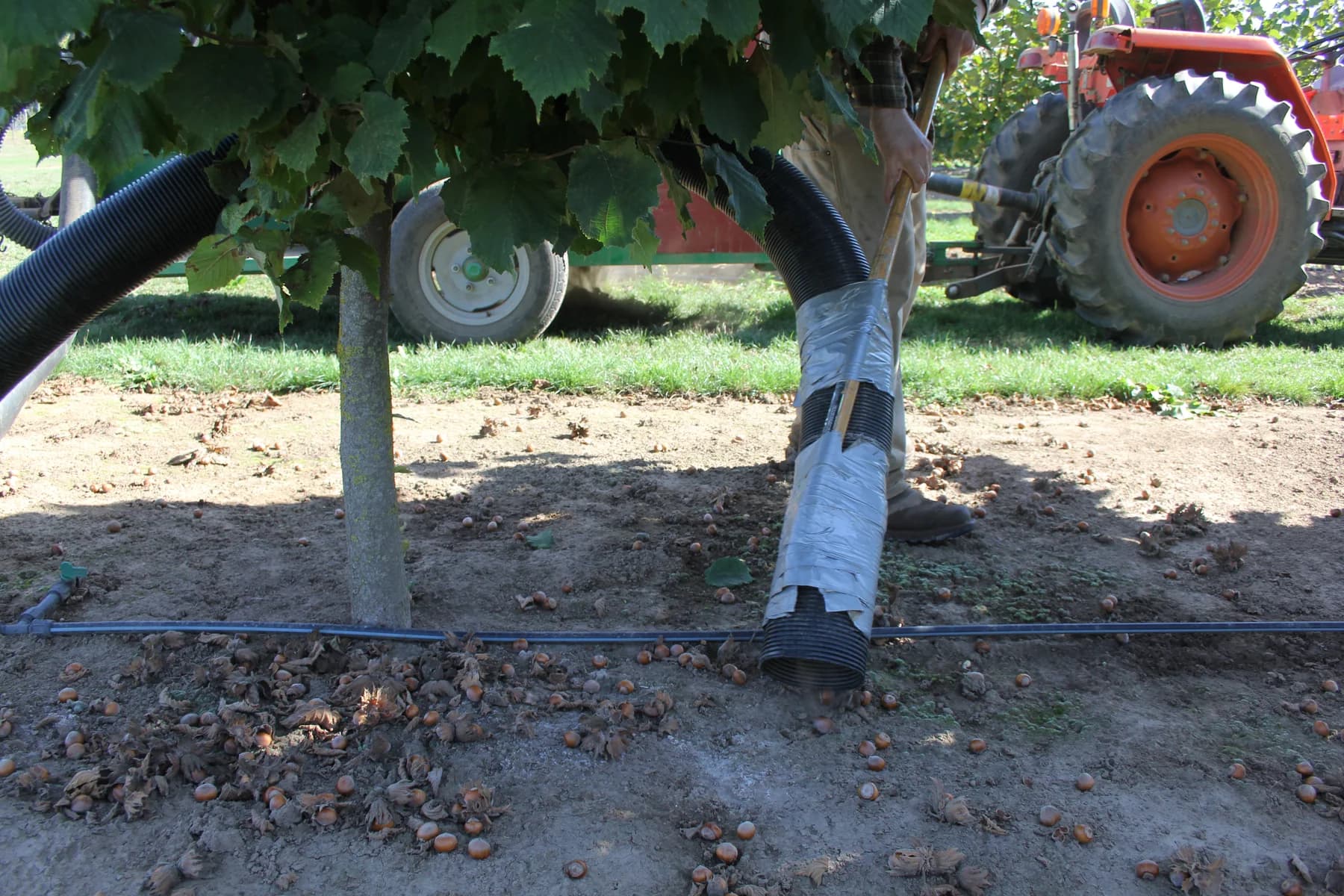
Collect fallen nuts
Keep the orchard floor and harvest equipment ready for the local drop period.
- 4
Dry and grade
The Liuhe report describes drying, sorting, packing and cold storage.
- Keep local examples separate
- Liuhe County’s cooperative reported picking from late August to mid-September in 2023. The separate Liaoning maturity entry concerns Yuzhui only. Cultivar, elevation and season change timing.5,6
- Confirm the sales route before planting
- Set buyer specifications for nut size, drying, grading, packaging and storage before choosing orchard scale. The sources reviewed do not establish a current national farm-gate price or a general commercial margin.5
Frequently asked questions
- Which hazelnut is grown commercially in China?
- The national production guide focuses on Ping’ou hybrid hazel, a cross of Corylus heterophylla and C. avellana. Do not treat its advice as a guide to every hazelnut species.
- What climate suits Ping’ou hybrid hazel?
- China’s forestry standard lists annual mean temperature of 3.2–15°C, annual precipitation of 650–1,300 mm and more than 2,100 sunshine hours, with important cultivar and snow-cover qualifications.
- How far apart are hazelnut trees planted in China?
- The national modern-orchard reference is 4–5 m between rows and 1.5–2.5 m between plants. The guide says to adapt the layout to site, cultivar and orchard system.
- When are hazelnuts harvested in China?
- A Liuhe County cooperative harvested from 25 August to 15 September in 2023, while a named Liaoning cultivar has a separate August maturity listing. Neither is a countrywide harvest schedule.
- Do Chinese hazelnut orchards need pollinizers?
- Yes. The national guide calls for compatible main and pollinizer varieties. Check bloom overlap and pollen supply for the selected cultivars.
Regional hazelnuts guides
Local dates, soil-temperature history and sources for specific regions:
Sources and image credits
- 1. State Forestry and Grassland Administration — National Hazelnut Industry Development Guide — Issued 2020. Ping’ou hybrid hazel, regional matching, orchard establishment, pollinizers and spacing.
- 2. Yunnan Forestry and Grassland Bureau — LY/T 2205-2013 ecological conditions for Ping’ou hybrid hazel — Industry standard LY/T 2205-2013. Ecological screening values for annual temperature, precipitation, sunlight and site requirements; not a yield guarantee.
- 3. National Forestry and Grassland Industry Plan 2021–2025 — 2022. Broad Chinese production-zone context for Ping’ou hybrid hazel.
- 4. State Forestry and Grassland Administration — hazelnut industry status — 2024. Industry-reported problems with cultivar matching and pollen availability in some expanding orchards.
- 5. Forestry Administration — Liuhe County cooperative harvest report — 2023. One cooperative’s harvest dates and drying, sorting, packing and storage process; local case only.
- 6. National Forest Tree Improved Variety Catalogue — 2025. Named Liaoning cultivar maturity example for Yuzhui; not a national maturity date.
- 7. Hazelnut crop photo — Ivar Leidus — Wikimedia Commons; CC BY-SA 4.0. Common hazelnut crop-identification photograph; not a photograph of a regional orchard or Himalayan hazel.
- 8. Hazelnut harvest — Sean Nealon / Oregon State University — CC BY-SA 2.0 — https://creativecommons.org/licenses/by-sa/2.0/. Oregon State University orchard-floor harvest photo. Resized derivative retains CC BY-SA 2.0; cultivar and species are not established by the file description.
- 9. Hazelnut harvest photo license — CC BY-SA 2.0 — Creative Commons Attribution-ShareAlike 2.0. The resized Sean Nealon / Oregon State University photograph retains this license.
- 10. Hazelnut product photo license — CC BY-SA 4.0 — Creative Commons Attribution-ShareAlike 4.0. The resized Ivar Leidus photograph retains this license.
Image credits
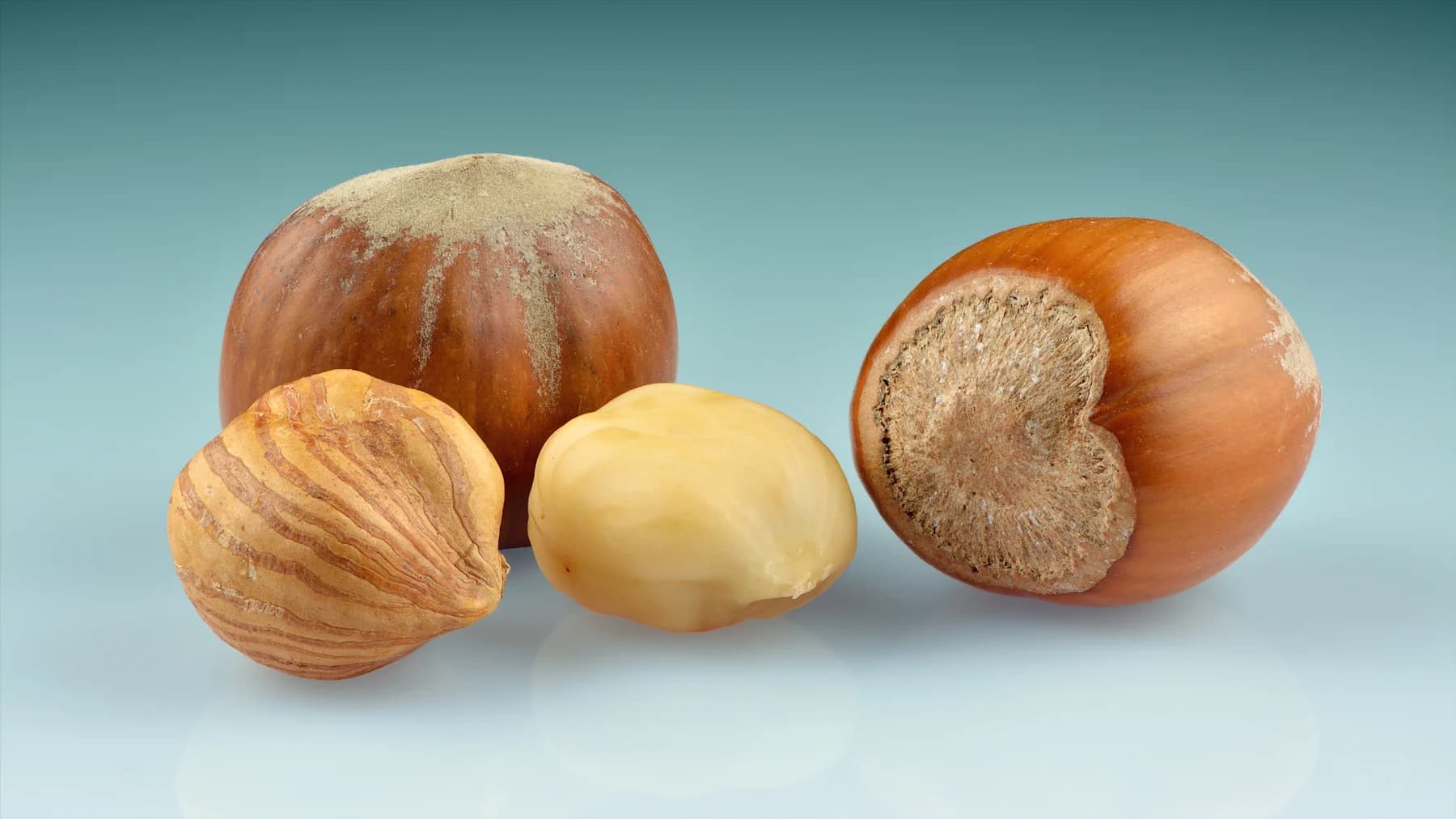
- Common hazelnuts (Corylus avellana) and kernels. Photo: Ivar Leidus, CC BY-SA 4.0; resized under the same license. Product reference, not a local orchard or an identified Ping’ou hybrid.
- Hazelnut harvest at Oregon State University’s North Willamette Research and Extension Center, USA. Photo: Sean Nealon / Oregon State University, CC BY-SA 2.0; resized under the same license. A harvest-system example, not a photograph of the page’s region.
Figures are published averages or study assumptions for the places named, not guarantees for your field. Check current local recommendations and product labels before acting.