

Guava farming in Arizona: feasibility
USDA’s 2022 Census of Agriculture counted two Arizona farms reporting guavas, but suppressed acreage to protect confidentiality. That establishes a small farm presence, not a tested Arizona commercial orchard system; local extension and field records are still needed for reliable inputs, yields and harvest timing.
By AgriAuditor. Updated .
Scope: Commercial feasibility for common guava (Psidium guajava) in Arizona. Census presence is not treated as proof of a scalable production package or state-level profitability.
At a glance
Perennial growth and climate in Arizona
A perennial planting remains in the field for multiple years. Establishment is a long-term investment; flowering, fruit development, harvest and plant care recur as the planting matures. Follow the named cultivar and production system.
Establish a long-lived planting1,2,3
Choose establishment timing with a local adviser using your cultivar, planting material and field conditions in Arizona. A single month cannot cover every site and production system. The historical climate display describes one regional reference point.
Historical monthly climate
Reference period: 1996-01-01 to 2025-12-31. ERA5-Land monthly mean soil temperature at 0–7 cm, air temperature and frost days at the regional reference point (33.5, -111.9). Select a month to inspect its historical conditions.
Month tiles show mean air temperature.
January historical conditions
- Mean topsoil temperature
- 11.8°C
- Mean air temperature
- 11.9°C
- Mean frost days per month
- 1.8 days
Use this monthly history to assess winter exposure, seasonal heat and water planning. It does not calculate cultivar chill hours, flowering dates, frost damage during bloom or fruit maturity. Topsoil at 0–7 cm describes shallow soil context, not the full root zone. The monthly history does not establish a local flowering, maturity or harvest period.
Climate source: Open-Meteo Historical Weather APIRead the farm census carefully
- 1
Confirm crop identity
Distinguish common guava from pineapple guava and other tropical fruit.
- 2
Use the census signal
Treat two farms as documented presence, not a state acreage estimate.
- 3
Locate production records
Seek farm, county and extension data before scaling advice.
- 4
Record missing metrics
Track spacing, water, harvest, packout and costs in a local trial.
- Two farms do not define a commercial production model
- The 2022 Census lists two Arizona farms with guavas and suppresses acreage. This verifies farm-reported presence while protecting confidential totals; it does not identify county, scale, cultivar, yield or whether the farms share a production system.1
Assess cold exposure and water before planting
- 1
Map minimum temperatures
Use on-site records and frost exposure, not statewide averages alone.
- 2
Verify water supply
Measure allocation, quality and delivery cost for the proposed block.
- 3
Check planting-stock identity
Confirm common guava cultivar and source.
- 4
Get local review
Ask commercial extension staff to assess site and irrigation constraints.
- Warm-site information is not a farm prescription
- University of Arizona’s campus arboretum describes guava as a warm-climate species that is intolerant of cold and frost. That botanical context is not a commercial Arizona planting recommendation; evaluate site-specific winter exposure, irrigation supply, salinity and microclimate with local extension before investment.2,3
Run a measured commercial pilot
- 1
Set a limited acreage
Avoid committing full commercial scale before local results exist.
- 2
Measure inputs
Record water, labor, nutrient tests and winter protection costs.
- 3
Track fruit quality
Log yield, maturity, marketable packout and losses.
- 4
Test sales
Confirm repeat buyer demand and handling requirements.
- Do not import a subtropical calendar
- The reviewed Arizona sources do not support guava spacing, irrigation volumes, fertilizer rates, commercial pruning, yield targets or harvest months. A pilot should document these with a named cultivar and buyer; climate normals cannot supply missing crop-specific thresholds.1,2,3
Decide whether the market supports expansion
- 1
Confirm a sales channel
Get written requirements and estimated weekly demand.
- 2
Model total water cost
Include pumping, conveyance and drought-year reliability.
- 3
Calculate marketable yield
Use actual local packout, not a foreign benchmark.
- 4
Expand only after validation
Review several seasons of crop, cost and buyer records.
Frequently asked questions
- Is guava grown on Arizona farms?
- USDA’s 2022 Census reported guavas on two Arizona farms, with acreage suppressed. This shows farm presence but not the scale or performance of a commercial system.
- Can guava be grown commercially in Arizona?
- The sources reviewed do not establish a tested commercial production package. A farm must assess frost exposure, irrigation economics, local fruit quality and buyer demand before expansion.
- What spacing is used for Arizona guava?
- No commercial Arizona spacing recommendation was located. Do not copy spacing from other climates without testing cultivar, canopy, equipment and water constraints locally.
- When is guava planted in Arizona?
- No Arizona commercial planting calendar or crop-specific temperature threshold was verified. Use a local site assessment and measured pilot rather than a month inferred from climate averages.
Regional guava guides
Sources and image credits
- 1. USDA National Agricultural Statistics Service — 2022 Census of Agriculture, Arizona — 2022 Census, published 2024. Table 37 reports two farms with guavas; acreage is suppressed. This is farm-presence evidence, not a production recommendation.
- 2. University of Arizona Campus Arboretum — Psidium guajava — Plant record. Species identity and broad warm-climate/frost context; not commercial field advice.
- 3. University of Arizona Cooperative Extension — Fruits — Current topic page. Extension fruit-production coverage context; no guava-specific commercial protocol located.
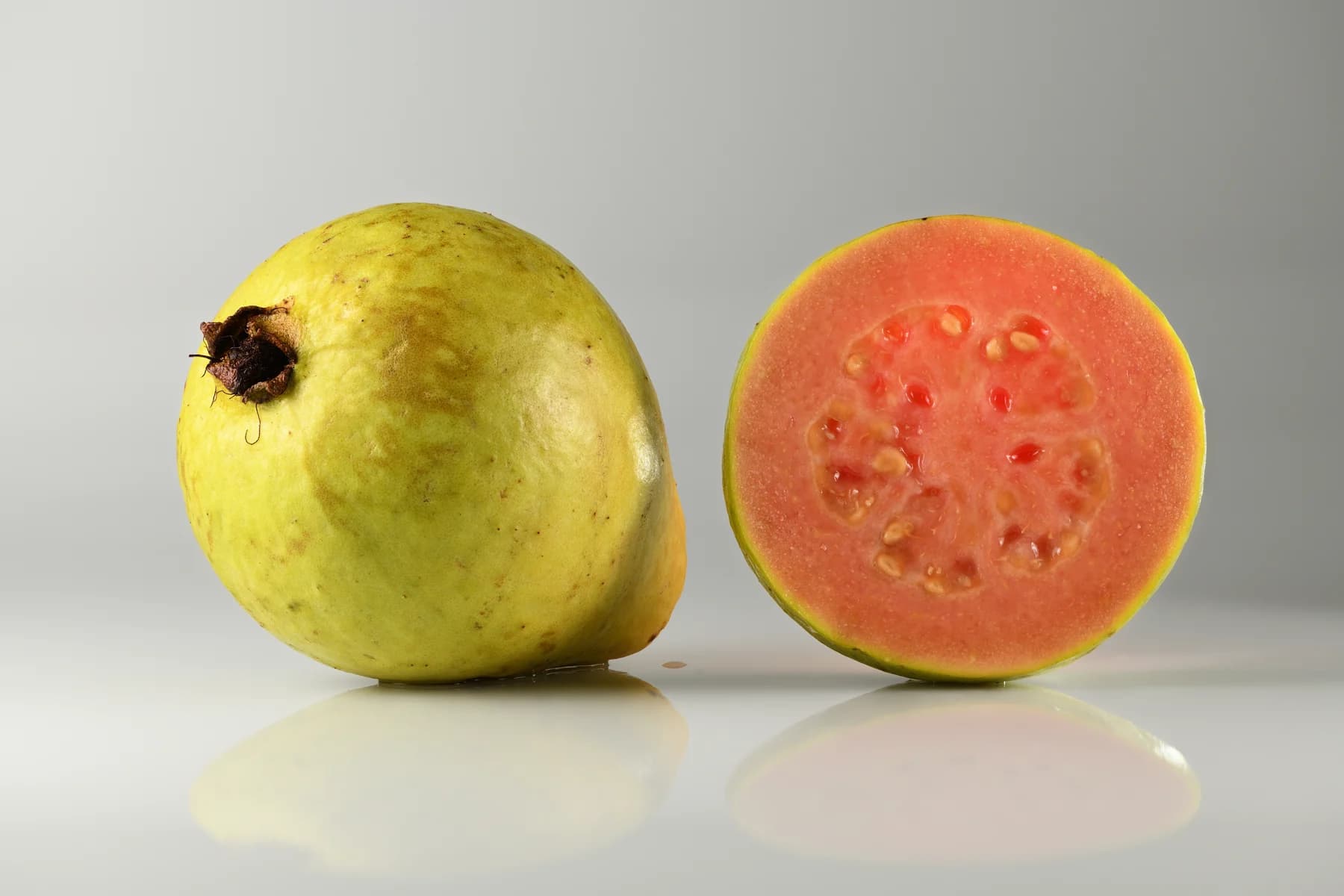
- 4. Guava pink fruit — Ivar Leidus — March 22, 2025; CC BY-SA 4.0. Brazil-grown Psidium guajava fruit photograph. Not evidence of Arizona or Chinese production or cultivar performance.
- 5. Fruit photograph license — CC BY-SA 4.0 — Creative Commons Attribution-ShareAlike 4.0. The resized fruit photograph retains its original share-alike license.
Image credits
- Pink-fleshed guava (Psidium guajava), grown in Brazil. Photo: Ivar Leidus, CC BY-SA 4.0; resized under the same license. Fruit reference, not a local orchard or identified cultivar.
Figures are published averages or study assumptions for the places named, not guarantees for your field. Check current local recommendations and product labels before acting.