

Growing guava in China
Guangdong has a valid provincial guava cultivation standard and current extension activity, providing a regional reference for commercial planning. The accessible detailed spacing figures come from a Guangzhou draft, and remain proposals rather than adopted requirements.
Scope: Commercial fresh-fruit guava in Guangdong. Province-level standards and local extension examples are distinguished from draft proposals and cultivar-specific trials. Updated 2026-10-07.
At a glance
- Current local authority
- Guangdong DB44/T 1843-2016 is listed as valid; its technical clauses need direct confirmation1
- Cultivar evidence
- Sui Bai No. 1 appears on Guangdong’s approved 2024 variety list2
- Local production support
- Guangzhou extension visits addressed guava field management in 2025 and 20263,4
- Spacing caution
- Published 2.5–4 m options are from a 2025 draft, not an adopted standard5
Perennial growth and climate in China
A perennial planting remains in the field for multiple years. Establishment is a long-term investment; flowering, fruit development, harvest and plant care recur as the planting matures. Follow the named cultivar and production system.
Establish a long-lived planting1,2,3,4,5
Choose establishment timing with a local adviser using your cultivar, planting material and field conditions in China. A single month cannot cover every site and production system. The historical climate display describes one regional reference point.
Historical monthly climate
Reference period: 1996-01-01 to 2025-12-31. ERA5-Land monthly mean soil temperature at 0–7 cm, air temperature and frost days at the regional reference point (34, 113). Select a month to inspect its historical conditions.
Month tiles show mean air temperature.
January historical conditions
- Mean topsoil temperature
- 2.3°C
- Mean air temperature
- 1.7°C
- Mean frost days per month
- 28.5 days
Use this monthly history to assess winter exposure, seasonal heat and water planning. It does not calculate cultivar chill hours, flowering dates, frost damage during bloom or fruit maturity. Topsoil at 0–7 cm describes shallow soil context, not the full root zone. The monthly history does not establish a local flowering, maturity or harvest period.
Climate source: Open-Meteo Historical Weather APIPlan the fresh-fruit market first
- 1
Name the fruit type
Record cultivar and expected flesh and skin characteristics.
- 2
Confirm the buyer
Agree on size, maturity, appearance and delivery conditions.
- 3
Choose planting material
Verify cultivar identity and health with the nursery.
- 4
Budget harvest labor
Include repeated picking, sorting and rapid delivery.
- Select cultivar around buyer and handling needs
- Guangdong’s 2024 approved-variety list includes Sui Bai No. 1, with observations tied to that selection and its evaluation. Confirm fruit type, propagation identity, buyer size/quality requirements and local transport before extending a cultivar result to another orchard.2,3
Use drainage and soil tests to choose the block
- 1
Review field drainage
Avoid standing water and check runoff after heavy rain.
- 2
Test soil and water
Use current local lab results to guide amendments.
- 3
Compare the valid standard
Request DB44/T 1843-2016 technical clauses from the issuing body.
- 4
Treat draft values as proposals
Do not lay out acreage using the unadopted draft alone.
Use local service and field records
- 1
Record cultivar and block
Keep source, planting date and orchard location together.
- 2
Track flowering and fruit set
Measure actual crop response before adopting regulation practices.
- 3
Log water and fertility
Tie applications to soil and water tests.
- 4
Review pest symptoms
Ask local extension to identify problems before treatment.
- Keep pruning and fruit regulation cultivar-specific
- Guangzhou extension reports record orchard technical service in 2025 and 2026. Use local extension for current practices and labels; the draft standard’s proposed fruit regulation and bagging practices are not a substitute for an adopted local protocol.3,4,5
Measure quality and packout
- 1
Pick to buyer maturity
Use the agreed fruit stage and handling specification.
- 2
Separate market grades
Record accepted and rejected fruit by lot.
- 3
Protect quality
Plan shade, transport and receiving capacity.
- 4
Recheck economics
Compare labor and packout with the farm’s own records.
Frequently asked questions
- Where is guava grown commercially in China?
- The reviewed local sources support Guangdong as a commercial guava region, with provincial standards, approved cultivars and recent Guangzhou extension activity.
- What guava spacing should a Guangdong farm use?
- The 2.5–4 m examples found are from a Guangzhou draft standard, not an adopted rule. Confirm spacing with the valid standard, cultivar, equipment and local extension.
- Is Sui Bai No. 1 a recommended guava cultivar?
- It is listed among Guangdong’s approved varieties. The performance observations apply to that selection and its reported evaluation, not automatically to every orchard or market.
- When should guava be planted in Guangdong?
- The sources reviewed do not support one provincewide planting month. Use locally verified planting-stock and field-readiness guidance rather than a climate-average calendar.
Regional guava guides
Local dates, soil-temperature history and sources for specific regions:
Sources and image credits
- 1. National Standards Information Public Service Platform — DB44/T 1843-2016, Guava cultivation technical regulations — Issued 17 May 2016; listed as valid. Official status of Guangdong’s provincial guava standard; technical clauses were not exposed in the public record.
- 2. Guangdong Department of Agriculture and Rural Affairs — Approved crop varieties — 2024. Approved Sui Bai No. 1 selection and cultivar-specific observations.
- 3. Guangzhou Academy of Agricultural and Rural Sciences — Zengcheng guava field service — 2025. Recent local field-service context for guava orchards.
- 4. Guangzhou Agriculture and Rural Affairs — Guava orchard technical service — 2026. Current orchard-service activity and local production context.
- 5. Guangzhou Administration for Market Regulation — Draft guava cultivation technical regulations — Draft dated 20 March 2025. Draft proposals only, including proposed spacing, site preparation and management.
- 6. Guava pink fruit — Ivar Leidus — March 22, 2025; CC BY-SA 4.0. Brazil-grown Psidium guajava fruit photograph. Not evidence of Arizona or Chinese production or cultivar performance.
- 7. Fruit photograph license — CC BY-SA 4.0 — Creative Commons Attribution-ShareAlike 4.0. The resized fruit photograph retains its original share-alike license.
Image credits
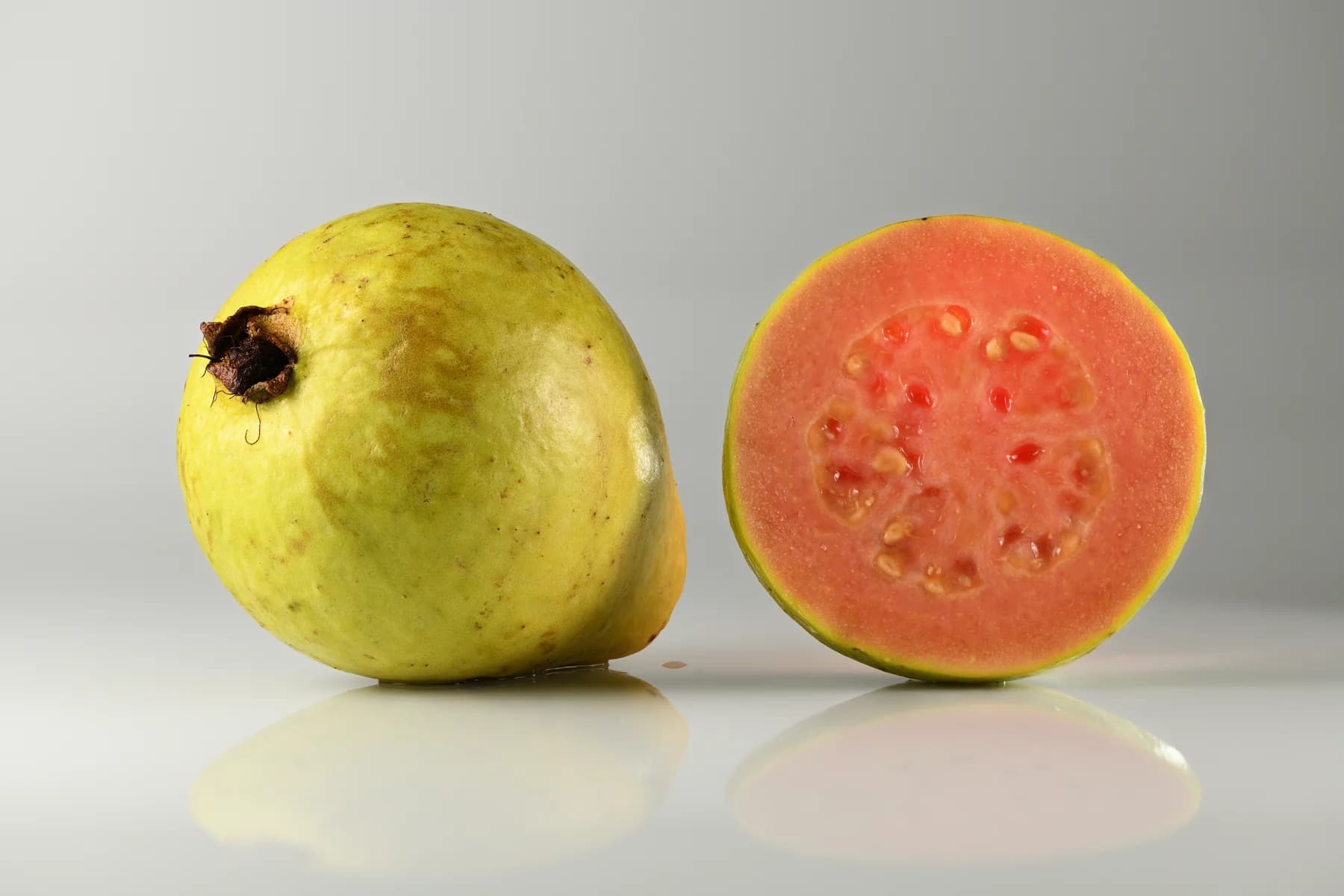
- Pink-fleshed guava (Psidium guajava), grown in Brazil. Photo: Ivar Leidus, CC BY-SA 4.0; resized under the same license. Fruit reference, not a local orchard or identified cultivar.
Figures are published averages or study assumptions for the places named, not guarantees for your field. Check current local recommendations and product labels before acting.