

Planning an apricot orchard in Iowa
Start an Iowa apricot orchard with a small cultivar trial and a plan for early-bloom frost risk. Winter survival alone does not ensure a crop. Compare several seasons of flowering, fruit set and marketable harvest before expanding, and match the cultivar, canopy and machinery to your field.
Scope: Iowa feasibility and trial-planning guide based on Iowa State cultivar and pollination guidance. Cultivar recommendations and harvest bands are regional references; they do not establish reliable commercial yield, spacing or profitability. Updated 2026-10-07.
At a glance
- Primary production risk
- Early bloom followed by late-spring frost can damage or destroy flowers1
- Cultivars named for statewide evaluation
- Moongold and Sungold; they require cross-pollination with one another1
- Regional cultivar reference
- Moorpark is listed for the southern two-thirds of Iowa1
- Historical harvest bands
- July for Goldcot, Moongold and Sungold; early August for Moorpark1
- Commercial data gap
- The reviewed Iowa references do not establish current commercial spacing, yield or profitability1
Perennial growth and climate in Iowa
A perennial planting remains in the field for multiple years. Establishment is a long-term investment; flowering, fruit development, harvest and plant care recur as the planting matures. Follow the named cultivar and production system.
Establish a long-lived planting1
The Iowa references reviewed identify cultivars and frost risks but do not establish a commercial tree-establishment date. Confirm current nursery stock, rootstock and field conditions with Iowa State Extension before establishing a block.
Management: Track winter survival and spring bloom1
Iowa apricots bloom early in spring, when late frost can damage flowers or eliminate the crop. Record bud survival, bloom dates, minimum temperatures, pollination overlap and fruit set by cultivar.
Management: Use cultivar-specific harvest observations1
The 2006 Iowa State cultivar guide lists July harvests for Goldcot, Moongold and Sungold, and early August for Moorpark. Use these as older reference bands and verify maturity in the local trial each year.
Harvest: Historical Iowa cultivar harvest references1
The Iowa State cultivar guide lists Goldcot in early July, Moongold in mid-July, Sungold in late July and Moorpark in early August. These are cultivar reference periods, not a forecast for every county or year.
Historical monthly climate
Reference period: 1996-01-01 to 2025-12-31. ERA5-Land monthly mean soil temperature at 0–7 cm, air temperature and frost days at the regional reference point (42, -93.5). Select a month to inspect its historical conditions.
Month tiles show mean air temperature.
July historical conditions
- Mean topsoil temperature
- 24.4°C
- Mean air temperature
- 24.0°C
- Mean frost days per month
- 0.0 days
Use this monthly history to assess winter exposure, seasonal heat and water planning. It does not calculate cultivar chill hours, flowering dates, frost damage during bloom or fruit maturity. Topsoil at 0–7 cm describes shallow soil context, not the full root zone. Harvest periods follow the production evidence above.
Climate source: Open-Meteo Historical Weather APIAssess frost risk before committing acreage
Apricot trees may survive cold winters while their early flowers still fail in a late freeze. A harvestable commercial crop therefore depends on both tree survival and bloom-stage weather.
- 1
Select hardy cultivars
Use Iowa State adaptation guidance and confirm current nursery material.
- 2
Check pollination
Pair compatible cultivars and verify overlapping bloom.
- 3
Record frost at bloom
Track minimum temperature, bloom stage and fruit set each year.
- 4
Measure marketable crop
Record grade, yield, picking labour, losses and buyer response before scaling.
- Separate winter survival from reliable bearing
- The Iowa State cultivar guide warns that apricots bloom early and spring frosts are a problem. Treat bloom-stage freeze risk as a major production uncertainty and measure it at the proposed site over multiple seasons.1
- Use cultivar adaptation at county scale
- Iowa State lists Moongold and Sungold for all Iowa regions and Moorpark for central and southern regions. Site exposure, elevation and cold-air drainage still matter; verify the planting site with local temperature records and current extension advice.1
- Avoid frost pockets
- Before planting, map low areas and compare bloom-stage minimum temperatures across candidate sites. The climate panel gives monthly averages at a reference point and cannot show a damaging overnight freeze at flower height.1
Plan pollination and a measured cultivar trial
- Pair Moongold with Sungold
- The Iowa State cultivar guide lists both cultivars as self-unfruitful and pairs them for cross-pollination. Confirm bloom overlap locally; a tree that survives without compatible pollen will not set a crop.1
- Keep the trial large enough to compare
- Record winter injury, first bloom, last frost, fruit set, maturity, marketable grade and picking time for each cultivar over several seasons. The reviewed state source does not establish a reliable commercial yield target.1
Plan spacing around the orchard system
- The local cultivar source does not give orchard spacing
- The reviewed Iowa State cultivar guide identifies adapted cultivars and harvest periods but does not establish commercial tree spacing, population or equipment clearances. Set layout after choosing the cultivar, rootstock, training system and harvest method with a qualified local adviser.1
- Keep room for observation and harvest access
- A trial layout should preserve safe machine and worker access while keeping each cultivar and pollinizer row identifiable. Record the surveyed tree count and trial area so results can be compared consistently.1
Use harvest dates as observations, not a guarantee
- 1
Check maturity by cultivar
The older state guide places named cultivars across July and early August.
- 2
Pick and grade separately
Keep lots identified by cultivar, date and block.
- 3
Track frost and crop loss
Record flower damage, set, drop and marketable packout.
- 4
Review several seasons
Compare crop frequency and labour before deciding whether to expand.
- Use the state cultivar table as a starting reference
- The 2006 Iowa State table places Goldcot in early July, Moongold in mid-July, Sungold in late July and Moorpark in early August. Cultivar, county and weather shift harvest; check fruit maturity in the field.1
- Secure the outlet before the trial bears
- Confirm buyer interest, maturity and grade requirements, harvest labour and delivery distance. The reviewed Iowa source does not establish a current commercial market price or profitability benchmark for apricots.1
Scale only if the local crop repeats
- Budget for spring-frost exposure
- Model crop-loss scenarios around early bloom and late frost risk. The cultivar guide warns that spring frosts threaten Iowa apricots; it does not provide a commercial yield forecast.1
- Use local numbers, not another state’s orchard plan
- California and Himalayan spacing, yield and input figures do not transfer to Iowa. Build the business case from several seasons of local survival, crop, grade, labour and buyer data.1
Frequently asked questions
- Can apricots be grown in Iowa?
- Iowa State lists Moongold and Sungold for all Iowa regions and Moorpark for central and southern regions. Apricot bloom is early, so spring frost remains a major crop risk.
- Which apricot cultivars need a pollinizer in Iowa?
- Moongold and Sungold are self-unfruitful in Iowa State guidance and should be planted together for cross-pollination. Confirm bloom overlap at the site.
- When are Iowa apricots harvested?
- The 2006 Iowa State cultivar guide lists Goldcot in early July, Moongold in mid-July, Sungold in late July and Moorpark in early August. Actual maturity varies by site and season.
- How far apart should commercial apricot trees be planted in Iowa?
- The Iowa sources reviewed do not provide a current commercial spacing recommendation. Set spacing from the selected rootstock, canopy, equipment and production design with local extension advice.
- Does the climate calendar identify the best planting month?
- No. Apricot is perennial, and the monthly historical panel does not calculate cultivar chill, bloom frost or establishment conditions. Use local records and current nursery guidance rather than a single planting month.
Regional apricots guides
Local dates, soil-temperature history and sources for specific regions:
Sources and image credits
- 1. Iowa State University Extension — Fruit Cultivars for Iowa (PM 453) — Published March 2006. Iowa cultivar adaptation and approximate harvest periods; historical reference, not a current commercial yield or spacing recommendation.
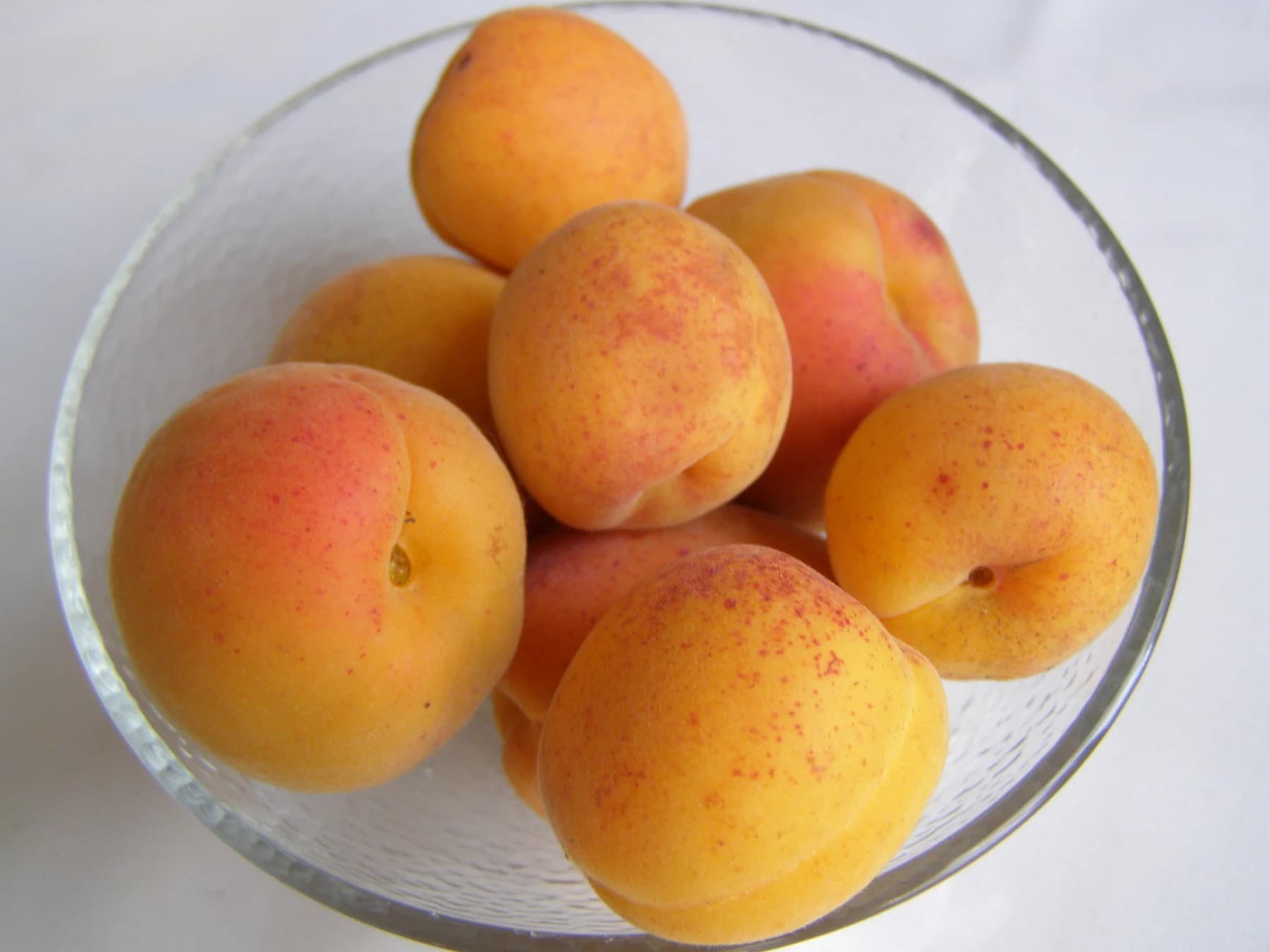
- 2. Apricot fruit photograph — Kmtextor — July 11, 2009; CC BY-SA 4.0. Apricots in a glass bowl, photographed in Germany. Product reference, not a local orchard, cultivar identification or harvest-method demonstration.
- 3. Apricot photograph license — CC BY-SA 4.0 — Creative Commons Attribution-ShareAlike 4.0. The resized photograph retains its original share-alike license.
Image credits
- Apricot fruit. Photo: Kmtextor, CC BY-SA 4.0; resized under the same license.
Figures are published averages or study assumptions for the places named, not guarantees for your field. Check current local recommendations and product labels before acting.
Some visuals in this guide are illustrations rather than photographs of a specific farm. See image credits.