

Growing apricots in California
California apricot production is concentrated in the Central Valley, with distinct fresh-market areas along the coast. A successful block needs enough winter chill for its cultivar, low bloom-frost exposure, suitable rootstock and a harvest plan matched to the market. The commercial layout and water figures below are historical local examples, not current statewide prescriptions.
Scope: California production context, with spacing and establishment examples from a 2003 San Benito County commercial study. Climate and harvest windows vary by subregion, cultivar and year; the cited study is not a current cost or yield forecast. Updated 2026-10-07.
At a glance
- Major production area
- Stanislaus, San Joaquin and Merced counties in the San Joaquin Valley1
- Climate checks
- Cultivar-specific winter chill, early bloom frost exposure, and dry spring weather1
- Historical commercial layout
- San Benito County study: 6.7 × 6.7 m (22 × 22 ft), about 222 trees/ha (90/acre)2
- California harvest references
- Central Valley: mid-May–mid-June; coastal districts: late June–late July3
- Postharvest work
- Leaf sampling in July; summer pruning after harvest, before winter rains4
Perennial growth and climate in California
A perennial planting remains in the field for multiple years. Establishment is a long-term investment; flowering, fruit development, harvest and plant care recur as the planting matures. Follow the named cultivar and production system.
Establish a long-lived planting2
A 2003 San Benito County commercial study set bare-root trees in late January or early February. That is one historical Central Coast operation, not a statewide date. Confirm the cultivar, rootstock, soil drainage and local nursery timing before laying out a block.
Management: Check bloom and spring-frost exposure1
California apricots can bloom from February into early March. Track bloom-stage minimum temperatures at the orchard: a monthly mean cannot show whether flowers were exposed to a damaging frost.
Management: Sample fruit and plan harvest by district3
UC IPM describes Central Valley harvest around mid-May to mid-June and coastal harvest from late June into late July. These are broad regional references; use cultivar maturity and field samples for the actual pick.
Management: Complete postharvest sampling and pruning4
UC IPM recommends July leaf sampling and pruning soon after harvest, with pruning finished about six weeks before rainfall begins to reduce infection risk in wounds.
Harvest: Historical regional harvest references3
Central Valley: approximately mid-May to mid-June. Coastal areas: late June to late July. Cultivar, elevation, weather and product grade shift the actual harvest.
Historical monthly climate
Reference period: 1996-01-01 to 2025-12-31. ERA5-Land monthly mean soil temperature at 0–7 cm, air temperature and frost days at the regional reference point (37, -120). Select a month to inspect its historical conditions.
Month tiles show mean air temperature.
February historical conditions
- Mean topsoil temperature
- 10.4°C
- Mean air temperature
- 10.7°C
- Mean frost days per month
- 1.6 days
Use this monthly history to assess winter exposure, seasonal heat and water planning. It does not calculate cultivar chill hours, flowering dates, frost damage during bloom or fruit maturity. Topsoil at 0–7 cm describes shallow soil context, not the full root zone. Harvest periods follow the production evidence above.
Climate source: Open-Meteo Historical Weather APIScreen climate, soil and rootstock before planting
Apricot is an early-blooming perennial. Site selection and cultivar choice determine whether a block receives enough chill without exposing bloom to recurring frost.
- 1
Map the subregion
Separate Central Valley production districts from coastal and inland-valley sites.
- 2
Check chill and bloom frost
Compare the named cultivar’s chill requirement with local records and spring minimum temperatures.
- 3
Test the soil
Check drainage, texture, salinity, pH and root-zone pest history before selecting a rootstock.
- 4
Plan the outlet
Choose fresh, drying or processing markets before fixing cultivars and harvest capacity.
- Use local chill and frost records together
- The UC California overview reports that common apricot cultivars need substantial winter chilling, while some low-chill cultivars are available. Apricots flower early, so a site can meet chill needs and still lose crops to bloom frost. Match the cultivar to local hourly chill and minimum-temperature records rather than an annual average.1
- Match rootstock to the field
- California commercial references describe several plum and peach-derived rootstocks with different tolerance to wet soil, pathogens, nematodes and tree vigor. Use field soil and water tests with a local adviser to select stock; do not copy a rootstock choice from another district.2
- Plan for dry spring conditions
- UC ANR identifies warm, dry growing conditions and well-drained soils as favorable. Rain during bloom or close to harvest increases disease risk, while poorly drained soil can constrain root health.1
Treat the historic spacing as a local reference
Between rows: 6.7 m (22 ft) · Within the row: 6.7 m (22 ft)
The 2003 Central Coast study used this square layout at about 222 trees/ha (90/acre). It is a historical local model, not a current California standard. Schematic, not to scale.
- Choose density with harvest access in mind
- The cited commercial study used 22-foot spacing for Blenheim on Marianna 2624 in San Benito County. Modern block layouts may differ with cultivar, rootstock, canopy, terrain, spray coverage and harvest equipment. Survey headlands and machine access before setting tree centres.2
- Choose rootstock and cultivar as one system
- UC ANR notes that rootstock affects tree size, soil fit and pest tolerance. Fresh-market operations may plant cultivars that ripen at different times to spread peak picking labour and target more market windows.2
Manage water and crop health from field evidence
- Do not copy an old irrigation budget
- The 2003 Central Coast cost study used 18 acre-inches per acre for its mature orchard under a specific local water source and assumed schedule. Water cost and effective rainfall were specific to that study. Use current evapotranspiration, soil moisture, rainfall and system performance to budget a California block.2
- Monitor pests and disease by crop stage
- UC IPM organizes apricot monitoring around dormancy, bloom, fruit development, harvest and postharvest. Scout and keep records for the problems present in the orchard; follow the current UC Apricot Pest Management Guidelines and pesticide labels rather than reusing chemical rates from old budgets.4
Stage harvest by district, cultivar and buyer
- Keep the harvest band regional
- UC IPM gives a Central Valley period from mid-May to mid-June and a coastal period from late June through late July. These dates describe broad zones, not a forecast for each farm or cultivar. Check maturity and coordinate picking with the buyer and packing or drying capacity.3
- Build labour and handling capacity around the crop
- Apricots ripen quickly and the UC commercial study identifies pruning, thinning, pest management and harvest as important cost centres. Price labour, bins, haulage and processing with current local quotes; its 2003 prices and yield assumptions are obsolete.2
Budget with current local prices and risk
- Model frost and market risk explicitly
- Early bloom exposes the crop to spring frost, and the state contains several production climates. Build conservative scenarios by district, cultivar, crop destination and marketable packout rather than applying a California-wide average.1,3
- Replace historical costs before making an investment decision
- The available UC Central Coast cost study is for 2003. It is useful for identifying operations, but not for current wages, water costs, yields, fruit prices or net returns. Obtain current quotes and prepare a farm-specific budget before planting.2
Frequently asked questions
- Where are apricots commercially grown in California?
- UC ANR identifies Stanislaus, San Joaquin and Merced counties in the San Joaquin Valley as major production areas, with additional fresh-market production in coastal and inland valleys. Climate and harvest timing vary between districts.
- When are California apricots harvested?
- UC IPM gives a broad Central Valley reference of mid-May to mid-June and coastal harvest from late June to late July. Cultivar and season change the actual window.
- How far apart should apricot trees be planted in California?
- A 2003 San Benito County commercial study used 6.7 × 6.7 m (22 × 22 ft), about 222 trees/ha (90/acre). Treat that as a historic local example; choose current spacing for rootstock, cultivar, machinery and field conditions.
- What climate is suitable for apricots in California?
- A cultivar needs enough winter chill to flower normally, while the orchard should avoid frequent frost at early bloom. Warm, dry spring weather and well-drained soil are favorable; check local chill and frost records.
- When should apricot trees be planted in California?
- The reviewed source does not support one statewide planting month. A 2003 San Benito study planted in late January or early February; confirm current timing with the local nursery and adviser for the selected stock and district.
Regional apricots guides
Local dates, soil-temperature history and sources for specific regions:
Sources and image credits
- 1. UC ANR Fruit and Nut Research and Information Center — Apricot in California — Regional production overview; acreage statistics in the page are from 2013–2014. California production districts, climate, bloom risk, soil and crop background. Older acreage and value figures are not presented as current.
- 2. UC Cooperative Extension — Apricots Cost and Return Study, Central Coast, San Benito County — 2003. Historical commercial orchard spacing, planting, irrigation and production operations for one Central Coast study; historical costs, yields and returns are not current forecasts.
- 3. UC IPM — Apricot fruit development and harvest — UC IPM production guideline. California fruit-development stages, pest monitoring and broad Central Valley/coastal harvest periods.
- 4. UC IPM — Apricot postharvest — UC IPM production guideline; page notes text updated 2014. Postharvest leaf sampling, summer pruning, and disease-risk timing before winter rains.
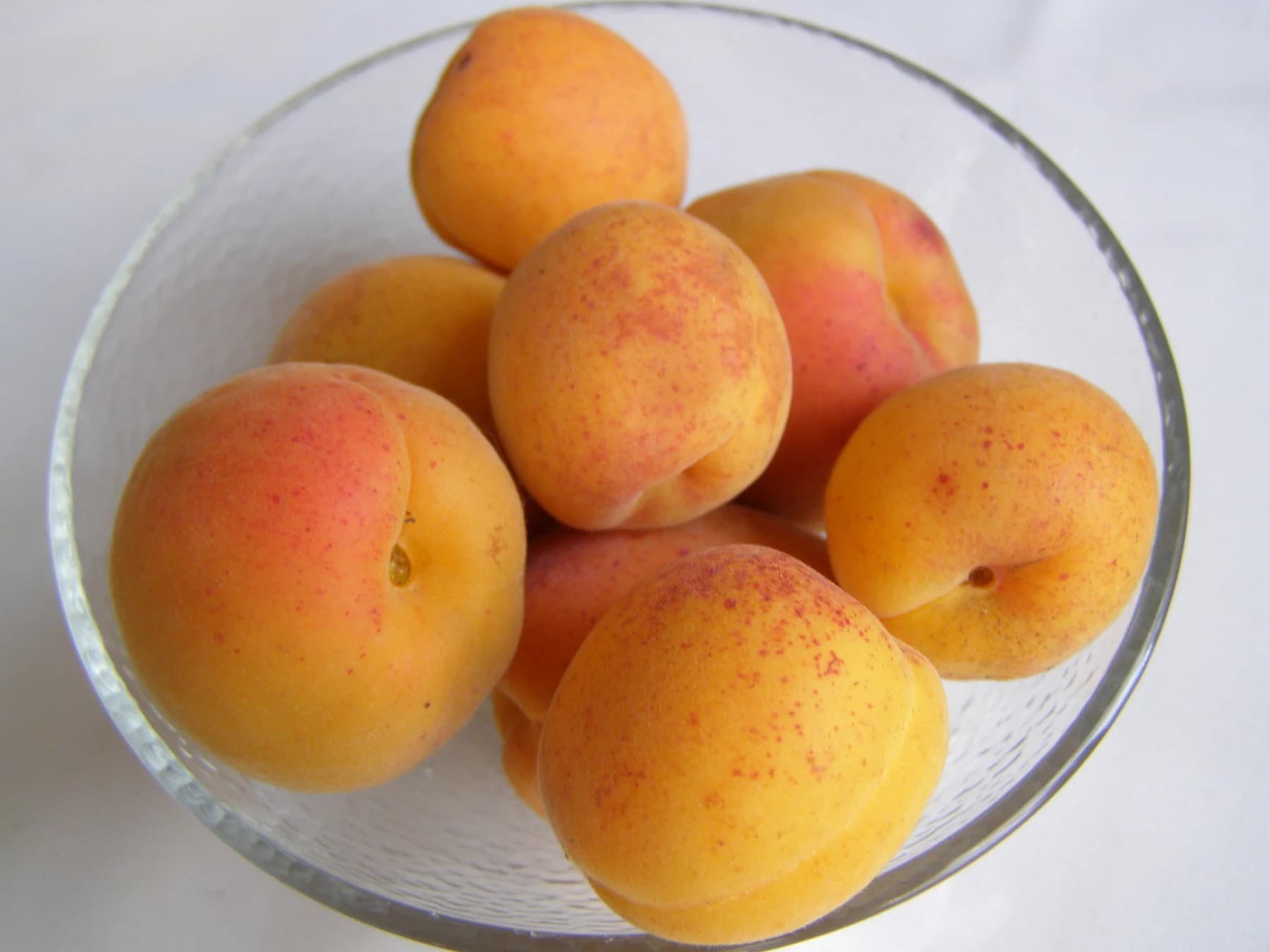
- 5. Apricot fruit photograph — Kmtextor — July 11, 2009; CC BY-SA 4.0. Apricots in a glass bowl, photographed in Germany. Product reference, not a local orchard, cultivar identification or harvest-method demonstration.
- 6. Apricot photograph license — CC BY-SA 4.0 — Creative Commons Attribution-ShareAlike 4.0. The resized photograph retains its original share-alike license.
Image credits
- Apricot fruit. Photo: Kmtextor, CC BY-SA 4.0; resized under the same license.
Figures are published averages or study assumptions for the places named, not guarantees for your field. Check current local recommendations and product labels before acting.
Some visuals in this guide are illustrations rather than photographs of a specific farm. See image credits.