

How to grow peanuts: a commercial guide
Peanuts flower above ground and push pegs into the soil, where the pods form. That makes three things matter more than anything else: planting into warm soil, putting calcium into the pegging zone at early bloom, and keeping peanuts out of the same field for years. Figures are Southeast and Mid-Atlantic commercial practice.
Scope: Commercial peanuts in the Southeast and Mid-Atlantic. Runner, Virginia, Spanish and Valencia types differ in seed size, gypsum rate and days to maturity. Updated 2026-10-16.
At a glance
- Plant when
- Soil at 10 cm (4 in) is 18°C (65°F) or more at noon for three days; mid-May is the best window in NC and FL1,2
- Seeding
- Set the planter for 16.4–19.7 seed per m (5–6 seed per foot) to get at least 13.1 plants per m (4 plants per foot) of row1,2
- Row spacing and depth
- Rows 76–91 cm (30–36 in); 4–7.5 cm (1.5–3 in) deep2
- Gypsum
- At early bloom, not before planting; NC broadcast about 1,350 kg/ha (1,200 lb/acre) of 85% gypsum1,2
- US average yield, 2025
- 4,220 kg/ha (3,767 lb/acre); 3.26 million t (7.18 billion lb) from 773,000 ha harvested (1.91 million acres)3
Choose a well-drained, sandy field
- Four years of cotton6.7 t/ha
- One of four years6.4 t/ha
- Two of four years6.2 t/ha
- Three of four years5.6 t/ha
- Four of four years5 t/ha
- Soil
- Peanuts do best on well-drained sandy loams that are loose and easy to till, with a moderately deep rooting zone. NC Extension notes that most production has moved onto sandy soils.1
Plant into warm soil at the right stand
- Light-textured soils: 4–7.5 cm (1.5–3 in)
- Heavier soils: 4–5 cm (1.5–2 in)
Peanuts can emerge from 7.5 cm (3 inches) or deeper.
- Soil temperature
- Do not plant until soil at 10 cm (4 inches) is 18°C (65°F) or higher at noon for three days, with good weather forecast for the next 72 hours. UF/IFAS gives 18–24°C (64–75°F) as ideal and above 20°C (68°F) for rapid germination.1,2
- Date
- Mid-May is the strongest window: UF/IFAS gives May 10–25, with planting possible into the first week of June and losses after that. NC finds yields often highest when planted in mid-May.1,2
- Stand
- NC aims for at least 13.1 plants per m (4 plants per foot) of row regardless of variety, which means setting the planter for 16.4 seed per m (5 seed per foot). UF/IFAS recommends 19.7 seed per m (6 seed per foot), roughly 145–170 kg of seed/ha (130–150 lb of seed per acre) depending on the variety.1,2
Put calcium in the pegging zone
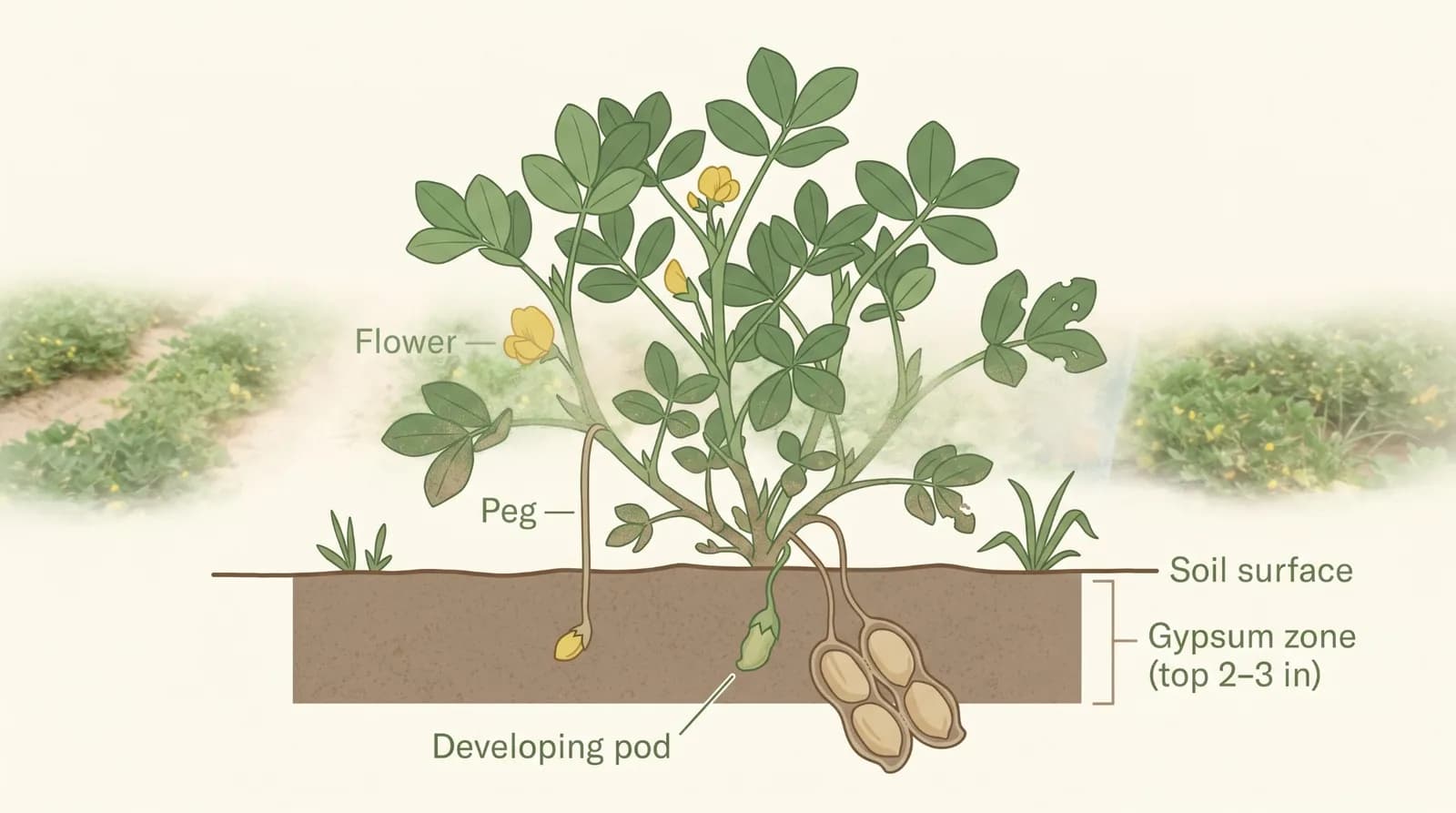
- Why gypsum
- Calcium moves up the plant, not down to the pods, so the peg and pod must absorb it straight from the soil. Adequate calcium for growth is not enough for pod development, and shortages show up as empty "pops" and poor seed quality.1
- When
- Apply at early bloom, about 60 days after planting in Florida, or late June to early July in NC. Do not broadcast before land preparation or planting, because rain can leach it. More than 100 days after planting is too late.1,2
- How much
- NC applies gypsum to all Virginia types regardless of soil test: about 670 kg/ha (600 lb per acre) of 85% product in a 41–46 cm (16–18 inch) band, or about 1,350 kg/ha (1,200 lb/acre) broadcast. UF/IFAS gives about 225 kg/ha (200 lb/acre) elemental calcium for runner and Spanish types and about 450 kg/ha (400 lb/acre) for Virginia types.1,2
- Do not stack it on low pH
- NC trials found high gypsum rates can cut yield when pH in the pegging zone is low, and that raising pH from 5.6 to 6.0 added 6% yield. Fix pH first.1
Time leaf spot and white mold sprays
Dig at maturity and dry
- 1
Warm soil
18°C (65°F) or more at 10 cm (4 in), three days running.
- 2
Plant
16.4–19.7 seed per m (5–6 seed per foot), 4–7.5 cm (1.5–3 in) deep, rows 76–91 cm (30–36 in).
- 3
Early bloom
About 60 days after planting: apply gypsum.
- 4
Pegging
Pegs enter the soil and pods form.
- 5
Maturity
Runner 135–155 days; Virginia types up to about 160.
- 6
Dry
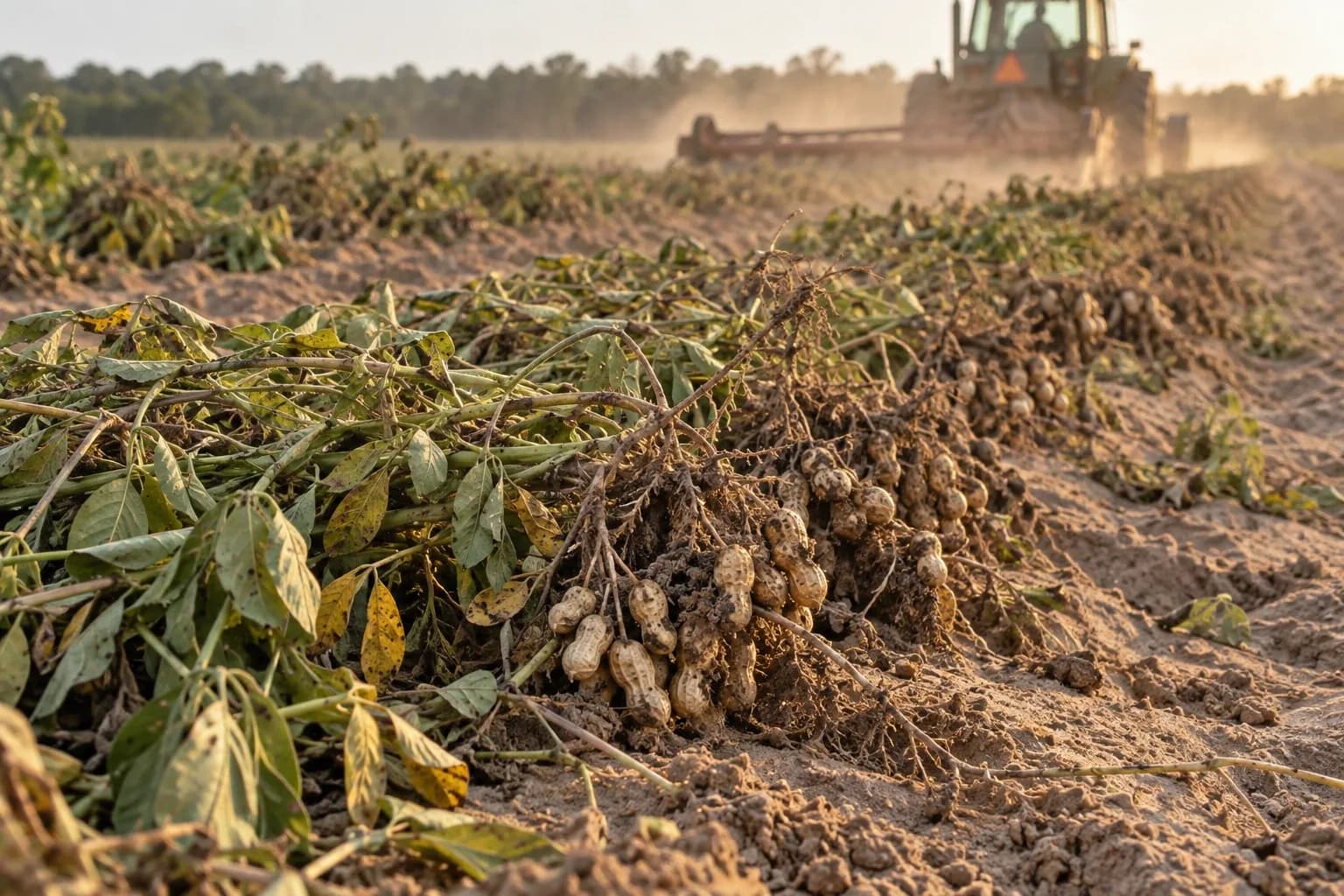
Field-dry 3–5 days to about 10% moisture.
Yield and economics
US peanut production in 2025 was 3.26 million t (7.18 billion lb) from 789,000 ha planted and 773,000 ha harvested (1.95 and 1.91 million acres), a record, with an average yield of 4,220 kg/ha (3,767 lb per acre). Georgia alone harvested 370,300 ha (915,000 acres) at 4,540 kg/ha (4,050 lb/acre).
- Missouri5.8 t/ha
- Arkansas5.6 t/ha
- Virginia4.9 t/ha
- Oklahoma4.8 t/ha
- Georgia4.5 t/ha
- Mississippi4.5 t/ha
- Florida4.4 t/ha
- North Carolina4.4 t/ha
- South Carolina4 t/ha
- Alabama3.8 t/ha
- Texas2.7 t/ha
Frequently asked questions
- When do you plant peanuts?
- Once soil at 10 cm (4 inches) is 18°C (65°F) or warmer at noon for three days. Mid-May is the strongest window in North Carolina and Florida, with planting possible into the first week of June.
- How long do peanuts take to grow?
- Runner peanuts need 135–155 days after planting; Virginia types in North Carolina can need up to about 160 days.
- How deep and how far apart do you plant peanuts?
- Plant 4–7.5 cm (1.5–3 inches) deep in rows 76–91 cm (30–36 inches) apart, setting the planter for 16.4–19.7 seed per m (5–6 seed per foot) of row to get at least 13.1 plants per m (4 plants per foot).
- Do peanuts need gypsum?
- Yes for pod calcium. Apply at early bloom, about 60 days after planting, not before planting. NC applies it to all Virginia types regardless of soil test.
- What soil pH do peanuts need?
- NC limes to an average of 6.2 so no part of the field falls below 5.8; UF/IFAS targets 6.2–6.5 and limes below 5.8.
- How often can you plant peanuts in the same field?
- UF/IFAS requires two years of non-legume crops between peanuts, and NC trials show yield rising with longer breaks, including after soybeans.
Regional guides and field planning
Sources and image credits
- 1. NC State Extension — 2024 Peanut Information, Chapter 3: Peanut Production Practices — January 2024. North Carolina, mostly Virginia market types: soil temperature, seeding rates, pH, rotation, gypsum, planting date and seed per acre.
- 2. UF/IFAS Extension — Peanut Production Guide: Management and Cultural Practices for Peanuts (SS-AGR-501/AG497) — Accessed 1 October 2026. Florida planting window, seeding rate, pH, gypsum timing, rotation, maturity, leaf spot and white mold timing, and drying.
- 3. USDA NASS — Crop Production 2025 Summary — Published early 2026. US and state peanut planted and harvested area, yield and production, 2023–2025.
Image credits
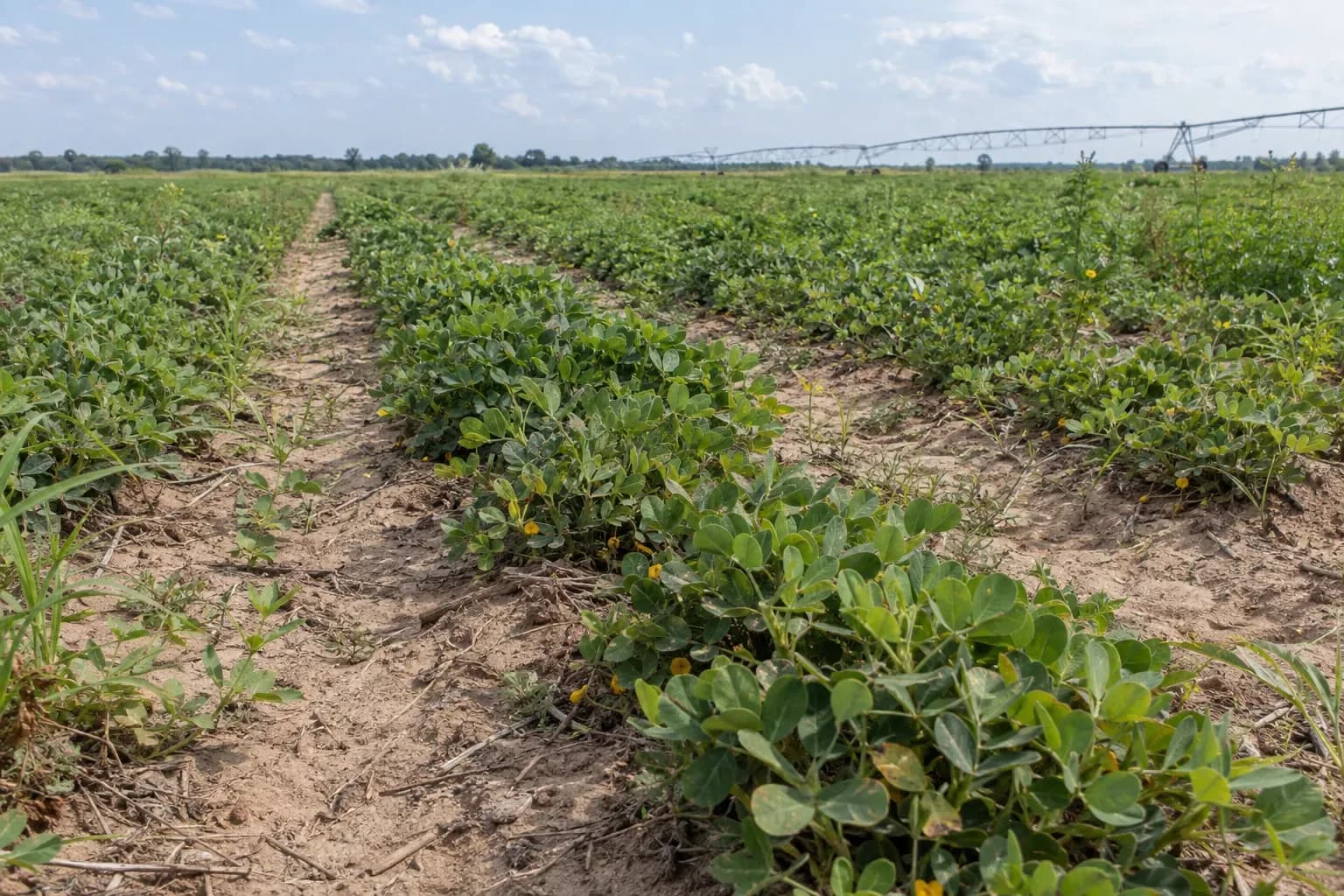
- Peanuts at flowering: low, bushy plants with small yellow flowers; the pods form underground.
- Pegs grow down from the flower into the top 5–7.5 cm (2–3 inches) of soil, where pods form and absorb calcium. Schematic illustration.
- Dug plants inverted in the row with the pods exposed to dry.
Figures are published averages or study assumptions for the places named, not guarantees for your field. Check current local recommendations and product labels before acting.
Some visuals in this guide are illustrations rather than photographs of a specific farm. See image credits.