

Growing peanuts in Texas
Texas peanut production spans South, Central and West Texas, with different soils, water supplies and market types. Select the market type with your sheller, then match planting stock, irrigation and harvest capacity to your field. The detailed 2011 Texas production manual provides historical references. Confirm its planting and maturity ranges against current local Extension advice before setting a crop schedule.
Scope: Commercial peanuts in Texas. Statewide crop statistics are separated from regional production examples. The detailed Texas A&M production manual is a legacy guide revised in 2011; confirm current seed, pest, chemical, irrigation and harvest recommendations with Texas A&M AgriLife Extension and the contracted sheller. Updated 2026-10-07.
At a glance
- Production regions
- South, Central and West Texas; production conditions differ by region1
- 2025 planted area
- 285,000 acres (about 115,335 ha)2
- 2025 harvested area
- 262,000 acres (about 106,030 ha)2
- 2025 Texas yield
- 2,450 lb/acre (about 2,745 kg/ha); a state average, not a field forecast2
- 2026 planting context
- AgriLife reported about 145,000 acres planted, down from 2025 amid market and dry-weather concerns4
- Water planning
- The legacy Texas manual cites 24–28 in of seasonal water for maximum yield; check its age and field-specific water supply1
Planting and harvest calendar for Texas
Use the source-backed production windows to coordinate establishment, crop care and harvest. Production districts and cultivars can have different cycles; the historical climate adds context for the field plan.
Planting: Historical Texas planting references1
The archived Texas guide says to plant into favorable soil conditions; its West Texas reference places runner and Virginia types by 15 May and Spanish types by 1 June, with Central and South Texas possibly later. These are dated regional limits, not a current statewide planting recommendation.
Harvest: Observed Texas digging activity1,4
The archived manual gives broad maturity ranges by Texas region, while the 2026 AgriLife report describes West Texas and Rolling Plains digging by late September and a later South Texas outlook. Dig by pod maturity and field condition, not by month alone.
Historical monthly climate
Reference period: 1996-01-01 to 2025-12-31. ERA5-Land monthly mean soil temperature at 0–7 cm, air temperature and frost days at the regional reference point (31.5, -99). Select a month to inspect its historical conditions.
Month tiles show mean topsoil temperature.
May historical conditions
- Mean topsoil temperature
- 25.6°C
- Mean air temperature
- 24.5°C
- Mean frost days per month
- 0.0 days
These are monthly means at one reference location. They describe seasonal field conditions, not crop maturity, actual seed-zone conditions, frost forecasts or a planting recommendation. Harvest bands follow the crop-specific production sources above.
Climate source: Open-Meteo Historical Weather APIPlan by Texas production region and market type
Texas is not one peanut production environment. Separate field decisions by region, water source, soil and the market type accepted by the buyer.
- Texas2,450 lb/acre
- United States3,767 lb/acre
- Confirm the buyer and seed supply first
- The Texas A&M manual identifies South, Central and West Texas as distinct production regions and notes that multiple market types are grown in the state. It advises consulting shellers about market acceptance and seed availability before choosing a variety. The named variety lists in that old manual are not current recommendations.1
- Read state statistics as scale, not a guarantee
- USDA NASS reports 285,000 Texas acres planted and 262,000 harvested in 2025, with 641.9 million lb produced. State averages combine different regions, market types, rainfed and irrigated systems, and do not predict a new field’s yield.2
- Account for shifting acreage and water risk
- AgriLife reported about 145,000 Texas acres planted in 2026, down from the previous year. Its September report linked planting choices to a dry outlook and market conditions; that is a single-season account, not a long-term acreage trend.4
Establish a uniform stand in warm, moist soil
- 1
Confirm market and seed
Check current variety acceptance, seed availability and contract terms.
- 2
Check the field
Review rotation, soil condition, drainage and irrigation-water test results.
- 3
Wait for suitable conditions
The archived Texas guide calls for warm, moist soil and a favorable emergence forecast.
- 4
Calibrate the planter
Set population and depth using current seed size, soil and local Extension guidance.
- Use the old dates only as historical context
- The 2011 Texas guide places West Texas runner and Virginia planting by 15 May and Spanish planting by 1 June, with Central and South Texas potentially later. It says to prioritize soil conditions favorable for rapid emergence. Check current county-level guidance, seed supplier information and sheller requirements before choosing a date.1
- Protect emergence
- The manual warns against planting into extremely dry soil and then relying on delayed irrigation; it describes pre-irrigation as a way to prepare moisture for establishment. Confirm that the water supply can reach the planted acreage at the required time.1
- Choose varieties for local constraints
- Match market type, maturity, disease history, soil and water to current Texas trial results and seed availability. Cultivar names in the archival guide reflect older releases and should not be treated as a present-day shortlist.1
Size irrigation around water supply and quality
- Budget water before acreage
- The legacy Texas guide cites 24–28 inches of seasonal water for maximum yield and says to use irrigation-system capacity when deciding how much land to plant. Treat this as an older planning reference, not an irrigation prescription or a guarantee of yield.1
- Prioritize flowering, pegging and pod fill
- The manual describes water use as highest during flowering, pegging and pod development, and reports that heat and moisture stress can suppress flowering. The 2026 AgriLife report documented prolonged temperatures above 95°F across much of the peanut region alongside inadequate water in some fields; plan monitoring around crop stage and soil moisture.1,4
- Test irrigation water
- The Texas manual warns that peanuts are sensitive to salinity and sodium problems, with additional concern about boron in some West Texas areas. Have irrigation water and soil tested by a qualified lab before committing a field; use current interpretation rather than relying on thresholds in the old manual.1
Scout and adjust to local disease pressure
- Track disease history and canopy conditions
- The Texas guide describes differences in foliar and soil-borne disease pressure among production regions. Keep field histories and scout for leaf spots, pod rot and other symptoms; use current Texas A&M AgriLife diagnosis and management guidance for the specific field.1
- Avoid carrying old pesticide schedules forward
- The manual is over a decade old and includes product references that may no longer be registered or appropriate. Follow current labels, state recommendations and resistance-management guidance; this page does not prescribe pesticides.1
Dig by pod maturity and plan drying
- 1
Sample several field areas
Use representative plants and pods; one spot can misstate field maturity.
- 2
Inspect pod maturity
The Texas manual describes mesocarp color as a maturity clue and cautions against using the calendar alone.
- 3
Balance yield and grade
Avoid digging too early or leaving mature pods exposed to losses and deteriorating conditions.
- 4
Dig when field conditions allow
The 2026 report describes regional differences in digging progress and weather delays.
- Use regional maturity ranges cautiously
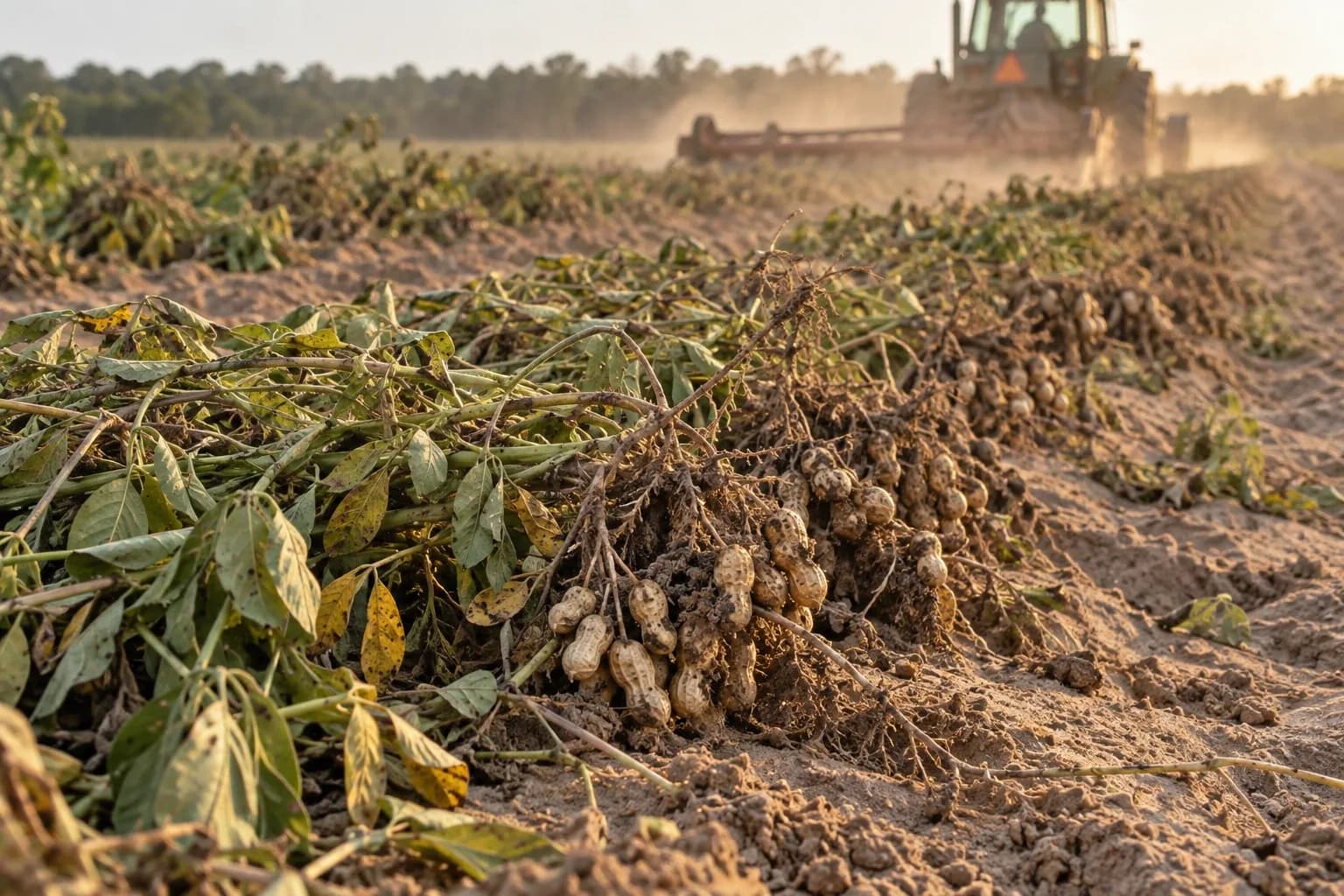
- The archival guide reports 130–140 days in South Texas, 140–150 in Central Texas and 150–170 in West Texas. Temperature, variety, planting date and moisture change development, so these ranges are background only; maturity sampling is the field decision tool.1
Frequently asked questions
- When are peanuts planted in Texas?
- An archived Texas A&M guide gives West Texas references of 15 May for runner and Virginia types and 1 June for Spanish types, with Central and South Texas possibly later. These are dated references; check current local advice and soil conditions.
- How long do peanuts take to mature in Texas?
- The older Texas guide reports about 130–140 days in South Texas, 140–150 in Central Texas and 150–170 in West Texas. Variety, temperature, planting date and moisture affect maturity; sample pods before digging.
- How much water do Texas peanuts need?
- A legacy Texas guide cites 24–28 inches of seasonal water for maximum yield. Treat it as historical planning context and calculate field needs from rainfall, soil, crop stage, irrigation capacity and current local advice.
- When should Texas peanuts be dug?
- Dig based on representative pod-maturity samples and field conditions. Calendar estimates alone can lead to early or late digging and losses.
- What was Texas peanut production in 2025?
- USDA NASS reports 285,000 acres planted, 262,000 harvested, an average yield of 2,450 lb/acre and production of 641.9 million lb.
Regional peanuts guides
Local dates, soil-temperature history and sources for specific regions:
Sources and image credits
- 1. Texas A&M AgriLife Extension — Texas Peanut Production Guide — Archival guide, revised 2011. Texas production regions and market types, historic planting windows and maturity ranges, irrigation demand, water quality, pod maturity and digging. Treat dated varieties, pesticide directions and calendar cutoffs as legacy context; verify current recommendations locally.
- 2. USDA NASS — 2025 State Agriculture Overview: Texas — 2025 estimates; Quick Stats data as of 6 October 2026. Texas planted and harvested peanut acreage, average yield and production for 2025.
- 3. USDA NASS — Crop Production 2025 Summary — Published January 2026. United States 2025 peanut acreage, yield and production, for state-to-national context.
- 4. Texas A&M AgriLife Today — Texas peanut growers adjust to market and weather in 2026 — 29 September 2026. Texas 2026 acreage estimate, heat and drought stress, regional digging progress and harvest outlook. These are observations from one season, not recurring calendar dates.
Image credits
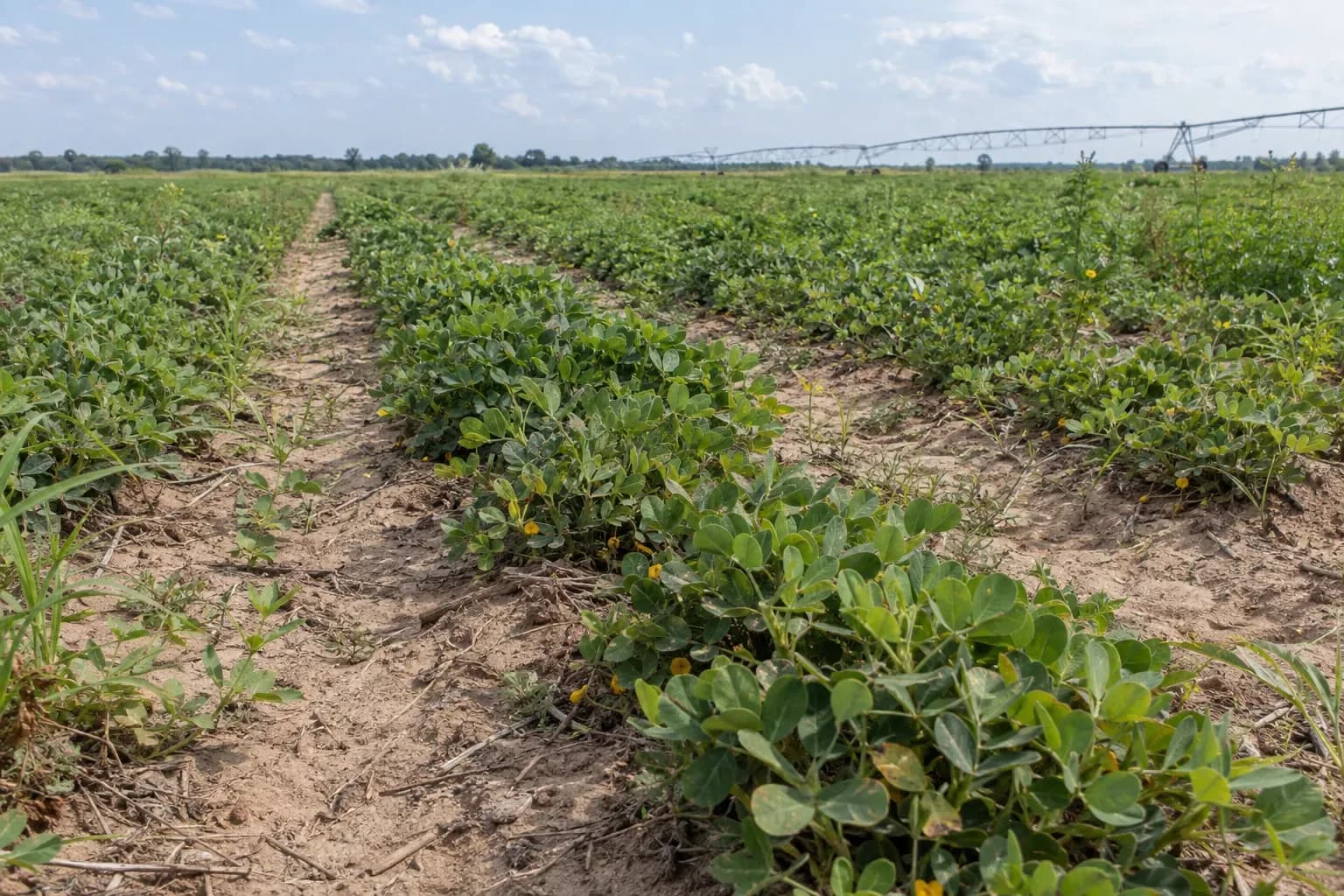
- Peanut field at flowering. Illustration.
- Peanut pegs enter the soil, where pods develop. Schematic illustration.
- Digging exposes the pods for field drying. Illustration.
Figures are published averages or study assumptions for the places named, not guarantees for your field. Check current local recommendations and product labels before acting.
Some visuals in this guide are illustrations rather than photographs of a specific farm. See image credits.